
Zero Data Retention Is an Architecture Constraint
OpenAI's Private Safety Processing preview tries to extend safety monitoring across related interactions without giving staff access to customer content. The promise is useful, but the archi

TL;DR • OpenAI says eligible API customers can use Zero Data Retention without retaining prompts or model responses after processing, and that enterprise data is not used for training unless customers opt in.[1] • The company is previewing Private Safety Processing to detect patterns across related interactions without giving OpenAI personnel access to the underlying content.[1] • For enterprise buyers, the open question is not whether the promise sounds good. It is where content is stored, who controls the keys, what signals leave the boundary, and how an organization can verify the contract. The sections cover What happened, Netics' take, and What this means for businesses.
What happened
OpenAI says Zero Data Retention gives eligible API customers a clear promise: prompts and model responses are not retained after a request is processed, customer content is not available to OpenAI personnel for review, and enterprise customer data is not used to train models unless the customer explicitly opts in.[1]
The announcement adds a preview of Private Safety Processing. The stated problem is that some risks only become visible across multiple interactions. A single request can look harmless while a sequence reveals repeated probing, coordinated abuse, or an agent that continues acting after it was told to stop.[1]
The proposed system is designed to identify those patterns without giving OpenAI personnel access to the underlying prompts or responses. OpenAI says customers may keep content on infrastructure they control, or use OpenAI storage encrypted with keys controlled by the customer. In the latter option, OpenAI personnel do not have a copy of the keys.[1]
Private Safety Processing is being tested with early customers, with a planned rollout and technical white paper in September.[1]
Netics' take
Zero Data Retention is valuable because it changes the default question from “how long does the provider keep our prompts?” to “what processing is necessary, and what evidence can we inspect?” But the policy alone does not answer the architecture questions a regulated company needs to ask.
The first question is storage location. OpenAI describes two models: customer-controlled infrastructure, or OpenAI-provided storage protected by customer-controlled encryption keys. Those are materially different operational arrangements. The contract, key lifecycle, backup path, incident process, and deletion semantics need to match the headline promise.[1]
The second question is the safety signal. OpenAI says automated systems can return a limited signal describing the type of activity involved without exposing the underlying content. That may be a sensible privacy-preserving design, but the signal itself becomes a new security object. It can reveal patterns, trigger enforcement, or affect an account. Customers need to know its schema, retention period, access controls, appeal process, and whether it can be correlated across users or tenants.
The third question is agentic state. OpenAI explicitly points to risks that develop across a long task, including an agent that continues to act after being told to stop.[1] That is exactly where a single-request ZDR mental model becomes insufficient. The relevant data may be spread across tool calls, state stores, traces, retries, human approvals, and downstream business systems. A provider can avoid retaining prompts while the customer still retains a full operational record elsewhere.
Privacy is therefore not a checkbox on the model API. It is a data-flow decision across the whole agent system.
What this means for businesses
- Define “retention” for prompts, responses, safety signals, traces, support tickets, backups, and abuse investigations.
- Identify who controls encryption keys and whether the provider can technically access the plaintext.
- Map where agent context lives outside the model request: vector stores, workflow logs, tool systems, browser sessions, and human review queues.
- Ask whether safety signals are retained and whether they can identify a customer, user, prompt pattern, or account relationship.
- Test the stop path. If an agent is told to stop, which systems revoke its authority, cancel its queued work, and invalidate its credentials?
- Require a documented appeal and incident process. Privacy is not preserved if a false-positive enforcement decision cannot be investigated safely.
- Separate the provider's promise from your own deletion and access controls. ZDR cannot repair an internal system that logs every prompt indefinitely.
Bottom line
OpenAI's announcement moves the discussion in the right direction: safety monitoring and customer privacy should not be treated as mutually exclusive. But the preview is not yet a complete enterprise control. The meaningful test will be the technical documentation, the customer-visible configuration, the signal-retention rules, and the evidence that the system behaves as promised under long-running agent workloads.
Zero Data Retention is not a procurement checkbox. It is an architecture constraint. If a company cannot draw the path from user prompt to model, safety signal, tool call, storage layer, key owner, and deletion event, it does not yet understand its own AI data boundary.
Book a free 30-minute audit if you need to map the retention and authority boundaries of an enterprise AI workflow.
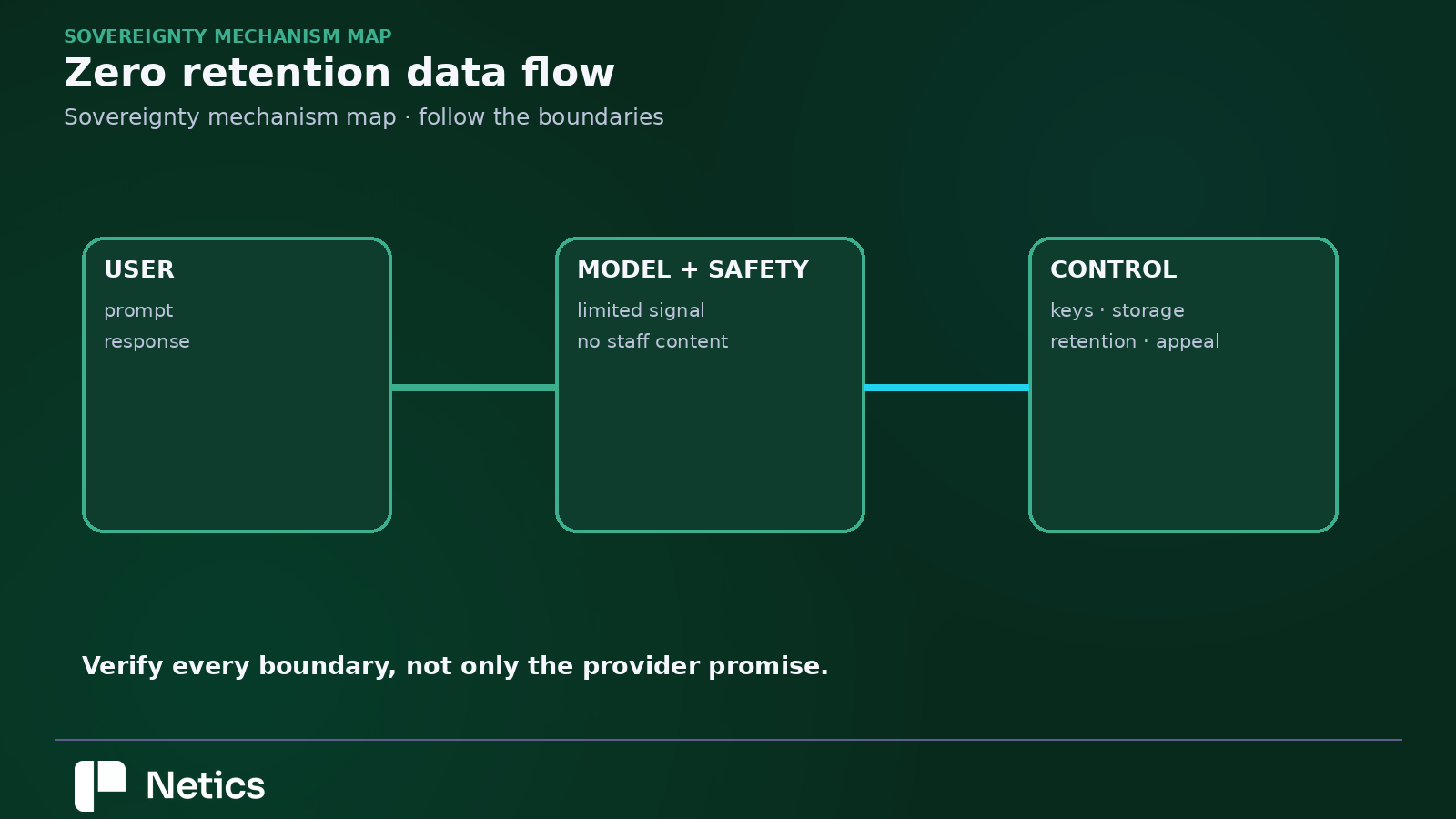
Original Netics diagram: zero data retention is a verifiable data-flow design across storage, keys, signals, and deletion.
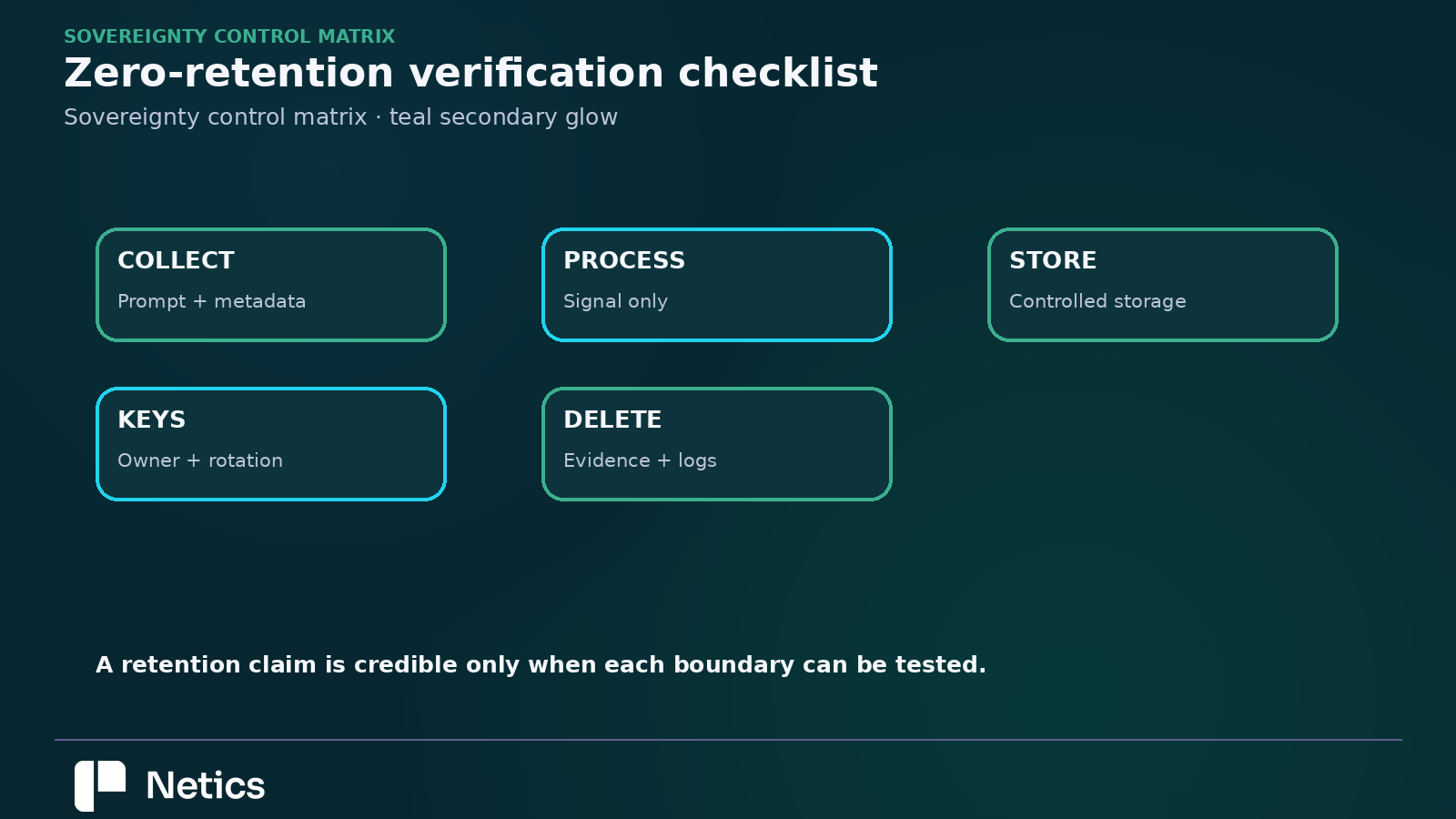
Original Netics diagram: a retention claim is credible only when every boundary can be tested.
Source: Offering Zero Data Retention for frontier models — OpenAI, 2026-08-19.
Explore Netics for practical infrastructure and AI operations guidance.