
The World Bank Wants Small AI Built for Weak Connections
The World Bank's chief knowledge officer argues that narrow models running on ordinary phones, in local languages and without reliable connectivity, can shorten development timelines. The Se

TL;DR
- Small AI is the World Bank's term for a design approach to AI development: narrow models aimed at one well-defined problem, running on the devices people already own, trained on local data and reachable through SMS or voice.
- Paschal Donohoe, the Bank's chief knowledge officer, told the Guardian that these models can run on a mobile phone with low connectivity, in the language of the community, and argued that development which took centuries could happen within decades.
- The Global AI and Digital Summit was held in Seoul from 19 to 22 October 2026, with a session titled Small AI. Big Impact on the programme for the morning of 20 October, the point at which, in our reading, a phrase can become something governments are asked to fund. This article reads the programme as captured on 19 October, and the signal is the agenda itself, which gave small AI a session of its own.
- The numbers behind the agenda are large: more than 2 billion people were offline as of 2025, and the Bank says 1.2 billion young people in the Global South will reach working age over the next decade against roughly 420 million new jobs.
- The enablers the Bank itself names are broadband, digital literacy and trusted local institutions, and it warns that without them solutions risk remaining pilots. Its own World Development Report found almost a third of rural schools in sub-Saharan Africa without electricity.
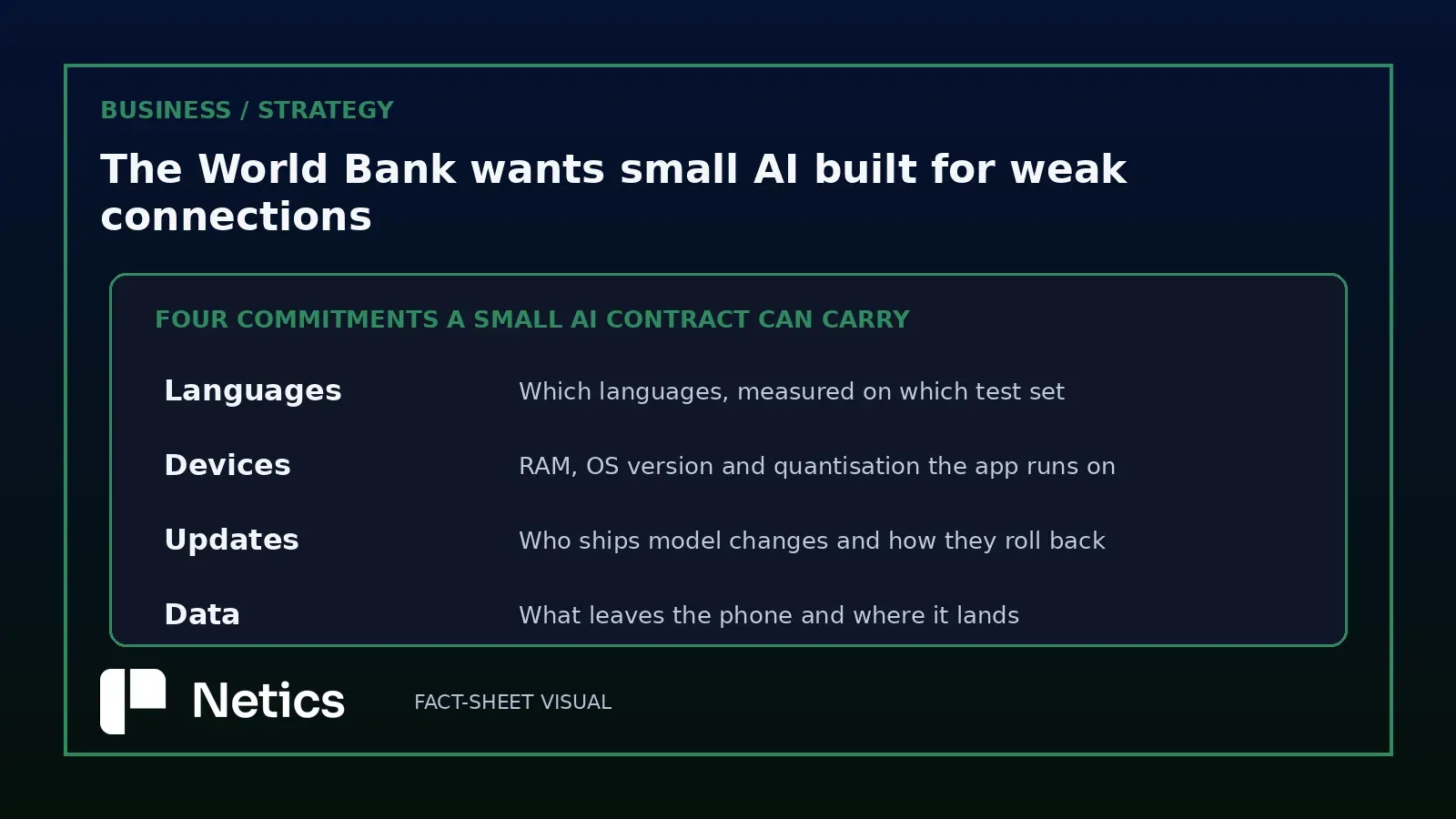
- A deployed small AI is a procurement object, and four commitments decide whether it survives contact with users: which languages are tested, on which devices, with which offline behaviour, and who ships the updates.
What the World Bank means by small AI
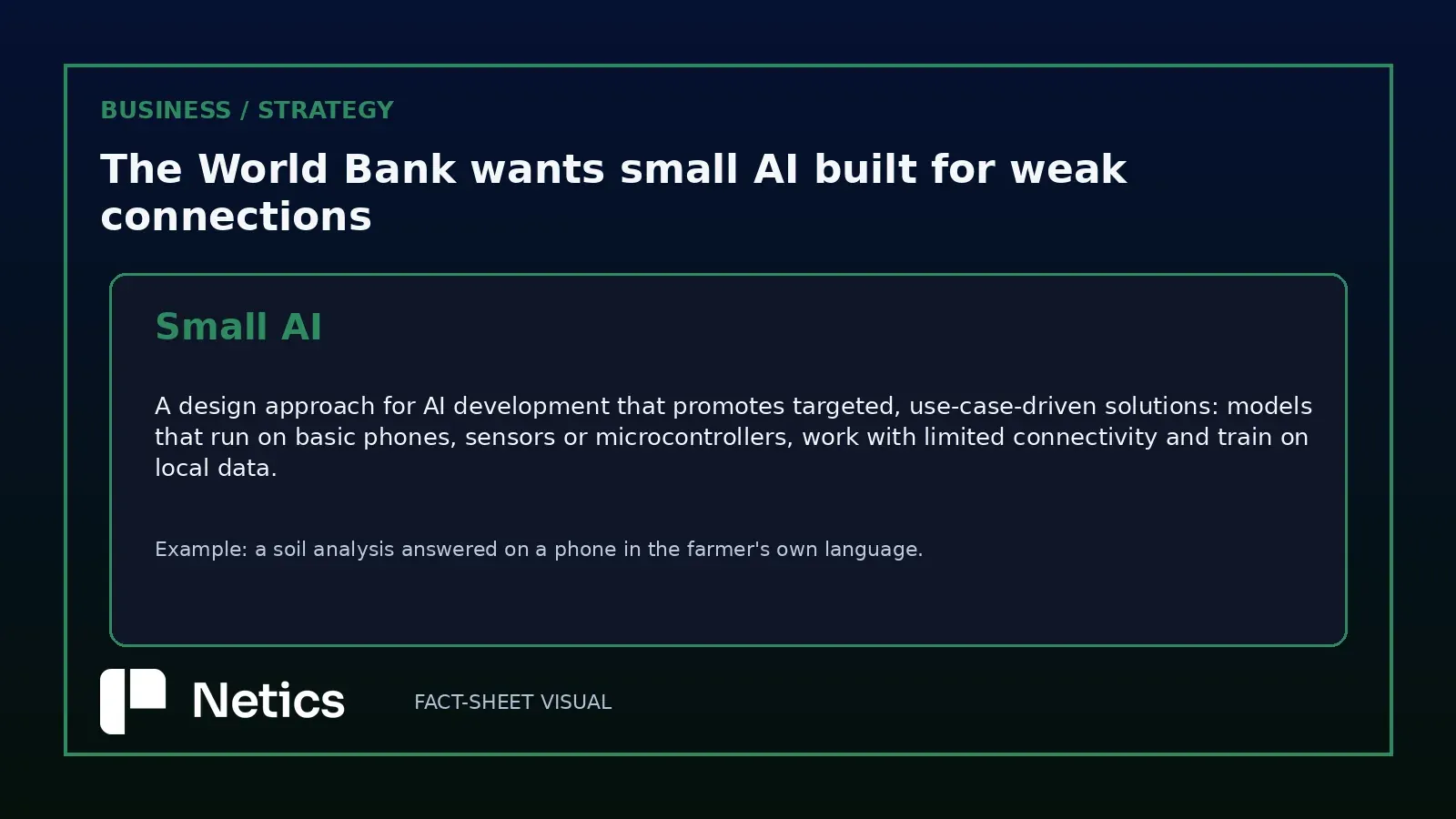
The Bank's own definition is a design approach, and the word approach is doing the work. Small AI describes narrow, use-case-driven solutions that address a single well-defined problem on accessible hardware: basic phones, sensors or microcontrollers, running models locally.
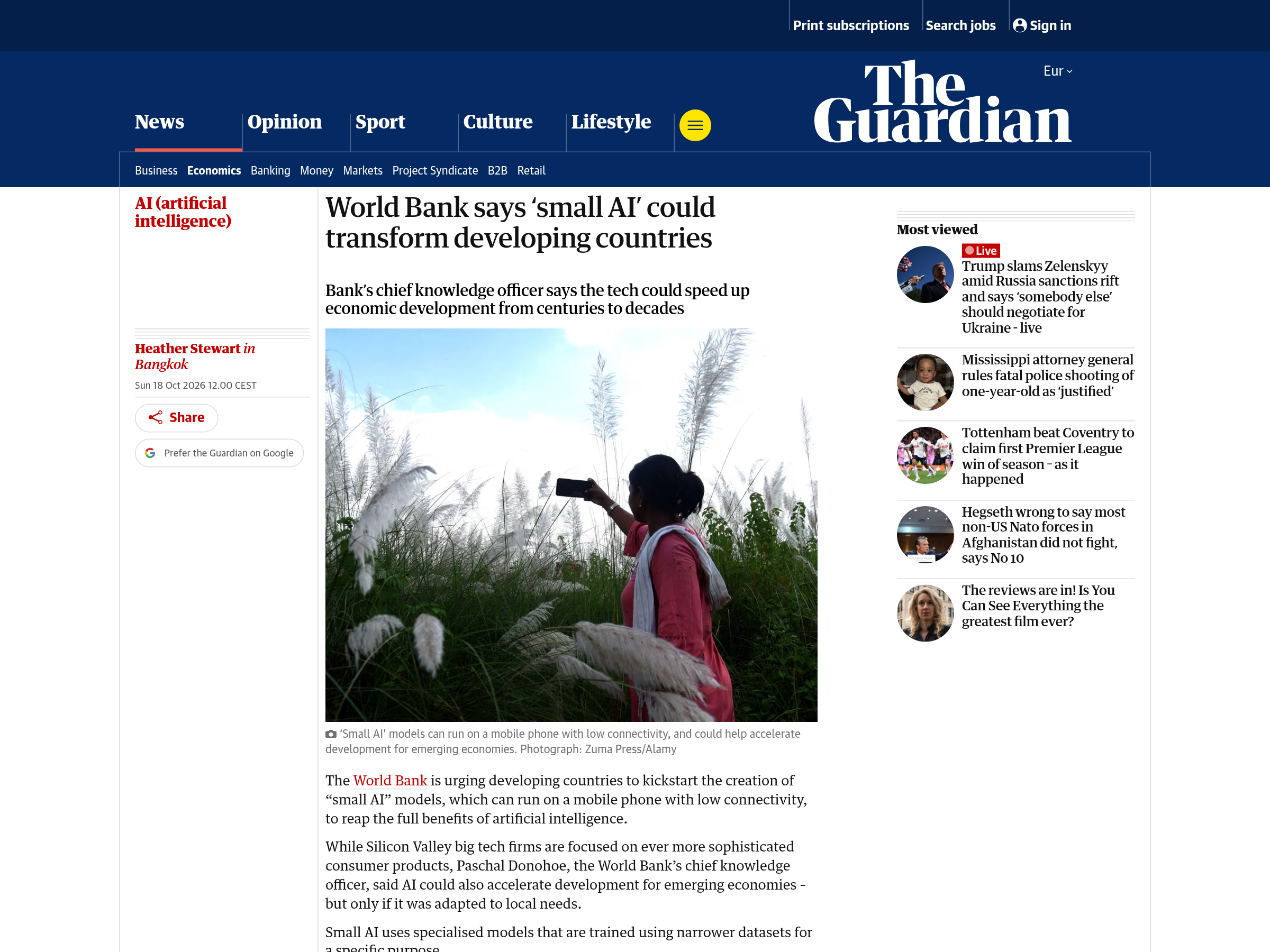
Donohoe's version, given to the Guardian around the World Bank and IMF annual meetings in Bangkok, is the same idea in the language of a development agency. He describes models available in a local setting, with low connectivity and in the local language of the community, and adds that such models tend to be available on a mobile phone.
The example he reaches for is concrete. Farmers in the Bank's AgriConnect agricultural scheme in India needed soil analysis in their own language, and the arithmetic of expert supply rules out the obvious answer. There will not be enough scientists and agricultural experts to do that for every small farm in India, he said. A narrow model that answers one question well, on a device the farmer already owns, can reach the farms that the supply of experts cannot cover.
That framing carries straight into procurement. A soil-analysis model can be specified with a language, a device and an accuracy figure for a specific question, which makes it easier to test and much harder to fake than a general assistant judged on a demo and an average benchmark score.
Seoul puts the phrase on a programme
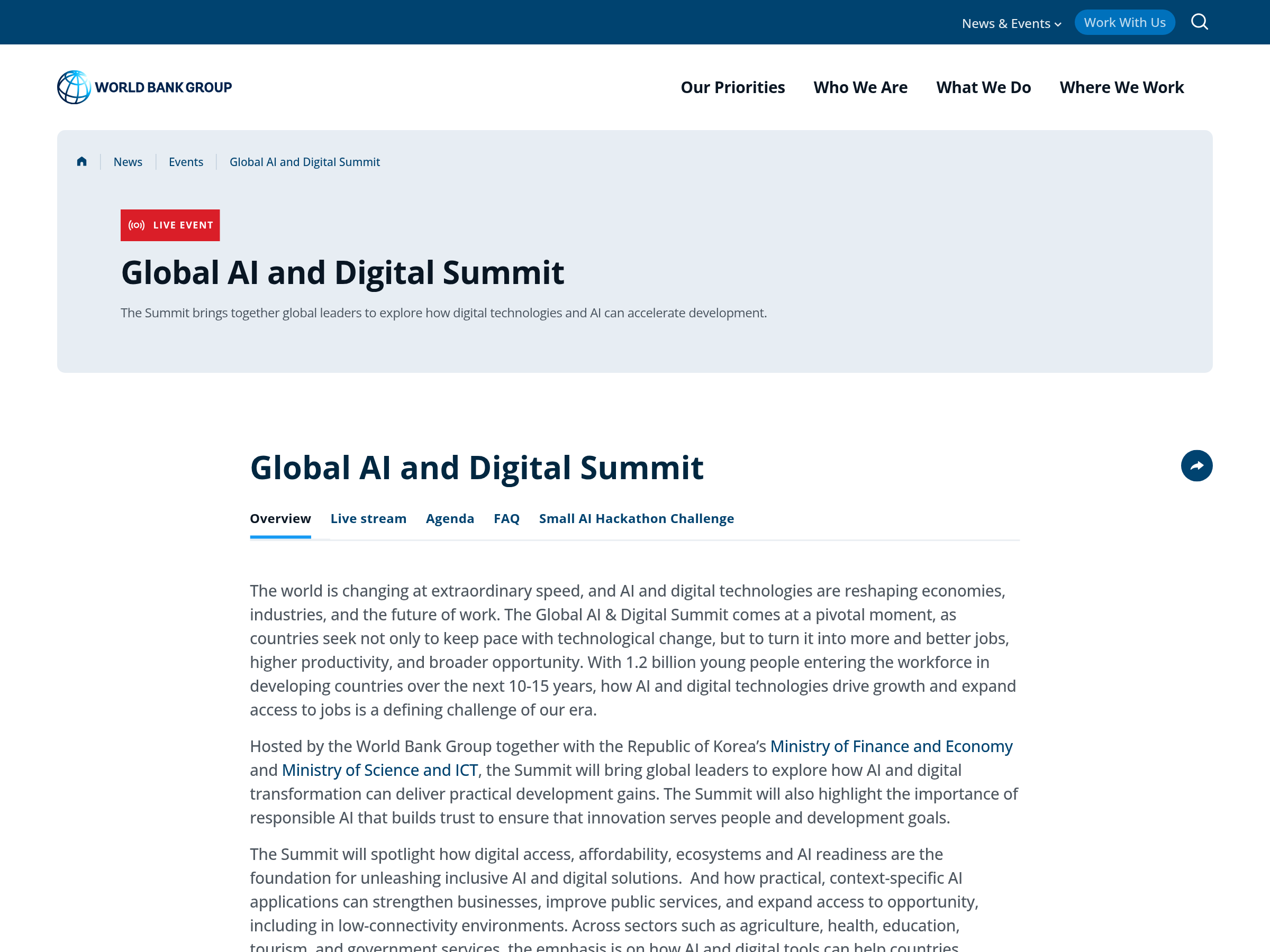
The summit was held from 19 to 22 October 2026 in Seoul, co-hosted by the World Bank Group and the Government of Korea, and the session names are worth reading as a map of the Bank's priorities. Small AI. Big Impact was scheduled for 9:45am KST on 20 October with Ajay Banga, Bosun Tijani, Hoshik Shin and Kate Kallot, moderated by Mark Tetto.
A second session, Closing the Gap: The Promise of AI in Developing Economies, was scheduled for 21 October with Donohoe alongside Michael Kremer, Gaurav Nayyar and Darlington Akogo. What matters for this analysis is the programme itself, which records the ideas the Bank chose to give a session of their own.
Programmes like this matter beyond their own hour, because a term that appears on a ministerial agenda can become a term that appears in loan documents, tender specifications and national AI strategies. Small AI is moving from an argument made in an interview to a category that vendors will be asked to supply, and the specification for it will be written by whoever shows up with a definition first.
The Bank's own framing for the summit makes the stakes explicit. With 1.2 billion young people entering the workforce in developing countries over the next 10 to 15 years, how AI and digital technologies expand access to jobs is described as a defining challenge. That sentence sits next to a much less comfortable one on the same event pages: as of 2025, more than 2 billion people remained offline.
Two billion offline and 420 million jobs
The labour arithmetic is the reason this argument has urgency. Over the next decade, 1.2 billion young people in the Global South will reach working age, and current trends point to about 420 million new jobs, according to the Bank's summit event pages. In our reading, the gap is one of demand, and a cheaper delivery channel can address part of it.
Kristalina Georgieva, managing director of the International Monetary Fund, speaking at the same Bangkok meetings, called on governments to provide the preconditions: access to electricity, access to digital infrastructure, people geared to adoption and government protection against bad actors. With those in place, she said, adoption could be as democratic as the cellphone. She also warned that over time 40 percent of jobs worldwide are likely to be augmented or eliminated by AI.
Donohoe's counterweight to that warning is a development claim. Economic development that could have taken centuries, he argued, now has the potential to happen within decades. He pointed to 120 billion dollars of private capital the Bank mobilised in the past year through guarantees and other instruments.
Both halves belong in the same paragraph. A model that answers a soil question and a financing guarantee address different parts of the same gap, and in our reading what connects them is delivery cost: a phone-based narrow model interests a development bank because it promises to reach more users for each dollar spent. Neither the Guardian interview nor the summit pages give an accuracy, device or cost figure for small AI, so that promise is still untested.
The enablers decide whether a pilot ships
The Bank is unusually direct about the limits of its own idea. Its summit event pages state that small AI still requires foundational enablers: broadband connectivity, digital literacy and trusted local institutions, and that without them solutions risk remaining pilots.
The Guardian's reporting adds the physical picture. The Bank's World Development Report, published in August, found that almost a third of rural schools in sub-Saharan Africa lacked electricity and more than two-thirds did not have a consistent internet connection. A model that runs offline on a phone removes one dependency from that list. The others remain, and a school without power cannot host a deployment of any kind.
The gap between offline capability and those physical enablers is where most small AI projects will be decided. A pilot is funded for a quarter, on one device model, in one district, with a team that includes the person who built it. A service runs for years, across whatever handsets people actually own, maintained by someone who inherited it. The technical work of moving between the two is unglamorous: versioning, logging, evaluation and a rollback plan.
Four commitments a small AI contract can carry
The outcome turns on the contract. What the buyer writes down decides it, and the four lines below are the ones that separate a demo from something a ministry or a mid-sized company can run.
Languages. Name the languages and dialects covered, and the test set each figure comes from. A single accuracy number across a multilingual population hides the failure that matters, which is the user whose language had only a thin share of the training data.
Devices. State the handset baseline, the operating system version and the quantisation the model ships at, then measure latency and memory use on that baseline. A model that runs on the evaluator's phone but fails on the farmer's is a pilot artifact.
Offline behaviour. Write down what the application answers when there is no network, and how it marks an answer produced without fresh data. The alternative is a user who cannot tell a cached guess from a live result.
Updates and data. Assign one owner for model updates, version numbers and rollback, and state what leaves the phone and where it lands. On a shared device in a low-connectivity setting, the data boundary is a privacy decision before it is an engineering one.
Our approach to delivery work is set out under our build practice. For a company in France or Morocco weighing a narrow on-device model against a hosted assistant, the trade is legibility against cost: in our reading, an on-device model can be audited, tested per language and designed so that less data leaves the phone, and it will never have the range of a hosted model. Small AI is a defensible choice when the task is narrow and the alternative is no service at all.
Sources
Source: World Bank says 'small AI' could transform developing countries — The Guardian, by Heather Stewart in Bangkok, published 18 October 2026, retrieved 2026-10-19 (the Bank's call for small AI models that run on a mobile phone with low connectivity, Paschal Donohoe's role and his remarks on local settings, local languages and development within decades, the definition of small AI as specialised models trained on narrower datasets, the AgriConnect farmers in India needing soil analysis in their own language and the shortage of agricultural experts, the suggestion of collaboration between the Bank, governments and the private sector, the Bangkok annual meetings, Kristalina Georgieva's preconditions and her cellphone comparison and her 40 percent jobs warning, the August World Development Report findings on rural schools in sub-Saharan Africa, and the 120 billion dollars of mobilised private capital).
Source: Global AI and Digital Summit — World Bank Group event pages, captured 2026-10-19 (the Seoul dates of 19 to 22 October 2026 co-hosted with the Government of Korea, the 1.2 billion young people entering the workforce over 10 to 15 years, the Small AI. Big Impact session on 20 October at 9:45am KST with its speakers and moderator, the Closing the Gap session on 21 October and its speakers, more than 2 billion people offline as of 2025, 1.2 billion young people reaching working age against 420 million new jobs, the definition of Small AI as a design approach using basic phones, sensors or microcontrollers running models locally with limited connectivity, local data and SMS or voice delivery, the foundational enablers of broadband, digital literacy and trusted local institutions, and the AI Repository).
Source: the Guardian's interview with Paschal Donohoe of 18 October 2026 and the World Bank Group's own Global AI and Digital Summit pages — the remarks, the figures, the summit programme and the definition of small AI above trace to those two sources. Images are captures of the Bank's event page and of the Guardian interview, plus two Netics editorial diagrams. More analysis is published on neticslabs.com.