
DuckDB 2.0.0 LTS Ships Its Biggest Feature Release on a Support Clock
DuckDB 2.0.0 LTS landed on 21 October 2026 with the Quack protocol, asynchronous I/O, a VARIANT type, agent mode and an extensible SQL parser, built from close to 20,000 commits. It carries

TL;DR
- DuckDB is an open-source analytical database that runs inside one process, and version 2.0.0 LTS, codenamed Cinnamon Teal, was released on 21 October 2026 with the Quack protocol, asynchronous I/O, a first-class VARIANT type, agent mode, triggers and an extensible SQL parser.
- The release is built from close to 20,000 commits since DuckDB 1.5, and the project calls it the biggest feature release so far, in contrast with the 1.0 line that concentrated on stability.
- The support label carries a date: 2.0 is supported until at least October 2027, with the calendar page listing an end of life of 22 October 2027.
- Three version lines run in parallel until 17 November 2026, when community support for 1.4 ends, and two lines remain until March 2027, when the extended support for 1.5 ends.
- The storage format moves in one direction now, since releases before 2.0 cannot open files written by 2.0 while existing files that 2.0 reads and writes stay readable by older releases.
- A migration plan for a small data team is a shadow system, a pinned client library and a decision about whether to wait for the first patch release in November.
What an LTS label buys a data team
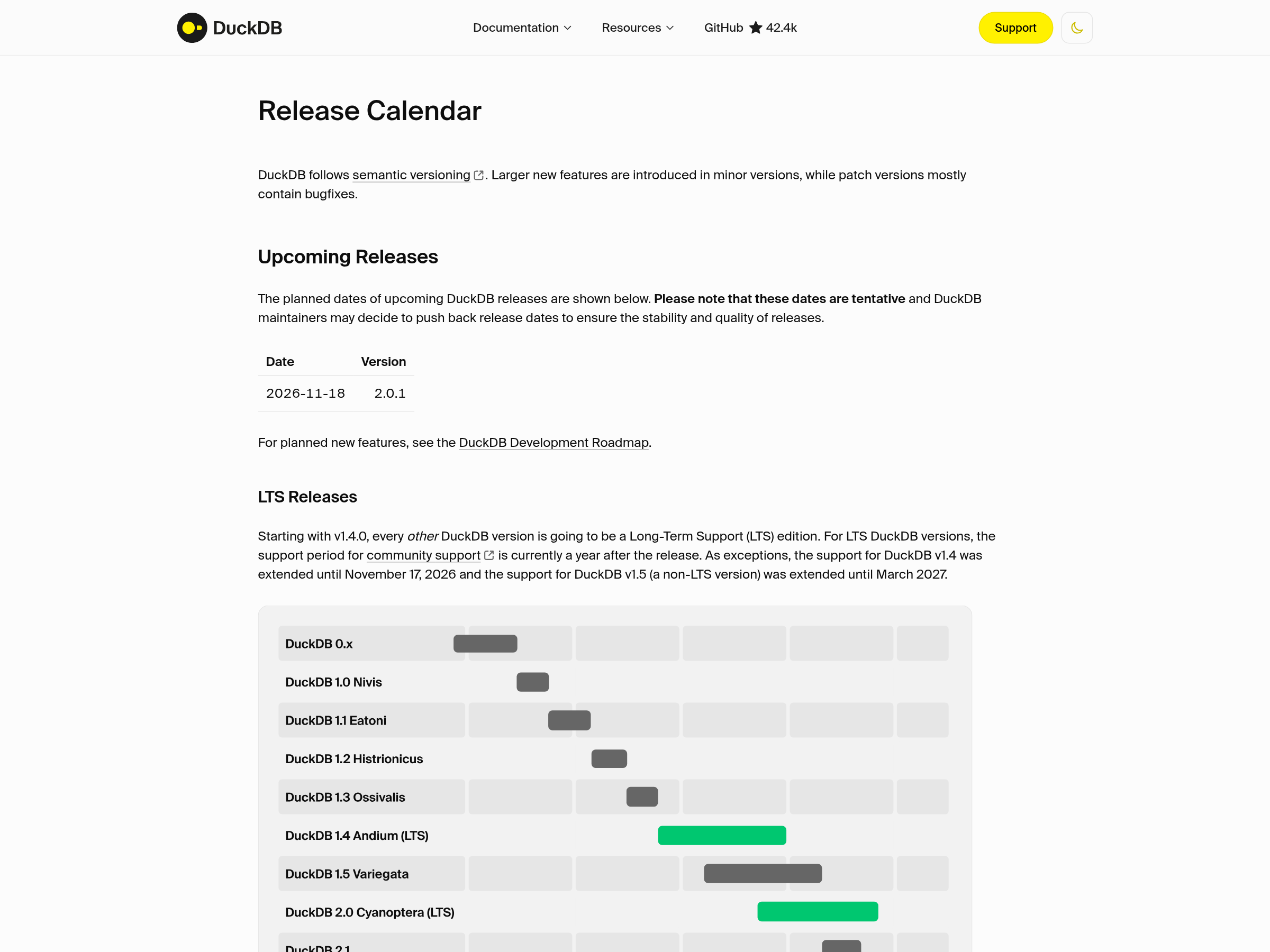
DuckDB's release calendar explains the label better than the announcement does. Starting with version 1.4.0, every other release is a Long-Term Support edition, and the community support period for an LTS version currently runs a year after its release. The 2.0.0 entry shows the release date of 21 October 2026 and an end of life of 22 October 2027, which is the one date a team should copy into its own calendar.
That calendar matters more than usual for a tool that lives inside an application. An embedded analytical database is linked into a Python service, a CLI script, a scheduled job or a notebook, and each of those places upgrades on its own schedule. A support window turns an indefinite promise into a deadline somebody can plan against, and the project publishes the next release on the same page, with 2.0.1 tentatively dated 18 November 2026.
The version policy underneath is ordinary semantic versioning, with larger new features arriving in minor versions and patch versions mostly carrying bugfixes. What the LTS cadence adds is a promise about how long a given minor version will keep receiving those patches, which is the question a team asks when a pipeline that runs nightly depends on the answer.
Quack, VARIANT and the features in this release
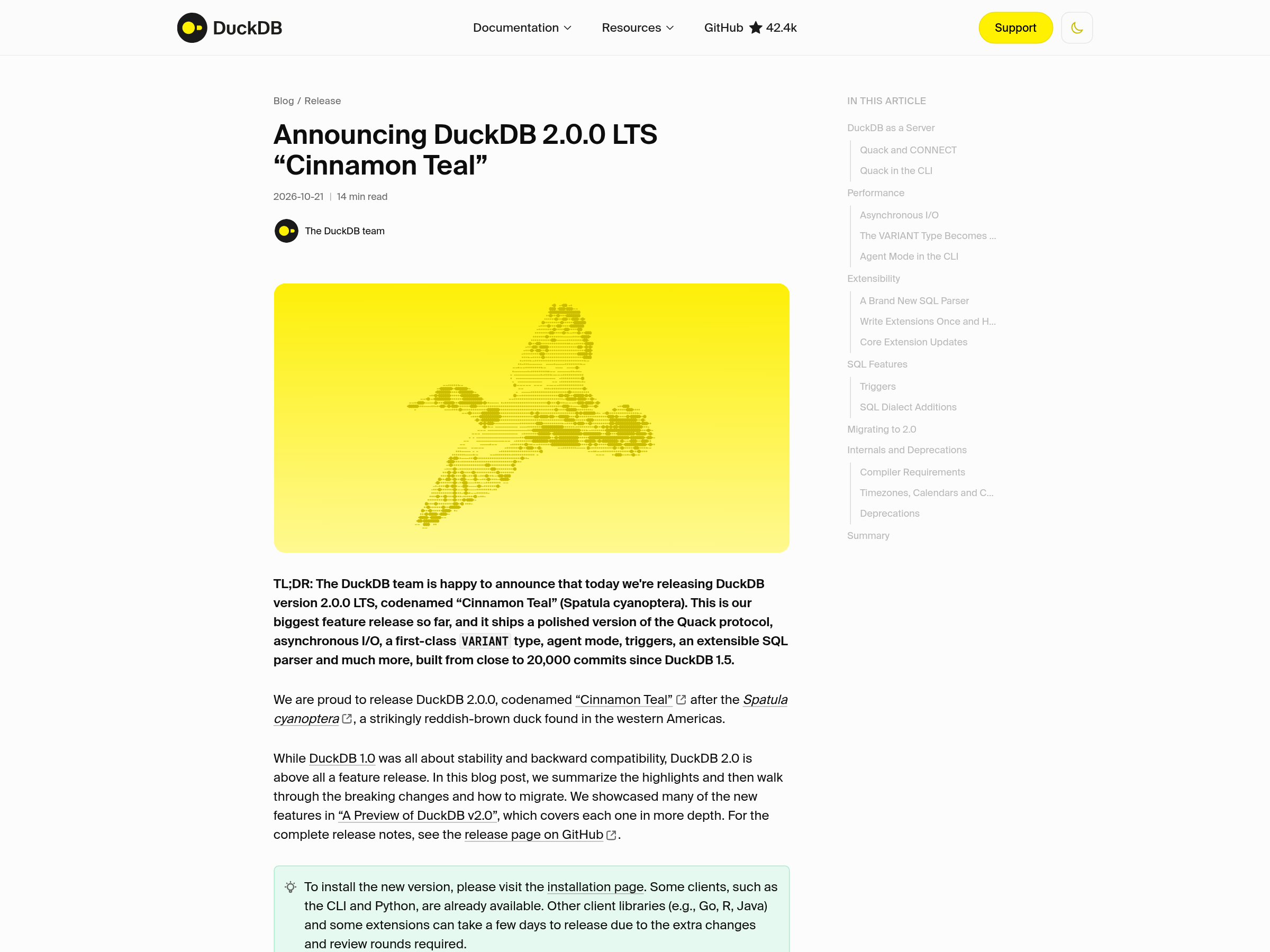
The feature list is longer than a version bump usually carries. The Quack protocol arrived in DuckDB 1.5.3 in May and let DuckDB run in a traditional client-server setup; 2.0 ships a polished version of it. Asynchronous I/O now covers reads of Parquet and CSV files and of DuckDB's native storage format: the I/O layer scales independently from query processing and keeps multiple requests in flight, which the project says brings far more parallelism to remote reads and faster queries on object storage such as S3.
The other additions change how the engine is used. A first-class VARIANT type gives semi-structured data a native home. Agent mode lets the CLI detect when a coding agent is driving it and switch to compact output, triggers bring CREATE TRIGGER with BEFORE and AFTER triggers at row or statement level, and the extensible PEG-based SQL parser, opt-in since DuckDB 1.5, is now the default. Triggers still have gaps: the announcement lists BEFORE … FOR EACH ROW and UPDATE … FOR EACH ROW triggers as not yet supported, so trigger logic carried over from another database needs checking case by case.
The internals moved as well. DuckDB 2.0 switches to Clang as the default compiler for release builds, with the engine and its core extensions built that way on Linux and macOS, the CLI on Windows, and most Windows core extensions still on MSVC. The ICU library is gone entirely: the icu extension now implements timezones, calendars and collations itself, with timezone data built from the IANA database and compressed to around 45 kB.
The storage format now moves in one direction
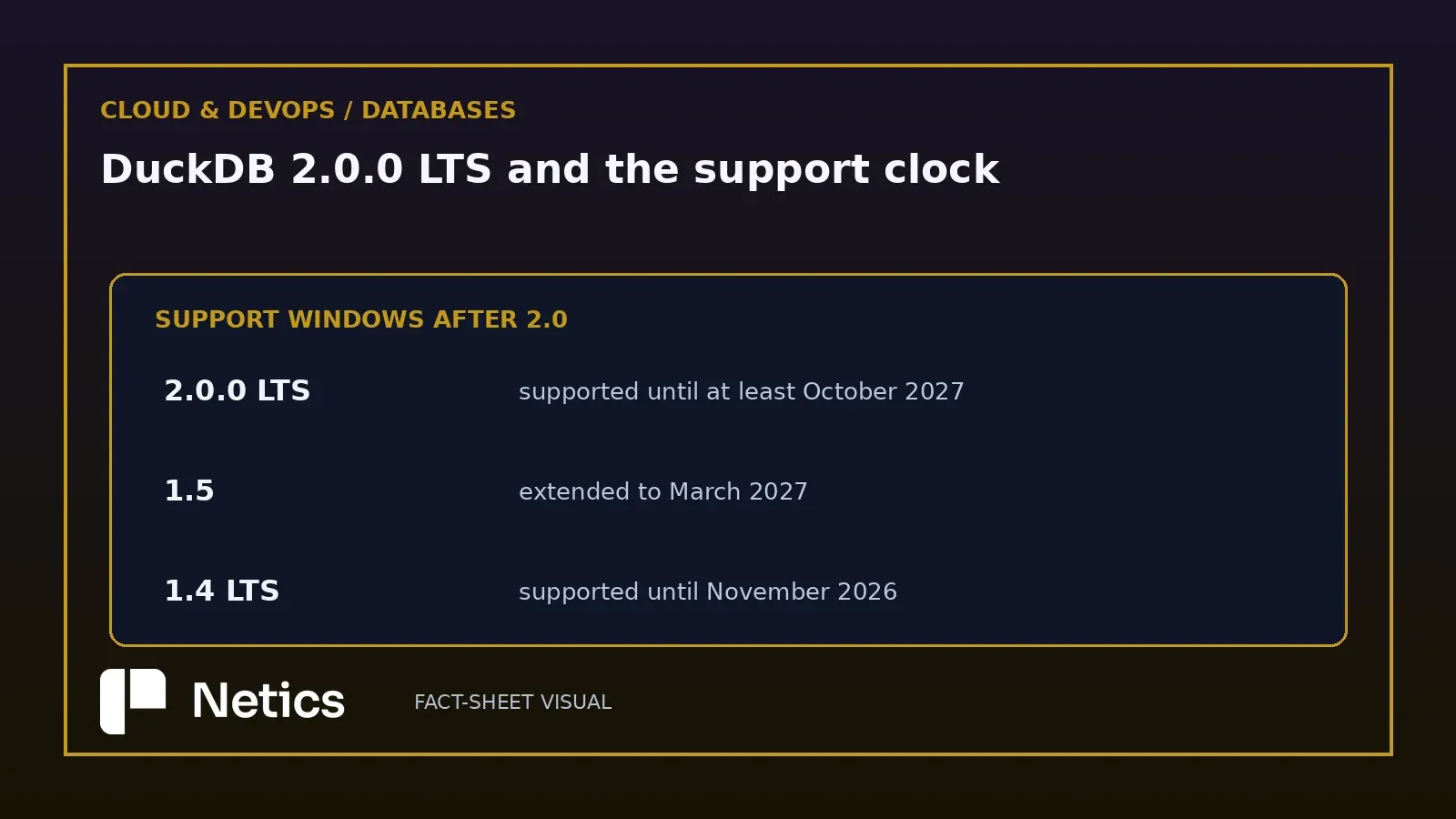
The breaking change that matters is in the file. DuckDB versions before 2.0 cannot read database files created by DuckDB 2.0, while 2.0 still reads and writes files created by earlier versions, and those older files remain readable by older releases. The trap sits in new files: any database file created by 2.0 cannot be opened by the version a team would roll back to.
The project's own advice follows from that. Test 2.0.0 on a shadow system before switching production over, and if the workload is mission-critical, consider waiting for the first patch release in November. A migration guide accompanies the release, and each service upgrades its client library on its own schedule: once one moves to 2.0, any database file it creates can no longer be opened by the version it ran before.
Snapshots are the cheap insurance here. Any team that exports a copy of its analytical data before the upgrade, in Parquet or in a plain CSV of the tables that matter, converts an irreversible step into a reversible one. Our reading at Netics is that Parquet and CSV copies are the safer insurance, since they sit outside the DuckDB database file format that changed in 2.0.
Three support lines until mid-November, then two until March 2027
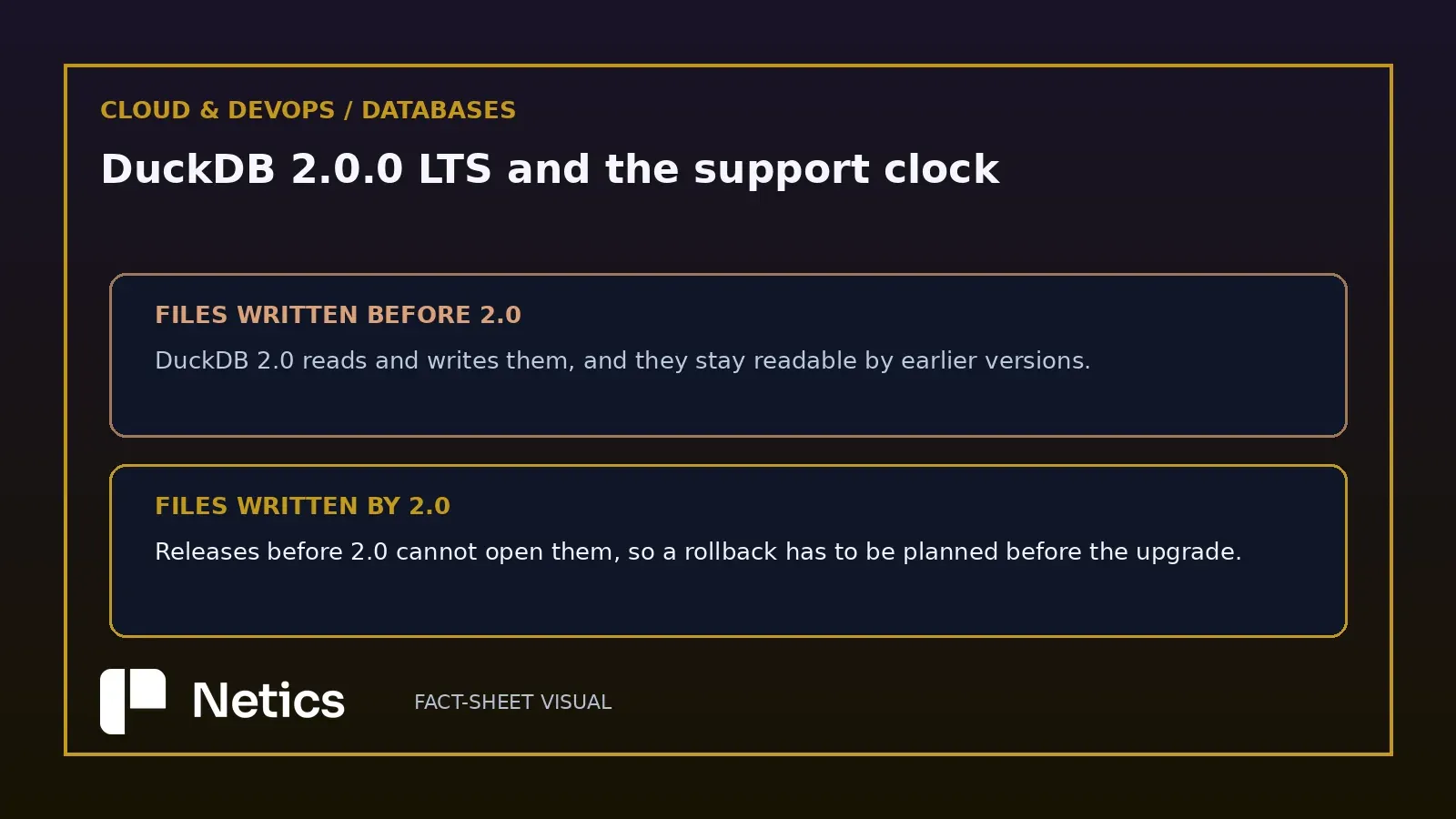
Until 17 November 2026 a team can choose between three supported versions, then between two until March 2027, and the choice comes down to risk appetite. Version 1.4 stays supported until late November 2026, which the calendar page states as 17 November 2026. Version 1.5 was extended to March 2027 and, as the announcement puts it, that effectively turns a non-LTS release into an LTS one. Version 2.0 runs until at least October 2027.
The practical reading is that 1.5 is the conservative bridge. A team that needs the fixes but wants a longer runway than 1.4 offers can sit on 1.5 until March 2027, run 2.0 on a shadow system in the meantime, and move once a patch release or two has shipped. The announcement names the storage format as the most likely source of problems.
The calendar also makes the long-term shape visible. Every other release is meant to be an LTS edition, so a team can plan two-step moves and skip the versions in between. The alternation is not strict, since 1.5 gained LTS-length support after its release, and the next patch of the current line carries only a tentative date.
A migration plan for a small data team
The plan fits on one page. Export the data that matters to Parquet before touching anything. Pin the client library version in the service that reads it, so that no service creates 2.0 database files before the shadow test is done. Run 2.0.0 against the shadow copy and compare row counts and query results on the reports somebody actually reads. Decide on a date, and write down which version line the team will sit on until that date.
The reason to bother is visible in the feature list. Our reading at Netics is that a single-process analytical engine that gains a client-server mode, a semi-structured type and asynchronous I/O can query more data where it already sits. That argument is the same one behind the private assistant that answers from your own documents: keeping the data where it already lives, and adding the compute next to it.
An embedded DuckDB lives inside an application, which is where Netics does custom web and mobile development with small teams. The version choice above is the kind of decision that belongs in a runbook with a date on it, because each support line has an end date.
Sources
Source: Announcing DuckDB 2.0.0 LTS Cinnamon Teal — DuckDB, duckdb.org/2026/10/21/announcing-duckdb-200, 21 October 2026, retrieved 2026-10-21 (the release of DuckDB 2.0.0 LTS, codenamed Cinnamon Teal after the Spatula cyanoptera, described as the biggest feature release so far, shipping a polished version of the Quack protocol, asynchronous I/O, a first-class VARIANT type, agent mode, triggers and an extensible SQL parser, built from close to 20,000 commits since DuckDB 1.5; DuckDB 2.0 as a long-term support release with support until at least October 2027, version 1.4 still supported until late November 2026 and version 1.5 extended until March 2027; files created by 2.0 unreadable by earlier versions while 2.0 reads and writes existing files that stay readable by older versions; the recommendation to test on a shadow system and to wait for the first patch release in November for mission-critical workloads; the switch to Clang as the default compiler for release builds; the removal of the ICU library, with the icu extension implementing timezones, calendars and collations itself from the IANA database in around 45 kB).
Source: Release Calendar — DuckDB, duckdb.org/release_calendar, retrieved 2026-10-21 (2.0.0 LTS released 2026-10-21 with end of life 2027-10-22; the next planned release 2.0.1 on 2026-11-18; starting with v1.4.0 every other DuckDB version is a Long-Term Support edition with a community support period currently a year after the release; v1.4 extended until November 17 2026 and v1.5 extended until March 2027; semantic versioning with larger new features in minor versions and patch versions mostly containing bugfixes).
Source: the DuckDB 2.0.0 LTS announcement post and the DuckDB release calendar, both retrieved 2026-10-21 — every version number, date and figure above traces to one of those two pages. Images are captures of the announcement post and the release calendar, plus two Netics editorial diagrams. Netics builds application and data work with small teams through custom web and mobile development.