
"Cloudflare Workers AI vs Amazon Bedrock: Edge Inference or Managed Enterprise Model Access?"
"Workers AI puts 50+ open models on Cloudflare's edge GPUs behind pay-per-use pricing. Bedrock puts 100+ hosted models — including frontier labs — behind enterprise controls. They are not co

Source: Cloudflare Workers AI documentation and Amazon Bedrock overview
TL;DR
This comparison explains What Cloudflare Workers AI actually is; What Amazon Bedrock actually is; Model access: curated open catalog vs multi-lab marketplace; Deployment model: edge-native vs centrally managed; Enterprise controls: what Bedrock documents that Workers AI does not; Cost model: pay-per-use simplicity vs optimization tooling; Agent and orchestration surface; Where the two overlap, and where the choice is not really a choice. The practical choice depends on workload, governance, operational ownership, and the constraints documented by the primary sources.
What Cloudflare Workers AI actually is
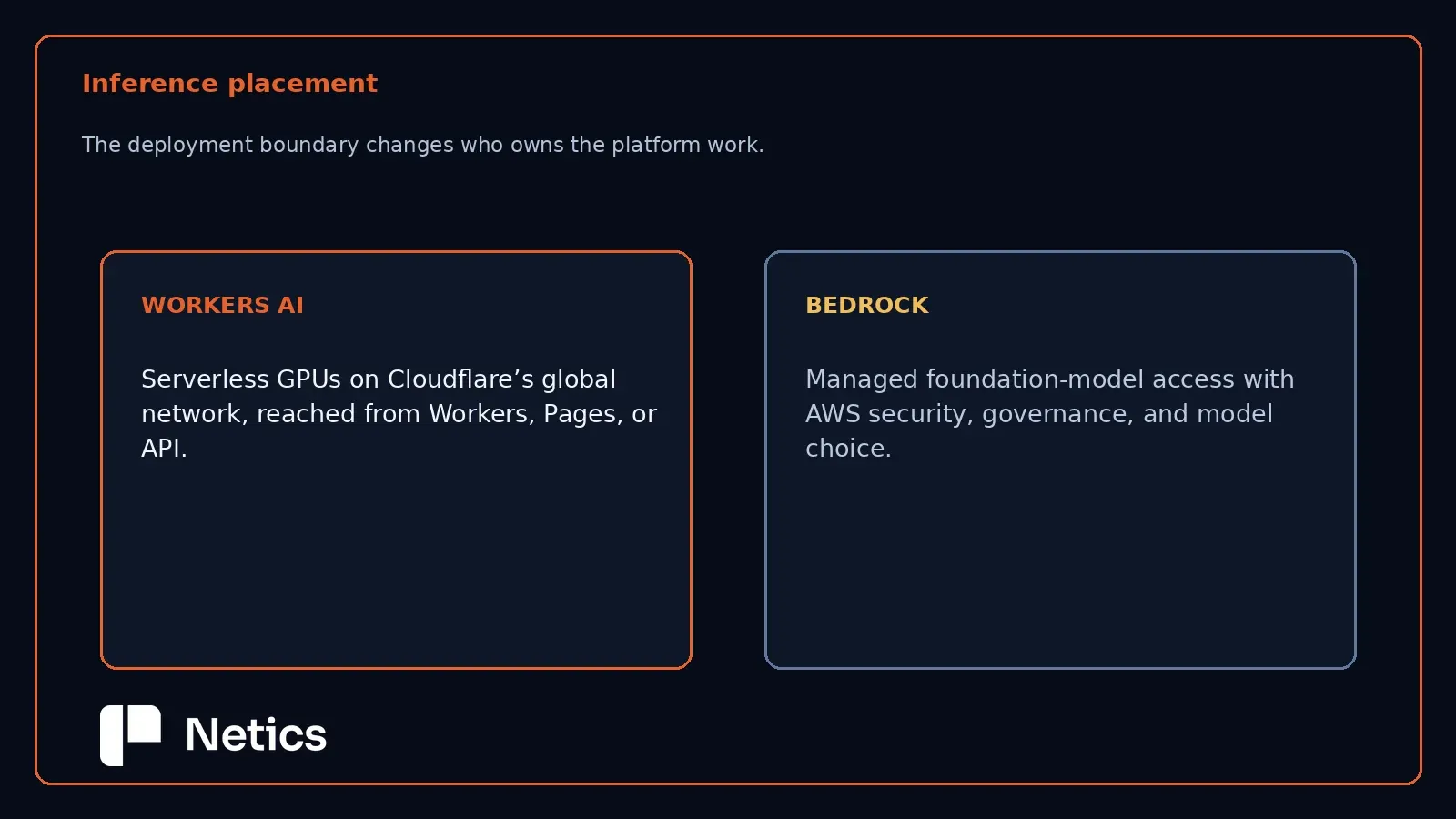
Workers AI is documented as letting developers run machine learning models, powered by serverless GPUs, on Cloudflare's global network, with the explicit promise of not having to worry about scaling, maintaining, or paying for unused infrastructure. It is available on both Free and Paid Cloudflare plans, and it is invoked from Workers, Pages, or directly via the Cloudflare API. The catalog is described as 50+ open-source models, and the docs frame it as one piece of a broader developer platform that also includes AI Gateway (caching, rate limiting, retries, model fallback) and Vectorize, Cloudflare's vector database for semantic search and retrieval-augmented use cases. As of the documentation's April 21, 2026 update, Workers AI is generally available, with a separate custom-requirements form for teams that need private custom models or higher limits.
What Amazon Bedrock actually is
Bedrock is described in AWS's own documentation as a fully managed service that provides secure, enterprise-grade access to high-performing foundation models from leading AI companies, enabling you to build and scale generative AI applications. The supported-model list spans 100+ foundation models from Amazon, Anthropic, DeepSeek, Moonshot AI, MiniMax, OpenAI, and xAI, with AWS marketing pages citing recent additions such as xAI's Grok 4.6 (a 500K context window, configurable reasoning effort) and OpenAI's GPT-5.6 family available through the Responses, Converse, and Chat Completions APIs. Bedrock exposes multiple integration paths — a Messages API compatible with the Anthropic SDK, an OpenAI-compatible Chat Completions API, AWS's own Converse API, and a lower-level Invoke API — which matters for teams migrating existing model-provider code rather than rewriting against a new SDK.
Model access: curated open catalog vs multi-lab marketplace
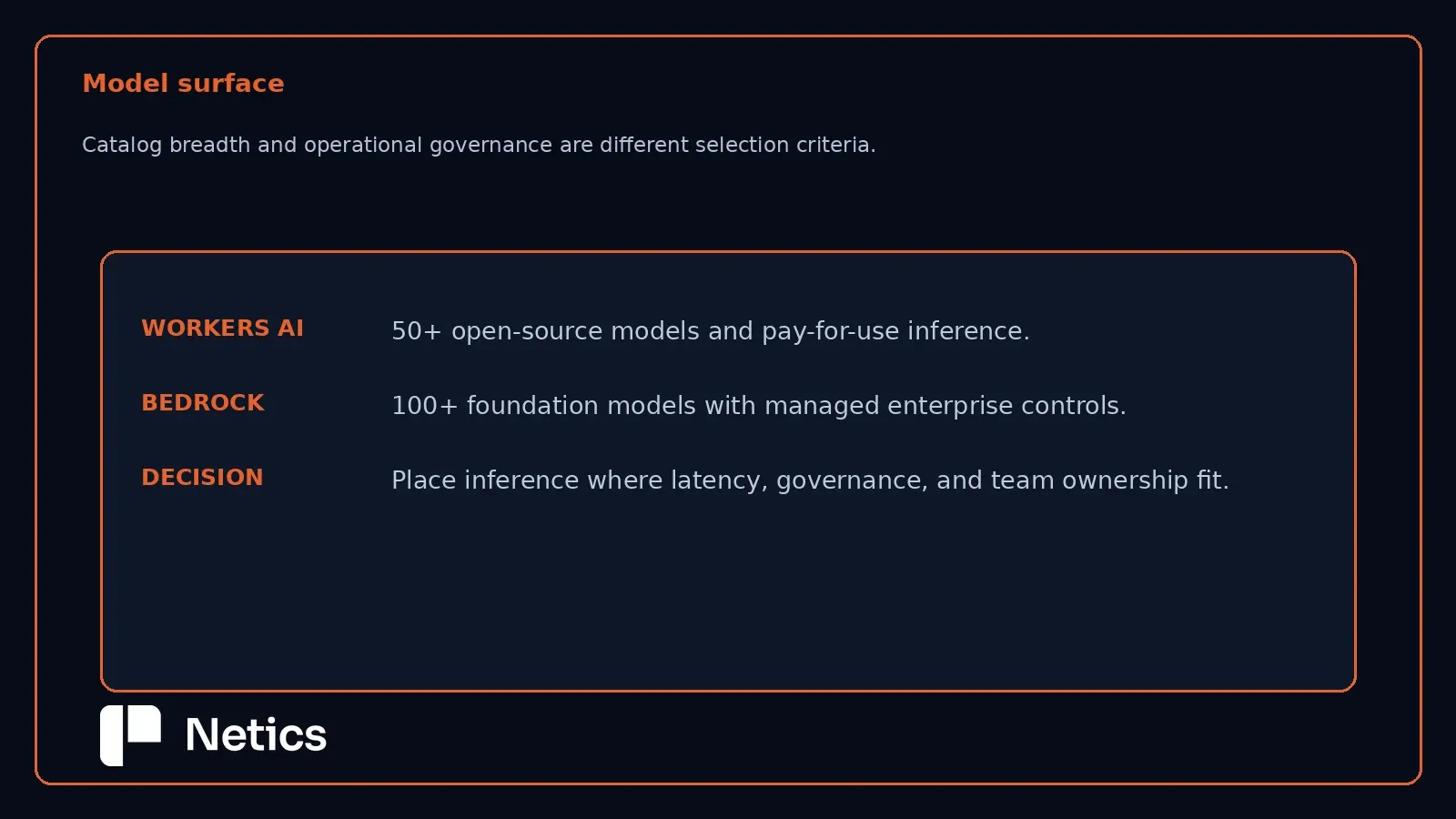
This is the sharpest structural difference. Workers AI's catalog is open-source models curated by Cloudflare — useful for classification, embeddings, and generation tasks where a smaller open model is sufficient and where paying per-token to a frontier lab would be overkill. Bedrock's catalog spans proprietary frontier models from Anthropic, OpenAI, and xAI alongside AWS's own Amazon Nova line and open entrants like DeepSeek — the pitch is choose the best model for your use case from AWS's own marketing copy, with evaluation tools to pick the best model based on your unique performance and cost needs. If a workload genuinely requires the reasoning ceiling of a current frontier model, Workers AI's catalog is not built for that; if a workload is well served by an open model and the priority is deployment simplicity and low idle cost, Bedrock's breadth is unused surface area.
Netics visual — model breadth is not the same axis as model fit; match the catalog to the workload, not the other way around.
Deployment model: edge-native vs centrally managed
Workers AI's core claim is proximity: inference happens on GPUs placed across Cloudflare's network, invoked from the same Workers runtime that already serves edge compute for many Cloudflare customers. There is no separate provisioning step — a Worker calls the AI binding and the request is served from nearby infrastructure. Bedrock is a managed AWS service consumed through bedrock-runtime regional endpoints; AWS documentation shows cross-Region inference being added for specific model families (for example, OpenAI models gaining Global and Geo cross-Region routing) as a way to improve throughput and reduce per-token cost, but this is a managed-region model, not an edge-everywhere model. Netics reading: Workers AI's architecture is a genuine advantage for latency-sensitive, high-fan-out inference (real-time moderation, edge personalization); Bedrock's architecture is a genuine advantage for centralizing governance over a fleet of models used across many internal teams.
Enterprise controls: what Bedrock documents that Workers AI does not
AWS's Bedrock marketing page is explicit about compliance and safety surface area in a way the Workers AI documentation reviewed here is not: Bedrock Guardrails is described as helping block up to 88% of harmful content and identify correct model responses with up to 99% accuracy to minimize hallucinations and data ambiguity using Automated Reasoning checks, and Bedrock is described as being in scope for ISO, SOC, CSA STAR Level 2, GDPR, and FedRAMP High, and as HIPAA-eligible, with data never stored or used to train models. Workers AI's own documentation, in the source reviewed here, does not make equivalent named-standard compliance claims — it emphasizes operational simplicity (no scaling or maintenance burden) rather than governance tooling. That gap is worth naming plainly, not softening: a regulated buyer evaluating Workers AI would need to verify compliance posture directly with Cloudflare rather than infer it from this documentation.
Cost model: pay-per-use simplicity vs optimization tooling
Workers AI is described simply as pay-for-what-you-use, with a dedicated pricing page but no elaborate cost-optimization tooling mentioned in the source reviewed. Bedrock's cost story is more instrumented: AWS cites Model Distillation (distilled models run up to 500% faster and cost up to 75% less, with minimal impact on accuracy) and Intelligent Prompt Routing (can cut costs by up to 30% while maintaining quality), plus prompt caching and both real-time and batch processing options. These are AWS's own stated figures from its own evaluation conditions, not independently verified benchmarks, and they should be read the way any vendor-stated performance claim should be read — as a hypothesis to validate against your own workload, not a guarantee. Netics illustrative example: a team running a fixed-shape batch job (nightly document summarization, say) is exactly the profile AWS's own copy targets with batch processing and distillation; a team running unpredictable, bursty edge traffic is closer to Workers AI's pay-per-use model, where there is no idle capacity to distill away in the first place.
Agent and orchestration surface
Bedrock's marketing describes Bedrock AgentCore as the end-to-end platform to build, connect and optimize highly capable agents securely, at scale using any framework and model, plus a separate Bedrock Managed Agents offering built specifically around OpenAI's frontier models and harness. Robinhood is cited by AWS as a customer that scaled from 500 million to 5 billion tokens daily over six months on Bedrock while cutting AI costs 80%, attributed to AWS's own quoted company representative — a real published case study, though it is AWS's own customer-story content and should be read with the understanding that it reflects Robinhood's specific workload, not a general result. Workers AI's documented related products — AI Gateway and Vectorize — are lighter-weight building blocks (observability, caching, vector search) rather than a full agent orchestration platform. A team building multi-step autonomous agents with enterprise access controls has more purpose-built tooling on Bedrock today, per the sources reviewed; a team wiring a single inference call into an existing Worker has less reason to reach for that machinery at all.
Where the two overlap, and where the choice is not really a choice
There is a real overlap zone: both let a developer send a prompt and get a completion back, and both offer an OpenAI-compatible-adjacent API surface — Bedrock's Chat Completions API explicitly, Workers AI through its own binding. But outside that overlap, the decision tends to resolve itself once the actual constraint is named. If the constraint is this needs to run close to users at the edge, on an open model, billed simply — that is Workers AI's stated design center. If the constraint is this needs governed access to whichever frontier model performs best, with audit-ready compliance and agent tooling — that is Bedrock's stated design center. Teams that try to force one platform to do the other's job tend to discover the gap at the worst time: a compliance review that Workers AI's documentation doesn't address, or a latency budget a centrally-hosted Bedrock endpoint can't hit without cross-Region routing overhead. Read any vendor's own stated numbers as a starting hypothesis to validate against your own workload, not a conclusion to accept at face value.
Source: Cloudflare Workers AI documentation, last updated April 21, 2026; Amazon Bedrock overview and product page, accessed August 2026.
Need help choosing — or actually deploying — the right inference architecture for your stack? Netics runs targeted infrastructure audits scoped to your workload, not a vendor's benchmark. Talk to us about an audit if latency, compliance, or model-cost tradeoffs are an open question for your team.
For a context-specific architecture review, book a 30-minute audit with Netics.