
Automated Suspension Needs a Human Owner
The reported Dutch case against Uber shows why high-impact automated enforcement needs accountable owners, evidence, explanations, and a real route to human review.

TL;DR
A reported €825 million fine against Uber places automated driver deactivation inside a wider governance problem: high-impact decisions cannot be left as ownerless system outputs. A defensible enforcement process needs a named decision owner, a recorded reason, accessible evidence, advance warning where possible, a meaningful appeal route, and timely human review. Automation can detect risk and recommend action, but someone must remain answerable for the outcome. The summary also covers: What the Reported Case Exposes; Warning and Proportionality Belong in the Workflow; A Clearly Labelled Hypothetical Control Example; Appeals Need Decision Rights, Not Just Contact Forms; Human Oversight Must Have a Budget and a Boundary.
The case also needs to be read with its prior enforcement context. TechCrunch reported earlier Dutch fines of €290 million and €10 million, alongside testimony involving 170 drivers. Those figures do not prove that every suspension was unlawful; they show why a high-impact enforcement system needs an evidence trail that can be examined across cases.
What the Reported Case Exposes
The TechCrunch report describes complaints in the Netherlands concerning automated driver deactivation without sufficient warning or human oversight. The Dutch data protection authority was reported to have issued Uber a fine of €825 million, around $966 million. TechCrunch cited Reuters and Dutch regulator context in reporting the case.
Uber disputes permanent deactivations without review and plans to appeal. That position matters. A reported enforcement action remains subject to dispute, and the final legal or regulatory outcome should not be treated as settled by a news report. The governance question, however, is already clear enough to examine: when software can remove a person’s ability to work, where does responsibility sit?
The report also says that one driver gathered testimonies from 170 drivers. That detail changes the shape of the story. A single disputed decision may be described as an anomaly. A body of testimonies suggests that affected people may experience the same process as a pattern, even when the system presents each action as an isolated risk response.
Detection Can Be Automated; Accountability Cannot
Automated enforcement is attractive because it can process signals continuously and apply a consistent rule. It can identify suspicious activity, compare records, pause access, or route cases for investigation. Those capabilities may be useful. They do not answer the central accountability questions.
Who approved the policy? Who owns the threshold? Who can change it? Who sees the evidence before a suspension becomes permanent? Who is responsible when the data is incomplete, the signal is misclassified, or the person affected cannot understand what happened?
A system that produces a suspension without a human owner creates a responsibility gap. The operator can point to the model, the product team can point to policy, and the review team can point to the queue. The affected worker still bears the consequence. Governance must close that gap by assigning ownership before the system goes live.
The principle applies beyond platforms. Account closures, access restrictions, fraud holds, benefit decisions, workplace sanctions, and marketplace penalties can all become high-impact automated outcomes. The higher the consequence, the less acceptable it becomes to treat the system output as the endpoint.
The Minimum Evidence Package
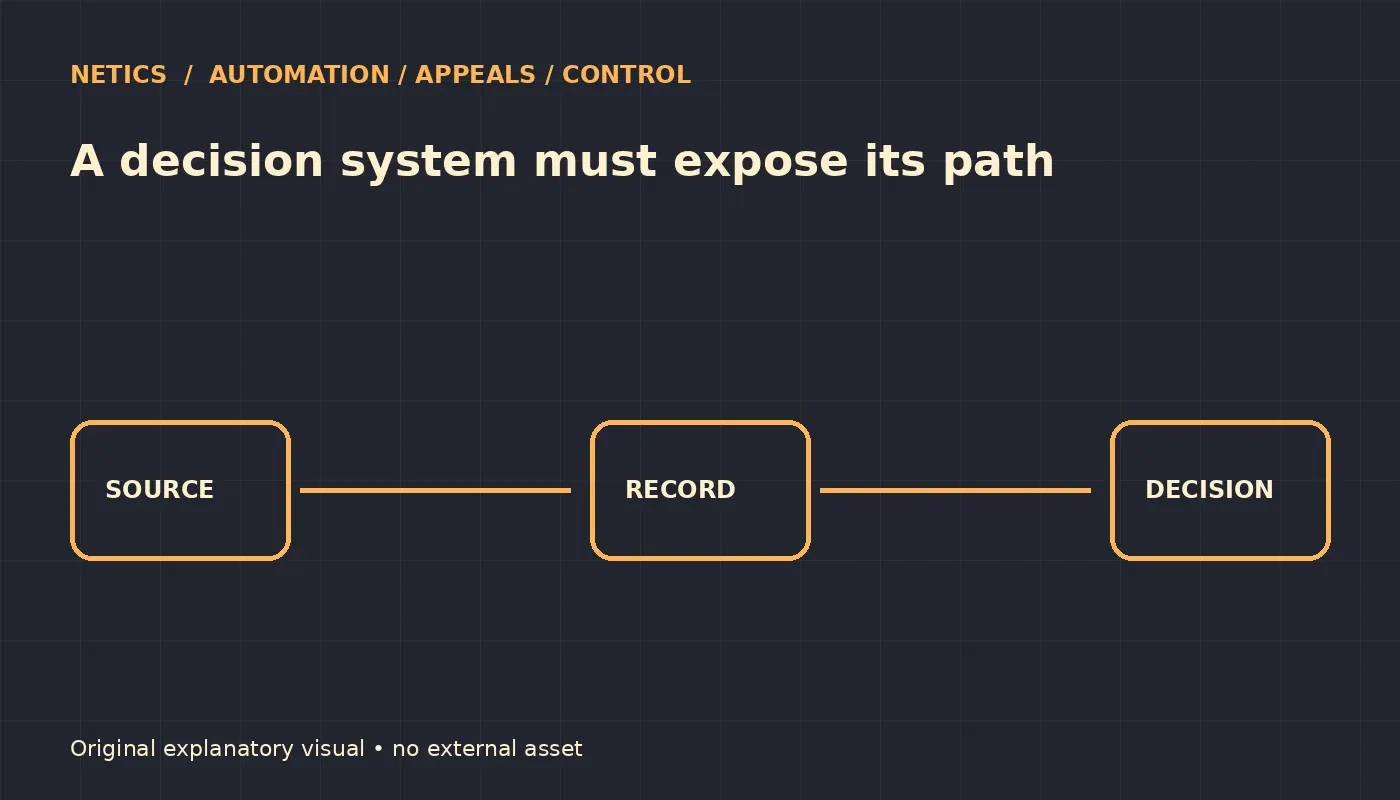
A suspension should be supported by an evidence package that a reviewer can inspect. The package does not need to expose proprietary detection methods or reveal sensitive information. It does need to make the decision traceable.
At minimum, the record should identify the rule or policy involved, the event or pattern that triggered it, the relevant time window, the confidence or uncertainty associated with the signal, and the action taken. It should preserve the source records used for the decision and show whether later information changed the assessment.
The record serves two audiences. A human reviewer needs enough context to decide whether the action was justified. The affected person needs enough explanation to respond meaningfully. A vague statement such as “policy violation detected” does neither. It describes an outcome while withholding the route by which the outcome was reached.
Evidence also creates discipline inside the organization. If a team cannot state what triggered a suspension, it cannot reliably test whether the rule is working. If it cannot reconstruct the decision later, it cannot distinguish a legitimate enforcement action from a data error or a broken threshold.
Warning and Proportionality Belong in the Workflow
The reported complaints included automated deactivation without sufficient warning. Warning is not a cosmetic courtesy. It can provide a chance to correct a misunderstanding, supply missing information, or stop a repeated problem before access is removed.
A warning should be meaningful rather than automatic. It should state what requires attention, what response is available, and what may happen next. The organization should also define exceptions for situations where immediate action is necessary, while preserving a rapid human review after the fact.
Proportionality matters at each stage. A temporary restriction, a request for clarification, and a permanent deactivation carry different consequences. They should not all be triggered by the same unexamined signal. The system should distinguish between detection, precaution, investigation, and final enforcement.
That separation gives the operator more options than a binary choice between ignoring risk and removing access. It also creates measurable decision criteria: how often warnings are resolved, how often restrictions are reversed, which signals produce the most appeals, and whether certain evidence types routinely lead to mistaken action.
A Clearly Labelled Hypothetical Control Example
Hypothetical control example: A platform’s automated system flags a driver account for possible policy violations. The system may place a short temporary hold if the risk requires immediate containment, but it cannot permanently deactivate the account by itself.
The hold record assigns a named operations owner and includes the triggering rule, relevant evidence, timestamp, and uncertainty note. The driver receives a plain-language explanation and a route to submit information. A trained reviewer must examine the record within a defined internal period before any permanent action is taken.
If the reviewer confirms the action, the record states why the evidence met the policy threshold. If the reviewer reverses it, the system records the reason for reversal and feeds that outcome into threshold testing. If the evidence is incomplete, the case remains unresolved rather than being converted into a permanent penalty by default.
The example does not require the reviewer to disregard automated signals. It requires the reviewer to own the decision, inspect the evidence, and leave an auditable explanation.
Appeals Need Decision Rights, Not Just Contact Forms
An appeal process fails when it merely gives people a mailbox or a form. The person appealing needs a realistic opportunity to affect the outcome. That means the appeal must reach someone with authority to reverse or modify the original action, and the reviewer must have access to the underlying evidence.
Appeals should also be designed to detect systemic problems. The reported testimonies from 170 drivers show why individual case handling and aggregate monitoring belong together. If many appeals concern the same trigger, warning failure, or unexplained permanent action, the organization should treat that pattern as a control signal.
A useful appeal record captures the original decision, the new information supplied, the reviewer’s conclusion, and the final remedy. It should also preserve the distinction between a decision upheld because evidence was sufficient and a decision upheld because no one revisited it. Those outcomes may look identical in a dashboard while representing very different levels of control.
Human Oversight Must Have a Budget and a Boundary
Human review is often promised as a safeguard without defining its capacity. That creates another failure mode: a nominal review layer that cannot process the volume or complexity of cases. A credible control therefore needs staffing, training, escalation rules, and a clear boundary around which decisions require review.
Permanent or highly consequential actions should receive stronger scrutiny than reversible warnings. Reviewers should be able to pause enforcement when evidence conflicts, request additional information, and escalate policy ambiguity. Their work should be sampled for quality, with reversal patterns and recurring failure modes reported to the policy owner.
The owner also needs authority over the automated system itself. If reviewers identify a faulty trigger but cannot change the rule, the organization has created a feedback queue without a correction path. The control loop must connect appeals and review findings to policy maintenance, testing, and change approval.
The Governance Test
The practical test is simple: can the organization explain who made the decision, why the evidence supported it, what the affected person could do, and how a human could change the outcome?
If the answer is unclear, the system is not ready to carry high-impact enforcement. The problem is not that automation detected a possible violation. The problem is allowing detection to become punishment without a responsible decision point.
Netics’ broader view of responsible technology is grounded in this kind of operational detail. Effective automated decision human oversight depends on ownership that survives a model update, an appeal, a disputed record, and a regulator’s questions. A system may be fast, consistent, and technically sophisticated. None of those qualities removes the need for a person who can say: this decision was mine, here is the evidence, and here is how it can be challenged.
Source: TechCrunch — 2026-08-23