
The 2026 State of Open Source in Europe Report Puts Sovereignty in Numbers
The fifth State of Open Source in Europe report finds 94% of European organisations treat digital sovereignty as strategically important, and it prices what governance and private forks cost

TL;DR
- The State of Open Source in Europe is an annual survey report from the Linux Foundation, produced with LF Europe and LF Research, that asks European organisations how they use, govern and sustain the open source software their operations depend on.
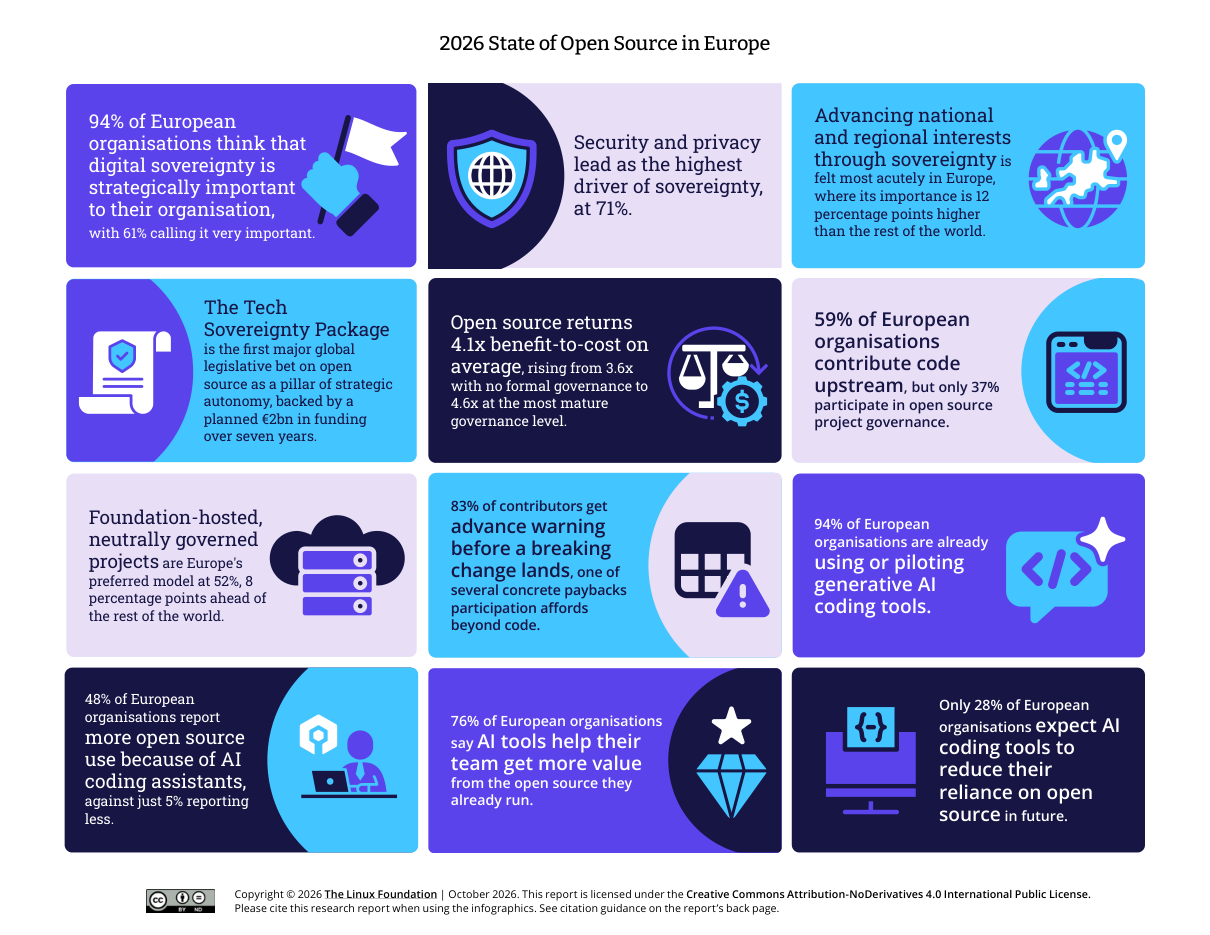
- The fifth edition arrived on 7 October 2026 at Open Source Summit Europe in Prague, and the headline numbers describe a strategic shift: 94% of the organisations surveyed call digital sovereignty important to their technology strategy, and 61% call it very important.
- Organisations with the most mature open source governance report 4.6x benefit-to-cost on their open source investment, the European average is 4.1x, and organisations with no formal framework report 3.6x.
- Private forks carry a measured bill: 311 hours per release cycle across 9.5 forks on average, and 28% of the organisations maintaining them cannot track that cost.
- 59% of European organisations contribute code upstream while 37% take part in open source project governance, which the report's authors frame as the participation gap.
What the report measures
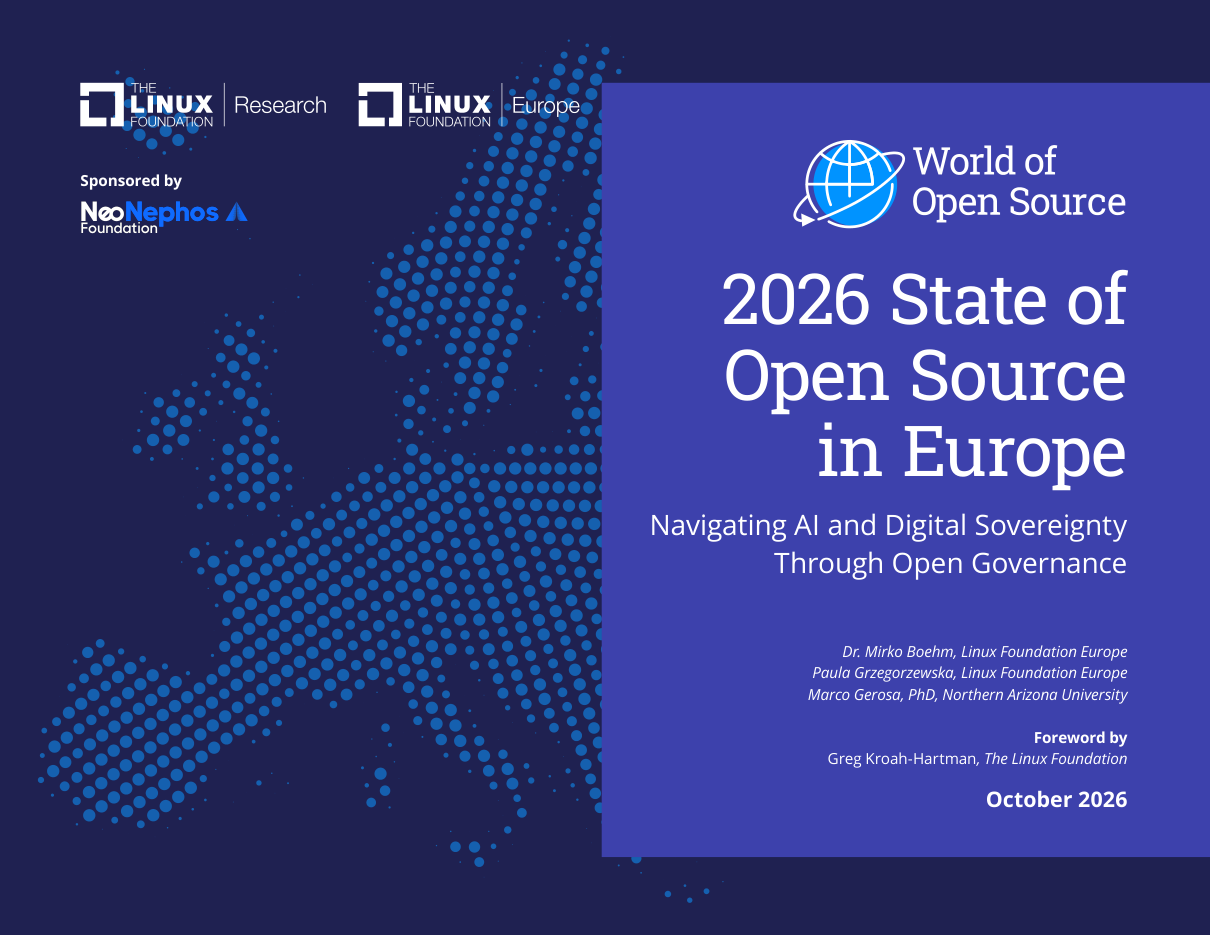
The State of Open Source in Europe has run for five editions, and its method is a survey of organisations, with respondents describing their own estates and practices. The 2026 edition was released at Open Source Summit Europe in Prague on 7 October 2026 by the Linux Foundation with LF Europe, LF Research and NeoNephos, and it asks how organisations adopt, govern and pay for the open source software their operations depend on.
That framing shapes how the figures should be read. A finding such as the 94% who call digital sovereignty important describes what respondents report about their own strategy, across a sample whose sizes, sectors and open source maturity differ widely. The report sorts those respondents by governance maturity throughout, which turns one headline number into a comparison between groups.
Sovereignty as a test of the supply chain
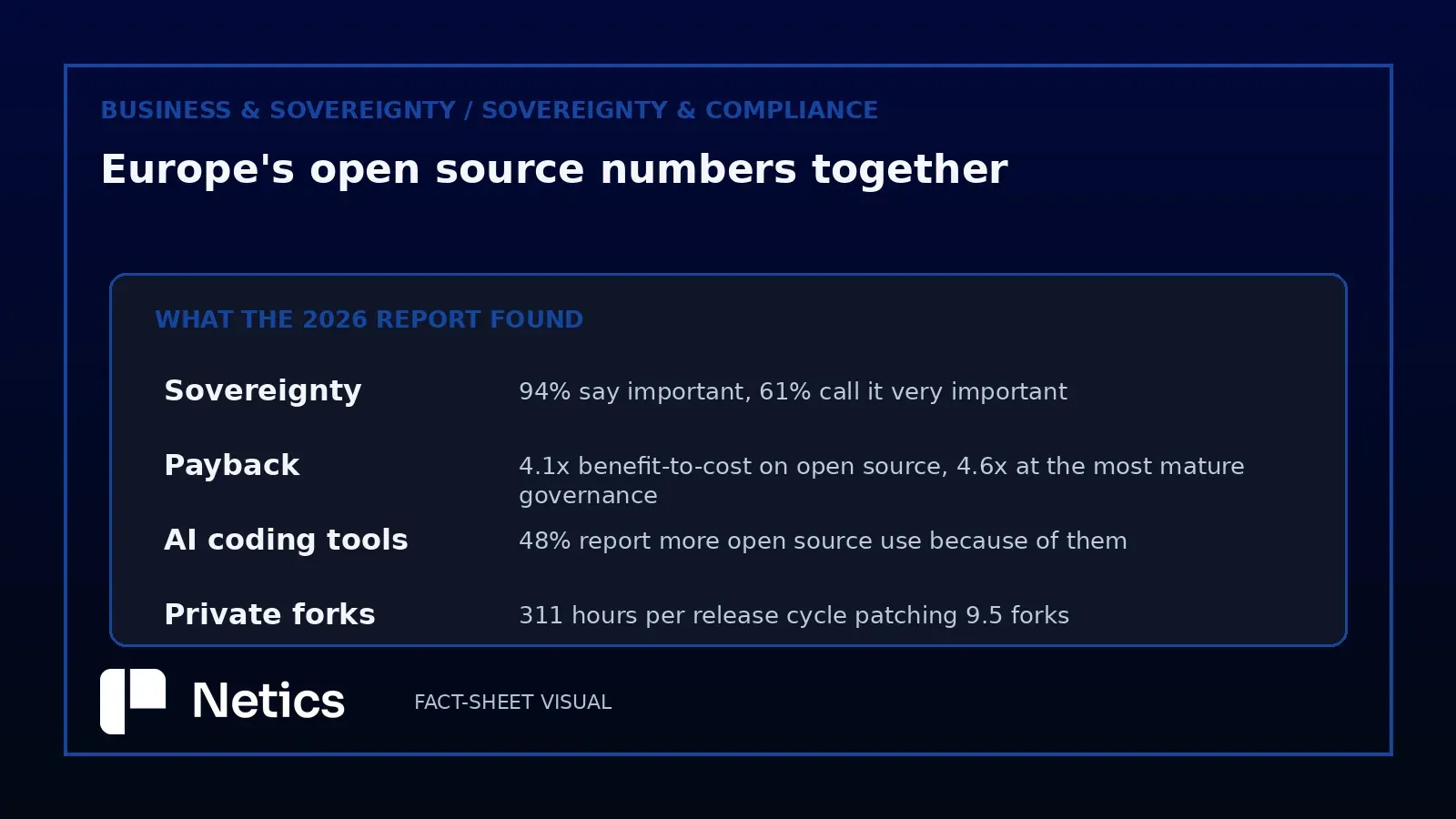
Digital sovereignty is the report's organising theme. 94% of respondents call it important to their technology strategy, 61% call it very important, and security and privacy lead the drivers at 71%. The report places the European figure 12 percentage points above the rest of the world.
The detail underneath those numbers is where the operational content sits. Asked which delivery model organisations prefer for the projects they depend on, respondents put foundation-hosted and neutrally governed projects first at 52%, eight percentage points ahead of the rest of the world. A preference for neutral governance is a statement about who holds the decision rights over a component a business cannot easily replace: who can change the licence, who sets the roadmap, who fixes the flaw, and how quickly the answer arrives.
Put those questions in a procurement template and the sovereignty debate stops being abstract. The report's contribution is to show how widely they are now asked at management level.
Governance moves the return
The second theme is money. Organisations with the most mature open source governance report 4.6x benefit-to-cost on their open source investment. Organisations with no formal governance framework report 3.6x. The European average sits at 4.1x, and 31% of those surveyed still run no formal framework.
The spread is modest in absolute terms and consistent in direction: organisations that write down how open source enters their estate report more value from it. Governance here covers familiar artefacts, an approval path for new dependencies, an inventory of what is deployed, a process for tracking licence obligations, a named owner for security updates. Running that requires somebody deciding that a dependency is an asset with an owner, and that call sits with management.
The bill a private fork runs up
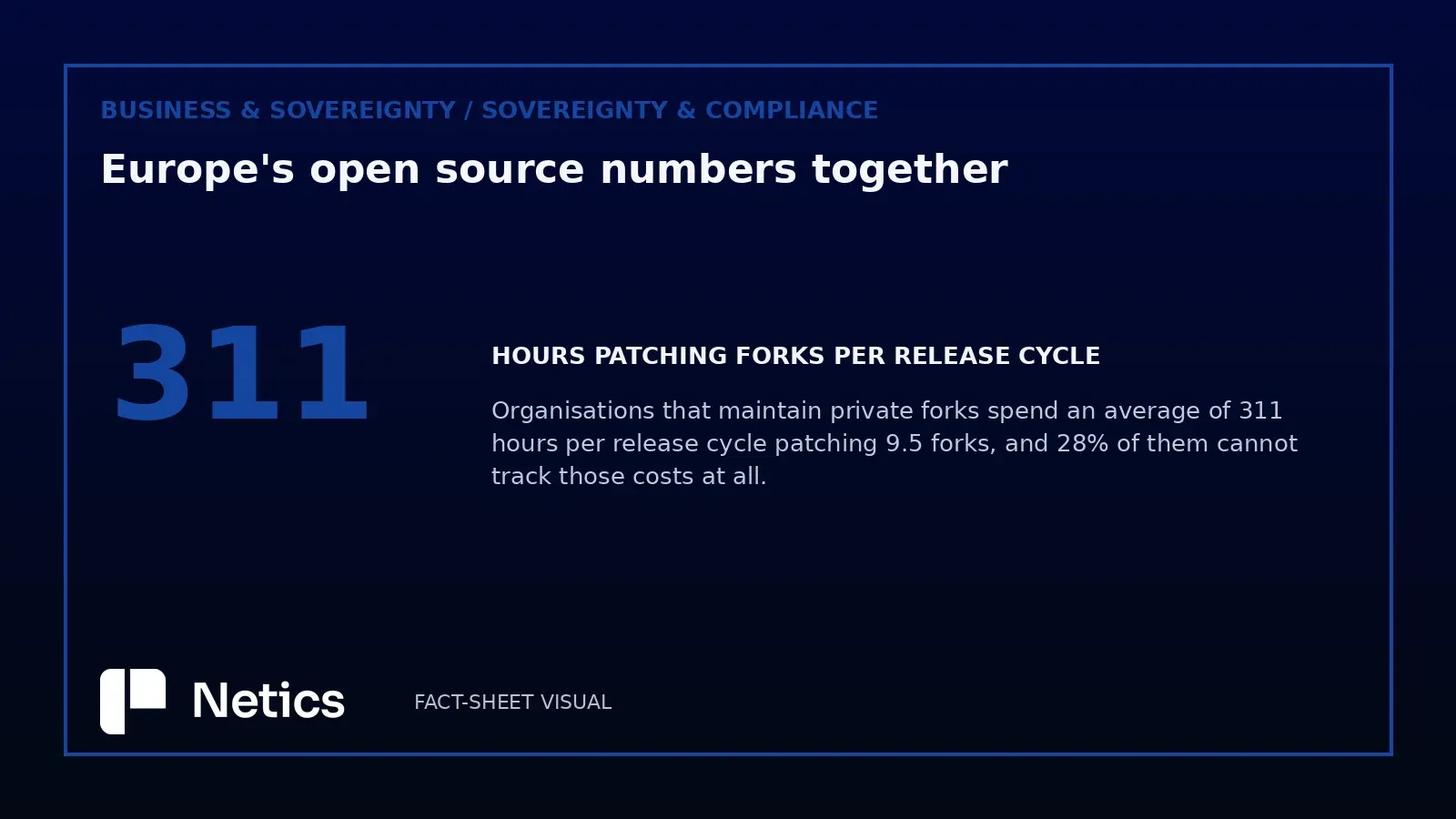
48% of the organisations surveyed maintain private forks of open source projects, and the report prices that choice: an average of 311 hours per release cycle patching 9.5 forks, with 28% of those organisations unable to track the cost at all.
A private fork is a decision to own a divergence from upstream, and the report's own breakdown makes the trade-off visible. Maintaining one is defensible when a business needs a change upstream will accept, and the bill grows with every release the fork misses. Somebody has to re-apply the patch, watch for the flaw that the upstream fix covers and the fork's copy does not, and keep the build running. The 311 hours measure the maintenance half, and the risk half shows up in how far your fork drifts from the code everybody else audits.
The participation gap in the numbers
The report connects two figures in its conclusion. 59% of European organisations contribute code upstream, and 37% take part in the governance of the projects they rely on. European developers account for nearly 40% of contributions to foundational infrastructure projects including Kubernetes and OpenStack, a large share of the work and a smaller share of the seats.
"Europe has clearly heard the message on digital sovereignty. The next step is participation," said Thierry Carrez, general manager of Linux Foundation Europe. In the same press release he said open source reduces dependence on any single vendor or country, and argued that "consuming open source alone doesn’t give you effective control over the technology".
Participation is more accessible than it sounds. A reproducing bug report, a documentation fix, a test case, or funding a maintainer all count. The report adds a practical incentive: 83% of contributors receive advance warning before a breaking change lands. Reading the roadmap early is worth real money in a migration budget, and it arrives with the act of showing up.
Putting the numbers to work in a small IT estate
Four figures from the report are worth a line in next year's technology plan. The 311 hours per release cycle is a maintenance commitment that arrives with the first private fork, and budgeting for it costs less than discovering it mid-migration. The spread between 4.6x and 3.6x is an argument for a dependency inventory with a named owner for each component. The 48% who report more open source use because of AI coding tools describes a pattern most teams are already living through, and the 28% who expect those tools to reduce their reliance on open source describes the opposite outcome with the same starting point.
At the infrastructure layer the same questions turn into architecture decisions, which is the work behind a sovereign infrastructure and cloud exit plan for a European estate. Our earlier reading of the European sovereignty package covered the regulatory half of this shift, and the survey numbers here describe how organisations are responding to it.
Sources
Source: 2026 State of Open Source in Europe report — The Linux Foundation, October 2026 — https://www.linuxfoundation.org/hubfs/Research%20Reports/WorldofOS_EUSpotlight_2026_final.pdf, published October 2026, retrieved 2026-10-10 (report licensed under Creative Commons Attribution-NoDerivatives 4.0; figures used: 94% sovereignty priority with 61% very important, security and privacy the leading driver at 71%, the European figure 12 percentage points above the rest of the world, 4.1x average benefit-to-cost against 3.6x with no formal governance and 4.6x at the most mature level, 59% contributing code upstream and 37% in project governance, 52% preferring foundation-hosted and neutrally governed projects, 83% of contributors warned before a breaking change, 48% more open source use because of AI coding assistants against 5% reporting less, 28% expecting AI coding tools to reduce their reliance on open source, 311 hours per release cycle across 9.5 private forks).
Source: Linux Foundation Europe press release, Digital Sovereignty Drives European Tech Strategy, but Governance and AI Strain Present Major Hurdles — https://www.linuxfoundation.org/press/linux-foundation-europe-report-finds-digital-sovereignty-drives-european-tech-strategy-but-governance-and-ai-strain-present-major-hurdles, published 2026-10-07, retrieved 2026-10-10 (fifth annual report released at Open Source Summit Europe in Prague with LF Europe, LF Research and NeoNephos; European developers nearly 40% of contributions to Kubernetes and OpenStack; 31% with no formal open source governance framework; 76% say generative AI coding tools increase the value of open source and 48% increased usage; 28% cannot track private fork costs; 76% say open source involvement improves engineering skills and 53% say it supports recruitment; the 2026 Tech Sovereignty Package expected to spur 2 billion euros; quoted: Thierry Carrez, general manager, Linux Foundation Europe).
Source: 2026 State of Open Source in Europe, Linux Foundation Research landing page — https://www.linuxfoundation.org/research/world-of-open-source-eu-2026, retrieved 2026-10-10.
Source: The Linux Foundation and Linux Foundation Europe — 2026 State of Open Source in Europe report and press release, published 7 October 2026, retrieved 2026-10-10. Figures from the report's key-findings page and the press release; images are the report cover and key-findings page, published with the report under Creative Commons Attribution-NoDerivatives 4.0.