
Spectrum-X Ethernet and the New Procurement Math for AI Factories
NVIDIA claims 2.68ms failover against 1.08s for traditional Ethernet, and 98% theoretical line-rate distribution, in its own Spectrum-X evaluation. Those numbers belong in a procurement test

TL;DR
NVIDIA's case for Spectrum-X Ethernet rests on three named mechanisms — hardware-accelerated adaptive routing, targeted congestion control, and NIC-based Plane Load Balancing across a Multiplane topology — aimed at a specific failure of traditional Ethernet in large synchronous training clusters: ECMP-driven stragglers that slow the whole job down to the speed of its slowest link. NVIDIA's own stated evaluation reports 2.68ms failover against 1.08s for traditional Ethernet in a named scenario, and 98% theoretical line-rate distribution. Those are real, specific, attributable numbers. They are also NVIDIA's numbers, from NVIDIA's test conditions, for NVIDIA's product. Networking is becoming an AI-factory operating-model decision rather than a commodity line item, and that shift means procurement now needs workload-specific validation, a defined failure budget, and exit terms — not a vendor slide accepted at face value.
NVIDIA’s Spectrum-X mechanisms address synchronized AI-factory traffic; this explainer turns the vendor benchmark into a failure budget, cluster decision, and Netics position.
What NVIDIA is arguing
NVIDIA's framing treats large-scale AI training as a synchronization problem before it is a bandwidth problem. In a giga-scale training job, thousands of GPUs exchange gradients on a tight, repeated schedule, and the job runs at the pace of its slowest network path. NVIDIA argues that traditional Ethernet's equal-cost multi-path routing and standard congestion behavior were not designed for this pattern, and that they produce stragglers — individual flows that lag behind — which degrade synchronous training efficiency across the whole cluster, not just the affected link.
Spectrum-X's answer, per NVIDIA, combines three named mechanisms: hardware-accelerated adaptive routing that reacts to real-time path conditions instead of static hashing, targeted congestion control tuned for the bursty, synchronized traffic pattern of collective training operations, and NIC-based Plane Load Balancing that spreads flows across a Multiplane topology at the network interface card level rather than relying purely on switch-side decisions. NVIDIA presents this as a coherent system rather than an accumulation of point features, and structurally that argument holds: the three mechanisms target the same failure mode from three different layers of the stack.
Reading the benchmark numbers correctly
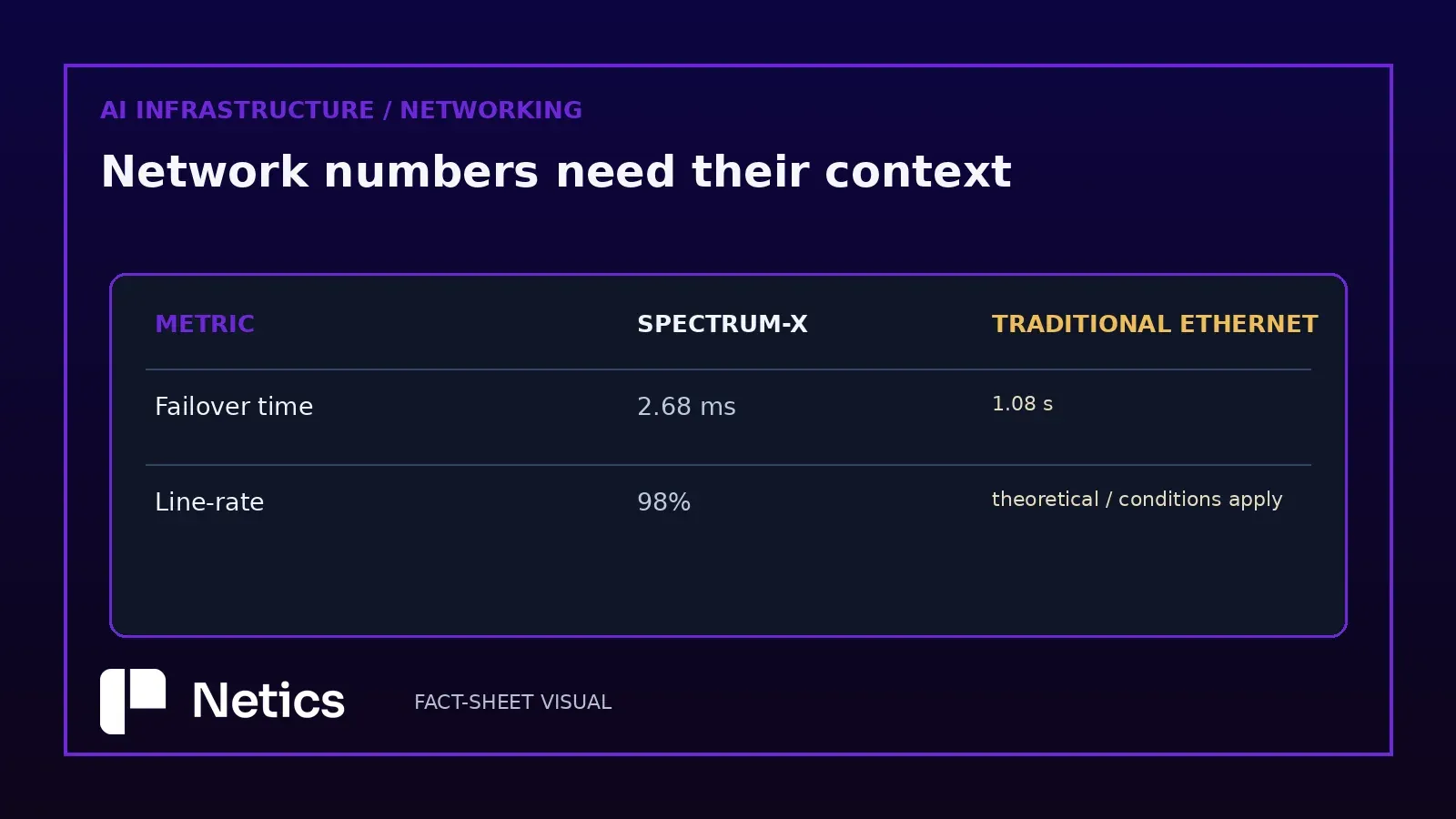
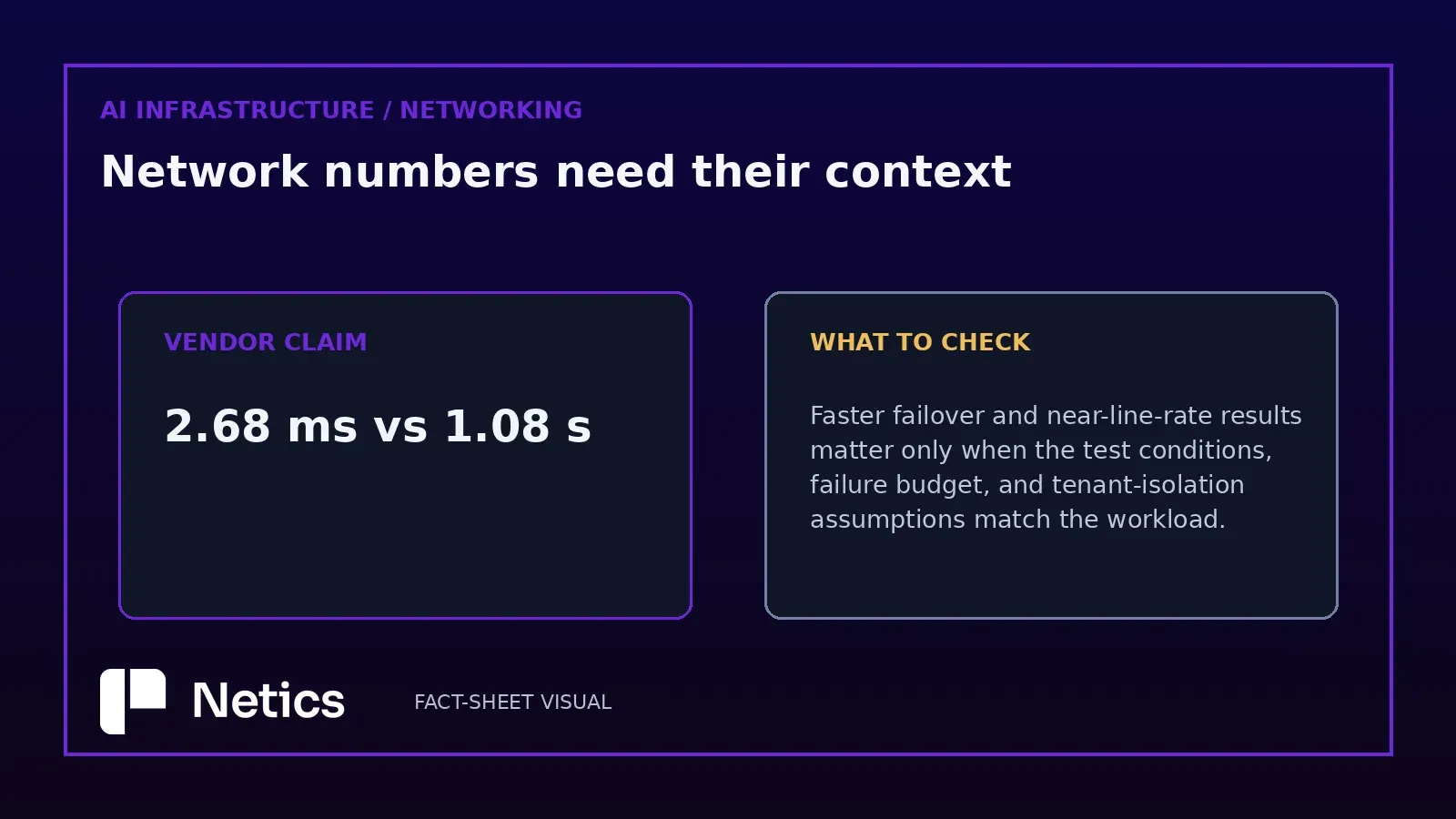
NVIDIA states 2.68ms failover against 1.08s for traditional Ethernet, and 98% theoretical line-rate distribution, in its own evaluation. Both figures are precise and attributable, which is more than can be said for a lot of vendor networking material, and NVIDIA deserves credit for naming a specific scenario rather than an unqualified "faster." But precision is not the same as generality. A 400x failover-time improvement is dramatic; it is also a single stated scenario, under NVIDIA's own test conditions, on NVIDIA's own hardware stack end to end. The 98% figure is explicitly theoretical line-rate distribution — a ceiling under favorable conditions, not a guaranteed sustained figure under a buyer's actual mixed workload, topology, and failure patterns.
None of that makes the numbers false. It makes them a starting hypothesis rather than a purchasing conclusion. The traditional-Ethernet comparison point matters too: "traditional Ethernet" covers a wide range of real-world configurations, congestion-control tunings, and topology choices, and a buyer's existing traditional-Ethernet deployment may already sit closer to or further from NVIDIA's comparison baseline than the stated scenario implies. The gap between a vendor's best-case comparison and a buyer's actual baseline is exactly where procurement decisions go wrong.
What a real procurement test plan looks like
Turning Spectrum-X's claims into a defensible purchasing decision means testing against your own workload, not the vendor's demo. That means: replaying representative collective-communication patterns from your actual training jobs, not a synthetic benchmark; measuring failover behavior under a failure injection plan that matches your operational reality, not a single staged scenario; and establishing what "acceptable straggler behavior" means for your specific job mix before comparing platforms, since the cost of a straggler differs enormously between a short fine-tuning run and a multi-week foundation-model training job.
It also means pricing the switch honestly against the alternative. NVIDIA's argument for moving networking into the AI-factory operating-model conversation is directionally right — for genuinely giga-scale synchronous training, network topology decisions do belong at the architecture table, not the procurement afterthought table. But that argument applies with different force depending on cluster scale. A team running modest fine-tuning jobs on a few dozen GPUs is unlikely to hit the straggler-dominated regime Spectrum-X is built for, and should not import a giga-scale procurement conversation into a workload that does not need it.
Where this connects to the wider agentic infrastructure question
Networking choices at this scale rarely stay isolated from the rest of the stack. A cluster built around a specific vendor's adaptive routing, congestion control, and NIC-based load balancing accumulates dependencies the same way a data or agent architecture does — and the same discipline applies. Netics has made the same point about consolidating data infrastructure for agent systems: the decision that matters is not whether the vendor's mechanism works in its own demo, but whether every write, retrieval, and failure path in the resulting architecture stays auditable and recoverable under your own operating conditions. The same test applies to a network fabric decision: can you audit it, can you fail out of it, and do you know the cost of doing so before you sign.
That question extends past the network layer into whoever controls the security boundary running on top of it. As AI-factory infrastructure absorbs more vendor-specific mechanisms — adaptive routing today, control-plane offload elsewhere — the operational question shifts from "does the mechanism work" to "who enforces the boundary when it doesn't," a question Netics has examined directly in where enforcement authority actually needs to sit in an AI agent stack.
Netics' conclusion
Spectrum-X's mechanism is coherent and its failure mode — ECMP-driven straggler behavior degrading synchronous training — is real and well understood in the networking literature, not an invented problem. The numbers NVIDIA cites are precise enough to be testable, which is the right standard to hold a vendor to. The mistake would be treating a precise number as a validated one. Test the mechanism against your own workload and your own failure budget before it enters a purchase order. Vendor benchmarks are a hypothesis. Your test plan is the evidence
For an architecture review, visit Netics..