
Salesforce on Google Cloud: The Agent Stack Gets a Shared Foundation
Salesforce and Google Cloud are unifying infrastructure and agents: Hyperforce on Google Cloud, Gemini Enterprise with Salesforce data via MCP, and Zero Copy data sharing. Netics on what is

TL;DR
- At Dreamforce on September 15, 2026, Salesforce and Google Cloud announced an expanded partnership: Salesforce on Google Cloud via Hyperforce, Gemini Enterprise reading Salesforce data, and Zero Copy data sharing between Data 360 and BigQuery.
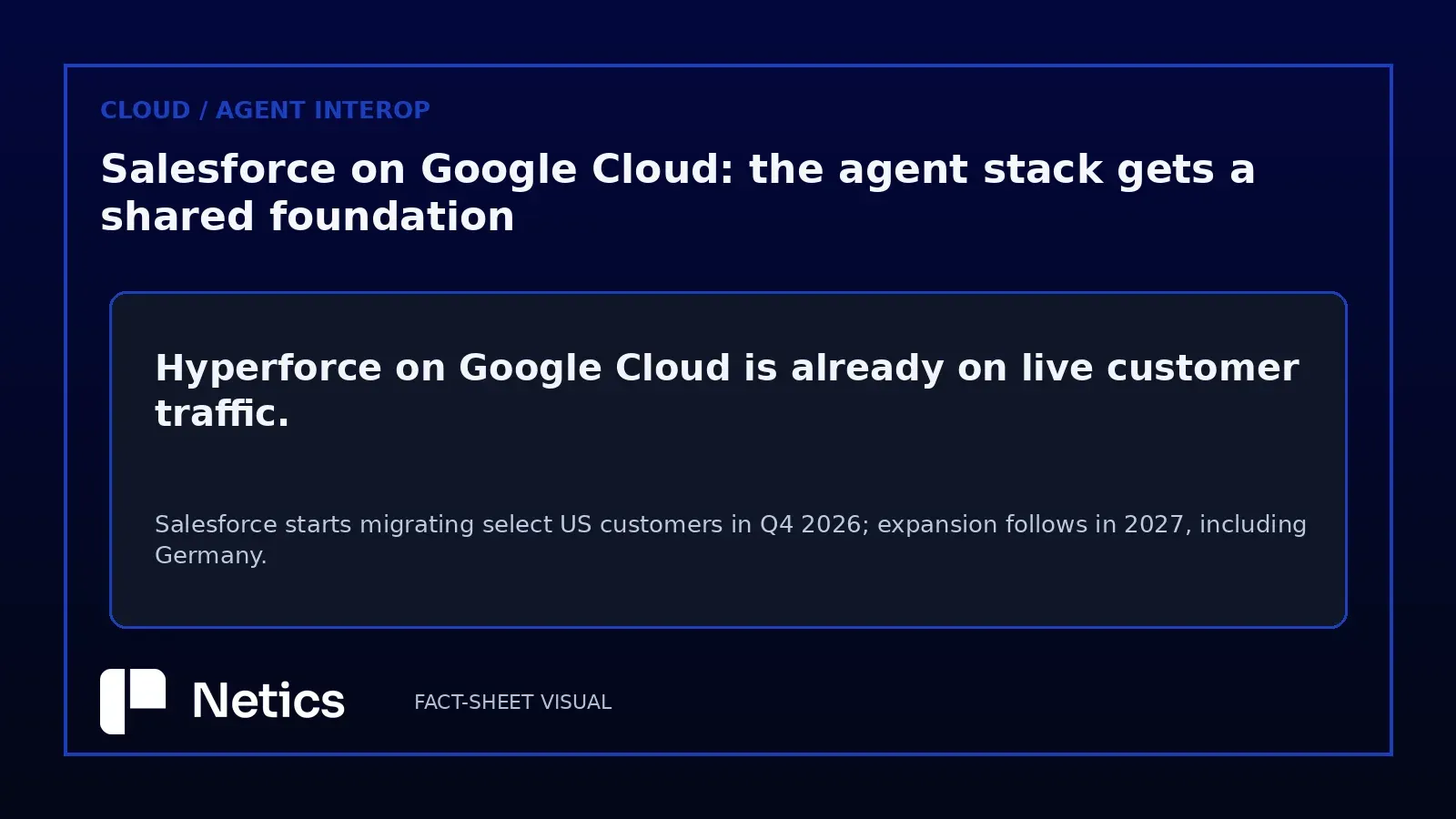
- Hyperforce on Google Cloud is already on live production customer traffic; select US customer migrations start in Q4 2026, with North America GA in November 2026.
- Salesforce's headless architecture, built on MCP, makes thousands of Salesforce capabilities available directly in Gemini Enterprise — pipeline health, account summaries, case triage — without custom integration.
- Google's Gemini models now run natively inside Agentforce, powering Prompt Builder and the Reasoning Engine.
- Netics' take: the announcement is less about models than about data plumbing — MCP interoperability and Zero Copy sharing are what let agents from two vendors act on the same facts. The governance question neither press release answers: two compliance postures now meet at the integration boundary.
What was actually announced
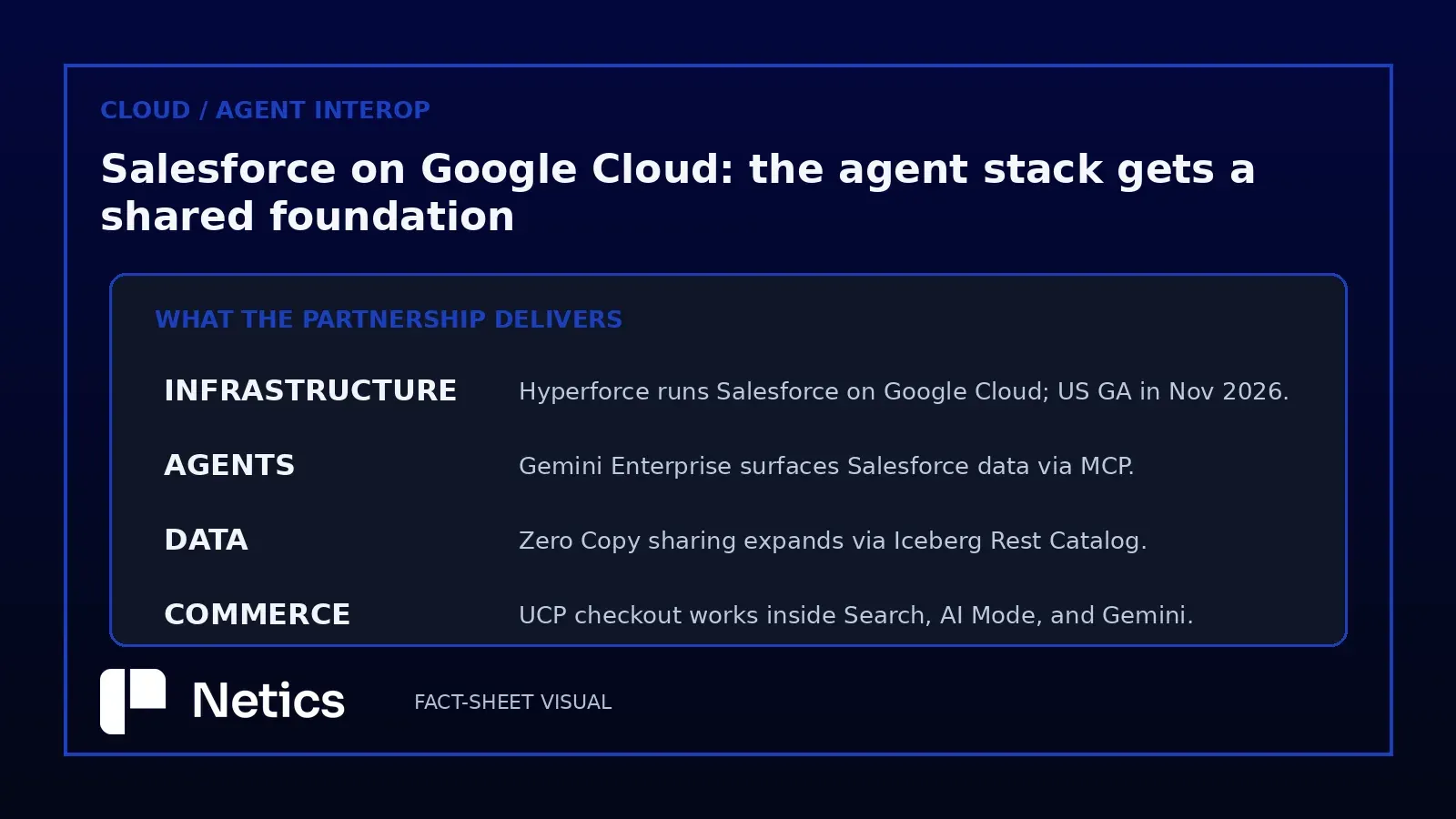
The partnership announcement at Dreamforce 2026 has four real pillars, and it is worth keeping them separate because they run on very different clocks. First, infrastructure: Salesforce workloads run on Google Cloud through Hyperforce, and this is the most concrete claim in the release — already handling live production customer traffic, with select US customer migrations starting in Q4 2026 and North America GA in November 2026, followed by phased expansion in 2027 including Germany. Second, agents: Salesforce's headless architecture, built on the Model Context Protocol standard, makes thousands of Salesforce capabilities available to any model, agent, or interface, and Google Cloud is one of the first hyperscalers to implement it. Third, models: Google's Gemini models run natively within Agentforce, powering Prompt Builder and the Reasoning Engine. Fourth, data: Salesforce Data 360 and BigQuery already support Zero Copy sharing, and the two companies are expanding it with Iceberg Rest Catalog open standards and Private Connect.
The sequencing inside the announcement is telling. The infrastructure migration has a date (November GA). The agent interoperability is available now in private preview with GA planned for late October (Salesforce Federated Connector for Gemini). The data expansion is already GA (the existing Zero Copy capability) and grows in the fall. Commerce is the outlier: UCP-powered checkout in Google Search, AI Mode, and the Gemini app starts this fall, with the UCP integration GA in October. These are four different product roadmaps bundled into one press release, which is exactly why enterprises should evaluate the pillars separately rather than as a single "partnership."
Why the data layer is the real news
The MCP and Zero Copy details matter more than the headline because they define what "agents reasoning on the same data" actually means operationally. Salesforce's headless architecture exposes its capabilities through MCP, and Google Cloud implements it, which means a Gemini Enterprise user can pull pipeline health, account summaries, and case triage from Salesforce without a custom connector. Tableau analytics joins the same loop through Tableau MCP, with governance, row-level security, and semantic models enforced at every agent query — not bolted on after the fact.
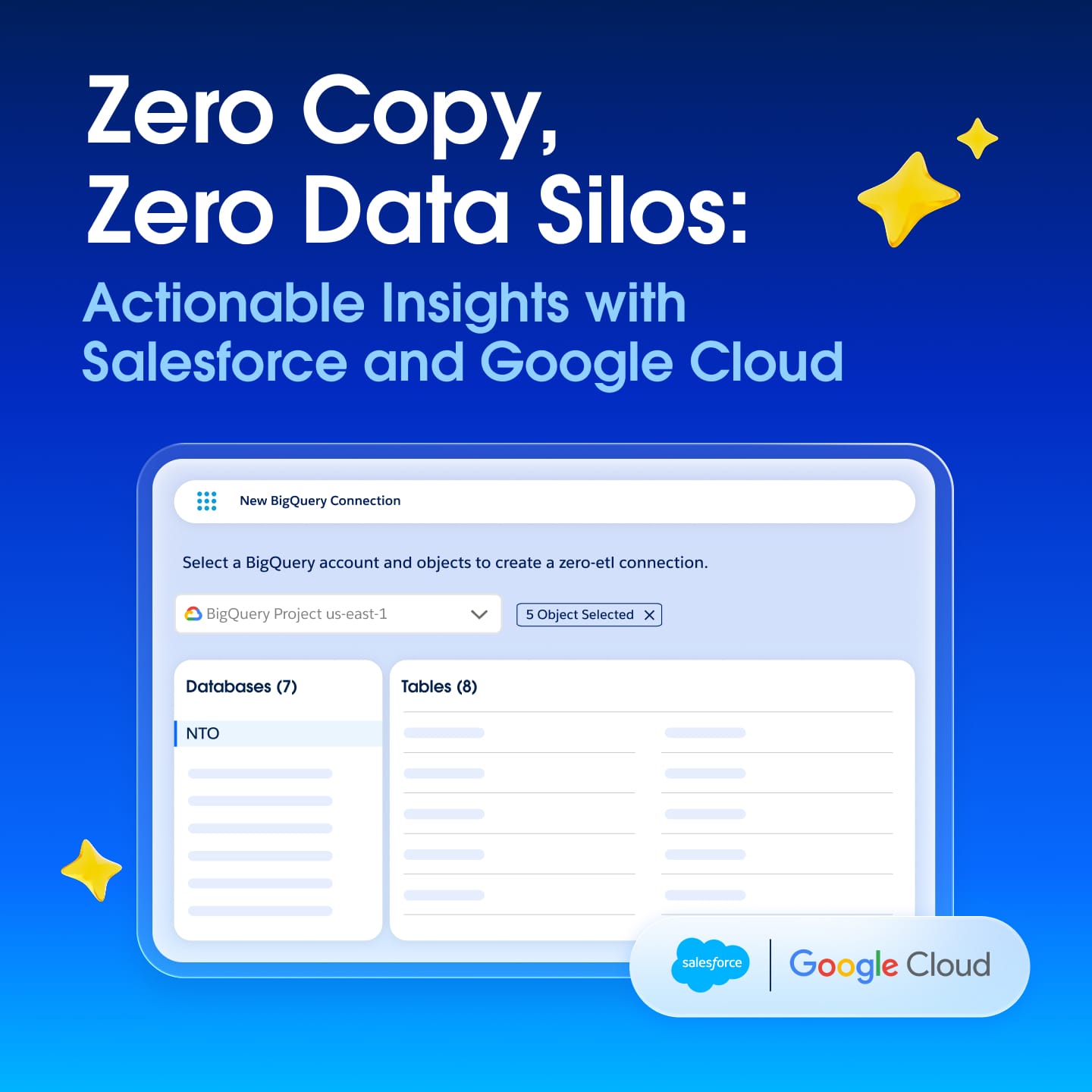
The Zero Copy expansion between Data 360 and BigQuery is the quieter but more structural piece: data sharing across the two platforms without copying, on Iceberg Rest Catalog open standards, with Private Connect for the network path. This is the layer that makes the agent story credible. An agent can reason across business context only if the data layer gives both vendors' tools a consistent view of the same facts. Copying data between platforms is how fragmented AI stacks are born; Zero Copy is the mechanism that keeps the two sides looking at one source of truth. For European enterprises, the expansion direction matters too: more regions and Iceberg open standards mean the same interoperability claim will eventually apply to EU data residency, not just the US launch footprint.
The governance question neither press release answers
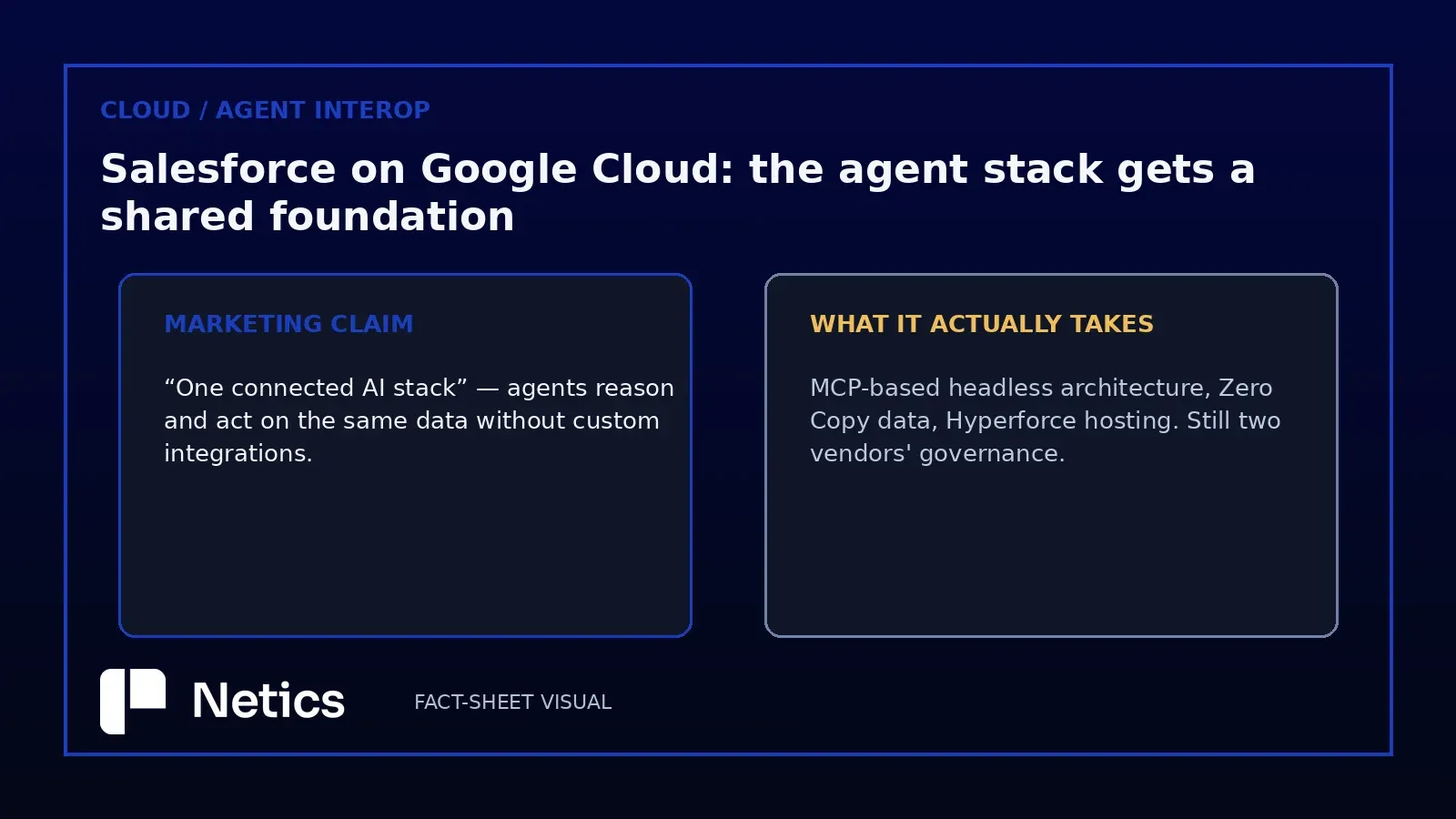
Both companies frame the partnership as a trust story. Salesforce's Meir Amiel puts it precisely: "What changes here is the infrastructure underneath our customers, not the trust they've built with us." Google Cloud's Kevin Ichhpurani adds that bringing Salesforce into Gemini Enterprise lets customers "build trusted agents that reason across their business context and securely take action." Both statements are true at the layer they describe. What neither press release addresses is the operational middle: two compliance frameworks meeting, two support chains, two billing surfaces, and two incident-management loops.
This is the part that will cost enterprises more than the integration work. MCP reduces the cost of connecting the systems; it does not reduce the cost of governing them. A joint customer running Salesforce on Hyperforce on Google Cloud still answers to Salesforce's trust and compliance posture for the application layer and Google Cloud's controls for the infrastructure layer. Both vendors' promises are individually credible — which is precisely why the integration point, where the two postures meet, needs its own explicit controls: who owns the data-processing agreement at the boundary, who answers incidents that span both platforms, and how the agent's access to Salesforce data through MCP is audited against the same standard as direct API access.
What the partnership actually changes for an enterprise
For a buyer, the change is real but narrower than the headline. If your organization already runs Salesforce and is evaluating Gemini Enterprise, the headless MCP bridge removes the custom-integration barrier for the first set of use cases — pipeline health, account summaries, case triage. If you are on Google Cloud and considering Hyperforce, you get a second deployment option for Salesforce with a concrete GA date. And if you are trying to make agents act across both platforms, the Zero Copy data layer is the foundation that makes it coherent.
The parts that need skepticism are the parts without dates. "Agents from either platform reason and act upon the same data" is the vision; the announced pieces are the first-mile connectors. Gemini models in Agentforce are GA now; the Federated Connector is private preview until late October; checkouts inside Google surfaces depend on a fall GA and merchant adoption. A partnership announcement with four roadmaps is not a finished architecture. The disciplined read is to start with the one piece that is already live — the data interoperability — and treat the agent and commerce promises as what they are: coming attractions with dates.
For teams designing agent systems across vendor boundaries, the same control-plane discipline we apply to agent access boundaries outside the model applies here: interoperability does not transfer governance, it multiplies the surfaces you must govern. Start with the data-sharing layer, define the boundary controls before connecting the agents, and time the adoption to the components that are actually GA. The Netics homepage is where we start these architecture reviews.
Sources
- Salesforce and Google Cloud Unify Infrastructure and Agents — Salesforce Newsroom, September 15, 2026.
- Salesforce and Google Cloud Unify Infrastructure and Agents for One Connected AI Stack — Google Cloud Press Corner, September 15, 2026.
- Salesforce and Google partnership page — Salesforce, accessed September 2026.
Source: Salesforce and Google Cloud Unify Infrastructure and Agents — salesforce.com, September 15, 2026.