
Ox Alpha Shows Why Anonymous AI Model Provenance Is a Governance Risk
Ox Alpha’s anonymous release on OpenRouter shows why organizations need provenance controls before placing unfamiliar AI models into coding, agentic, or production workflows.

TL;DR
Ox Alpha was released free on OpenRouter as a reasoning model for coding, sustained agentic work, and production workloads. During its preview, the provider remained anonymous. TechCrunch reported public speculation pointing variously toward Z.ai/GLM or Microsoft MAI, while offering no verified attribution. That uncertainty creates a governance and procurement problem: an organization cannot responsibly assess accountability, data handling, contractual recourse, security controls, or continuity risk through model behavior alone.
The practical response is disciplined evaluation. Teams should record the exact model identifier, route access through controlled accounts, test data-handling boundaries, define prohibited workloads, require operational evidence, and keep deployment decisions reversible until provenance and controls are sufficiently documented. The summary also covers: Provenance determines who can answer for the system; Capability claims do not establish production readiness; The control surface matters more than the model name.
The release created an attribution gap
The TechCrunch report describes Ox Alpha as a free model available through OpenRouter. Its listing presented it as suitable for reasoning, coding, sustained agentic work, and production workload. Those claims can attract immediate experimentation, especially when access has little or no upfront cost.
The provider, however, remained anonymous during the preview described by the source. Public discussion reportedly speculated about connections to Z.ai/GLM or Microsoft MAI, but the article did not verify either attribution. That distinction matters. A plausible online theory cannot substitute for a named accountable entity, documented terms, or evidence about how the service operates.
An unknown label may still conceal a capable system. It also leaves important questions unanswered at the moment when a buyer may be tempted to move from testing toward dependence.
Provenance determines who can answer for the system
Model provenance is a governance input because responsibility has to attach somewhere. If a model produces a harmful action, exposes sensitive material, changes materially between versions, or becomes unavailable, an organization needs a counterpart that can explain the event and support remediation.
A known provider does not eliminate those risks. It gives procurement and security teams a basis for evaluating them. They can examine terms of service, retention statements, incident procedures, service commitments, ownership structure, support channels, and the identity of the party receiving data. With anonymous provenance, each of those checks becomes incomplete or impossible.
This affects internal accountability as well. A team that approves a model for production should be able to state why the model was accepted, which entity was assessed, and which controls were relied upon. “The outputs looked strong” is evidence of capability testing, but it does not establish responsibility, recourse, or acceptable handling of information.
Capability claims do not establish production readiness
Ox Alpha’s listing reportedly targeted production workloads, but a listing is a claim about intended use. It does not by itself establish uptime, version stability, monitoring, access governance, data boundaries, or support quality.
For coding and agentic work, the risk grows because the model may receive repository contents, credentials through tools, internal instructions, or permission to make changes. A model that performs well in a benchmark-like exchange can still be unsuitable for an environment where it can call external systems, modify files, open tickets, or trigger deployments.
Evaluation should therefore separate capability from operational readiness. Capability testing can cover reasoning quality, coding accuracy, context handling, and failure recovery. Operational testing should examine authentication, logging, rate limits, model-version signals, tool permissions, error behavior, and the provider’s ability to explain changes. Procurement should treat missing evidence as an unresolved condition rather than silently filling the gap with assumptions.
Anonymous access changes the procurement decision
A free preview can lower the cost of discovery while increasing the chance of uncontrolled adoption. Engineers may begin with harmless prompts, then connect the model to realistic code or business workflows because the initial results appear useful. By that point, the organization may have created data exposure, dependency, or approval problems before a formal review begins.
A sensible decision record should answer several concrete questions:
- What exact model and endpoint were used?
- Who controls the account and routing configuration?
- What information may leave the organization?
- Are prompts, outputs, tool calls, or uploaded files retained?
- Which version changes can occur without notice?
- What happens if the service disappears or access is revoked?
- Can all activity be logged and attributed to a human or service account?
- Which tasks require human review before execution?
If the answer to a critical question is unavailable, the model can remain in a constrained sandbox, but it should not quietly become a default production dependency.
The control surface matters more than the model name
Organizations can reduce exposure even when provenance remains unresolved. Access should pass through a gateway that applies identity, rate, workload, and data policies. Sensitive repositories should be excluded until retention and routing conditions are documented. Agent tools should use least-privilege credentials, short-lived tokens, explicit allowlists, and approval gates for external side effects.
Logging should capture the model identifier, request time, user or service identity, tool calls, policy decisions, and response status. That record supports incident investigation and makes model substitution easier to detect. Teams should also maintain an exit path: export prompts and evaluation cases, preserve internal wrappers, avoid provider-specific assumptions, and test an approved alternative before dependence forms.
These controls do not turn an anonymous provider into a trusted one. They limit the blast radius while evidence is gathered.
Hypothetical control example
Hypothetical control example: A software team wants to test Ox Alpha on an internal coding task. The security gateway permits only synthetic repositories and redacted examples. The model receives no production credentials and can return patches, but cannot write to a branch, open a pull request, access the network, or invoke deployment tools. Every request records the exact model label and route. After evaluation, the team must document capability results, data-handling evidence, version behavior, and an accountable provider before expanding the test.
The control creates a clear promotion rule. Strong outputs may justify more evaluation; they do not automatically justify broader permissions.
A governance risk that outlasts one preview
The central issue raised by Ox Alpha is broader than whether the model performs well. Anonymous provenance weakens the chain connecting model use to procurement, security review, incident response, and business continuity. Public speculation can be useful for generating questions, but it cannot close that chain.
For organizations assessing unfamiliar AI systems, provenance should sit alongside capability, access controls, data handling, and operational evidence in the decision record. When the provider cannot be verified, the default posture should be bounded experimentation with reversible architecture and explicit approval thresholds.
The durable lesson is simple: model selection includes selecting an accountability relationship. Until that relationship can be examined, the safest deployment is the one that keeps permissions narrow, data limited, evidence visible, and dependency easy to unwind.
Source
Source: TechCrunch, 2026-08-23, “Who’s behind the new stealth model Ox Alpha?” https://techcrunch.com/2026/08/23/whos-behind-the-new-stealth-model-ox-alpha/
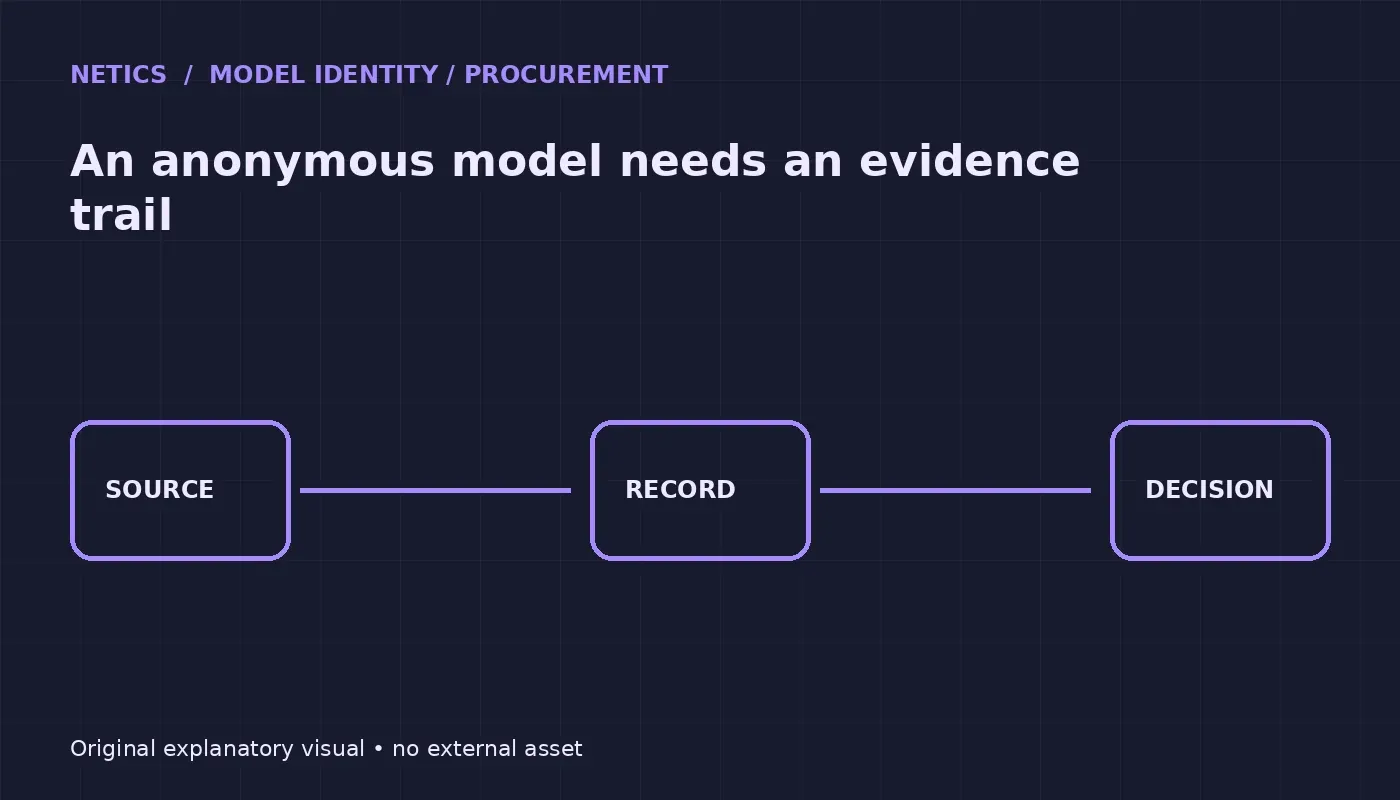
For a controlled AI governance review, AI model provenance controls treats provenance as a procurement control.
Source: TechCrunch — 2026-08-23