
OpenAI Ads Manager Moves Campaign Operations Into an Operating Layer
OpenAI is testing Sponsored Agents and adding natural-language campaign tools, but the useful shift is operational: review, labeling, privacy, and approval still define the boundary.

TL;DR
- OpenAI is testing Sponsored Agents: after an ad click, a user may choose a clearly labeled conversation with a business-sponsored agent. That conversation is distinct from ChatGPT’s independent answers and separate from the user’s original conversation.
- Ads Manager is adding natural-language campaign creation, updates, and analysis, plus suggested copy and imagery, optional text customization and translation, and HubSpot and Shopify integrations.
- Netics’ view is that this makes campaign work look more like an operating layer around marketing systems. It does not remove review, labeling, privacy, rollout, or human-approval controls.
OpenAI is changing both sides of the ad interaction
OpenAI’s announcement on AI-powered advertising introduces several connected changes rather than one new ad format. On the user side, the company is testing Sponsored Agents. On the advertiser side, it is adding natural-language controls and AI creative assistance to Ads Manager. It is also connecting ChatGPT Ads to HubSpot and Shopify.
The distinction between these pieces matters. An ad is still the discovery surface. A Sponsored Agent is an optional next interaction after the click, not a hidden replacement for the general assistant. OpenAI says the conversation is clearly labeled as business-sponsored, distinct from ChatGPT’s independent answers, and separate from the original conversation that the user started in ChatGPT.
The separation is more than interface copy. It gives the user a chance to understand which interaction is being shaped by a commercial relationship. A person might ask whether a dining table fits a room, how many people it seats, or how its finish should be cared for. The sponsored conversation can help explore those questions and then offer a link to the business website. The commercial context remains visible.

Sponsored Agents need a trust boundary, not just a label
The labeling is a good start, but it is not the whole control system. A sponsored agent can answer follow-up questions in a way that feels conversational, personalized, and authoritative. That makes the boundary between helpful product guidance and persuasive sales language important.
The practical questions are straightforward. What information does the agent receive from the campaign or product catalog? What can it claim about availability, fit, delivery, pricing, or returns? When does it hand the person to the business website? What is logged, and how long is it retained? Which answers require a human-approved source or a current catalog record?
OpenAI’s announcement establishes the product separation, not a full privacy or claims-governance specification. Netics would therefore treat the label as a minimum condition. The operating layer also needs a defined knowledge boundary, a route for correcting wrong answers, and an owner for approving the business facts that the agent can use.
Consider a hypothetical Casablanca retailer preparing a seasonal campaign. The retailer may want an agent to explain product dimensions and delivery zones. It should not silently improvise stock levels or promise a return outcome because those details appeared in an old brief. The example is illustrative, not a reported Netics customer case. The control is the same whether the business is large or small: bind commercial answers to an owned source and give a person authority to correct or stop the experience.
Natural language turns Ads Manager into a control surface
OpenAI says advertisers can use simple prompts in ChatGPT with the Ads Manager plugin to create, update, and analyze campaigns. A website or brief can become the starting point for a campaign. The system can help explain performance and recommend what to do next.
This is the part most likely to change day-to-day work. Campaign operations have traditionally been distributed across briefs, ad interfaces, analytics dashboards, CRM records, product catalogs, and spreadsheets. A natural-language layer can provide one conversational entry point across those jobs. The gain is not merely faster copywriting. It is the possibility of asking, in one place, what changed, which campaign needs attention, and what action follows.
But conversational control also makes intent easy to overstate. “Increase the budget on the best-performing campaign” sounds precise until the organization has to define best-performing, the attribution window, the spend ceiling, the time period, and the approval required. Natural language is a useful interface; it is not a complete policy.
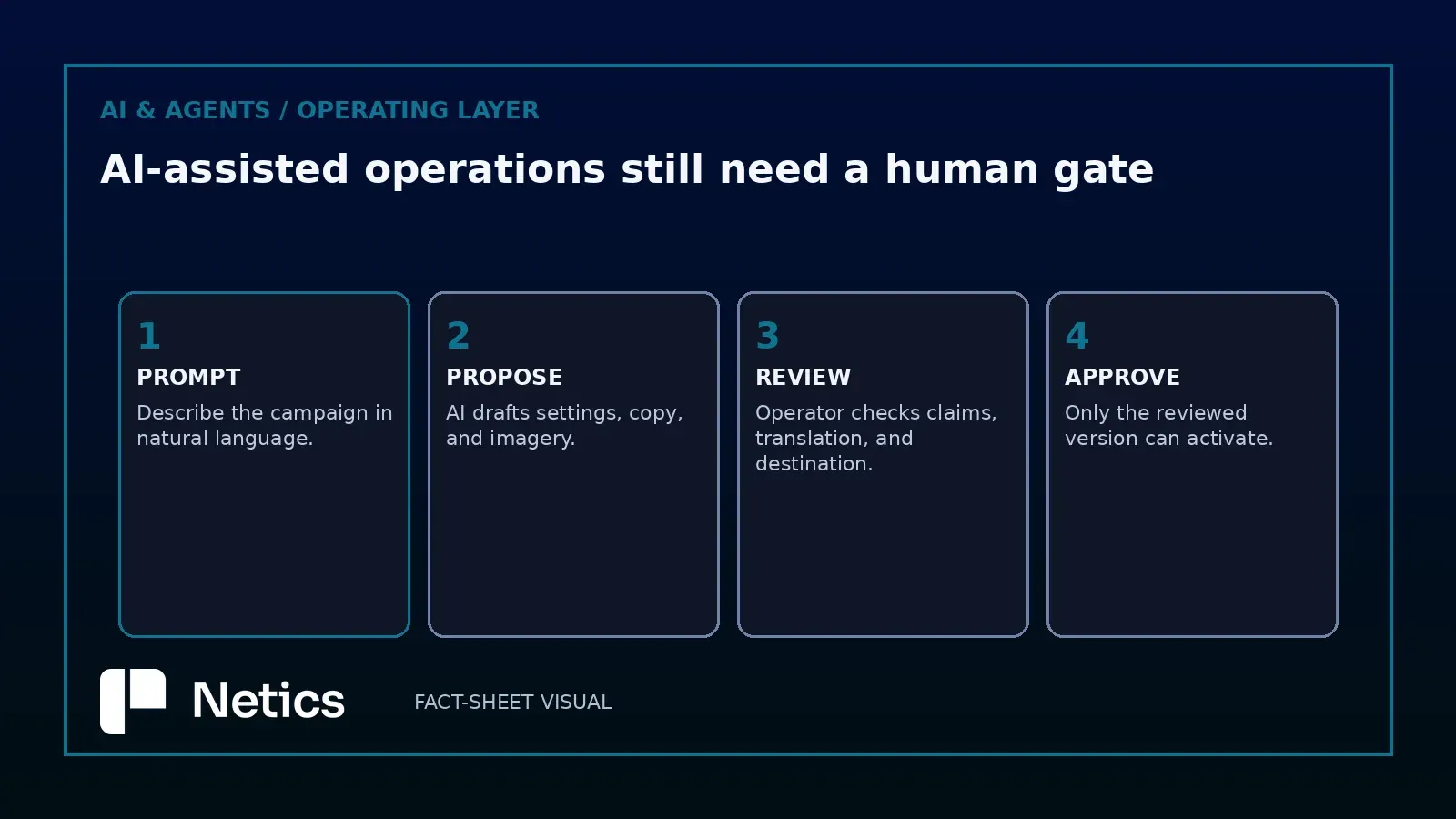
A mature implementation should translate each request into a reviewable action: the campaign selected, the fields changed, the evidence used, the estimated impact, and the person who approved the change. That is how an operating layer stays auditable instead of becoming an opaque shortcut.
Creative assistance increases throughput and review debt together
Ads Manager is also adding suggested copy and imagery based on a landing page and campaign objective. Advertisers remain in control, OpenAI says: they can review and edit the suggestions before deciding whether to add them to a campaign.
The sentence contains the correct governance shape. Suggestions are not approvals. The useful test is whether the review step is real enough to catch a misleading promise, a mismatched image, a missing disclosure, or a creative asset that does not reflect the landing page.
OpenAI is also launching optional AI-powered text customization. When enabled, it can adapt existing headlines and descriptions to fit the context of a conversation and automatically translate ad copy into a user’s preferred language. Optional matters here. A translation or contextual rewrite can improve relevance, but it can also change emphasis, legal meaning, or the level of certainty in a claim. The original approved copy should remain recoverable, and localized variants should have their own review path.
HubSpot and Shopify make the operating layer consequential
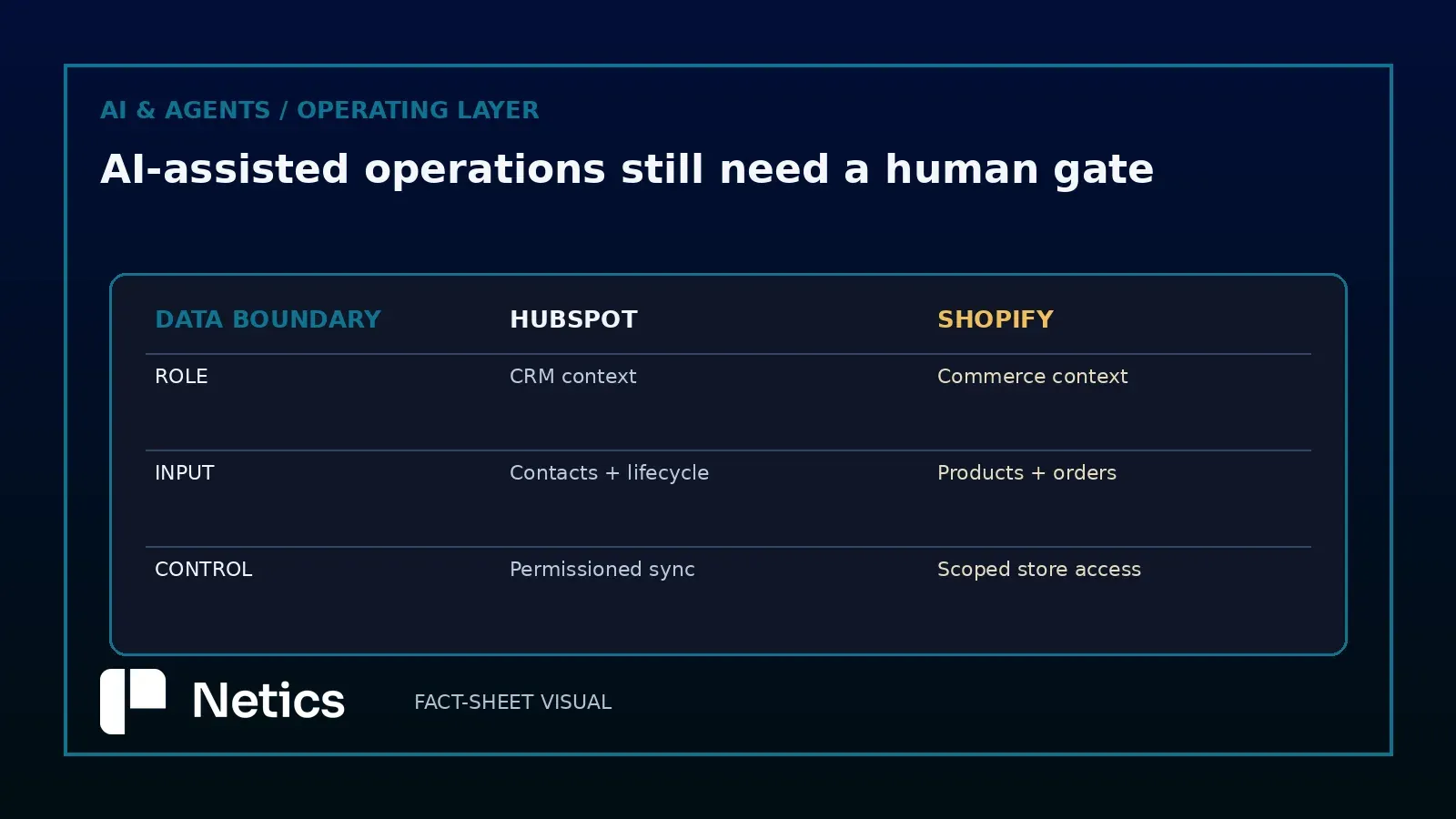
The integrations with HubSpot and Shopify show why this is not just a new creative editor. OpenAI identifies HubSpot as its first CRM partner. Businesses managing customers there can connect a ChatGPT Ads account, create ads, track performance, and follow up on leads using HubSpot context.
Shopify is the first ecommerce partner. US-based Shopify merchants can use the ChatGPT Ads app, with products integrated through Shopify Catalog. OpenAI says the app is available internationally from September 23 in markets where ChatGPT Ads are available.
Those caveats are material. The announcement does not describe universal availability, and the international date is conditional on ChatGPT Ads availability in the relevant market. Sponsored Agents are being tested with select advertisers in the United States. A business should not plan a global campaign rollout from this announcement alone.
The integrations also create more data paths to map. Customer context, product information, campaign settings, performance data, lead follow-up, and AI-generated creative may now move between systems. Privacy review should follow those flows rather than stopping at the presence of a familiar integration logo. Access scopes, retention, regional availability, catalog freshness, and human ownership still need explicit answers.
The Netics decision: treat assistance as an operating layer
The announcement points toward a credible shift in campaign operations. AI can sit around the campaign lifecycle: turn a brief into a draft, update settings from a request, interpret performance, propose copy and imagery, translate variants, and connect the work to CRM and commerce systems.
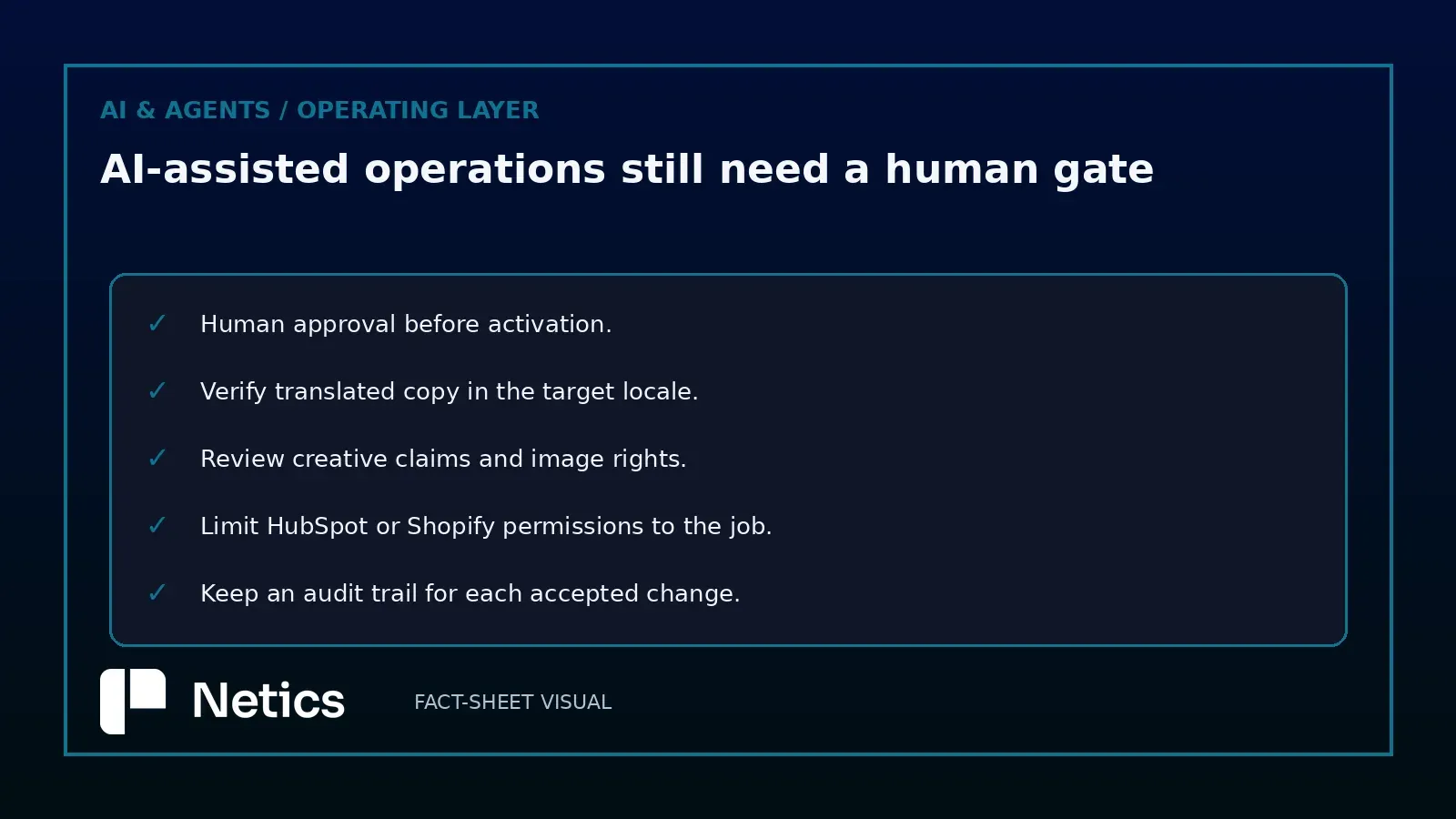
This is an operating layer because it coordinates actions across systems. It is not an autonomous marketing department. The controls should be designed before the shortcut becomes normal: clear Sponsored Agent labeling; separation from general answers and the original conversation; approved data sources; privacy and retention review; reversible changes; creative and translation review; spend limits; and named human approval.
For now, the staged rollout is the message to keep. Sponsored Agents are in testing with select US advertisers. Shopify’s international availability is conditional. The integrations are early partner launches, not proof that every market or workflow is covered. Businesses should pilot one bounded campaign, log the proposed and approved changes, inspect the lead and catalog data path, and define a stop condition before widening access.
For the wider Netics perspective, visit the Netics homepage. The Netics production-readiness analysis makes the adjacent point: a working model is not the same thing as an operated service. The same discipline applies here. A fluent campaign assistant is not production-ready merely because it can create an ad.
Sources
- OpenAI — Reimagining advertising with AI, published September 16, 2026; primary source for Sponsored Agents, Ads Manager capabilities, AI creative assistance, text customization, rollout caveats, HubSpot, and Shopify.