
Local AI Needs a Router Before It Needs a Bigger Cluster

TL;DR
NVIDIA’s Personal AI Router, or PAIR, makes a useful infrastructure argument: a local AI setup with several capable computers needs coordination before it needs another expensive box. PAIR routes independent inference requests across paired local nodes while leaving the agent’s familiar Ollama or LM Studio interface intact. Its mDNS discovery, approved secure pairing, mTLS and generated certificates create a trust boundary; its scheduler checks model presence, engine state, readiness and current load before selecting one node, so scheduling is part of the product’s value. NVIDIA’s Hermes demonstration reports 8 minutes 48 seconds for a five-subagent workload on three devices versus 18 minutes on one RTX Spark laptop, but the result is unofficial and configuration-specific. Our position is supportive but narrower: routing is a strong capacity and queueing mechanism, not complete data governance. Businesses still need an inventory, access policy, retention rules and an honest answer about which prompts may leave which boundary.
The real problem is queueing, not a shortage of GPUs
The local AI conversation often jumps straight to hardware. A team sees an agent waiting, concludes that the model is too slow, and starts comparing larger GPUs. NVIDIA’s PAIR source describes a more precise failure mode: one lead agent can divide a task among specialists, and those specialists can generate many independent model calls. When all calls target one local engine, they compete for the same execution slots. The queue grows even when another compatible computer is idle on the same network.
The distinction matters. A single request that needs more memory still needs a stronger eligible node. PAIR does not combine GPUs, pool VRAM, shard a model or split one inference request across machines. Its opportunity is workload-level concurrency. Several independent calls can occupy several ready systems, while each individual call stays on one node for its lifetime.
For a small business, this is a more credible starting point than the phrase “home cluster” suggests. The goal is not to pretend a living room is a data centre. The goal is to stop treating every local computer as an isolated island.
PAIR keeps the application interface familiar
PAIR is a virtual inference router, not a new inference engine. Ollama or LM Studio still runs the model on the selected machine. A compatible application sends an Ollama-compatible or LM Studio-compatible request through PAIR’s local proxy; PAIR identifies the engine and model requirements, chooses an eligible node, and streams the response back to the originating application.
The “no new API” approach is strategically important. Agent harnesses do not need to discover every workstation or learn a new cluster protocol. A configurable base URL can continue to point at the local endpoint that the application already understands. PAIR takes over the default Ollama or LM Studio service port, with a configurable proxy port when the harness uses another port.
The benefit is not only developer convenience. Stable interfaces reduce the number of moving parts in a migration. An organisation can test routing with an existing local workflow, observe jobs, and decide whether the operational trade-off is acceptable before redesigning the application layer.
A home network is dynamic infrastructure
The source is strongest when it treats local hardware as changeable. A gaming PC becomes busy with an interactive application. A laptop sleeps or leaves the network. An engine stops. One workstation has the requested model while another has a different model. A useful router must handle these facts rather than assume a permanently powered, identical fleet.
PAIR uses mDNS to discover nearby systems, and a user approves a secure pairing request to establish the trusted set of nodes. A client can join the available pool when it is ready and drop away when it is powered down or reclaimed. That elasticity is a better fit for household and small-office equipment than a rigid cluster design.
The point is not that every machine should run inference all the time. The point is that availability becomes a scheduling input. A business can use capacity when it exists without turning every laptop into an always-on server.
Scheduling is where the product earns its place
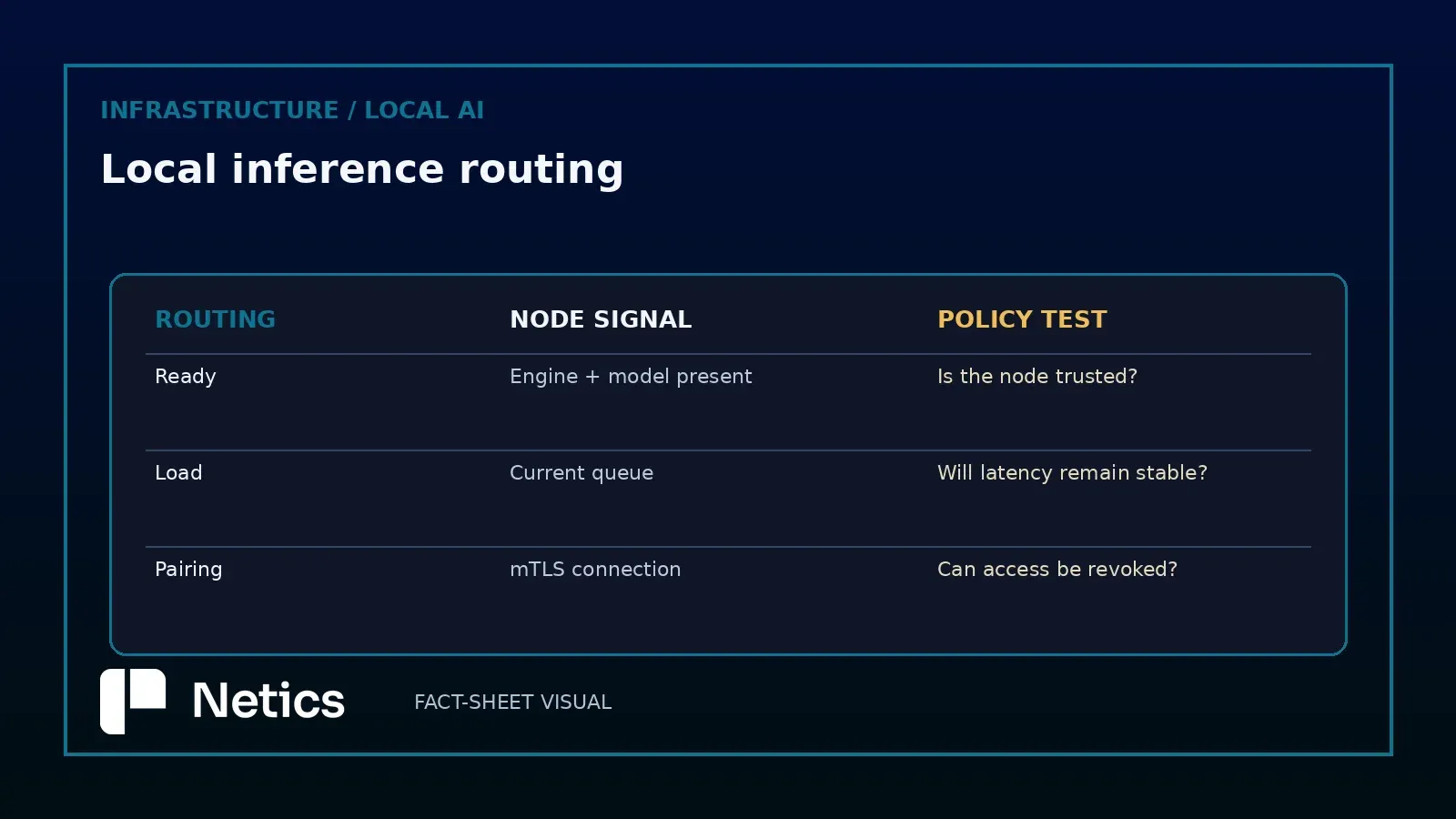
Discovery alone would produce a list, not a router. PAIR’s scheduler filters paired systems using live information: whether a node is online and ready, whether the supported inference engine is enabled, whether the exact requested model is present, the current workload including active jobs, and existing GPU utilisation.
PAIR provides the right level of abstraction for independent work. The agent decides what task to request. PAIR decides where an eligible task should run. If two workers ask for the same model and two nodes are ready, the router has a basis for distributing them. If only one node has the model, the eligible pool is smaller. If a graphics-intensive application is using a GPU, current utilisation can influence whether that node should receive more work.
The source also makes an important model-management point: models do not have to be identical on every node. Different systems can host different models, and routing can follow model location. Loading the same model tag on more nodes expands the pool for that request; it does not create one larger virtual model.
The 8:48 demonstration is useful, but narrow
NVIDIA reports a five-subagent desktop demonstration using Ollama and Qwen 3.6 35B A3B. On one RTX Spark laptop, the workload took 18 minutes on average. On a three-device PAIR cluster containing an RTX Spark laptop, a DGX Spark and an RTX 5090, it took 8 minutes 48 seconds on average.
The result is a meaningful illustration of the routing thesis: enough parallel work, enough ready nodes, and a scheduler that can place calls can reduce end-to-end completion time. It is not a universal benchmark. NVIDIA labels the result an unofficial, configuration-specific demonstration; outcomes depend on workload parallelism, model, engine settings, hardware, network and node availability.
We should also read the measurement correctly. The worker count and PAIR job count are different. One worker can generate multiple model requests. The PAIR Jobs view is the ground truth for whether work actually ran on more than one eligible node. A good evaluation therefore measures queueing, completion time, output quality and observed routing on the machines that matter, not just the number printed in a product announcement.
Security starts with approved pairing
Local is not automatically trusted. PAIR’s design acknowledges that by requiring an approved secure pairing process. mDNS helps systems find one another, but discovery is not authorisation. Node-to-node communication is blocked until the secure connection and pairing are established. Once paired, communication is protected with mTLS and generated certificates.
The security model is a sensible foundation for a private network. It gives the operator a defined trusted set instead of silently accepting every machine that answers a discovery query. It also recognises that inference traffic and prompts deserve transport protection even when they stay inside the home or office.
Our caution is about scope. Certificates and mTLS protect communication between paired nodes. They do not, by themselves, answer who may submit a prompt, which model may process a sensitive record, how long logs remain, whether a sleeping laptop is encrypted, or whether an employee can add a new node. Those are governance and operations questions around the router.
Routing is not complete data governance
The boundary we do not want the announcement’s local-first framing to blur is governance. PAIR is designed to keep prompts, data and inference traffic on the existing local network. That can reduce exposure to a remote inference service, but it does not make every local destination appropriate for every dataset.
A company still needs a node inventory and a classification of what each node is allowed to process. It needs a rule for model downloads, a way to remove a paired device, certificate rotation, audit records, and a decision about whether job telemetry contains sensitive information. It also needs to know whether the local engine or application stores prompts, outputs or error traces. Routing can enforce placement based on engine, model and load; it cannot substitute for retention, identity and policy controls that sit above it.
Netics’ position is therefore straightforward: adopt the router as a capacity primitive, then wrap it in governance. “It stays on our network” is a useful statement about transport location, not a complete privacy assessment.
Where PAIR fits in a practical architecture
PAIR is most compelling for multi-agent research, coding or organisation workflows that expose several independent calls. It can reduce queueing, free a primary workstation for interactive work, and let compatible devices contribute capacity when they are ready. It is less compelling for highly sequential tasks, one long model call, or a setup where only one node has the required model.
A sensible pilot should begin with one workload and a short inventory. Record the agent’s requests, the models they require, the nodes that have those models, the times when those nodes are available, and the privacy class of the input. Pair only approved systems. Enable Ollama or LM Studio, verify model presence, run the same workload with one node and with the pool, and inspect PAIR’s Jobs and metrics views.
Do not promise linear scaling. The network, engine settings, model loading and foreground GPU use all shape the result. The operational question is not “How many computers can we connect?” It is “Which independent work can we route safely, and what evidence will tell us the route helped?”
Netics’ position: schedule first, expand second
NVIDIA PAIR points toward a healthier local AI buying decision. Before purchasing a larger accelerator, measure whether the bottleneck is actually concurrency. If several requests are independent and trusted machines already exist, scheduling may deliver more value than another isolated endpoint.
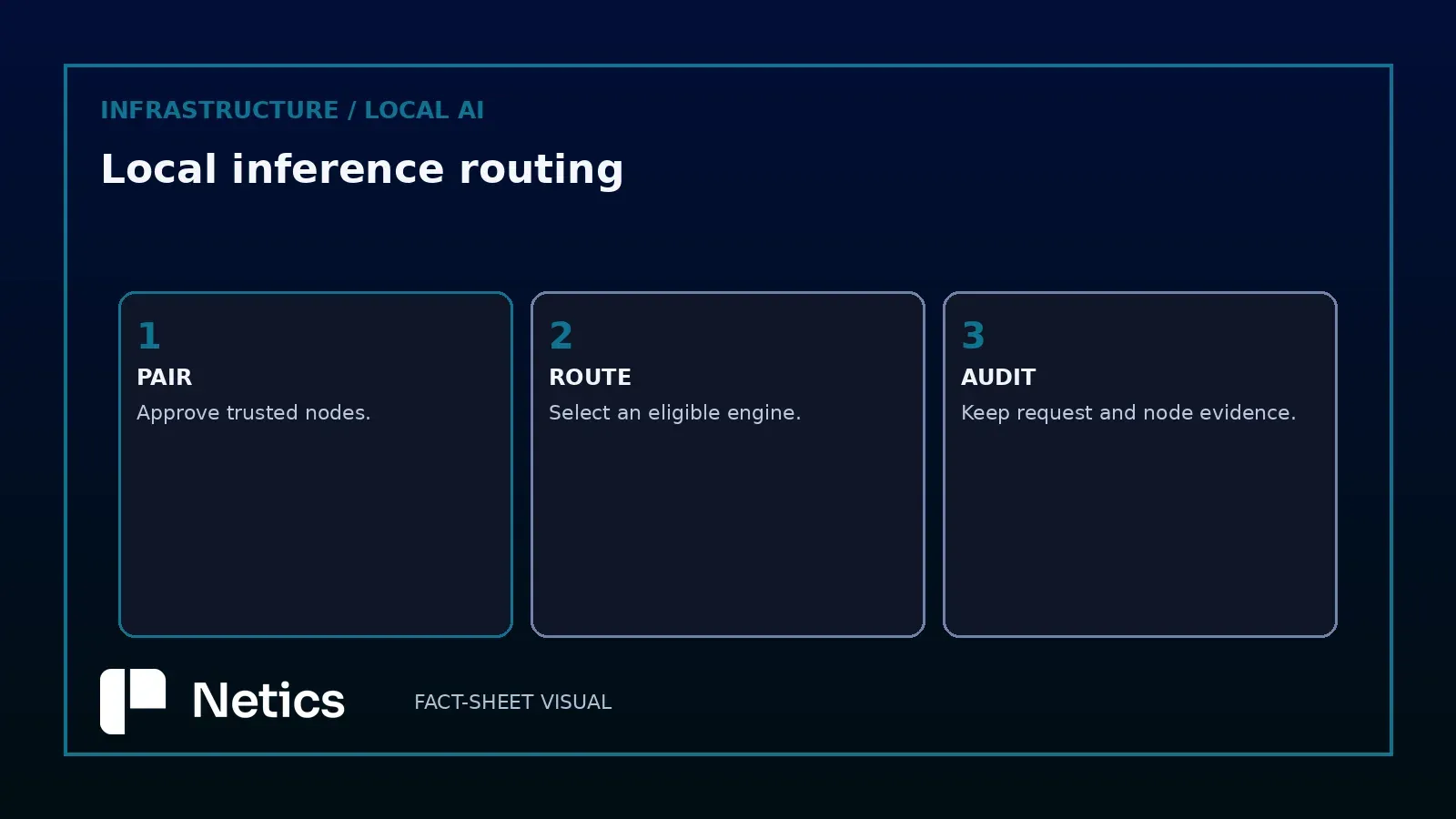
But the router should remain a component, not a sovereignty slogan. The durable architecture has three layers: a scheduler that places eligible work, a secure transport and pairing model that limits node communication, and governance that determines which data may travel where and for how long. PAIR addresses the first layer and contributes to the second. The organisation still owns the third.
That is enough to make the project worth testing. It is not enough to declare the problem solved.
A measured local pilot is the right next step
The NVIDIA PAIR beta is available for supported Windows, macOS and Linux systems, with support described for NVIDIA GeForce RTX 20 Series and newer, RTX PRO workstation GPUs, DGX Spark and Apple M4+ silicon. The project supports graphical and terminal interfaces, and its repository is open source for inspection, issues and contributions.
Start small, document the trust boundary, and treat the 8:48 result as a hypothesis to test rather than a promise to repeat. If your business is deciding how to make private AI useful without turning every workflow into a cloud dependency, Netics can help design the infrastructure and governance around that pilot. You can also book a free 30-minute audit to review the workload, node inventory and data boundary before adding hardware.
Sources
- NVIDIA: NVIDIA PAIR Virtual Inference Router Expands Available Compute on Your Local Network, 3 September 2026.
- NVIDIA Personal AI Router.
- NVIDIA Personal AI Router repository.
Source: NVIDIA PAIR Virtual Inference Router Expands Available Compute on Your Local Network — developer.nvidia.com, 3 September 2026.