
NVIDIA Opens Its Scale-Up Fabric to Korean NPUs
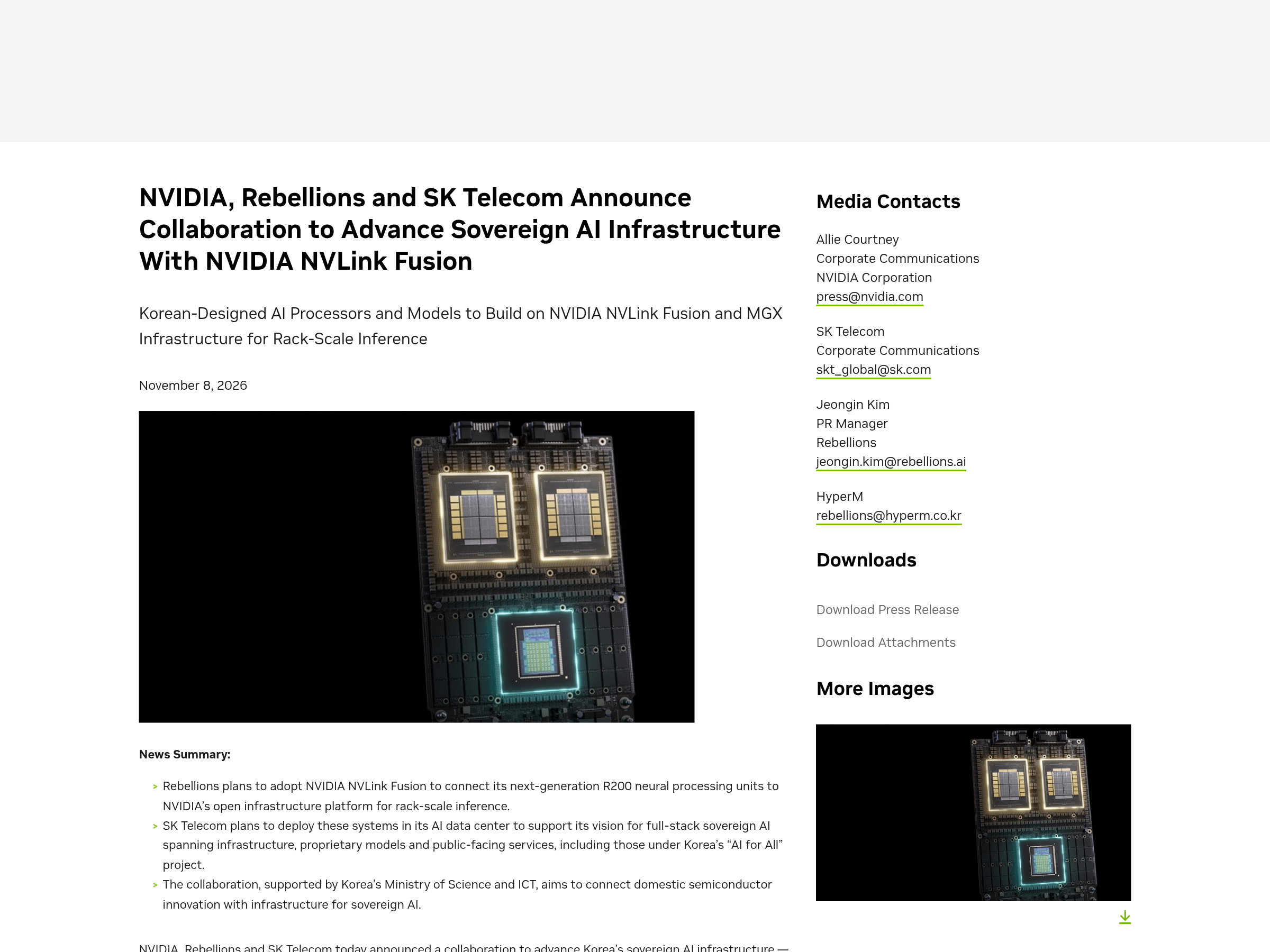
NVIDIA, Rebellions and SK Telecom will connect Korean R200 NPUs to NVLink Fusion and the MGX rack, split inference between GPU prefill and NPU decode, and aim for deployment in 2028.

TL;DR
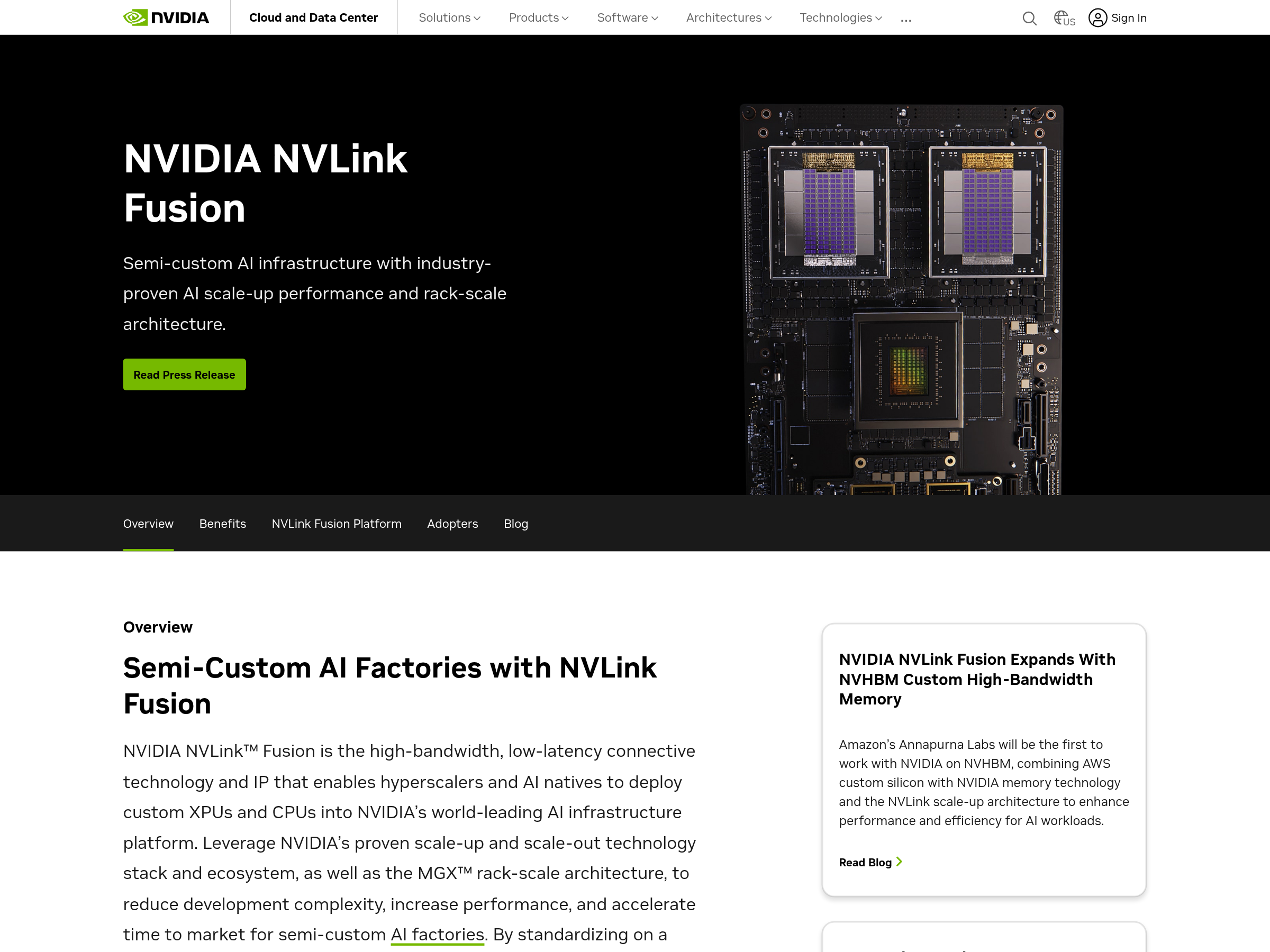
- NVLink Fusion is an NVIDIA technology that lets a chipmaker attach its own processor to NVIDIA's high-bandwidth scale-up networking, so a custom accelerator works inside an NVIDIA-designed rack.
- NVIDIA, Rebellions and SK Telecom announced a collaboration on 8 November 2026 in which Rebellions connects its next-generation R200 NPUs to that fabric and adopts the MGX rack architecture, and SK Telecom plans to deploy the systems in its AI data centre.
- The R200 is an inference NPU aimed at low latency and energy efficiency on frontier models, including mixture-of-experts models with trillions of parameters, connected inside a rack through NVLink.
- The companies plan to split inference across architectures, with NVIDIA GPUs handling prefill and Rebellions NPUs handling decode, so each stage runs on the silicon that suits it.
- The MGX rack is where the arrangement becomes practical, because GPU and NPU systems share the rack footprint, the power delivery and the cooling design that a building has to supply.
- Korea's Ministry of Science and ICT supports the work, and Rebellions expects its R200 systems to be ready for deployment in 2028, which places the procurement clock well ahead of the hardware.
- SK Telecom brings the data centre, its own foundation models including A.X K2, and public services developed under the country's AI for All project.
- The claim to test is sovereignty with a dependency: Korean silicon and Korean models run inside an NVIDIA fabric and an NVIDIA rack specification, so the national stack stays compatible at the layers NVIDIA defines.
- For a ministry or an enterprise, the decision in front of them is a rack specification and a supply chain, and the silicon is one input among several.
NVIDIA's newsroom release of 8 November 2026 is short, and it answers a question that national AI programmes keep circling: what a country buys when it wants its own accelerators. The answer it offers involves Korean NPUs, a Korean carrier, a Korean ministry and an NVIDIA interconnect, all inside one rack specification.
Three parties, one rack specification
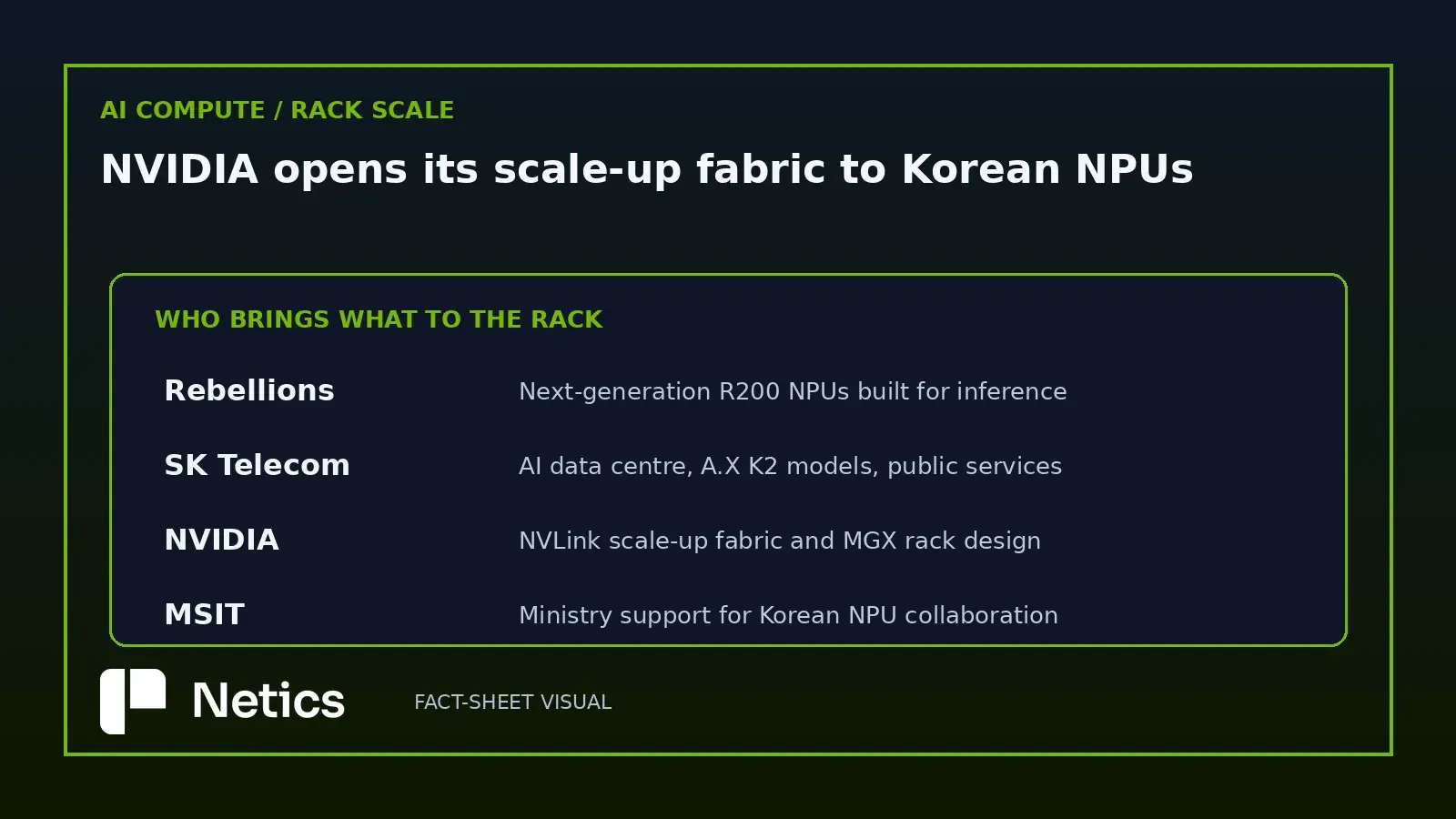
Each party brings a different asset. Rebellions develops inference accelerators and brings its next-generation R200 NPU, along with a software stack it describes as built on open source technology and open standards. SK Telecom brings AI data centre operations, its own foundation models including A.X K2 and public-facing services built under the AI for All project. NVIDIA brings the scale-up networking, the rack architecture, the reference designs and an ecosystem of original design manufacturers and component suppliers.
The division matters because the release is explicit about which layer each company owns. Rebellions develops the processor and the system design, SK Telecom operates the facility and the services, and NVIDIA supplies the fabric and the rack. The release describes a collaboration that brings together Rebellions' silicon, SK Telecom's AI data centre and the NVIDIA platform.
NVLink Fusion is a licensing boundary drawn around scale-up
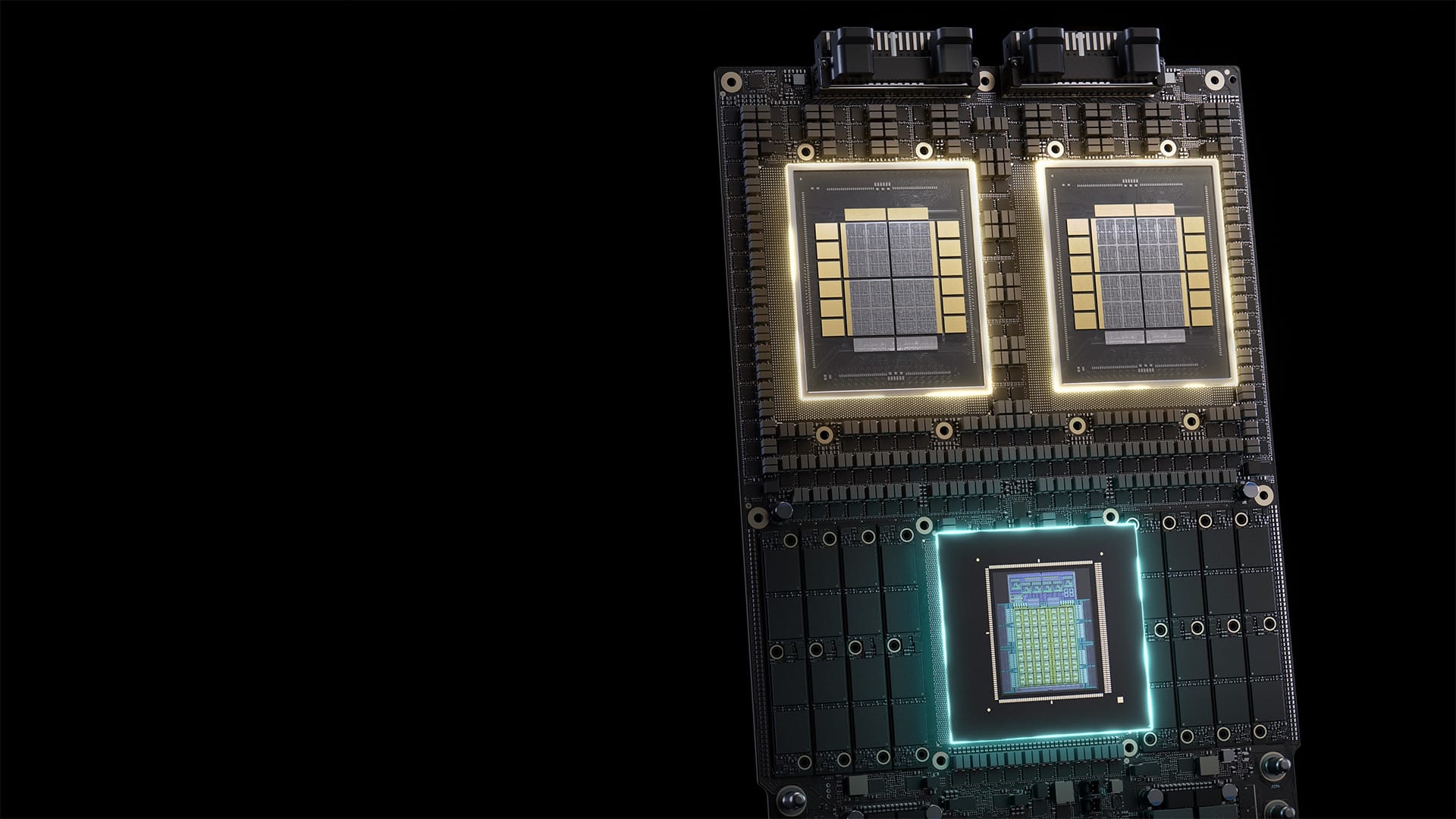
The technical description in the release is one sentence long and worth more than the headline: NVLink Fusion extends NVIDIA's vertically integrated, horizontally open platform to custom XPUs. A chipmaker keeps designing its own processor and gains access to NVIDIA's high-bandwidth, low-latency scale-up networking, which is the part of an AI system that decides how fast accelerators can exchange data inside a rack.
That is a specific kind of openness. Scale-up networking has been the closed core of NVIDIA's system advantage, and opening it to third-party silicon converts a competitor into a module inside the same rack. The chipmaker gains a place in systems that customers were already planning to buy, an established supply chain through MGX, and reduced deployment risk. The cost is also real, because the interface that carries the traffic belongs to someone else, and the roadmap for that interface does too.
Prefill on GPUs and decode on NPUs is the architectural claim
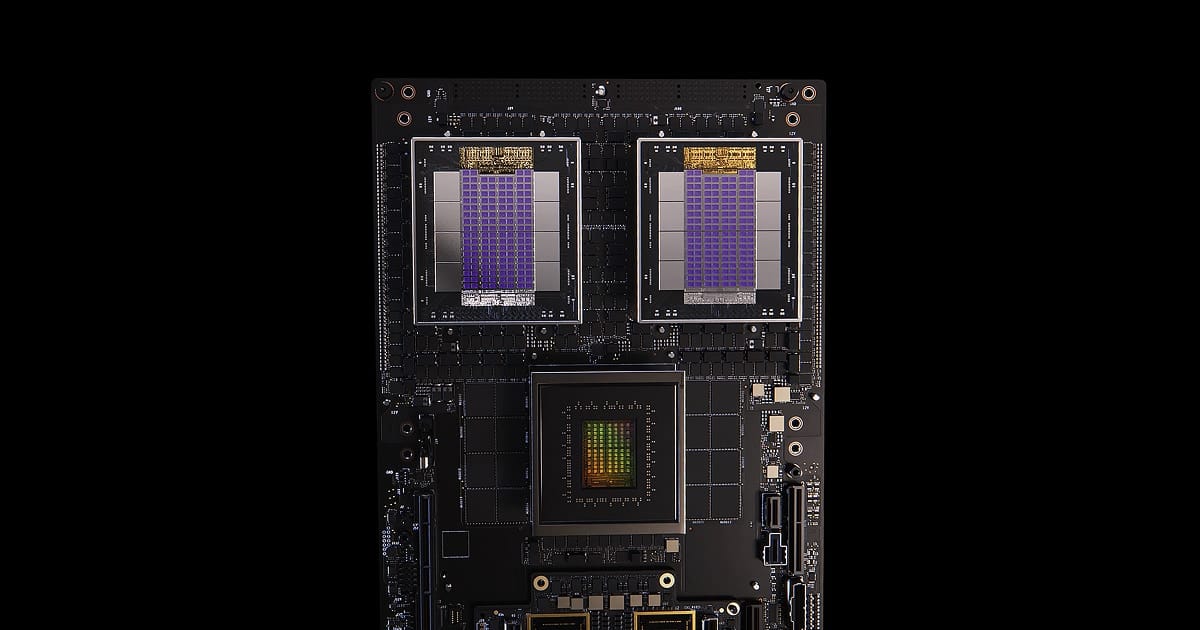
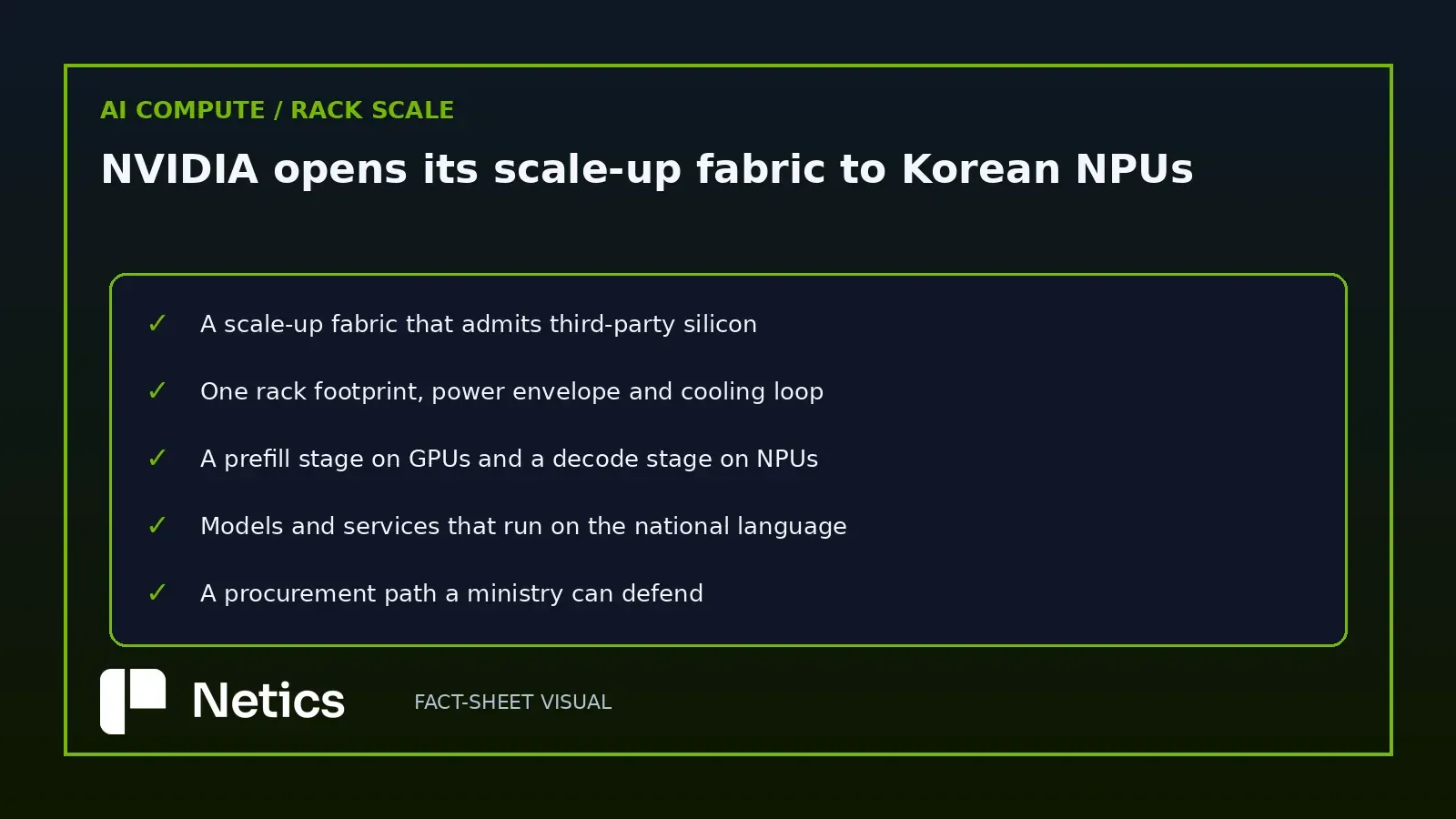
The release's architectural centre is its plan for disaggregated inference. The companies plan to develop an approach to disaggregated inference, assigning different stages of response generation to the processor architecture best suited to each task, with NVIDIA GPUs for prefill and Rebellions NPUs for decode.
Disaggregation is a reasonable response to how inference actually behaves. Prefill processes the whole prompt at once and behaves like a large matrix multiplication. Decode produces one token at a time and is limited by memory bandwidth. A system that runs the two stages on hardware chosen for each can raise throughput and power efficiency, which is precisely what the release claims. The claim remains a plan: the release describes intended work, and 2028 is the date attached to the systems.
The 2028 date sets the procurement clock
Rebellions expects its R200 systems to be ready for deployment in 2028. That single sentence should shape how the announcement is read. The release says the R200 systems are expected to be ready for deployment in 2028.
Data centre planning runs on power, cooling and floor space, and the MGX rack elements listed in the release are exactly those three plus the footprint. A programme that starts designing a building before the hardware arrives has to pick a rack specification early, and that specification is where the lock-in is set, well before the first NPU ships. The same document then decides which suppliers can quote for the hall, a purchasing consequence that lands years ahead of any benchmark.
What a ministry buys when it buys sovereignty
Korea's Ministry of Science and ICT supports the collaboration, and the release frames the goal as AI services tailored to the country's language, industries and priorities. The deputy prime minister's quote describes Korean-developed NPUs entering the computing infrastructure market alongside NVIDIA, and the government's role as support across physical AI and GPU supply.
Read that as a policy position with a technical shape. A state that wants its own models hosted on its own soil needs three things that no single procurement delivers: silicon it can buy, a facility it can power, and a model stack that runs on both. The Korean arrangement assembles the three from different owners, and the ministry's presence is what turns a vendor partnership into a national programme. For French and European buyers watching the same pattern, the useful detail is that the MGX architecture gives GPU and NPU systems a shared rack footprint, power delivery and cooling design.
The dependency a sovereign stack keeps
The dependency deserves to be stated plainly, because the word sovereign does a lot of work in these announcements. Korean processors, Korean models and a Korean data centre will run inside an NVIDIA scale-up fabric and an NVIDIA rack architecture, with reference designs and an ODM ecosystem that NVIDIA coordinates. Sovereignty here means the ability to own the workload, the language and the facility, at the layers a country can own.
That is a defensible position, with sovereignty limited to ownership of the workload, the language and the facility. The exit test for any such programme is whether the stack keeps running when one supplier's roadmap stops suiting it, and the release names no second fabric. Teams planning around this class of hardware usually discover that the operational layer decides more than the silicon: driver versions, container images, scheduler configuration and the monitoring that tells you a rack is underperforming. That layer is the part a sovereign infrastructure and cloud exit plan has to own on hardware the team controls.
Sources
- NVIDIA, Rebellions and SK Telecom Announce Collaboration to Advance Sovereign AI Infrastructure With NVIDIA NVLink Fusion, NVIDIA Newsroom, 8 November 2026
- NVLink Fusion, NVIDIA product page
Source: the NVIDIA newsroom release of 8 November 2026 and the NVLink Fusion product page, both fetched on 10 November 2026. Every party, mechanism, quote and date above comes from those pages, including the R200 NPU, the MGX rack elements and the 2028 availability note.