
Gemini 4 Hydrogen Lands Above Argon on the Aggregate Index
"Gemini 4 Hydrogen costs $1.50 and $7.50 per million tokens flat across a one-million-token context, and Google's own benchmark table shows the tasks where a cheaper tier beats its flagship

TL;DR
- Gemini 4 Hydrogen is a model Google released on 12 November 2026 as the fast tier of its Gemini 4 family, built for everyday coding and agentic work beside the slower Gemini 4 Carbon and Gemini 4 Argon.
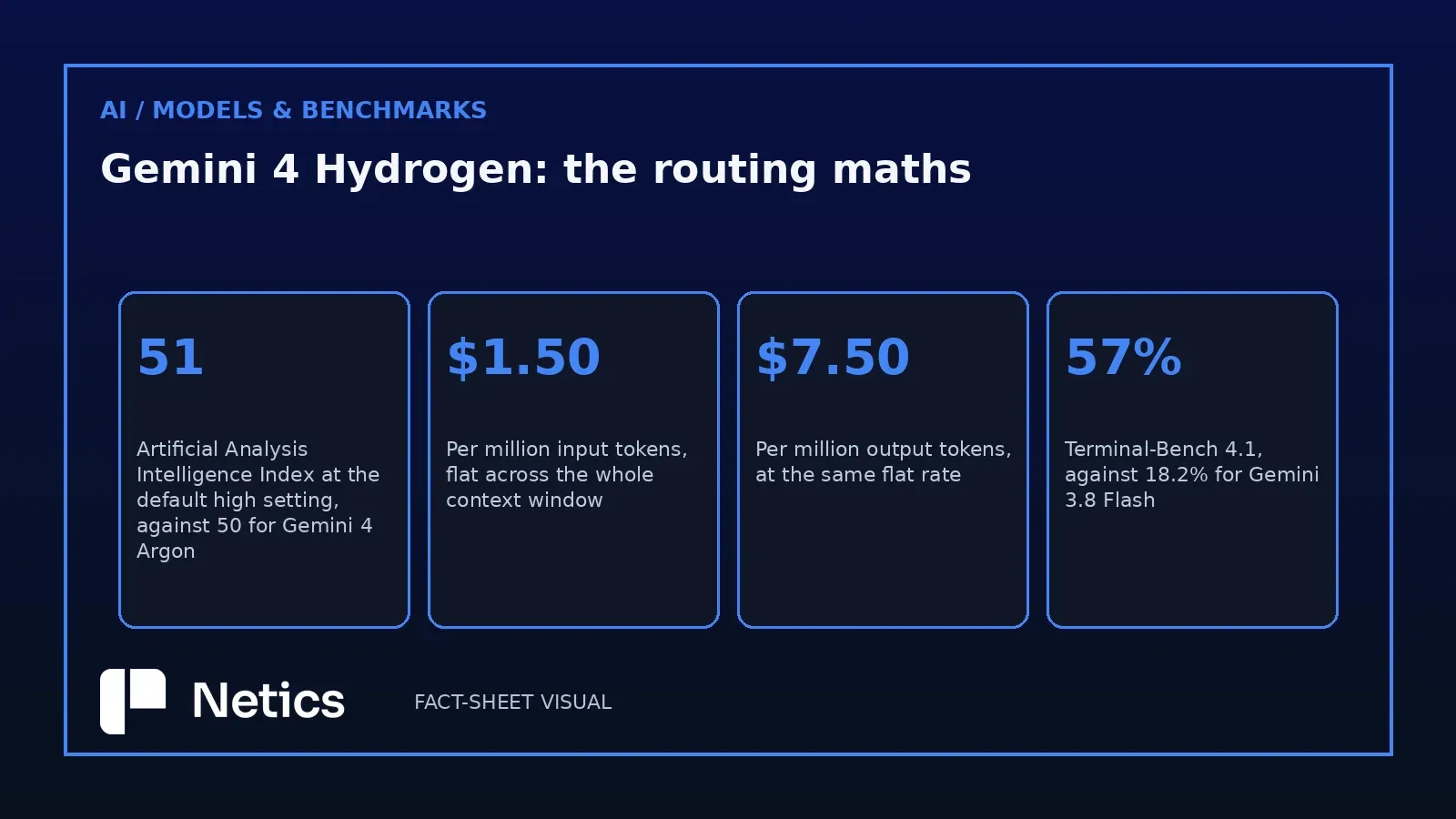
- Google prices it at $1.50 per million input tokens and $7.50 per million output tokens, flat across the entire one-million-token context window.
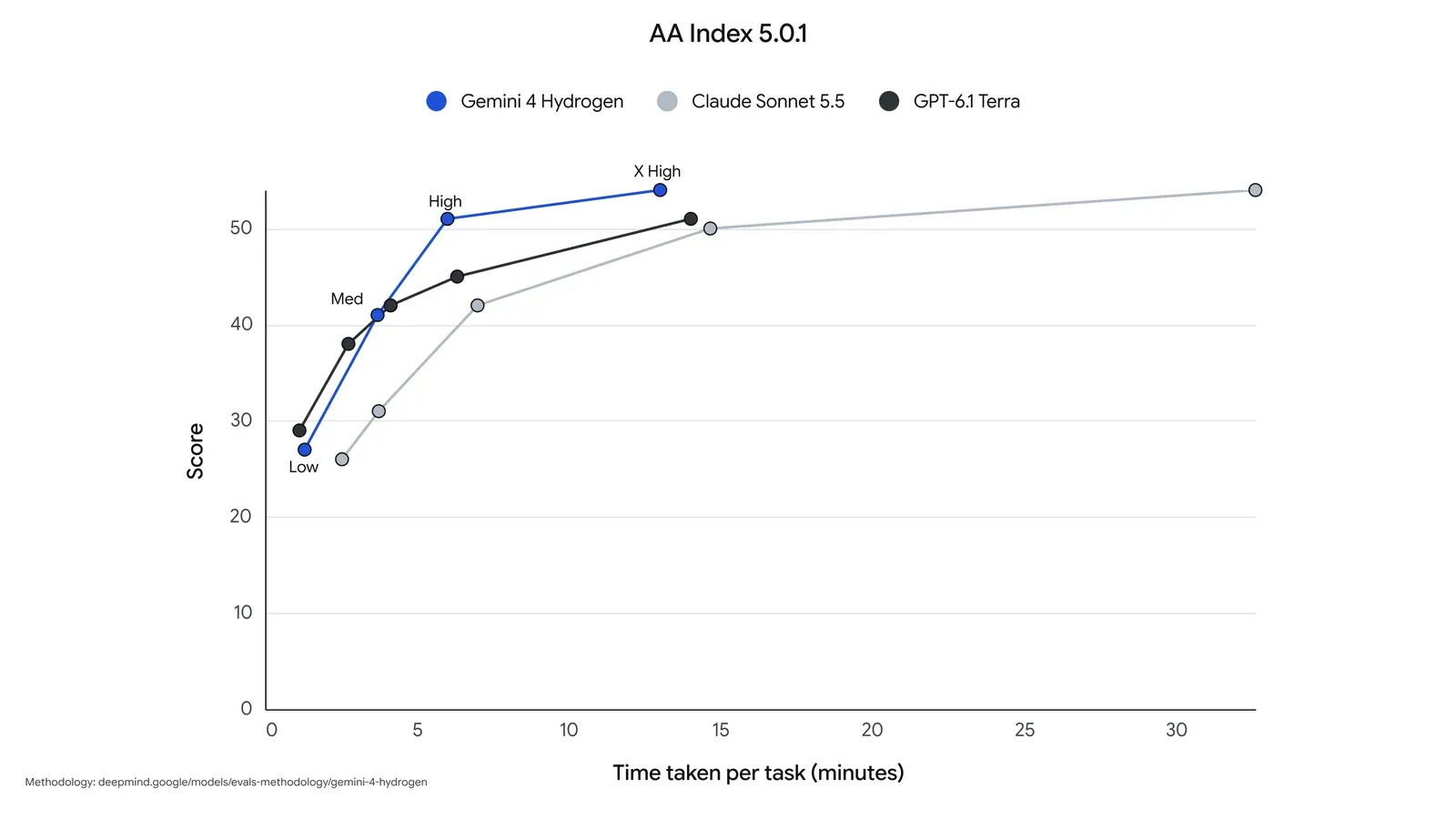
- Google's own figures put Hydrogen above Argon on the Artificial Analysis Intelligence Index at the default high thinking level, 51 against 50, and at 54 on the new xhigh level.
- Four thinking levels (low, medium, high, xhigh) let a team trade latency and cost against score inside one model.
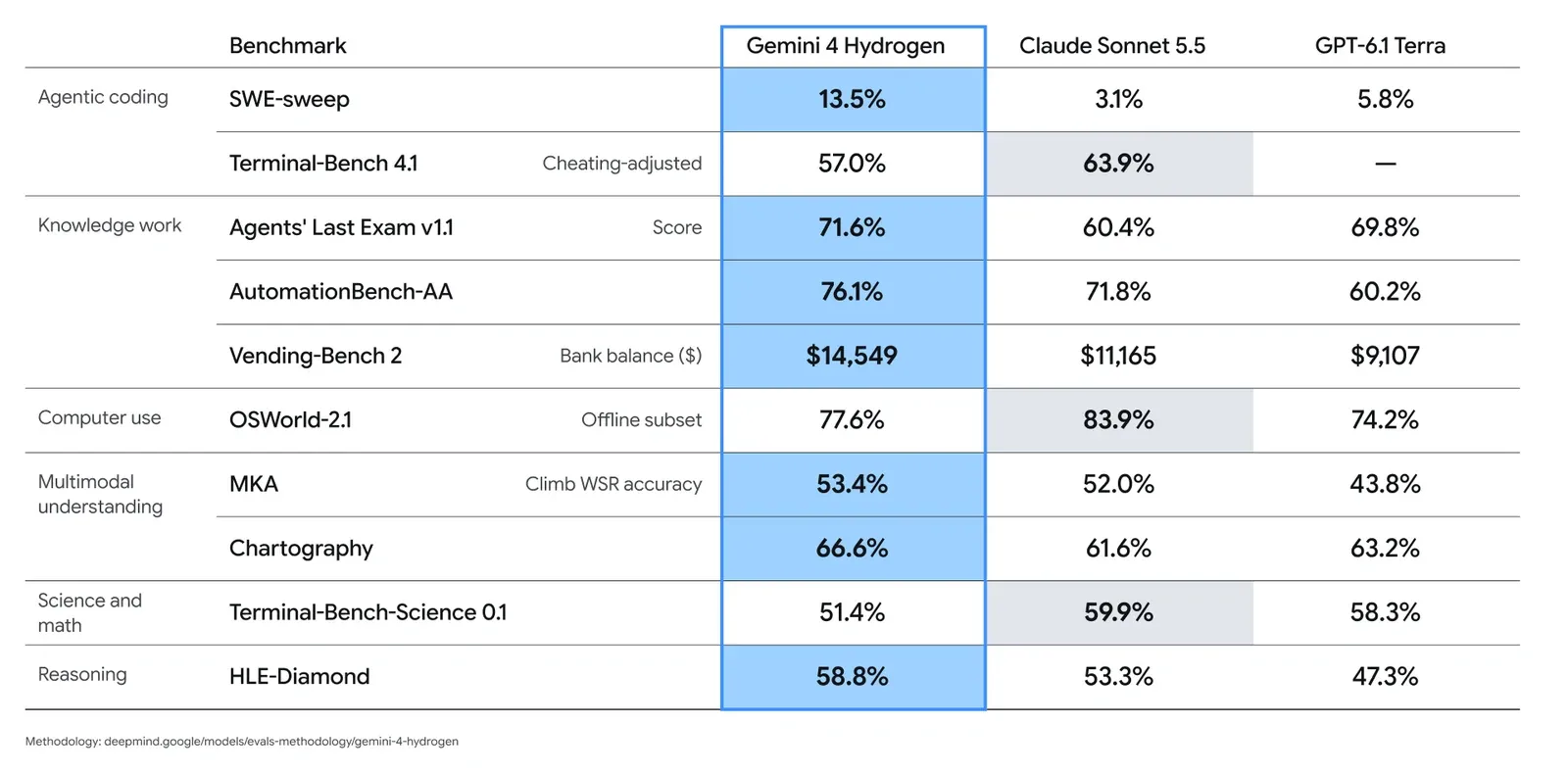
- The benchmark table in the announcement shows where Hydrogen trails Claude Sonnet 5.5: Terminal-Bench 4.1 at 57.0% against 63.9%, OSWorld-2.1 at 77.6% against 83.9%, and Terminal-Bench-Science 0.1 at 51.4% against 59.9%.
- Orchestrator in Google Antigravity routes work between Carbon and Hydrogen inside a single session, and Google reports near-Carbon task success on Terminal-Bench 4.0 with 24% less quota consumed and 19% faster completion.
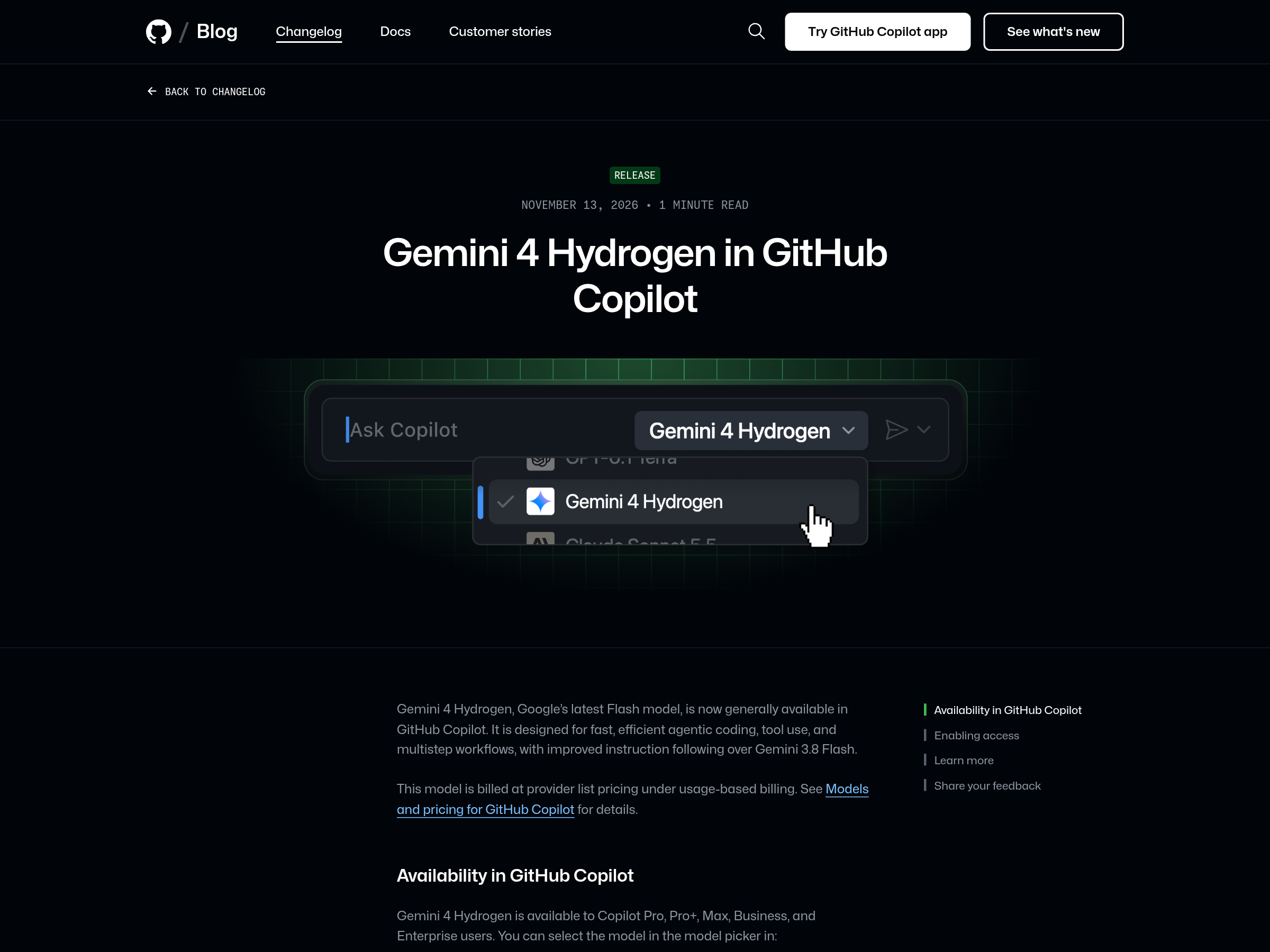
- GitHub shipped the same model in Copilot on 13 November 2026 at provider list pricing, and enterprise administrators control access through the model policy in Copilot settings.
- A platform team measures cost per finished task and latency at the thinking level it would actually set, because the aggregate index hides which task classes carry the score.
The model Google shipped on 12 November
Google announced Gemini 4 Hydrogen on 12 November 2026 in a post by Koray Kavukcuoglu, senior vice president at Google DeepMind and chief AI architect at Google. The company positions Carbon and Argon for deep, long-horizon reasoning, and Hydrogen for rapid execution across agentic workflows. The model reaches all tiers of Google AI Studio, the Gemini API, Gemini for business, the Gemini app, Google Search, Android Studio, and paid Google AI Pro and Ultra subscribers inside Google Antigravity.
The interesting part of the launch is what Google chose to publish alongside it. Hydrogen's page carries a ten-row comparison table against Claude Sonnet 5.5 and GPT-6.1 Terra, with the rows where Hydrogen loses left visible. That is unusual in a launch post, and it makes the announcement usable as a routing document.
Flat pricing across a one-million-token context
The price is $1.50 per million input tokens and $7.50 per million output tokens, and Google states that the price is flat across the whole one-million-token context window. Under Google's flat pricing, a 900,000-token repository dump carries the same unit rate as a 5,000-token question.
Hydrogen also pairs a one-million-token input with up to one million output tokens. Google describes the model synthesising dense PDFs, spreadsheets, charts, audio and recorded video into cited reports and structured deliverables. Consider a hypothetical French or Moroccan SME that scans supplier invoices and contracts: that combination sets the shape of the workflow as one long input, one long structured output and one flat bill.
Four thinking levels and the latency they buy
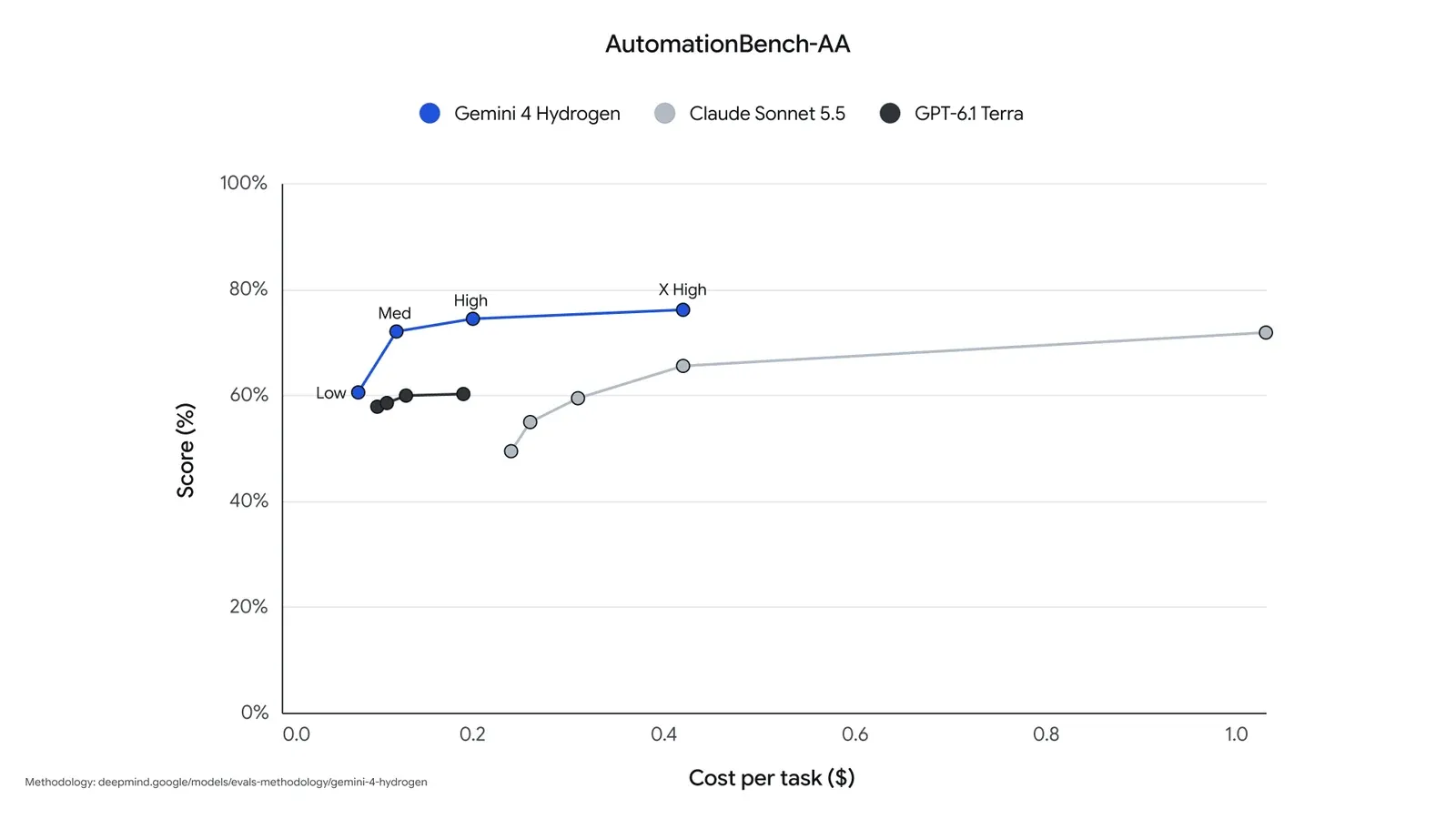
Hydrogen ships with four thinking levels: low, medium, high as the default, and xhigh as the new top tier. Google's framing is that the levels scale in a predictable progression, so a team pays for reasoning depth only where a task needs it. On the Artificial Analysis Intelligence Index, the default high level scores 51 and xhigh reaches 54.
That ladder is the practical part of the launch. A slow overnight job can run at xhigh, a chat assistant answering a customer at 10 a.m. can run at low, and both run on one model with one price sheet. The score-versus-time chart Google published shows how the ladder behaves against two competing models: Hydrogen reaches its top score earlier in wall-clock time, and the competing lines sit further to the right.
The rows where Hydrogen trails its closest rival
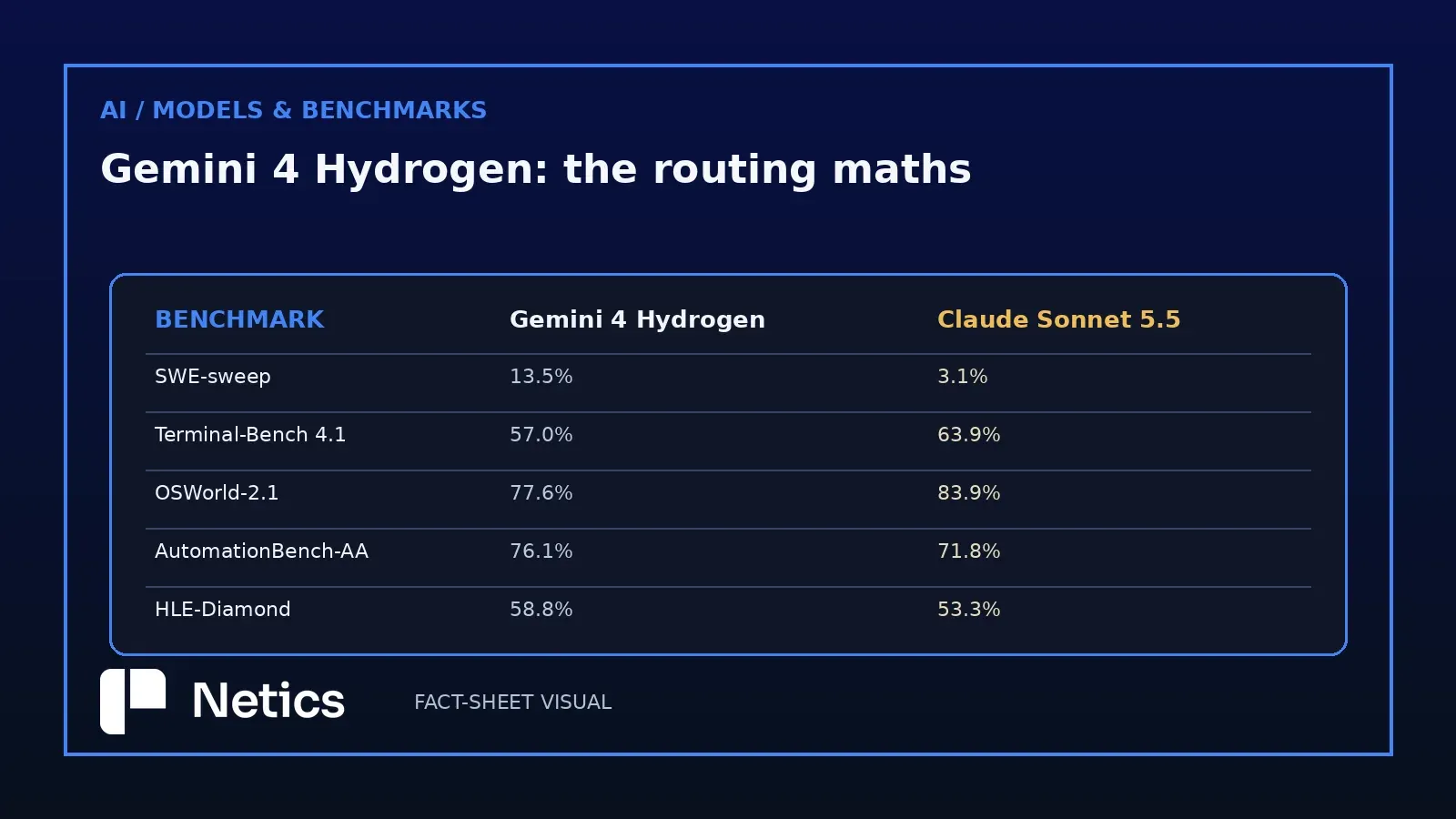
The table inside the announcement is where a careful reader should slow down. Hydrogen wins SWE-sweep at 13.5% against 3.1% for Claude Sonnet 5.5 and 5.8% for GPT-6.1 Terra, and it wins AutomationBench-AA at 76.1% against 71.8% and 60.2%. It loses Terminal-Bench 4.1 at 57.0% against 63.9%, OSWorld-2.1 at 77.6% against 83.9%, and Terminal-Bench-Science 0.1 at 51.4% against 59.9%. On HLE-Diamond it leads at 58.8% against 53.3% and 47.3%.
A single aggregate index collapses those rows into one number, and that number currently places Hydrogen above Argon. The table says something narrower: Hydrogen is the stronger choice for repository-scale bug repair and for automation-style tool work, and the rival model remains stronger for computer-use tasks and for science-heavy terminal work. Any team that reads only the headline will route the wrong task class to the cheaper model and then blame the model.
How Orchestrator routes work between Carbon and Hydrogen
Google also introduced Orchestrator in Google Antigravity, a component that switches between models such as Carbon and Hydrogen inside one session. On Terminal-Bench 4.0, Google reports that Orchestrator reached near-Carbon task success rates while consuming 24% less quota on average and finishing 19% faster. For parallel work, the company describes Carbon acting as the coordinator while Hydrogen powers worker and verifier agents across isolated workspaces.
Read that as the vendor building routing into its own product. Google's own engineering position is that a single model rarely fits a whole session: a hard architecture question wants the expensive reasoning model, and the code edits, test runs and verification that follow want the cheap fast one. A team that already pays for both tiers gains nothing from picking one by habit.
The pricing detail that carries this is quota accounting. Google measures Orchestrator on quota consumed, so the benefit shows up in a plan's allowance before it shows up in a dollar figure. A team on a flat seat price sees the difference as more work finished per seat.
What a platform team measures before switching
Four measurements decide whether a cheaper tier belongs in production. The first is cost per finished task, which includes the retries and the failed tool calls that the per-token price hides. The second is latency at the thinking level the team would actually set, measured on the tasks the team actually runs. The third is failure behaviour when a tool call fails or a search returns empty, which Google lists as a specific improvement over Gemini 3.8 Flash. The fourth is where the model is offered, because a model missing from the editor developers use costs more in workflow friction than it saves in tokens.
Then there is the governance question that arrives with the Copilot rollout. GitHub's changelog states that administrators of Copilot Business and Enterprise manage access through the model policy in Copilot settings, and that under default model enablement a new model is enabled automatically unless an administrator has turned off the global default or disabled that model. An organisation that tracks AI spend per team should check that setting before the picker fills up.
For teams running agents against their own infrastructure, the model choice usually sits inside a larger control plane: the tool permissions, the egress policy and the approval steps around each call. One implementation is a self-hosted AI agent platform, and the model tier is one setting inside it.
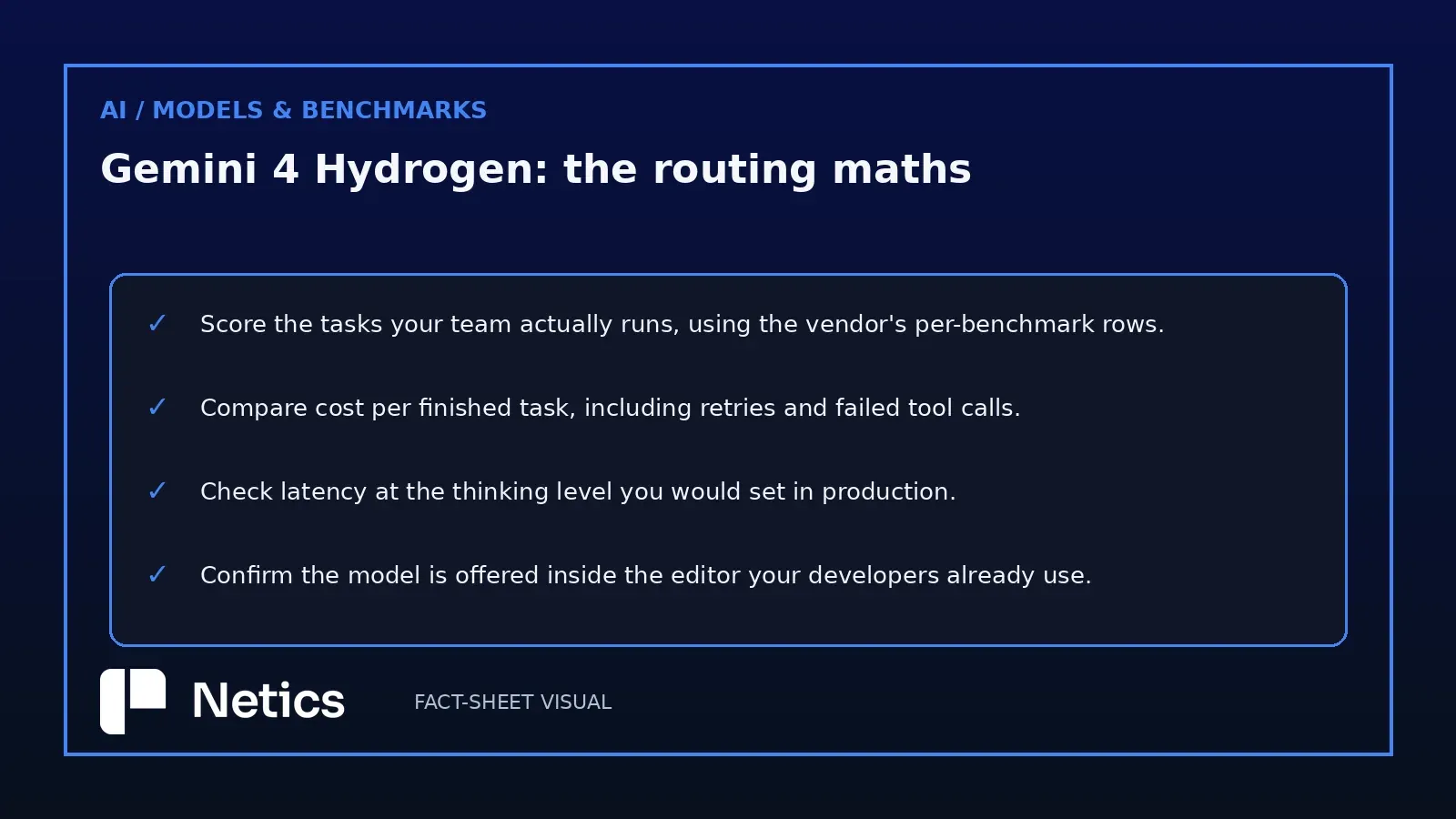
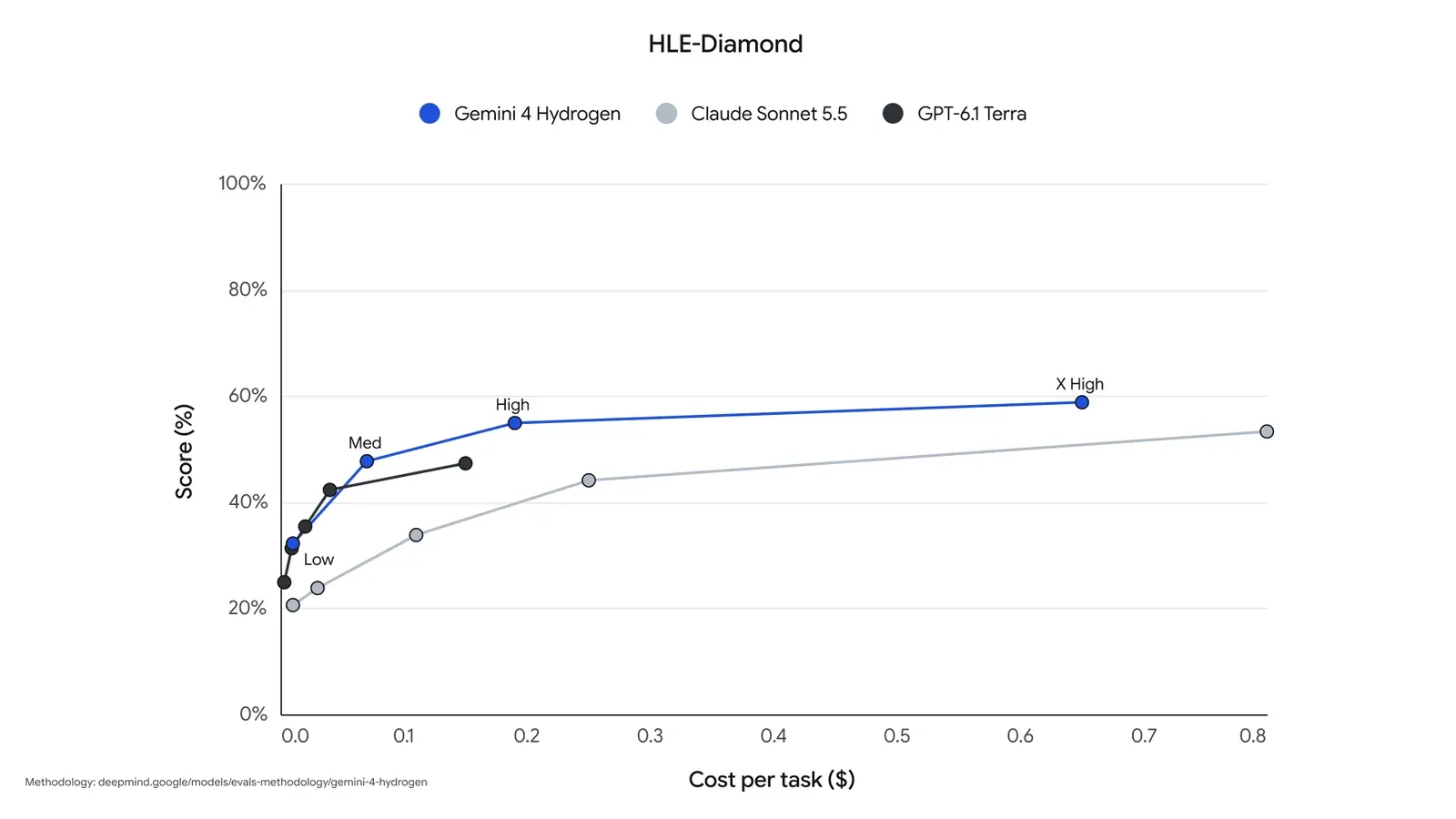
Hydrogen makes a credible case for the everyday tier of a two-model setup. The evidence that settles the question sits in the ten rows Google published, three of which point at a competitor, and in the cost-per-task curves behind the four thinking levels.
Sources
- Introducing Gemini 4 Hydrogen, Google blog, 12 November 2026, last updated 13 November 2026
- Gemini 4 Hydrogen in GitHub Copilot, GitHub changelog, 13 November 2026
Source: Google's Gemini 4 Hydrogen announcement (blog.google, published 12 November 2026, last updated 13 November 2026) and GitHub's Copilot changelog of 13 November 2026, both retrieved 14 November 2026. Those two pages carry the token prices, the index scores, the benchmark rows, the thinking levels, the Orchestrator figures and the Copilot availability described above.