
NVIDIA’s IFA 2026 Push Makes Local Agents a Systems Problem
NVIDIA’s IFA 2026 announcements make local agents easier to run, but hardware access, evaluation, routing, security and lifecycle discipline still decide whether they work.

TL;DR
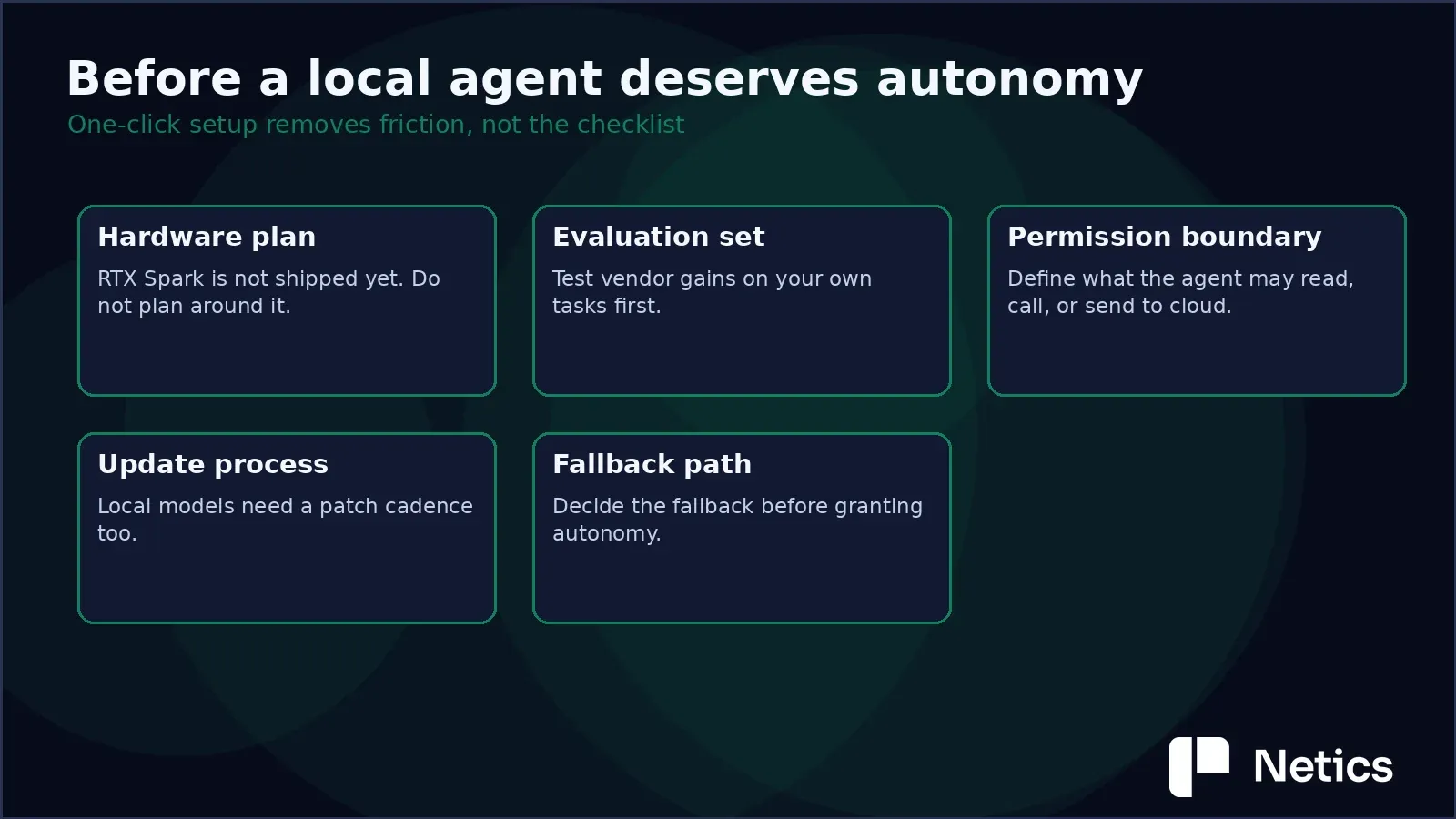
NVIDIA’s IFA 2026 announcements move local AI beyond a model-download hobby. Simplified setup in Hermes Agent, OpenClaw and Perplexity Portable Computer, faster llama.cpp and vLLM inference, NVIDIA PAIR for routing work across nearby PCs, RTX Spark Windows PCs arriving in October, DeepSeek Harness and MLPerf Client v2.0 together describe a local agent stack. The important shift is from cloud-only experimentation toward agents that can execute tools, retain context and work continuously on a user’s hardware. The limits are equally important: RTX Spark is not available yet, benchmark gains are vendor-attributed, local models still need deliberate routing, and keeping data on-device does not automatically make an agent safe. A local deployment needs a hardware plan, evaluation set, permission boundary, update process and fallback path before it deserves autonomy.
NVIDIA is packaging the local agent starting point
NVIDIA’s announcement is not one product launch. It is a coordinated attempt to remove the sequence of choices that has made local AI harder than cloud AI: select a model, choose an inference server, tune quantization, configure the agent and keep each component current. On Windows, NVIDIA says Hermes Agent, OpenClaw and Perplexity Portable Computer will offer simpler local model setup built on llama.cpp and NVIDIA’s latest inference optimizations.
The promise is useful, but it has a precise boundary. One-click setup removes installation friction; it does not remove the need to understand what the selected model can do, which tools it can reach or when the application will escalate a task to the cloud. The interface becomes simpler while the system behind it becomes more consequential.
The real shift is execution, not private chat
The strongest change in NVIDIA’s framing is that local AI is becoming an execution environment for agents rather than a private chatbot running beside a cloud service. The source describes Hermes as able to use tools, maintain context across tasks, remember information between sessions and create reusable skills over time. Perplexity’s local workflow can process complete tasks without consuming credits and selectively escalate parts of a task to one of more than 15 frontier models in the cloud when additional research or reasoning is needed. It asks for permission before sending content to the cloud.
That is a materially different architecture from cloud-only experimentation. A local agent can inspect a connected GitHub repository, analyze brokerage and tax documents without sending them to a chatbot, or examine a funnel export and post insights to Slack. Those are source-described examples, not proof that every installation will perform them safely. They show why local execution matters: the model is placed next to private files, tools and long-running context.
The consequence is that privacy becomes a property of the workflow, not a slogan attached to the model. A local model can reduce unnecessary disclosure, but the agent may still have credentials, logs, plugins, caches and cloud fallback routes. A permission prompt before escalation is a good user control. It is not a substitute for an inventory of what can leave the device and why.
The operating principle matches the wider Netics argument that production AI starts beyond the model. The model matters, but the durable system includes tools, identities, evidence, monitoring, escalation and a way to stop it.
Faster inference helps, but the numbers need a test
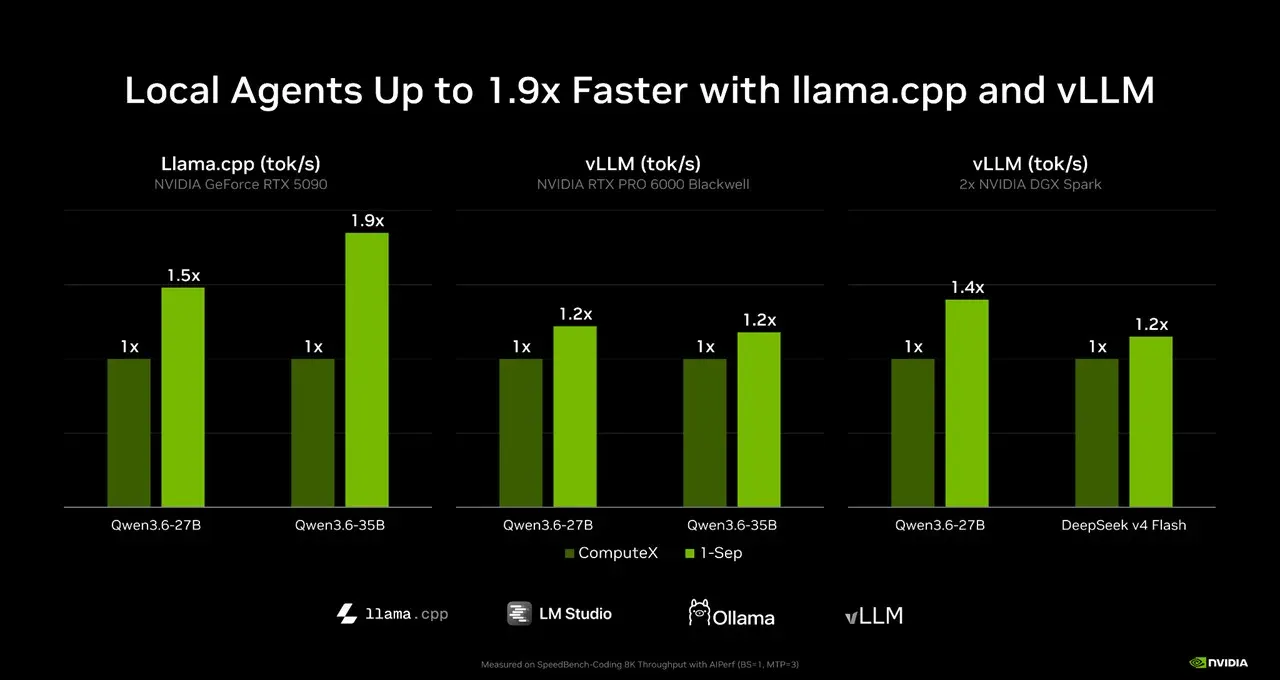
NVIDIA reports up to 1.9x higher throughput for llama.cpp on a GeForce RTX 5090 through kernel optimizations, enhanced speculative decoding and faster prefill. It reports 1.2x on the RTX PRO 6000 Blackwell Workstation Edition and up to 1.4x on two DGX Spark clusters for vLLM, using new XQA attention kernels in FlashInfer and backend optimizations. Users can access the improvements through llama.cpp and vLLM directly or through LM Studio and Ollama.
Those figures are meaningful signals about optimization work. They are not a universal speed guarantee for an agent. Throughput depends on model, quantization, prompt length, concurrency, tool latency, memory pressure and the exact workload. An agent that spends most of its time waiting for a browser, file scan or API response will not become 1.9x faster simply because token generation improved.
Evaluation should therefore separate model inference from task completion. Record time to first token, tokens per second, end-to-end task time, tool-call latency, error recovery and useful completion rate. Test the same model and workload on the same hardware before and after the optimization. Keep the prompt, context size and concurrency fixed. The benchmark result then becomes evidence for a deployment decision rather than a number copied into a procurement slide.
PAIR turns spare PCs into a routing layer
NVIDIA Personal AI Router, or PAIR, is the architectural piece that makes local capacity less dependent on one machine. NVIDIA describes it as free, open-source software that discovers compatible PCs on a local network and routes independent inference requests to the system with capacity. It works with Ollama and LM Studio, and can adapt as devices join or leave the network. The beta supports Windows, macOS and Linux, NVIDIA GeForce RTX 20 Series and newer, RTX PRO workstation GPUs from Turing onward, DGX Spark and Apple M4 or newer silicon.
The idea fits agentic workloads because a complex task can be split into smaller jobs that run in parallel. A Hermes workflow could assign several subagents to sort an inbox while PAIR distributes requests across idle computers. The main machine remains available for gaming, creative work or other tasks.
But routing is not the same as orchestration. A scheduler needs to know which device is trusted, which model is loaded, how much memory is available, whether the result is reproducible and what data crossed the network. A job routed to a family PC, workstation or shared development machine may have a different risk profile. Model capability is also uneven: the fastest available device may not be the right one for a sensitive document or a tool-enabled action.
Netics would treat PAIR as a model-and-device routing policy, not just a clever way to use idle compute. Begin with independent, low-sensitivity tasks. Record the selected node, model, configuration and result. Exclude devices that cannot meet the data, identity or retention policy. Parallelism is valuable only when the organisation can still explain where each subtask ran.
RTX Spark makes hardware availability part of the story
NVIDIA says RTX Spark Windows PCs arrive in October, with new designs from Lenovo and Acer joining six OEMs shipping in October. The platform is positioned for creators, gamers and AI agents, with a 1 Petaflop RTX Blackwell GPU, up to 128GB of unified memory and a 20-core Grace CPU. NVIDIA also connects the hardware to a new Windows Agent framework intended to let agents run safely in the background under OS-level control.
The specification explains the ambition: compact systems that can run capable models continuously, with enough unified memory to make larger local workloads practical. The October timing also exposes the first limit. An announcement is not a supply chain. Buyers still need confirmed regional availability, pricing, repair terms, driver support, power behaviour and software compatibility. None of those procurement questions can be answered by a peak performance figure.
Hardware abundance will not automatically create model portability. A 30-billion-parameter model such as Nemotron 3.5 Lightning, or Meta’s Muse Glimmer, may run across NVIDIA platforms with different memory and quantization requirements. DeepSeek v4 Flash is described as a 284-billion-parameter mixture-of-experts model with 13 billion active parameters that can run on a two-DGX-Spark cluster and DGX Station. “Runs locally” therefore needs a device, model, precision and workload attached to it.
DeepSeek Harness points to repeatable agent work
DeepSeek Harness, introduced in the announcement’s update section, pairs DeepSeek v4 Flash with an open-source harness for local agentic coding workflows on NVIDIA DGX Station and multi-DGX-Spark setups. This is important because a harness is closer to an execution pattern than a model demo. It can give a coding agent a repeatable environment for tools, context and task sequencing.
The open-source label should not be confused with operational completeness. Teams need to inspect the harness’s tool permissions, filesystem scope, network access, secrets handling, logs and upgrade path. A coding agent that can modify a repository needs a separate boundary between reading, proposing a patch, opening a pull request and merging code. The model’s size or benchmark score does not define that boundary.
The practical opportunity is to run a controlled local coding loop: fixed repositories, synthetic secrets, replayable tasks, explicit approval before writes and captured outputs. That makes local agent execution measurable without granting a new harness unrestricted access to production systems.
MLPerf Client v2.0 can improve the evidence layer
MLCommons’ MLPerf Client v2.0 adds benchmarks for agentic AI and image generation, alongside expanded large-language-model testing for real-world local AI workloads. Developed in collaboration with NVIDIA and other industry leaders, the release addresses a gap that raw inference throughput cannot fill: buyers need a more relevant way to compare client hardware and workloads.
A client benchmark still has a scope. It cannot represent every agent, private dataset, tool chain or security policy. Adding agentic workloads is valuable because it shifts evaluation closer to what users ask of a local system. The benchmark does not certify an agent for production; it becomes one layer alongside task success, abstention, tool safety, privacy checks, update regressions and recovery behaviour.
Local AI still needs a lifecycle and a kill switch
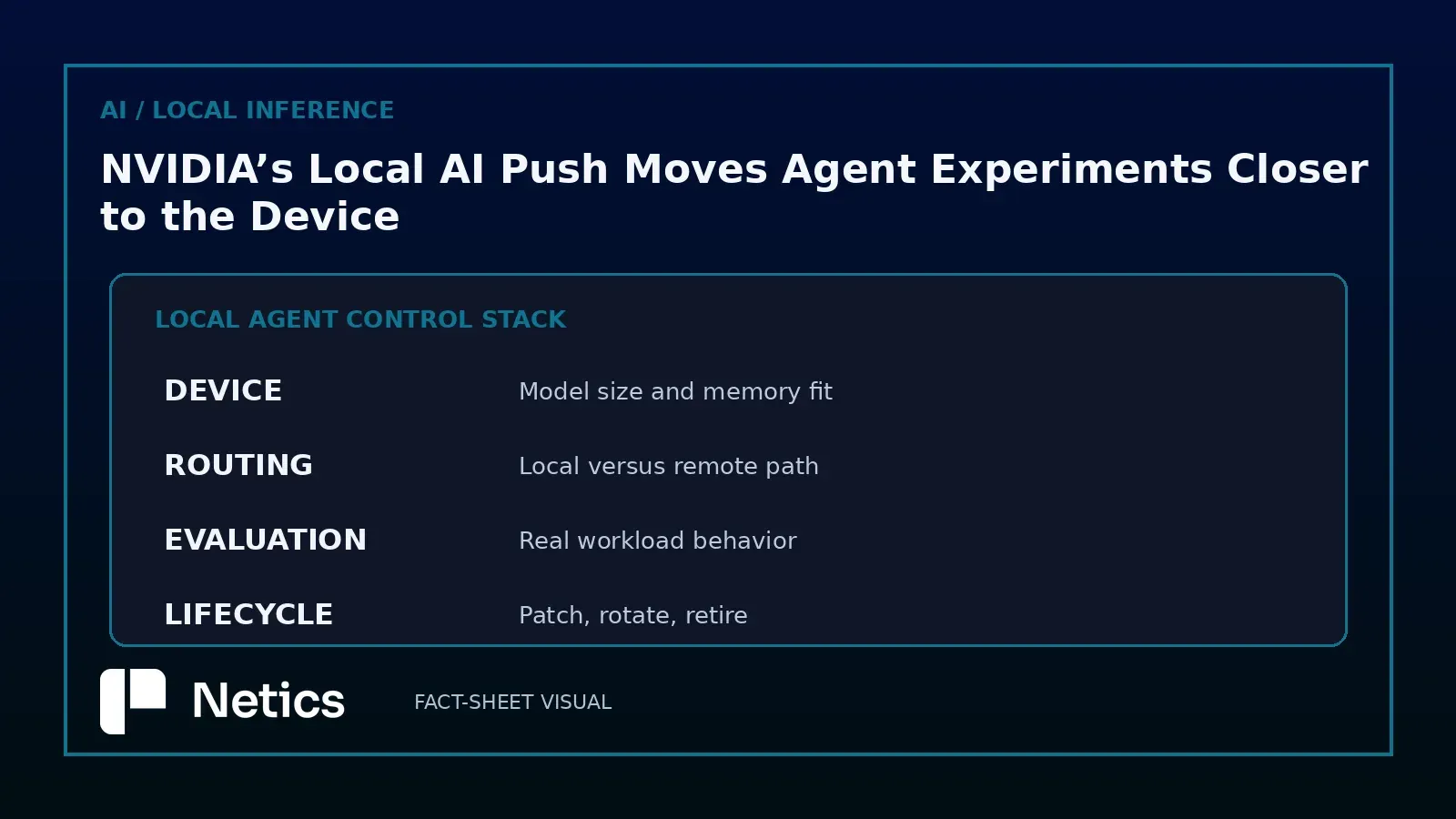
NVIDIA’s announcements make local execution easier to start. They do not make it self-governing. Before deployment, define which tasks stay local, which can use cloud escalation and which must stop. Maintain a model and runtime inventory with versions, quantization, hardware assumptions and licences. Test routing decisions when devices join or leave. Track the data retained in prompts, logs, caches and agent memory.
Evaluation must include hostile files, prompt injection in repository content, missing tools, stale skills, revoked credentials and model updates. Security must cover the operating system, inference server, agent process and local network, not only the model weights. Lifecycle ownership matters because a one-click installer can also make an update one click. Automatic convenience needs a rollback path and a record of what changed.
The Netics view is straightforward: IFA 2026 marks a transition from local AI as a technical experiment toward local agents as an execution stack. RTX Spark, faster inference, PAIR, DeepSeek Harness and MLPerf Client v2.0 are useful pieces. The winners will not be the teams that merely run the largest model on the newest box. They will be the teams that route work deliberately, evaluate the complete task, limit authority and keep the system understandable after launch.
For teams designing that control plane, Netics can help turn a promising local agent into a bounded operating system.
Sources
- Sparks Fly: NVIDIA Accelerates Local AI at IFA 2026 — NVIDIA, 13 September 2026.
- NVIDIA Personal AI Router — NVIDIA, accessed 13 September 2026.
- Introducing DeepSeek Harness — DeepSeek AI, accessed 13 September 2026.
- MLPerf Client v2.0 — MLCommons, August 2026.
- Portable Computer: Local-first AI — Perplexity, August 2026.