
Dialect Fine-Tuning Starts With Data Curation: What NVIDIA's Nemotron Recipe Shows
NVIDIA published a full recipe for adapting its Nemotron 3.5 ASR model to Saudi Arabic dialects, and the numbers are honest enough to be useful: a default UTMOS quality threshold of 3.0 woul

TL;DR
- NVIDIA published a complete recipe for adapting its Nemotron 3.5 ASR model to Saudi Arabic dialects, and the interesting numbers are not the headline WER gains — they are the ones that show where the pipeline's quality actually comes from.
- The curation step decided the outcome: structural checks on the SADA 2022 corpus retained 103,559 of 125,490 utterances, or 82.5% of the starting set (133.7 hours), and a default UTMOS quality threshold of 3.0 would have rejected almost everything in that same corpus.
- The replay mix — roughly 90% Saudi Arabic to 7% English — exists to prevent the classic failure of dialect fine-tuning: improving the target dialect while weakening the languages the model already handled.
- Adaptation depth is a measured trade: at 134 hours of target speech the data supports updating the whole encoder, and partial freezing costs 2.4 points against the full fine-tune.
- The transferable lesson for any team doing speech or language adaptation: what you decide to throw away from the corpus matters more than which model you start from.
The gap fine-tuning alone leaves open
NVIDIA's post starts from a deployment reality that benchmark scores hide: "a multilingual model that performs well on broad benchmarks may still fall short in deployment" when the speech people actually produce is dialectal. The concrete example is Saudi Arabic — a model may recognize Modern Standard Arabic or English fluently and still struggle with Najdi and Hijazi speech, or with the acoustic conditions of local recordings.
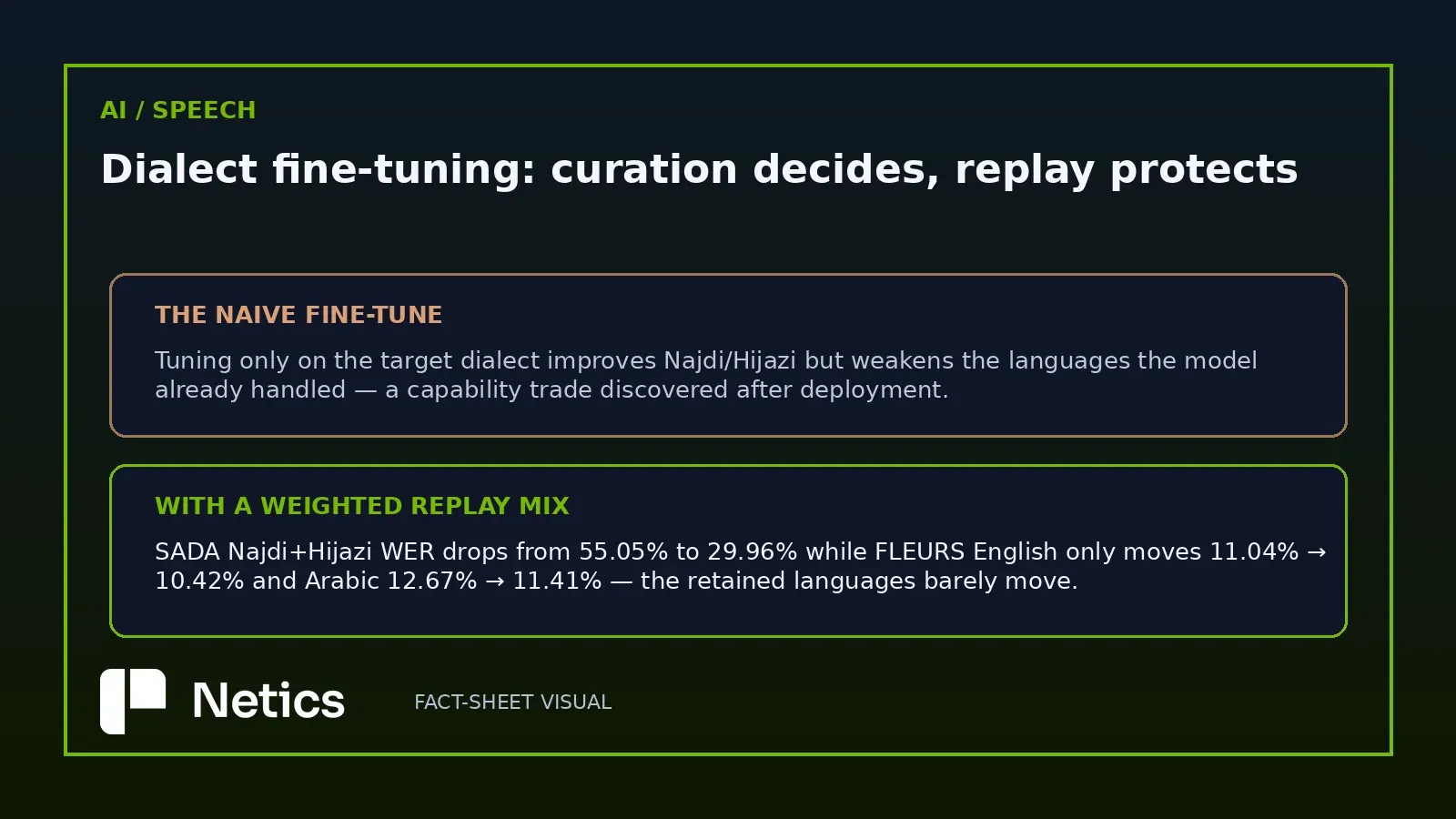
The subtle trap is the naive fix. "Fine-tuning only on the target dialect can improve it while weakening other languages" — that sentence is the whole reason the recipe exists. Without replay, a dialect fine-tune is a trade of one capability for another, and teams discover the loss when their English or Modern Standard Arabic users start complaining. The pipeline's weighted replay mix, around 90% target dialect to 7% English, is a mechanical answer to a mechanical problem: keep the old language data in the training mix so the update does not overwrite it.
Curation: the step with the real quality leverage
The most valuable section of the post is the one most teams skip: what to remove from the corpus. SADA 2022 marks inaudible speech with an annotation the model cannot emit — the Arabic markers render as "غيرواضح" / "غير واضح" (unclear). Every one of those occurrences creates an unavoidable error because the model has no token for the concept. Remove the structurally unlearnable material, keep the hard accents.
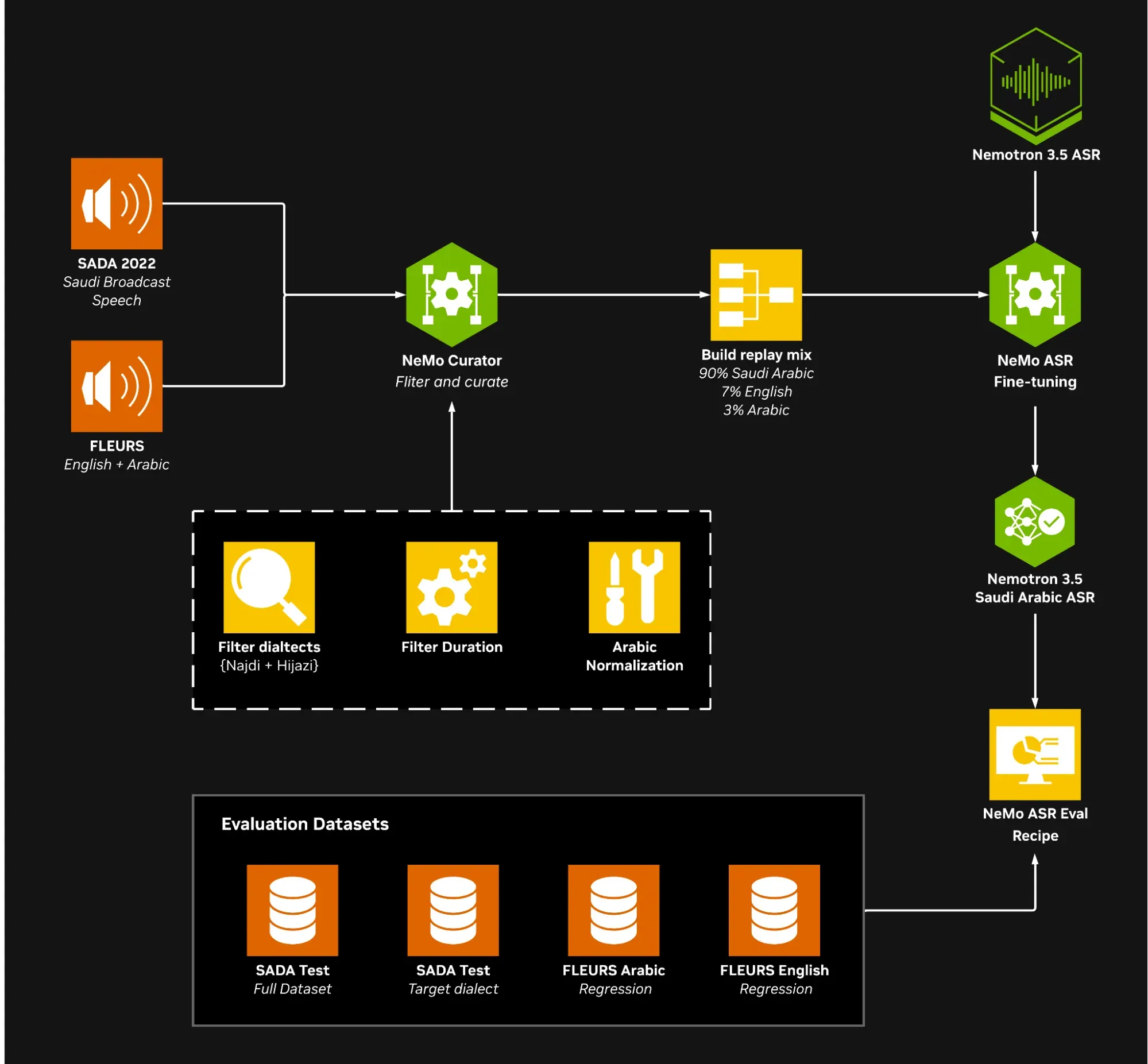
The numbers make the point. The structural checks retained 103,559 of 125,490 utterances — 133.7 hours, or 82.5% of the starting set. That is a deliberate, conservative pass that nonetheless kept the noisy and heavily dialectal audio, because the goal is stated explicitly: "remove structurally bad examples, not hard accents or noisy speech merely because the base model performs poorly on them." If you use automated quality scores, the post adds a warning that echoes through every speech project: inspect the distribution first — the SADA run found that a default UTMOS threshold of 3.0 would have rejected almost everything.
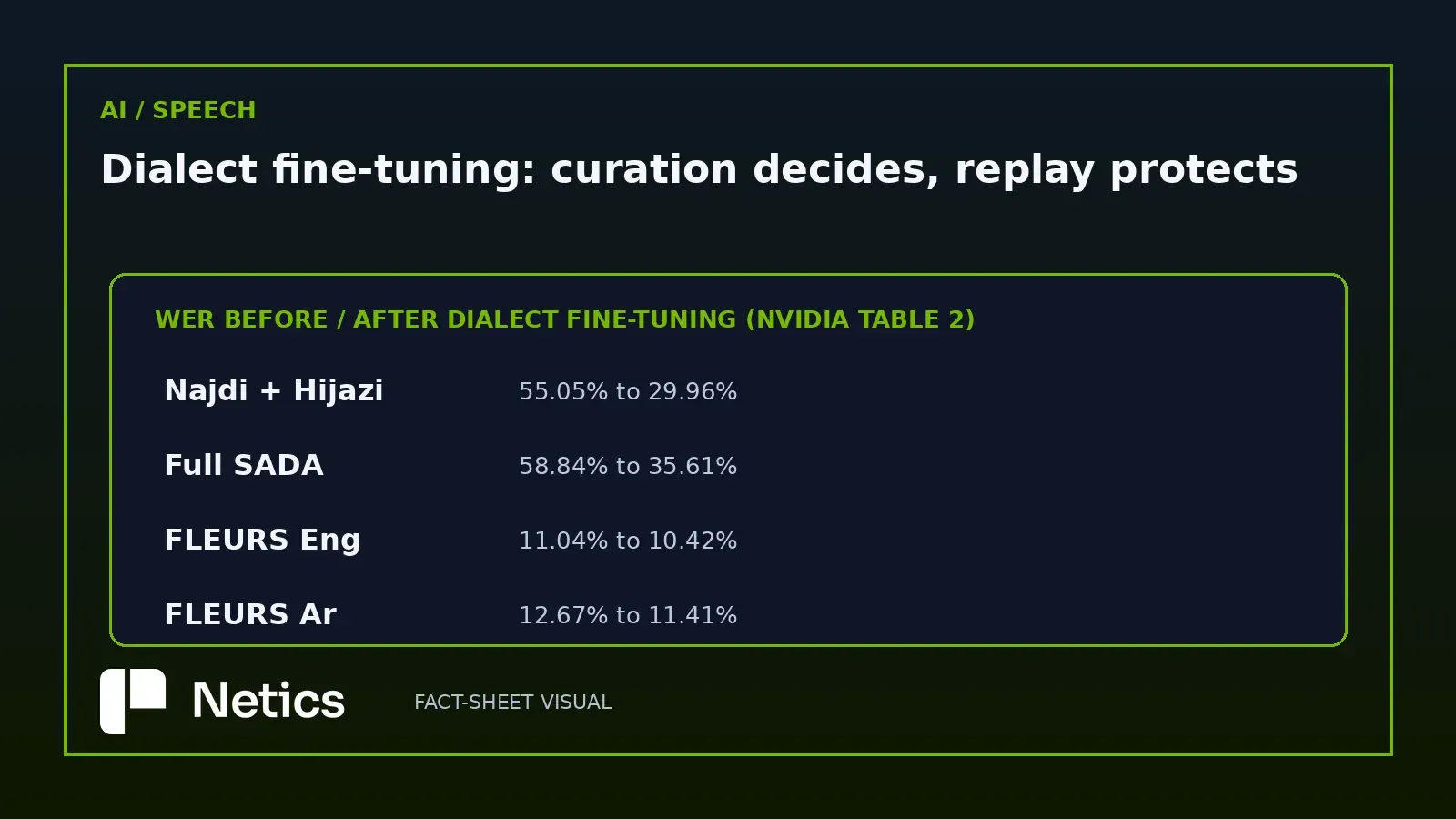
The evaluation method matters as much as the cleanup. NVIDIA split the work into an initial SADA-only experiment with a fixed validation split, then measured the full fine-tune on an independent test set plus FLEURS retention checks for English and Arabic. The before-and-after table is where the replay mix proves itself: SADA Najdi + Hijazi WER drops from 55.05% to 29.96%, while FLEURS English WER shifts only from 11.04% to 10.42% and FLEURS Arabic from 12.67% to 11.41%. The dialect improved dramatically and the retained languages barely moved — that is the replay mix doing exactly its job.
Adaptation depth: a trade you can measure
The post's fourth experiment answers the question every cost-conscious team asks: do you have to update the whole model? Nemotron 3.5 ASR has 24 encoder layers; a full fine-tune updates all of them, while partial unfreezing updates only the top N layers and always trains the decoder, joint network and prompt embeddings. The measured answer at 134 hours of target speech is unambiguous: "more trainable capacity was better at every step," and partial freezing costs 2.4 points against the full fine-tune.
That 2.4-point answer is more useful than any blanket recommendation, because it gives a decision rule: with roughly 134 hours of labeled speech you can afford the full encoder update; with less data, partial unfreezing becomes the risk-managed choice, accepting the 2.4-point tax for the stability of fewer changed parameters. The caveats the post prints at the top apply to every transfer: replay protects only what its data represents, partial unfreezing needs re-tuning when the mix changes, and the workflow does not generalize into evidence for every Arabic dialect or deployment environment.
What a production speech pipeline should copy
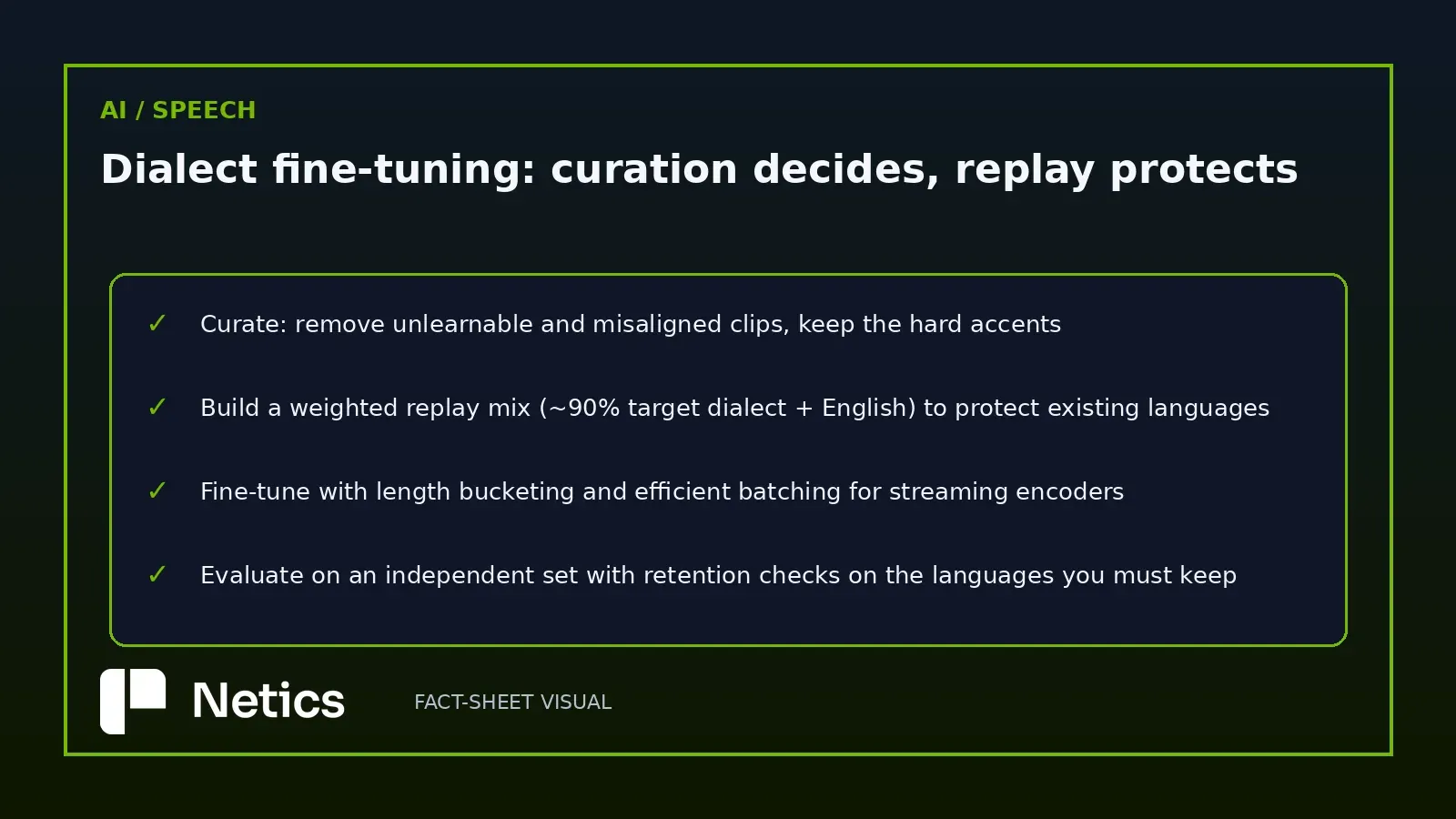
Strip the vendor context and the recipe is a portable sequence for any dialect or domain adaptation: select the dialects you actually intend to deploy; remove the clips the model structurally cannot learn and the ones that are probably misaligned; keep the hard accents; mix in a weighted slice of the languages you must retain; fine-tune with efficient batching — length bucketing alone "reduces padding and makes training practical for streaming encoders"; and evaluate on a set the tuning never saw, including retention checks on the languages you were afraid of losing.
Three details are worth copying even if you never touch Nemotron. First, the hardware honesty: the baseline experiment ran two 12,000 steps on NVIDIA RTX PRO 6000 Blackwell Workstation Edition GPUs — precise enough to reproduce. Second, the caveat framing: NVIDIA prints that "these are not universal defaults" and that the workflow "doesn't generalize into evidence for every Arabic dialect or deployment environment," which is the kind of limit statement that makes a vendor recipe trustworthy. Third, the extension path: the same post points to speaker diarization via the newly released Nemotron 3 Diarization, framing ASR adaptation as one step of a fuller pipeline.
The same discipline applies to the related languages and markets we work with in France and the Maghreb: a model that scores well on FLEURS-style benchmarks still has to prove itself on the dialects people actually speak, and the fix is a curation-and-replay loop, not a bigger model. That is the same argument this blog made about the 350M model that got better at structured output through its training loop: when the data pipeline and the loop are where the quality lives, the benchmark headline is the least interesting number in the room.
Sources
Source: Fine-Tuning NVIDIA Nemotron for Saudi Arabic Dialects, with a Path to Other Languages — developer.nvidia.com/blog, 2026-09-30 (all corpus counts, WER/CER figures, GPU configuration, unfreezing trade-offs and caveats quoted from the post; official Figure 1 and article page captured for visuals). Internal linkage: Structured output via the GRPO training loop. More AI engineering analysis on neticslabs.com.
Source: NVIDIA Technical Blog, 2026-09-30. Figures: official NVIDIA blog Figure 1 and article page, captured 2026-10-02.