
Meta MTIA 300 puts the network inside the training chip
Meta’s MTIA 300 makes communication a silicon-level concern with integrated RDMA NICs, message engines, near-memory reductions, and compiled HCCL collectives.

TL;DR
- Meta’s MTIA 300 is designed for recommendation and ranking-model training, where embedding tables can hold over 99% of model parameters and frequent AllReduce, AllToAll, and AllGather operations make communication a central constraint.
- The chip package integrates two network chiplets with 12 custom 800 Gbps RDMA NICs, delivering 1.2 TB/s of total I/O without crossing PCIe. Sixteen message engines and near-memory compute blocks handle collective communication away from the compute grid.
- Meta reports less than 0.5% compute-throughput degradation during concurrent GEMMs and collectives, plus 3.9-times-faster total communication than an equivalent GPU cluster on one 150-billion-parameter production recommendation model across 40 accelerators. Those are meaningful but workload-specific vendor results, not a general replacement claim.
- Netics’ view: the announcement is about a different bottleneck and a compiled, hardware-directed execution plane rather than a side effect competing with training cores. For infrastructure leaders, the practical takeaway is to measure message rate, host trips, topology, and compute interference—not only peak accelerator throughput.
The announcement is really about a different bottleneck
Meta’s August 24, 2026 engineering post presents MTIA 300 as the first member of its in-house accelerator family optimized for training ranking and recommendation models. The headline hardware detail is the built-in NIC. The more consequential idea is the premise behind it: for these workloads, communication is not merely the plumbing around compute.
Meta contrasts recommendation training with large language model training. Recommendation models can have embedding tables containing over 99% of their parameters. Their hybrid-parallel execution therefore generates frequent AllReduce, AllToAll, and AllGather collectives across hundreds of accelerators. On a conventional GPU design, Meta says, those operations run through resources that also execute training computation. The result can be expensive hardware that is present but underutilized while communication catches up.
The source is explicit about the scope. MTIA 300 is not presented as a universal accelerator for every model family. It is a design response to a communication-heavy recommendation and ranking workload. That distinction matters more than the launch language: the architecture starts with the traffic pattern, then chooses where networking and reductions belong.
Twelve NICs move the network past the PCIe boundary
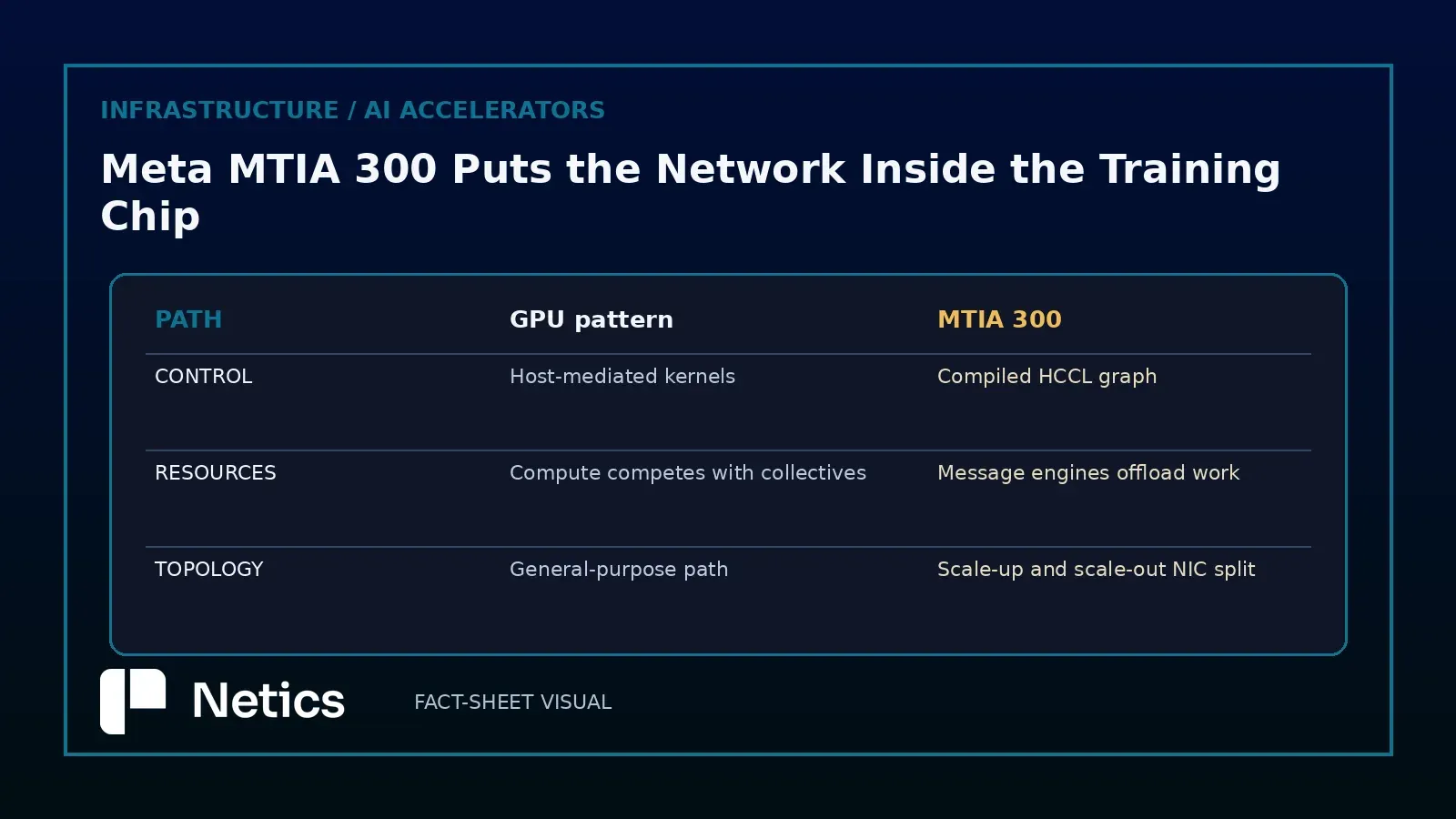
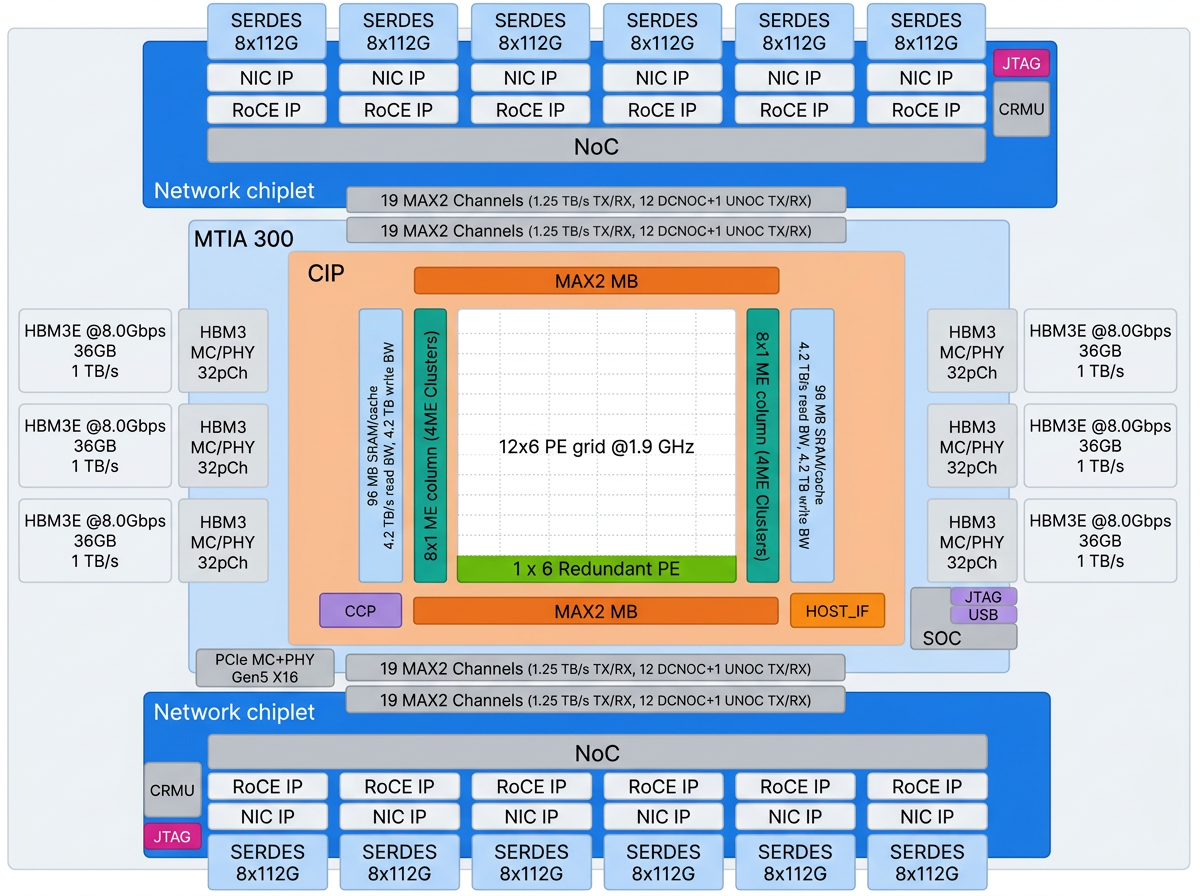
MTIA 300 puts the network interface inside the chip package. Its two network chiplets each contain six custom 800 Gbps RDMA NICs, for 12 NICs in total and 1.2 TB/s of total I/O bandwidth, without crossing a PCIe bus. Meta’s stated objective is to remove the host-device-NIC bottleneck associated with traditional GPU architectures, where the CPU mediates between accelerator and network.
The same 12 Ethernet-based NICs are used for two different communication scales. Within a rack of 16 nodes, scale-up communication can reach up to 1 TB/s. Across racks, scale-out communication is described at 200 GB/s. Meta says the NICs can be flexibly partitioned between those needs, with the split changed by reconfiguring the network rather than replacing hardware.
The flexibility is the architectural point to watch. A fixed accelerator-to-network boundary forces operators to provision around a presumed traffic pattern. An integrated, partitionable interface gives the system a way to reflect the topology it is actually using. It does not remove the physical difference between in-rack and cross-rack bandwidth; instead, it gives the communication software and network configuration a clearer place to manage that difference.
Meta also describes express doorbells for reducing transaction latency. The work-request write itself acts as the doorbell, eliminating an additional memory read and saving approximately 800 nanoseconds per operation, according to the source. For large transfers, that figure may be less important than sustained bandwidth. For frequent smaller messages, removing a memory-read round trip can become a more material design choice.
For infrastructure teams following the boundary between silicon and fabric, Netics tracks this kind of system-level shift because the performance question is no longer confined to the accelerator datasheet.
Message engines make communication an explicit subsystem
The chip pairs a 12-by-6 grid of processing elements with 16 dedicated message engines. The message engines handle communication independently of the compute grid. Each one contains an RISC-V core for orchestration, an NIC interface for routing requests to the appropriate NIC, and a near-memory compute block for reductions at 128 bytes per cycle.
The placement is deliberate. Meta puts the near-memory compute blocks at the chip edges next to HBM and cache. Collectively, those blocks deliver more than 2.8 TB/s of reduction throughput—over twice the stated I/O bandwidth. That relationship is necessary for line-rate execution of AllReduce and ReduceScatter without using the compute grid for the reduction work.
This is more than an offload feature in a library. The reduction engine, memory location, NIC path, and message-engine control plane are designed together. A library can schedule work efficiently, but it cannot create a second reduction datapath after the chip has been built. MTIA 300 makes that datapath part of the package’s identity.
Meta reports the resulting isolation in unusually concrete terms: concurrent large GEMMs and collective operations produce less than 0.5% degradation to compute throughput in its measurement, compared with over 20% degradation for traditional GPUs in the comparison. The figures are important evidence for the thesis, but the article does not supply enough detail to treat them as a universal benchmark. Readers still need the model, software versions, cluster configuration, and comparison methodology before translating the result into a purchasing decision.
HCCL turns collectives into a device-side program
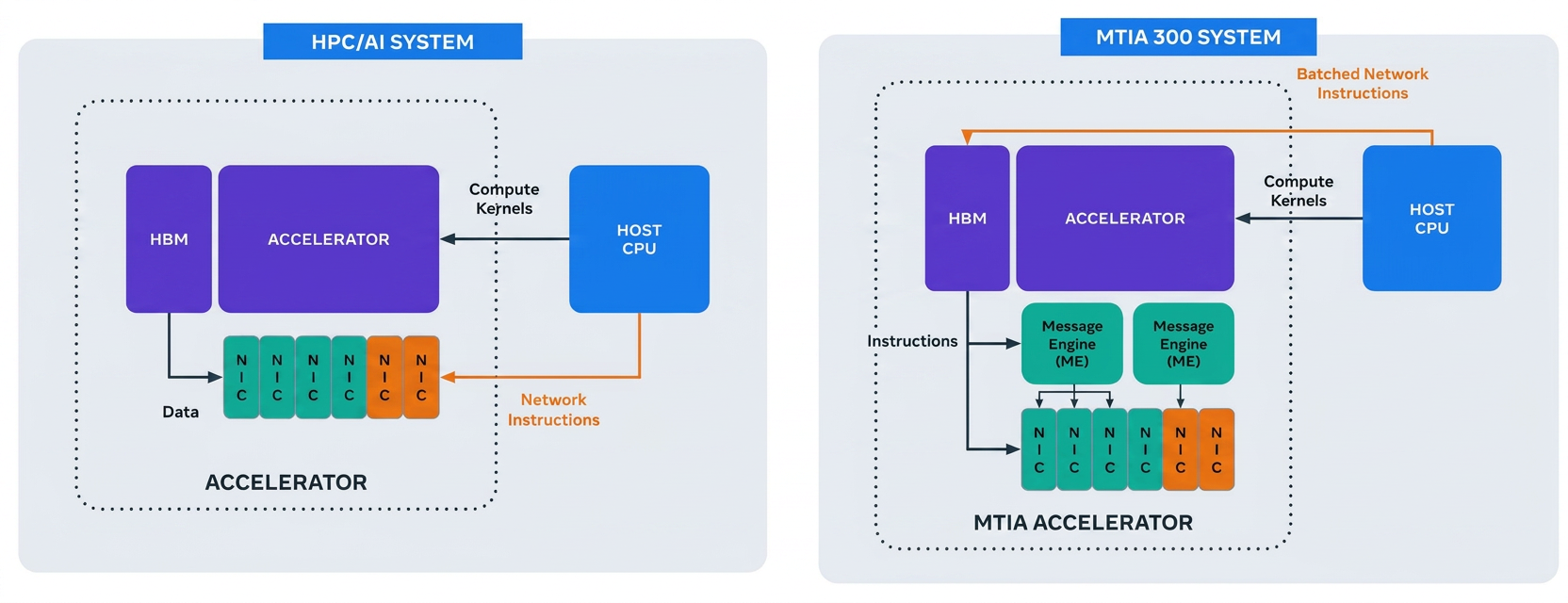
The hardware would be less useful if the host still had to orchestrate every collective. Meta’s HCCL communication library is co-designed with MTIA 300 and compiles each collective into a complete set of subgraphs: arrays of work-queue entries with explicit dependencies. Those subgraphs are dispatched to the message engines for autonomous execution. After the instructions are copied into HBM, Meta says, the host is no longer involved in execution.
This compiled-communication model fits into PyTorch’s c10d and torchcomms interfaces. Collectives traced through torch.compile can be compiled into one graph alongside compute operators. HCCL also chooses topology-aware algorithms that account for asymmetric scale-up and scale-out bandwidth, with the stated goal of limiting cross-rack traffic where bandwidth is constrained.
The software-hardware contract is the second half of the announcement. Integrated NICs without a communication compiler would still leave operators managing a collection of low-level paths. HCCL gives the accelerator a pre-arranged sequence of dependencies and a way to use the topology rather than merely expose it.
Meta also describes inference-specific paths: one-sided communication in which processing elements submit work directly through express doorbells, and device-triggered collectives in which compute kernels signal hardware-offloaded communication on a parallel stream without breaking graph execution. These capabilities are presented as part of the same design direction, although the production performance numbers in the post are centered on recommendation-model training.
The production numbers are useful—and bounded
Meta reports that HCCL reaches up to 940 GB/s of communication bandwidth within a single rack. On a 150-billion-parameter production recommendation model running across 40 accelerators, it says MTIA 300’s total communication time is 3.9 times faster than that of an equivalent GPU cluster.
The strongest reading is not “GPUs are finished.” It is that a communication-heavy workload can reward a platform that budgets silicon for networking, scheduling, and reduction rather than treating those activities as competition for general-purpose compute resources. The source does not define “equivalent GPU cluster” in the post’s summary, and it does not provide a cost, energy, availability, or total-training-time comparison. Those omissions set a limit on what the number can establish.
Meta identifies additional co-design effects. MTIA 300’s 216 GB of HBM3E supports larger local batch sizes, which can reduce trainer count and communication overhead. A 1:1 CPU-to-accelerator ratio allows CPUs to handle numerically intensive optimizer operations. High network bandwidth also gives Meta room to use higher-precision datatypes to maintain precision. These are system-level consequences, not isolated NIC features: memory capacity, CPU placement, network bandwidth, and datatype choice affect one another.
What infrastructure leaders should take from it
The immediate lesson is not to demand an integrated NIC in every accelerator. It is to measure communication as a first-class workload. Before comparing peak compute, teams should identify the collectives their models generate, the ratio of in-rack to cross-rack traffic, the size and frequency of messages, the amount of host orchestration, and the compute loss while communication runs.
The second lesson is to examine where the communication program lives. In MTIA 300, HCCL compiles dependencies and dispatches them to dedicated engines. A platform that exposes bandwidth but keeps collective progress host-driven may leave latency and CPU overhead on the table. Conversely, a compiled path can create its own software portability and debugging requirements; the source explains the model, but does not claim that migration is free.
Finally, keep the workload boundary visible. Meta says future inference workloads may produce smaller, more frequent, and more latency-sensitive messages, especially as reasoning, agentic, and long-context systems evolve. That is a forward-looking argument, not a measured MTIA 300 result. The defensible conclusion is narrower: designing around message rate and latency, alongside bandwidth, gives future systems more options than optimizing compute throughput alone.
Netics’ conclusion: communication belongs in the architecture review
MTIA 300 makes a persuasive case that communication can be a primary silicon design problem. Its integrated 12-NIC package, 16 message engines, HBM/cache-adjacent reductions, express doorbells, and compiled HCCL graphs form one coherent answer to a workload where moving data is inseparable from training the model.
The limits are equally important. The reported gains come from Meta’s own production context and a defined recommendation workload. The public post does not establish universal GPU superiority, total cost, or portability across model families. A careful buyer should treat the figures as a reason to inspect communication behavior—not as a benchmark shortcut.
The useful shift in perspective is this: when a training system is underperforming, the question is not only how many operations its compute cores can execute. It is also who owns the next message, where the reduction happens, how many host trips remain, and whether the network was designed as part of the machine from the beginning.
Sources
- Meta Engineering — MTIA 300: Meta’s First Training Chip with Built-in NICs and Communication-Offloading Engines, published August 24, 2026. Primary source for every Meta product detail, architecture description, and performance figure analyzed in this draft.
Source: MTIA 300: Meta’s First Training Chip with Built-in NICs and Communication-Offloading Engines — Engineering at Meta, August 24, 2026.