
iPhone Duo is here: Apple’s foldable bet turns the iPhone into a platform test
Apple has launched iPhone Duo, its first foldable iPhone, alongside iPhone 18 Pro. Netics examines the real opportunity: whether hardware, iOS 27, AI and app design can become one coherent p

TL;DR
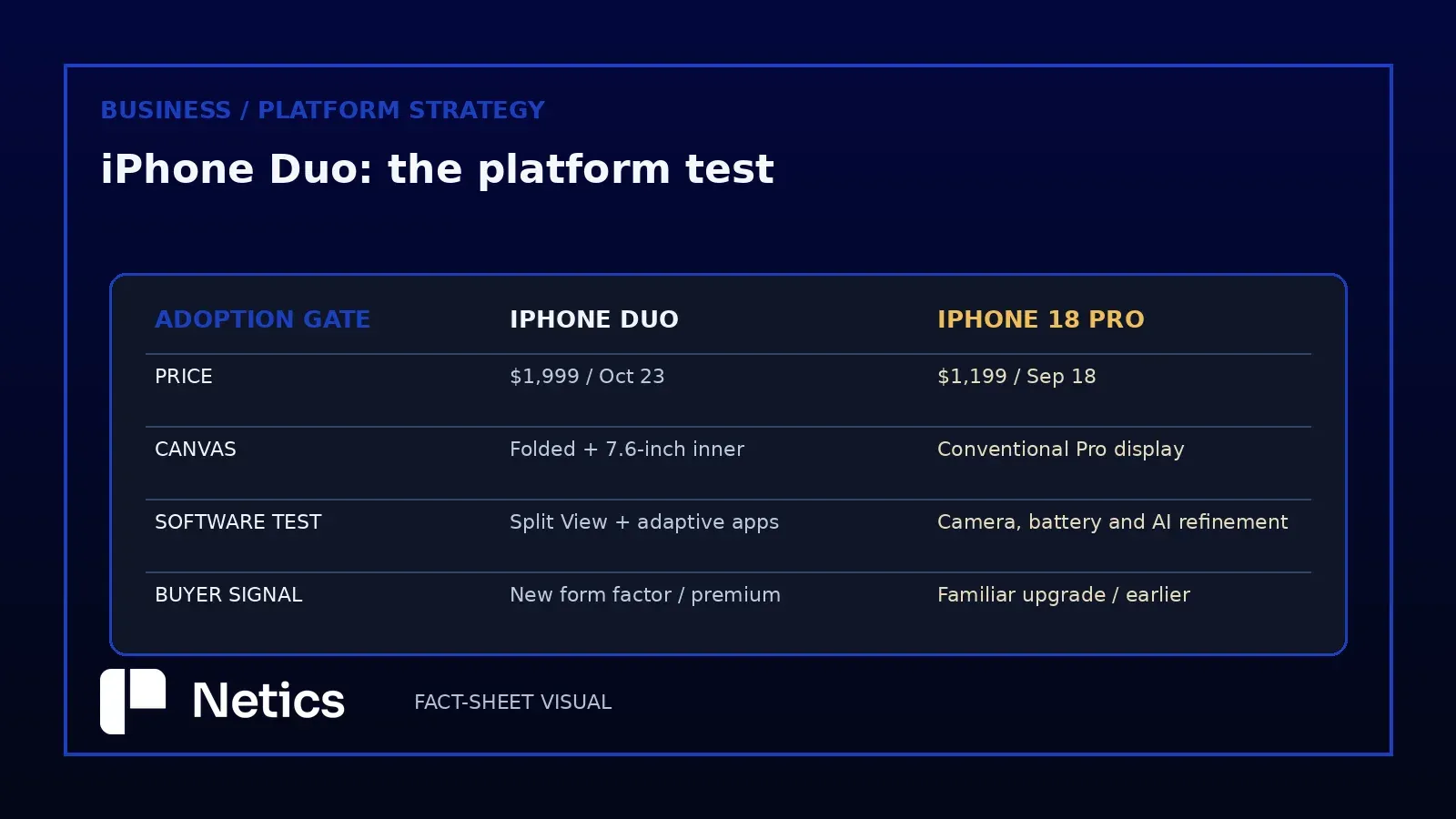
Apple has launched iPhone Duo, its first foldable iPhone, alongside iPhone 18 Pro and iPhone 18 Pro Max. Duo opens into a 7.6-inch display and closes around a 5.4-inch outer screen; it starts at $1,999, with pre-orders on October 16 and availability on October 23. The 18 Pro models arrive earlier, starting at $1,199, with pre-orders on September 12 and availability on September 18. The headline is hardware, but the strategic question is software: can Apple make the foldable screen, iOS 27, AI features and third-party apps behave like one coherent platform rather than an expensive novelty? That means asking what $1,999 changes about mainstream adoption, what developers and businesses should watch next, and whether the iPhone 18 Pro protects Apple’s conventional strategy while more screen improves—but does not solve—the AI experience.
Apple’s first foldable is deliberately more than a larger iPhone
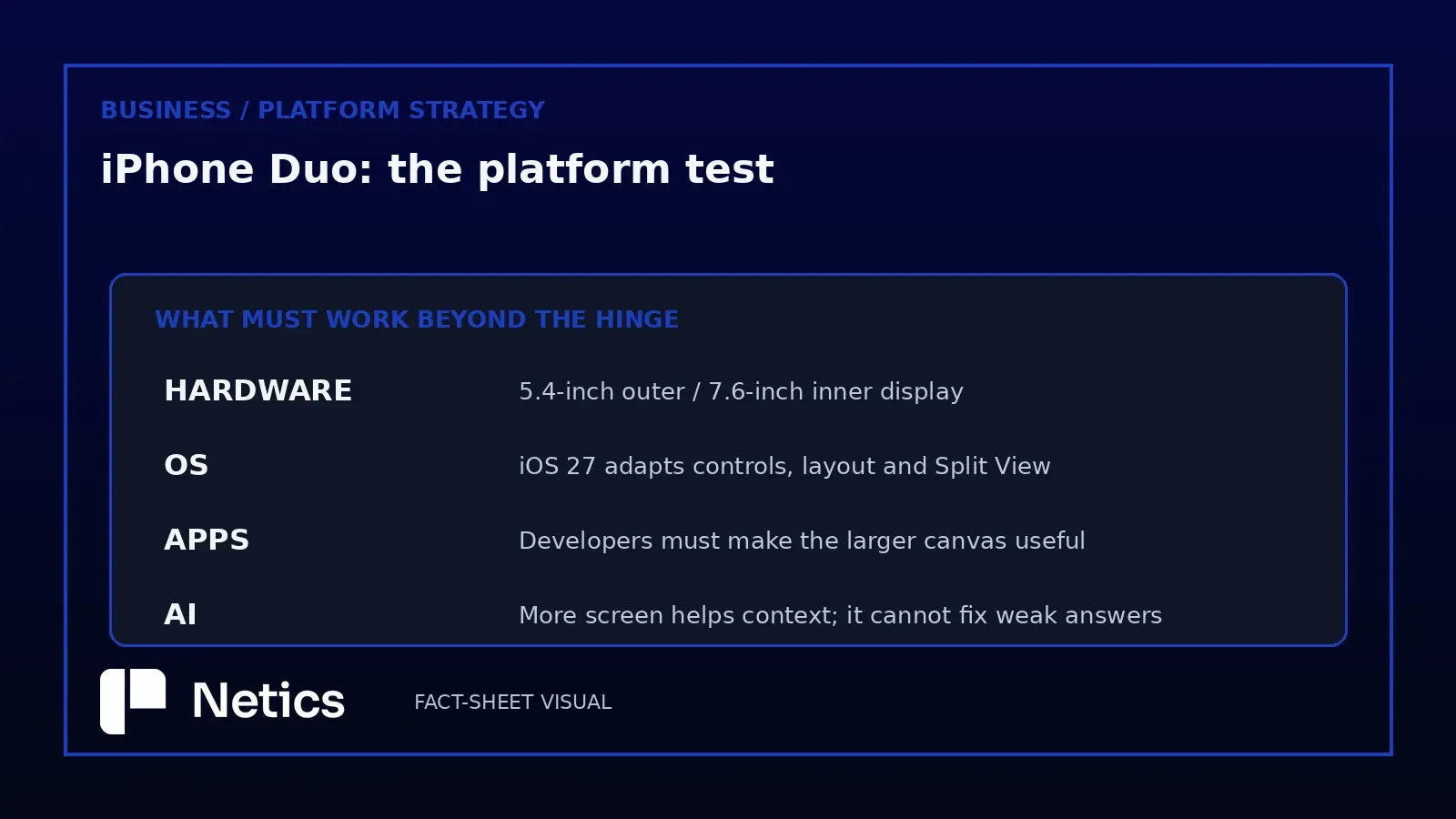
The iPhone Duo is a book-style foldable. Closed, it has a 5.4-inch outer Super Retina XDR display. Open, the inner Super Retina XDR display reaches 7.6 inches, with ProMotion, Always On and up to 3000 nits of outdoor brightness. Apple says the two displays share the same aspect ratio so content can move between them without feeling like it belongs to two unrelated devices.
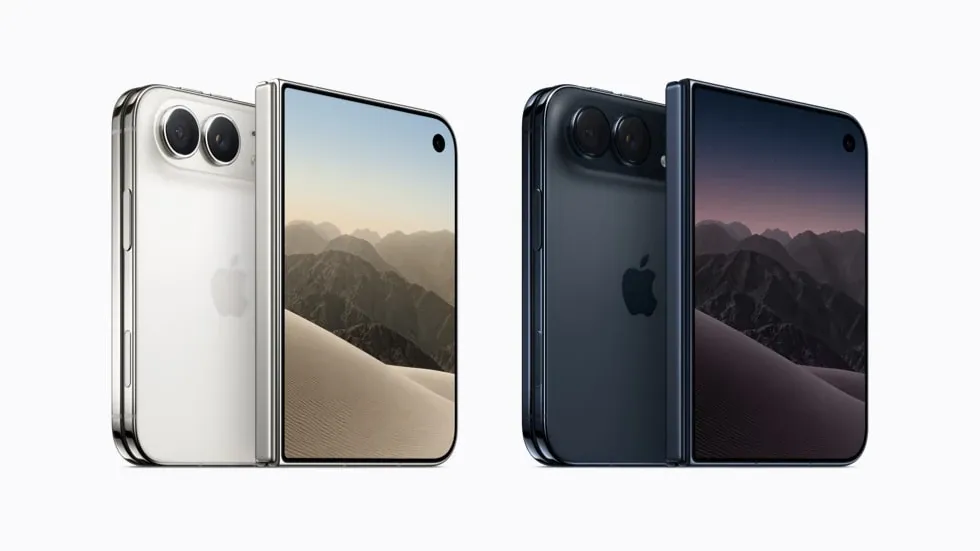
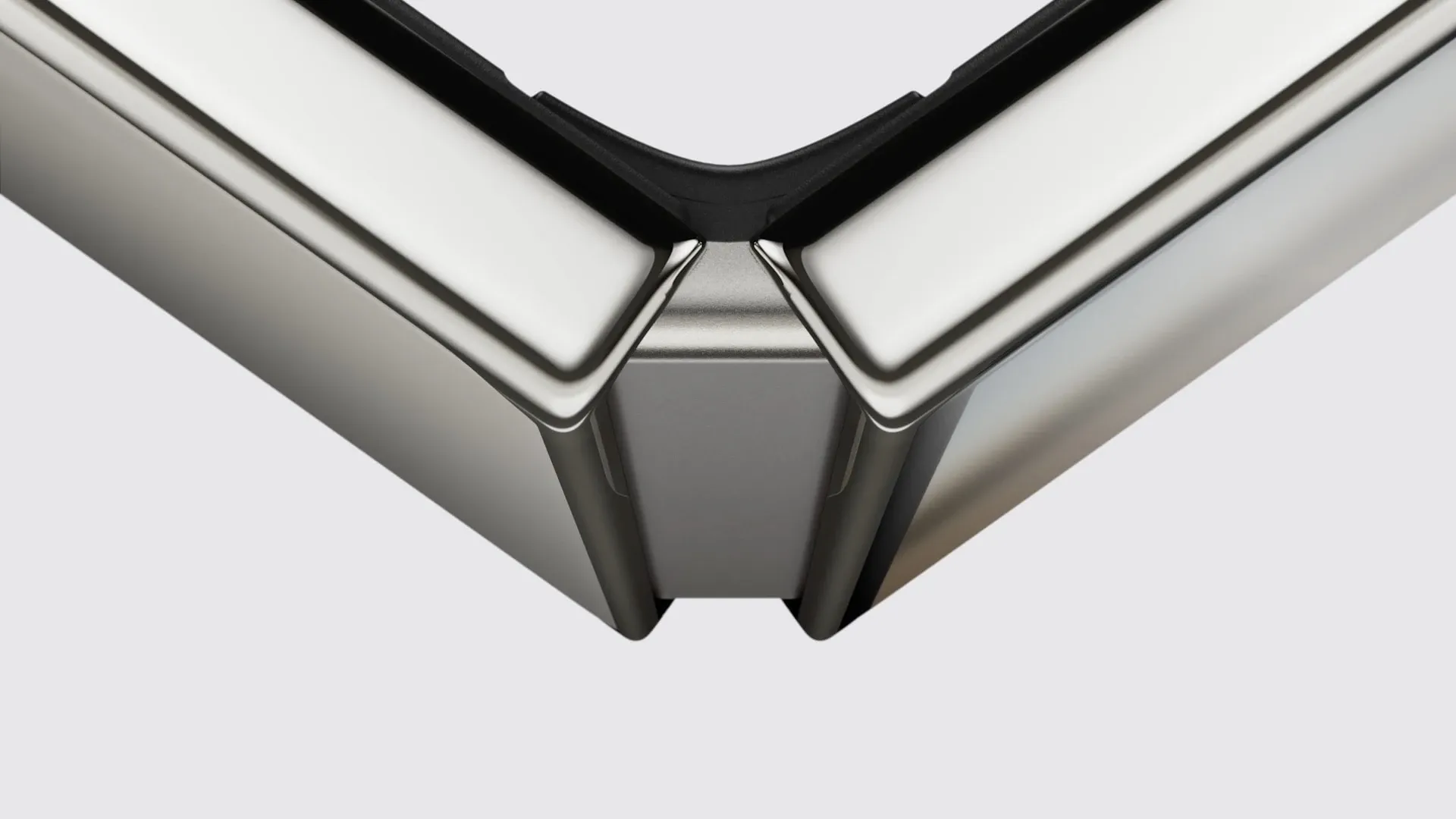
That continuity is important. Foldables have often asked users to tolerate a transition: one screen for quick tasks, another for serious work, with different proportions and different expectations. Apple’s pitch is that Duo should feel like one iPhone that changes scale. The nano-texture finish is meant to reduce glare and make the crease less visually dominant, while the hinge supports the centre of the display when the phone is open.
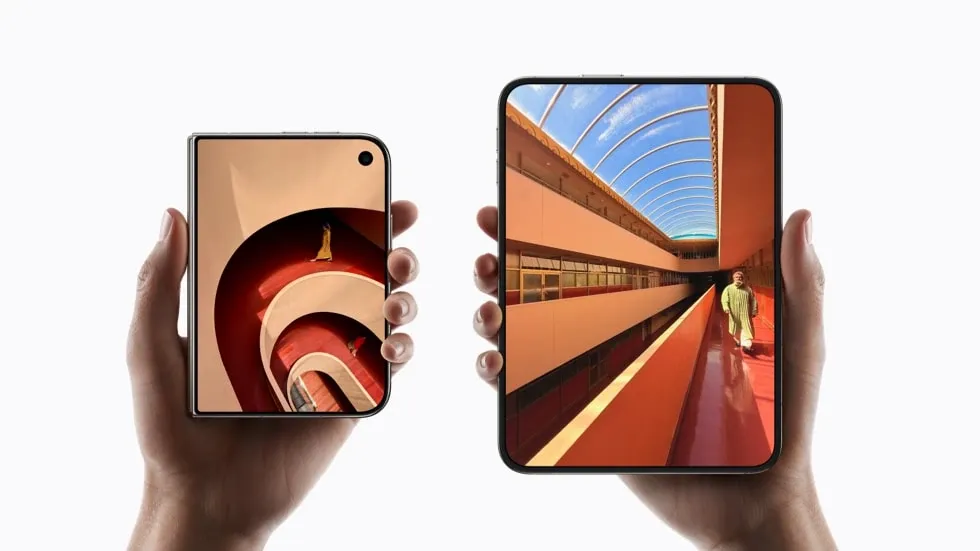
The specification story is also designed to remove familiar objections. Touch ID sits in the side button, Apple Watch can unlock the device, and the inner FaceTime camera stays hidden under the display until needed. Apple claims IP68 resistance and a titanium enclosure. Those details are not glamorous, but they are the difference between a demonstration device and something people might carry every day.
The real launch is iOS 27 plus an app ecosystem
The most consequential part of Duo is iOS 27’s adaptation to the wider canvas. Apple moves controls and navigation to the side to preserve vertical content space. When the phone is open, users can see two Home Screen pages with Today View, while the Dynamic Island is redesigned for the new orientation.
More importantly, Apple introduces Split View so two apps can run side by side. It also says Netflix, Zoom, Slack and other third-party apps are already adapting to the format. This is the point at which the launch becomes a platform test. The phone does not create value merely because its display is larger. It creates value if the larger display changes what users can do, and if developers can support that change without maintaining a permanently separate product branch.

Apple’s developer proposition is therefore as important as the hinge. Updated APIs, Xcode support and the ability to use two windows of the same app could make Duo useful for comparison work, content creation, communication and research. But the adoption loop has a condition: developers need enough users to justify adaptation, while users need enough adapted apps to justify paying a premium. Apple is trying to break that loop with its installed base and design authority.
$1,999 changes the meaning of “mainstream”
iPhone Duo starts at $1,999 in the United States, with storage options from 256GB to 2TB. That price places it above the iPhone 18 Pro range and turns the first generation into a premium signal rather than an immediate mass-market replacement.
The price can serve three purposes at once. It can recover the cost and risk of a new hinge, dual-display system and custom thermal design. It can create a halo product that pulls attention toward the wider iPhone range. And it can provide Apple with a controlled way to measure demand before it reduces the cost of later generations.

For businesses and app teams, the important question is not whether every customer will buy Duo. It is whether Duo becomes a visible enough executive, creator and power-user device to influence product expectations. A collaboration app that works well in Split View may be more valuable to those users than a generic app with a stretched layout. A retail or travel workflow that uses the inner display for comparison and the outer display for quick confirmation may justify targeted adaptation even if the installed base remains small.
That is a different calculation from “support every screen.” Teams should watch actual usage, task completion and retention before building a separate foldable experience. Responsive design is the starting point; a Duo-specific interaction model is an investment that needs evidence.
iPhone 18 Pro makes the conventional upgrade more defensible
Alongside Duo, Apple announced iPhone 18 Pro and iPhone 18 Pro Max. The Pro models use the A20 Pro chip, a next-generation vapor chamber, a smaller Dynamic Island and iOS 27 with Apple Intelligence and Siri AI. The main camera gains a variable aperture, while Apple positions the Pro Max around major battery-life gains.
The 18 Pro launch matters because it prevents the foldable from carrying the entire event. Customers who want the conventional premium iPhone can get a camera and performance upgrade from September 18. Customers who want the new form factor pay substantially more and wait until October 23. Apple is separating the products by use case rather than forcing one to replace the other.
The camera story also shows Apple’s broader direction. Duo adds a 48MP Fusion Main camera, a 48MP Fusion Ultra Wide camera, optical-quality 2x telephoto and 4K120 Dolby Vision capture. The foldable design lets users prop the phone for time-lapse and use the two displays in new ways. These are meaningful capabilities, but they also increase the amount of software Apple must make feel predictable across orientations.
AI gets more screen, but not a free pass
Apple connects both launches to Apple Intelligence and Siri AI. Duo’s larger display gives an assistant more room to coexist with another app, and Apple describes workflows where Siri can help while users continue looking at content. The device also introduces features such as image editing, Call Context and on-device AI capabilities through Apple’s software stack.
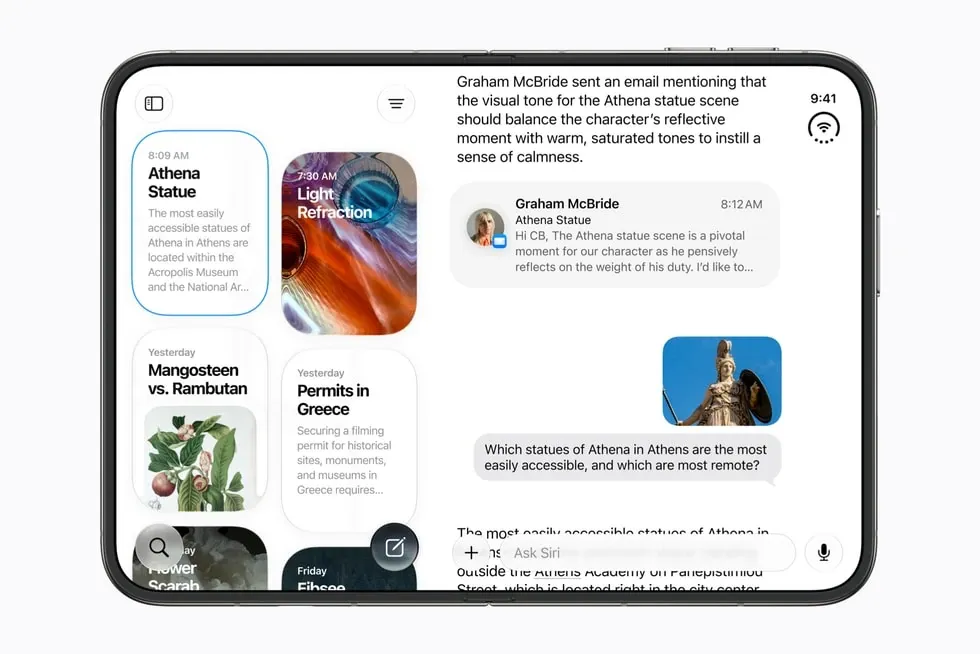
The larger canvas may make AI interactions more practical. A user can ask for help, inspect a result and continue working without constantly switching contexts. But the foldable does not solve the harder AI problem: whether the assistant is accurate, useful and trustworthy enough to become part of daily work. A larger screen can improve the interface; it cannot compensate for weak answers or unclear privacy boundaries.
For organizations, the sensible approach is to evaluate Duo as a workflow surface, not as proof that mobile AI has arrived. The questions remain familiar: what data leaves the device, which actions require confirmation, how are generated results checked, and what happens when the assistant misunderstands the user?
What developers and businesses should watch next
Netics’ view is that iPhone Duo is important because it combines several platform bets in one device: foldable hardware, adaptive operating-system layout, app multitasking, camera rethinking and personal AI. The hinge is the visible innovation. The durable value will be decided by the less visible layer underneath.
First, measure whether major apps use the inner display for genuinely different tasks rather than simply scaling up. Second, watch whether developers can share enough code and design logic between standard iPhone and Duo. Third, test whether AI workflows remain understandable when the assistant, another app and a larger canvas compete for attention. Finally, keep the economics reversible. Do not build a bespoke foldable path until real users demonstrate that it changes conversion, retention, productivity or revenue.
Apple has made the first move. The opportunity for the ecosystem is not to imitate the foldable shape; it is to identify the workflows where more screen, better multitasking and contextual AI produce a measurable advantage. If that advantage appears, Duo becomes a new platform surface. If it does not, it remains an impressive—and very expensive—demonstration of Apple’s ability to enter a category late and redefine its terms.

For more analysis of how AI changes product and operational decisions, visit the Netics homepage.
Sources
- Apple Newsroom — Apple unveils iPhone Duo — primary source for Duo specifications, software features, pricing, availability and official media.
- Apple — iPhone Duo — official product page.
- Apple Newsroom — Apple debuts iPhone 18 Pro and iPhone 18 Pro Max — primary source for Pro specifications, pricing and availability.
- Apple iPhone 18 Pro official media package — original press images used for editorial research.
- Apple official Newsroom product images used throughout this article: colors, display sizes, gallery views of camera, Siri AI and Netflix, plus the official comparison media.
- Apple launch video — Introducing the new iPhone 18 Pro
- Apple launch video — September ’26 event recap
- Apple launch video — iPhone Duo
- Apple launch video — iPhone 18 Pro
Source: Apple Newsroom original product imagery and official launch materials, accessed 2026-09-09.