
iPhone 18 Pro Max Makes Battery Endurance and 2TB Storage a Procurement Question
Apple claims up to 45 hours of video playback, six more hours than iPhone 17 Pro Max, faster charging, and a 2TB option. Netics examines what that changes.

TL;DR
Apple’s iPhone 18 Pro Max announcement puts two unusually concrete numbers at the center of the buying conversation: up to 45 hours of video playback and a six-hour improvement over iPhone 17 Pro Max. Apple also says five minutes of wired charging can provide around seven hours of video playback, while the lineup reaches 2TB of storage. Those are Apple claims, measured on preproduction hardware or under Apple’s stated usage model; they are not independent test results. Netics’ reading is that the Pro Max is being positioned less as a phone that merely lasts longer and more as a mobile endpoint with a wider operating buffer. For individuals, that can change how often a long day becomes a charging problem. For businesses, the meaningful question is whether the extra endurance and local capacity simplify a real workflow enough to justify the premium configuration. The Pro Max therefore targets a specific buyer: someone whose mobile work genuinely combines long stretches away from power with substantial local data.
Apple is selling a larger operating margin
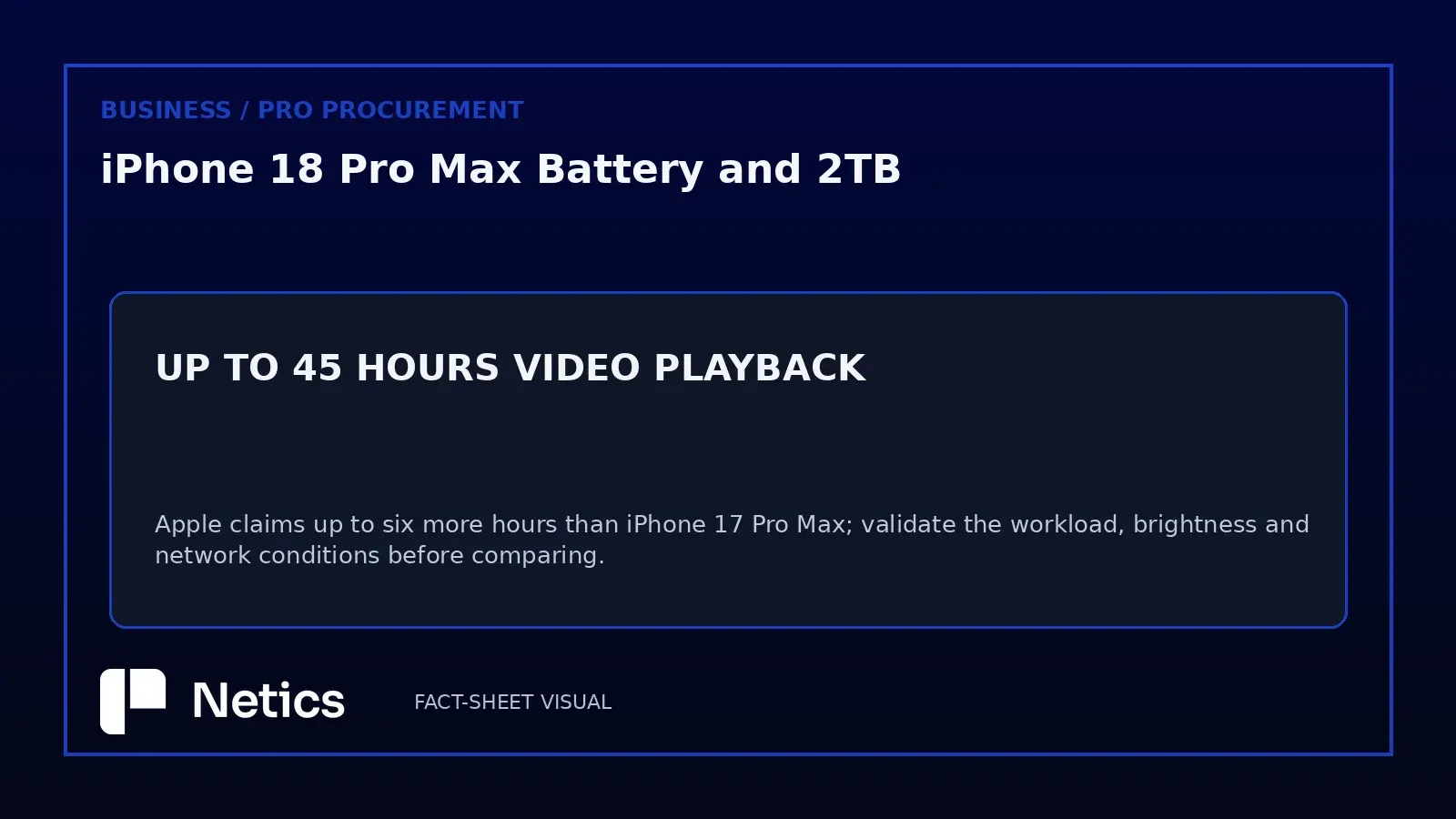
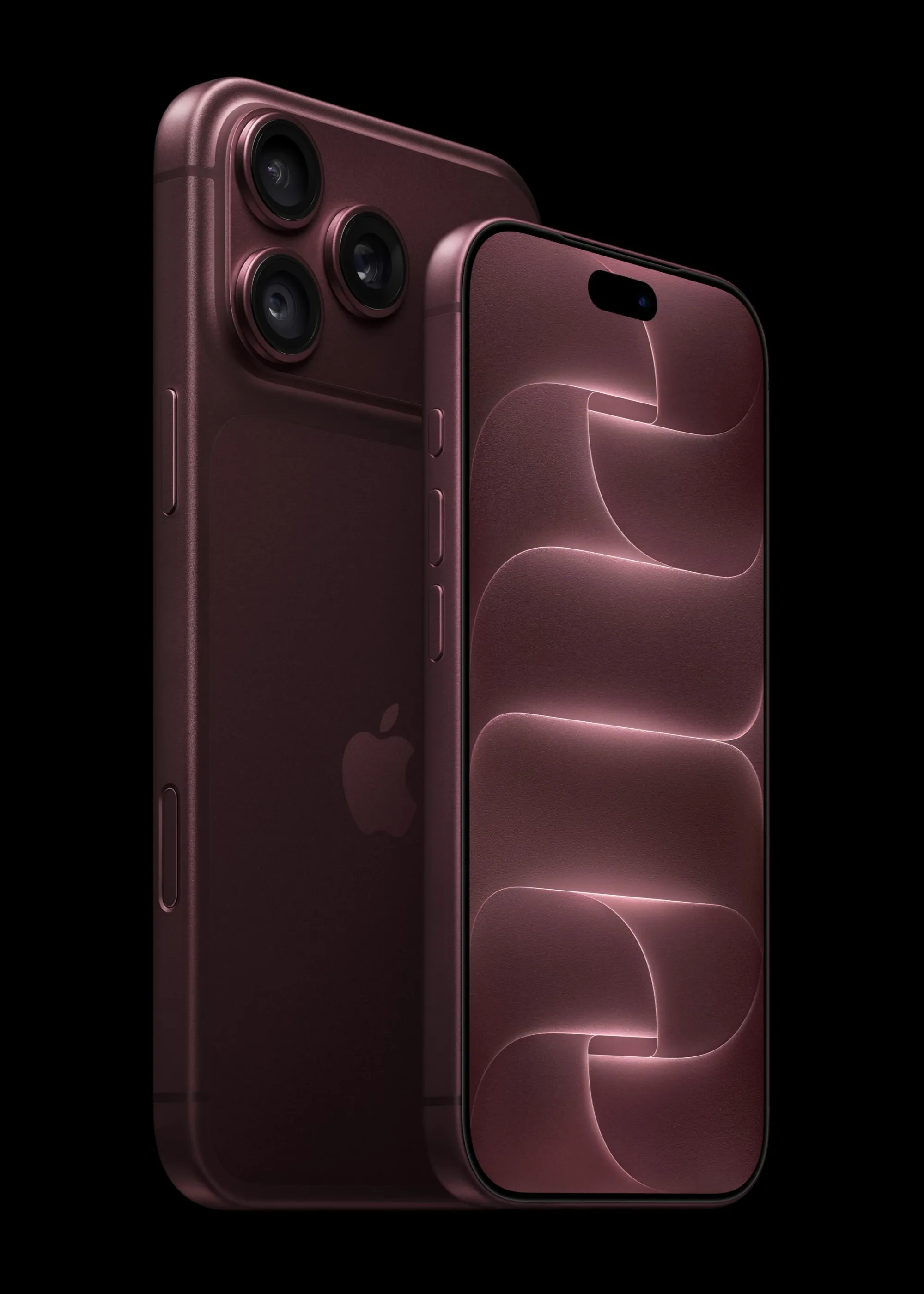
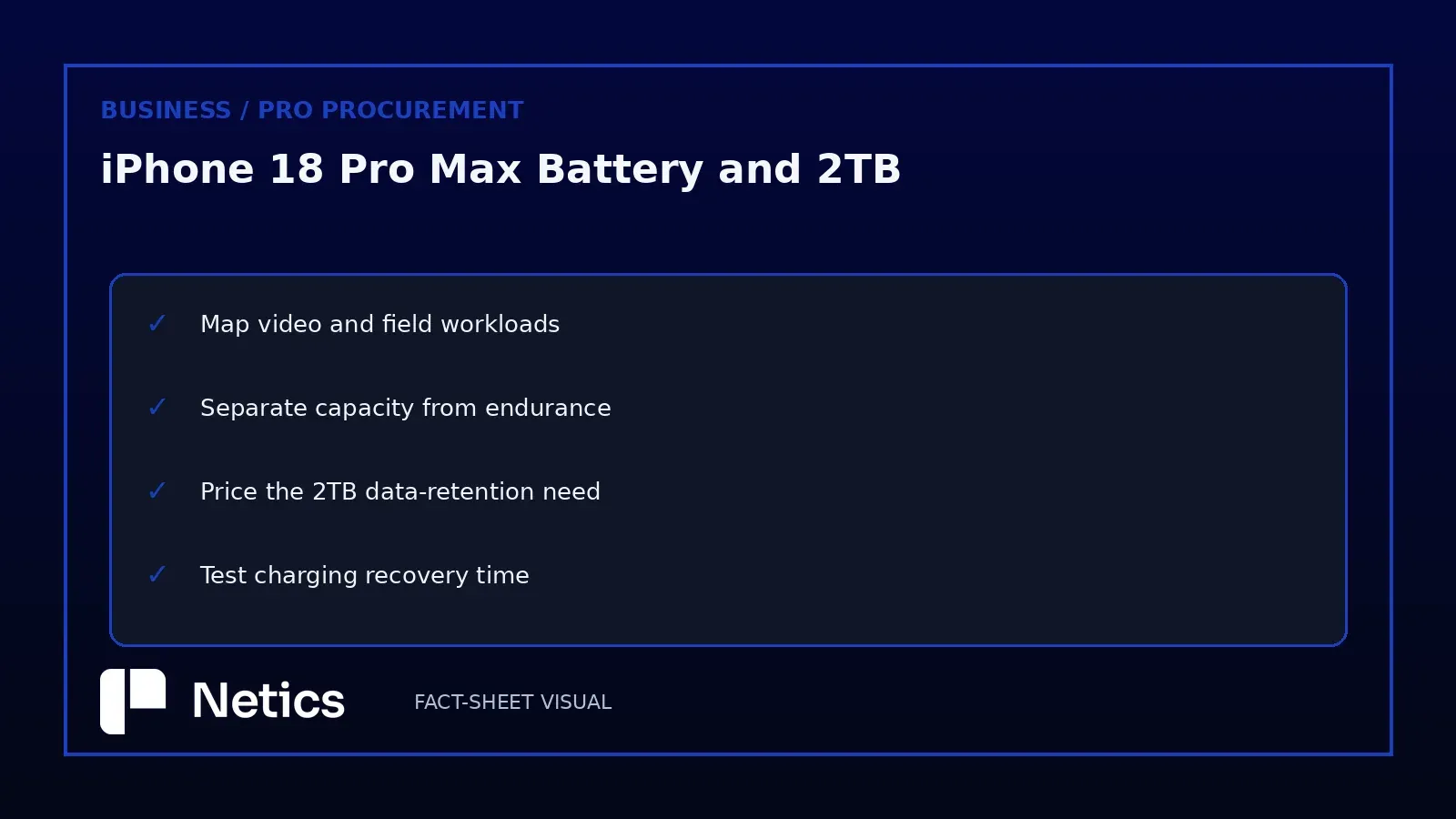
Netics visual: the diagram turns the launch claim into an operational question.
The headline is not simply “45 hours.” Apple’s product page describes the iPhone 18 Pro Max as offering up to six more hours of video playback than iPhone 17 Pro Max, and Apple’s newsroom says the Pro Max delivers its largest increase in battery life on an iPhone. The two statements work together: the claim is both an absolute ceiling and a generational comparison.
A distinction matters because a ceiling is not a promise about every workday. Video playback is a defined test activity, not a universal proxy for navigation, camera use, calls, gaming, cellular conditions, or background synchronization. Apple’s footnote says its battery-life testing used preproduction iPhone 18 Pro and iPhone 18 Pro Max units and software, LTE and 5G networks, and a representative usage profile. Apple also says actual results vary with use, configuration, cellular network, signal strength, and other factors.
The responsible reading is therefore narrower and more useful: Apple is claiming a materially larger endurance envelope. Netics would not turn that into a guaranteed number of office hours. We would turn it into a procurement question: which workflows currently fail when a device reaches a low battery, and what does that failure cost?
The six-hour gain is valuable because interruptions are expensive
A six-hour generational gain sounds like a specification until it is placed inside a day. A field employee recording evidence, a manager travelling between sites, or a creator working away from a desk does not experience battery capacity as a laboratory metric. The practical unit is an avoided interruption: fewer searches for an outlet, fewer decisions about which app can remain active, and less dependence on a power bank.
This is an analytical implication, not an Apple-measured business outcome. The sources do not report productivity gains, failure rates, or total cost of ownership. Still, the direction is clear enough for a buyer to test. Map the moments where a device is unavailable, then ask whether a larger endurance buffer changes the operating procedure. If the answer is no, the six-hour figure is mostly comfort. If the answer is yes, it becomes part of a device-policy decision.
Apple attributes the battery-life advance to new battery designs, powerful silicon efficiencies, and, for Pro Max, a larger battery. That explanation is important because it avoids treating endurance as a software promise alone. At the same time, it does not tell us how the balance behaves after months of use or under every enterprise workload. Those questions require independent testing and the organization’s own fleet data.
Faster charging changes the recovery pattern
Endurance and charging are different controls. A bigger buffer delays the low-battery event; faster recovery reduces the duration of the event when it arrives. Apple says five minutes of wired charging on iPhone 18 Pro Max provides around seven hours of video playback. The product page also says iPhone 18 Pro reaches up to 50 percent in around 15 minutes with a compatible power adapter, and labels faster wired charging as a lineup feature.
The Pro Max’s five-minute statement is the sharper operational claim for this article. It describes a quick top-off, not a complete charging cycle. Apple’s testing footnote says wired fast charge requires a 60W-capable USB-C cable and a USB Power Delivery 3.1-or-better adapter with Adjustable Voltage Supply; the required adapter or cable may be sold separately. Charge time varies with adapter, settings, usage, and environmental factors.
The qualification should shape deployment. A company cannot simply approve the handset and assume the recovery experience exists everywhere. Charging cables, compatible adapters, desk layouts, vehicles, travel kits, and shared workspaces become part of the policy. The device claim is only one component of the charging system.
2TB is a local-capacity decision, not just a bigger number
Apple lists iPhone 18 Pro and iPhone 18 Pro Max in 256GB, 512GB, 1TB, and 2TB capacities. The 2TB option is the second half of the Pro Max positioning. Endurance answers “how long can the endpoint remain active?” Capacity answers “how much material can it hold before the workflow must move or delete something?”
The sources do not specify a 2TB-only feature, a price, or a guaranteed number of hours of recorded media. Netics will not invent those values. The sensible interpretation is that Apple is giving buyers a very large local-storage tier for workflows that accumulate substantial files. That may be relevant to people who keep large media libraries or work with locally stored capture assets, but the business case depends on actual file policy, backup, synchronization, and retention rules.
A 2TB phone can reduce transfer pressure in a workflow; it can also increase the amount of data that must be protected. More local capacity is not a backup strategy. It does not replace a tested copy, access control, retention schedule, or a recovery path. The correct enterprise question is not whether 2TB sounds professional. It is whether the organization can govern the additional local data without creating an unmanaged pocket of risk.
The Pro Max fits a specific buyer, not every buyer
For an individual, the value proposition is coherent when long stretches away from power coincide with heavy local-data use. The buyer gets Apple’s claimed 45-hour video-playback ceiling, the claimed six-hour improvement over the previous Pro Max, a rapid top-off claim, and a 2TB choice. Those benefits are strongest when the buyer actually spends time filming, travelling, reviewing media, or keeping large files on the device.
For a business, the decision should be segmented. A mobile role that depends on continuous capture may care about endurance and capacity together. A desk-based role with reliable charging and centralized storage may gain little from 2TB. A shared fleet may value the five-minute recovery claim only if compatible charging equipment is standardized. Procurement should compare those scenarios rather than order the largest configuration by default.
This is also where Apple’s own testing language matters. Apple says the 30-hour “use per charge” figure is based on a new battery usage model that uses real-world data and a representative profile including messaging, photos, music, social media, video streaming, games, web browsing, and navigation. That is informative, but it remains Apple’s model and testing. A fleet decision should pilot representative roles, record charge events and storage growth, and keep the result separate from the vendor headline.
Netics’ position: buy the buffer only when you can govern it
The iPhone 18 Pro Max is being positioned around a practical form of excess: more time before charging, faster recovery after a short charge, and more local room before storage becomes a constraint. Apple’s claims make that positioning unusually easy to understand. They do not eliminate the need for verification.
Our recommendation is conditional. Buyers with genuine long-duration, media-heavy or travel-heavy workflows should evaluate the Pro Max against their interruption costs, and should include the 2TB tier in the comparison rather than dismissing it as a vanity specification. Enterprises should test the complete system: device, adapter, cable, storage policy, backup, fleet support, and security controls. Everyone else should resist paying for a theoretical buffer that their workflow never uses.
The right purchase is not the device with the biggest number. It is the configuration whose endurance and capacity solve a named operational problem without creating a larger data-governance problem. For more practical technology and infrastructure analysis, visit the Netics homepage.
Sources
- Apple iPhone 18 Pro Newsroom media package — Apple, accessed 2026-09-10.
- Apple Newsroom — Apple debuts iPhone 18 Pro and iPhone 18 Pro Max, published September 9, 2026. Primary source for Apple’s battery, charging, storage, and testing claims.
- Apple — iPhone 18 Pro and iPhone 18 Pro Max. Primary product page for the six-hour comparison, up to 45 hours of video playback, 30 hours of use, charging claims, and capacity positioning.
Source: Apple Newsroom, 9 September 2026 — https://www.apple.com/newsroom/2026/09/apple-debuts-iphone-18-pro-and-iphone-18-pro-max/