
A20 Pro puts sustained performance at the centre of iPhone 18 Pro
Apple’s A20 Pro combines a 2nm process, a dual 16-core Neural Engine, higher memory bandwidth and vapor cooling. Netics explains what remains to be measured.

TL;DR
Apple’s iPhone 18 Pro announcement makes a hardware point that is more important than a peak benchmark: A20 Pro and a next-generation vapor chamber are presented as a system for the highest sustained performance in iPhone history. The product page adds the mechanism around that claim: a two-nanometer process, new Neural Accelerators, a Dual 16-core Neural Engine with two times the compute, 50 percent higher memory bandwidth and a packaging design that places silicon beside memory to improve heat flow. Netics’ position is straightforward: these are promising design signals, not independent test results. The meaningful question is how long the phone can maintain useful throughput during an AI workload, and under what temperature, power and software conditions.
Apple is selling time under load, not just a faster opening burst
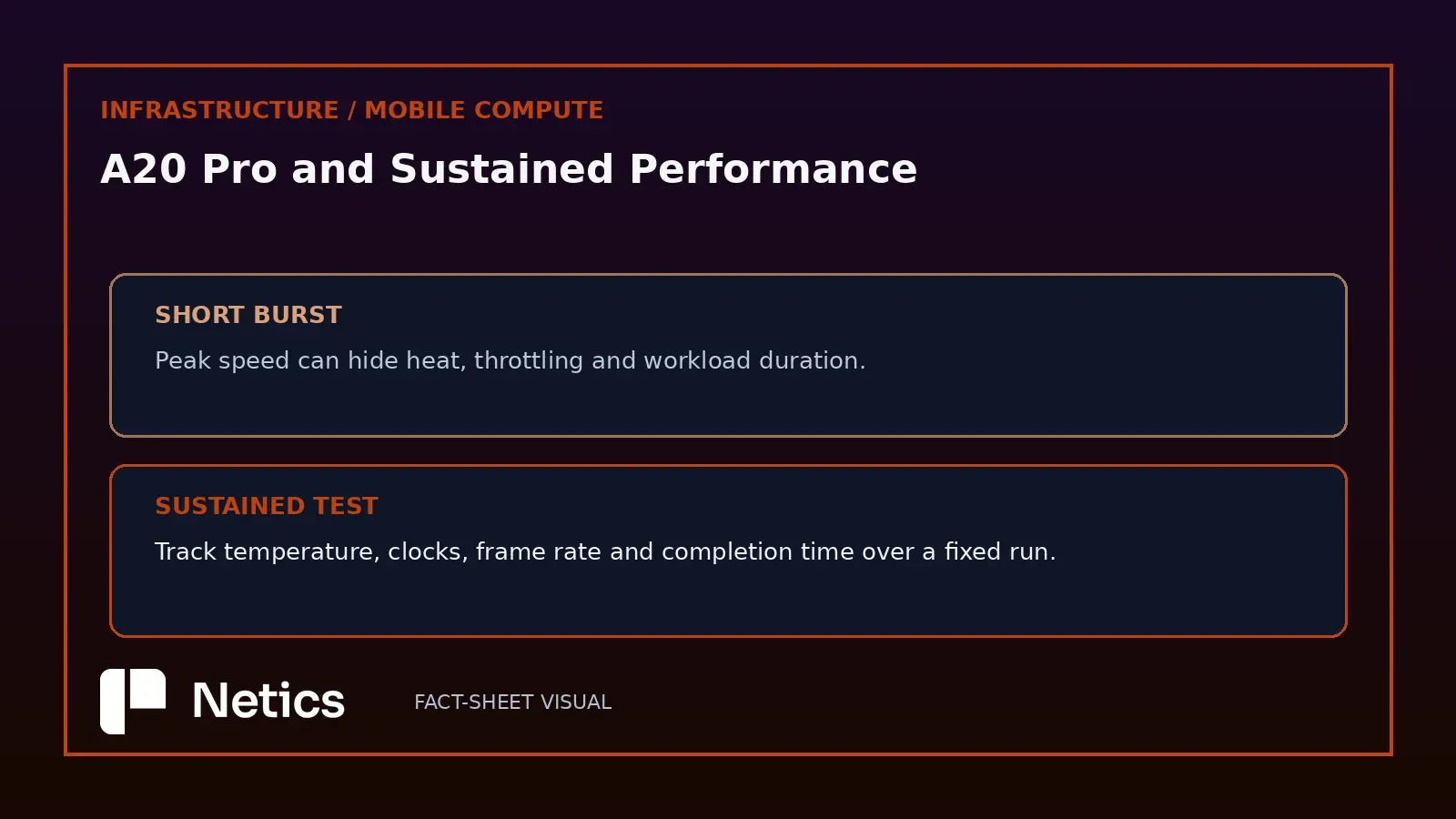
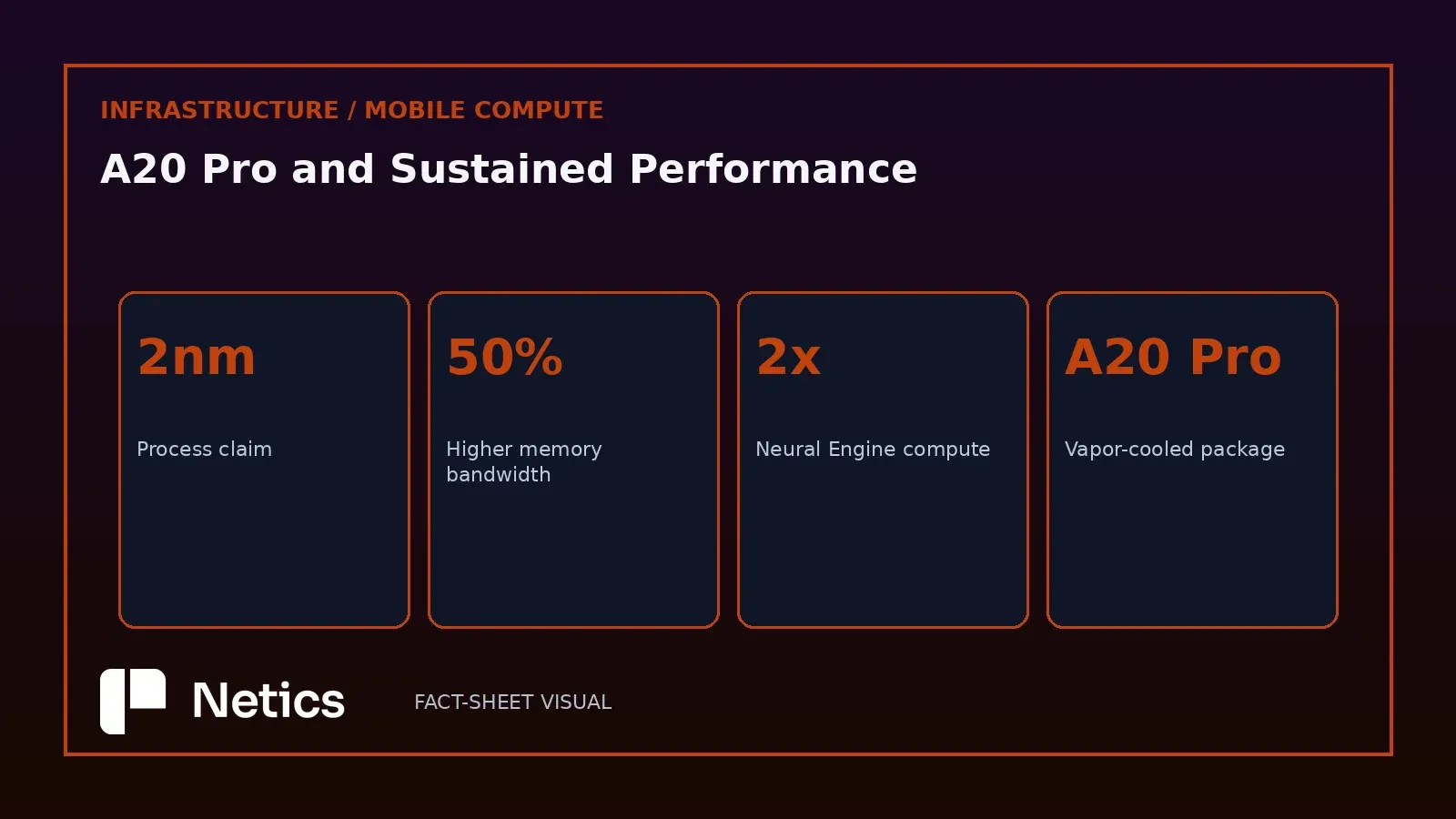
Netics visual: the diagram turns the launch claim into an operational question.
Apple announced iPhone 18 Pro and iPhone 18 Pro Max on September 9, 2026. In the release, the company connects A20 Pro and a next-generation vapor chamber to what it calls the highest sustained performance in iPhone history. That word, sustained, changes the evaluation. A short burst can demonstrate that a processor reaches a high level of output. A sustained result asks whether the device can keep delivering useful output after heat has accumulated and the system has had to manage its power budget.
This distinction matters for the workloads Apple highlights around intelligence. A prompt response, a brief image transformation or a small on-device operation may finish before thermal limits become decisive. Repeated generation, extended media processing, local model work or a long sequence of AI operations creates a different engineering problem. The phone has to move data, perform computation and dispose of heat repeatedly. Apple’s announcement gives us the architecture direction; it does not give us a third-party duration curve.
That is why Netics reads the vapor chamber as part of the performance story rather than as an accessory specification. The claim is not simply that A20 Pro can be quick. The claim is that the surrounding thermal system helps the phone remain quick for longer.
What the 2nm process does — and what Apple has not quantified
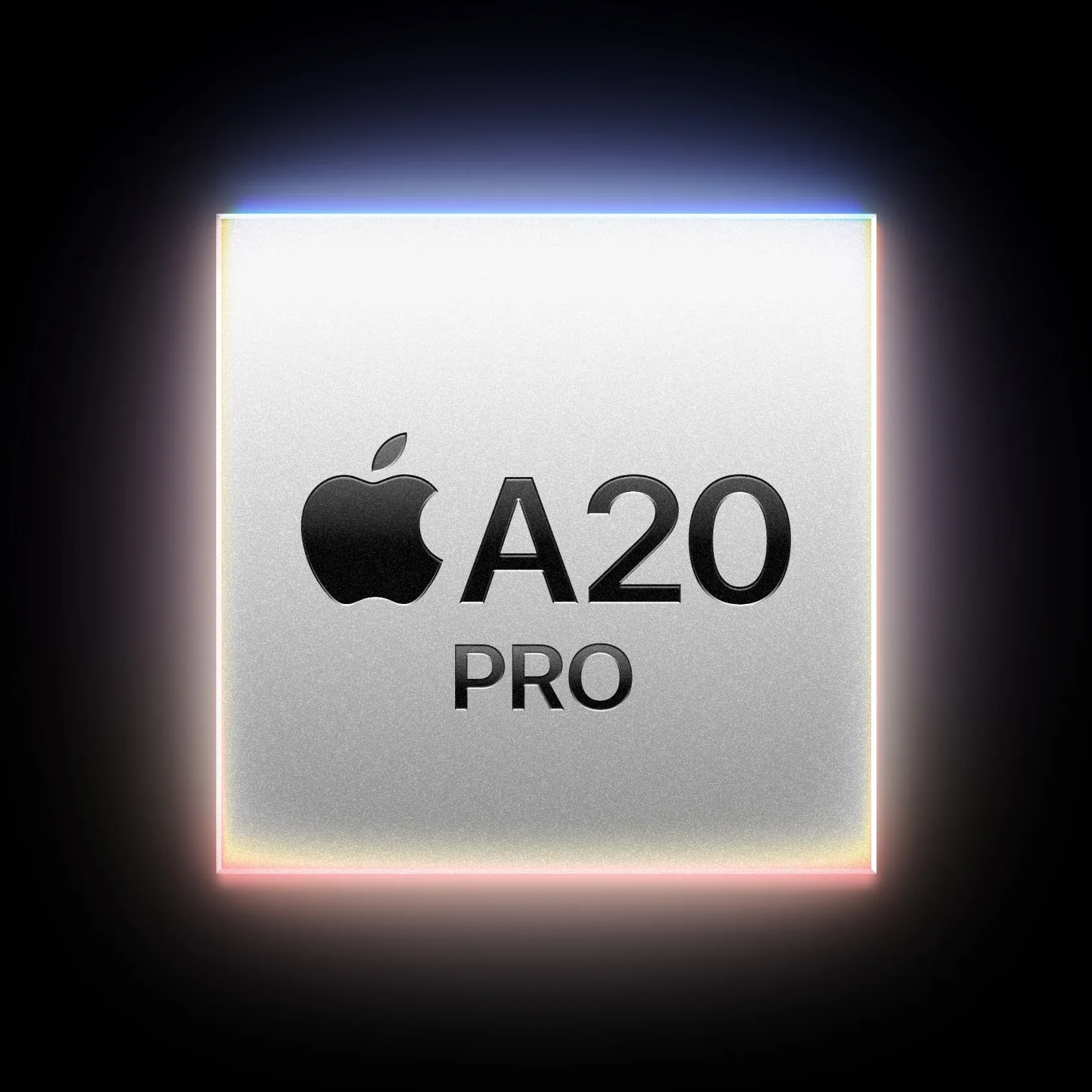
Apple says A20 Pro is built using the latest 2-nanometer process technology. A process label is meaningful context, but it is not a complete performance result. It tells readers that the chip is built on a newer manufacturing technology; it does not, by itself, establish a particular application speed, battery outcome or temperature under a defined workload.
The disciplined interpretation is therefore narrower. The 2nm detail is one part of the design foundation behind A20 Pro. Apple pairs it with claims about CPU, GPU, Neural Engine and memory behaviour on the product page, but the two sources do not provide a full independent test protocol for the sustained-performance headline. Netics will not convert a process generation into a guaranteed improvement for every application.
For buyers, this is a useful warning against spec-sheet arithmetic. Smaller process terminology can become a shortcut for “everything is faster and cooler.” Real systems are less tidy. The result depends on the work being performed, the software path, the memory traffic, the thermal environment and the duration of the run. Apple’s own wording supports investigating the complete system, not treating 2nm as a verdict.
Neural Engine capacity raises the ceiling for local intelligence
The product page describes new Neural Accelerators and a Dual 16-core Neural Engine with two times the compute. Those are specific claims about the hardware Apple is putting behind on-device intelligence. They also explain why sustained performance matters. More compute available for an operation is useful only if the phone can keep feeding that compute and controlling the heat generated over repeated work.
Memory bandwidth is part of that equation. Apple says the design delivers 50 percent higher memory bandwidth. Netics reads this as a potentially important companion to Neural Engine capacity: compute units and accelerators need data to arrive at the right rate, and an AI workload can be constrained by movement of data as well as arithmetic. That is analysis, not an Apple-reported benchmark. The sources do not tell us which model, tensor shape, precision, batch behaviour or software version produced a specific throughput number.
This is where the Dual 16-core description should be handled carefully. It is not a promise that every AI task will run at two times the speed. It is Apple’s product-page description of Neural Engine compute. A responsible review has to connect that capability to a defined operation and measure the result rather than repeat the headline as a universal multiplier.
Vapor cooling is a systems decision
Apple’s product page calls the chip vapor-cooled and says the design is intended to handle even the most intensive AI workloads. The Newsroom release describes a next-generation vapor chamber that dissipates more heat and enables a massive leap in sustained performance. The page also says the A20 Pro package places the silicon die side by side with memory, which Apple says drastically improves heat flow for significantly better thermal performance.
Those statements give a coherent engineering hypothesis. Heat has to travel from the active silicon into the package and then through the phone’s thermal path. A vapor chamber can help spread and move heat away from a concentrated region. Placing silicon and memory side by side is presented as a packaging choice that improves heat flow. Together, these choices target the period after the first burst, when thermal behaviour begins to shape performance.
They do not establish the size of the gain in every scenario. Apple does not publish, in these pages, a temperature-versus-time trace, a sustained wattage table or a workload-by-workload comparison with the previous generation. Those missing details are not a reason to dismiss the design. They are the reason to keep the claim labelled as an Apple claim until independent measurements exist.
How Netics would verify the sustained-performance claim
A credible test should begin by naming the workload, not by choosing a convenient benchmark after the fact. Testers should record the exact iPhone model, software build, power state, ambient conditions and starting temperature. They should also state whether the operation runs once or repeatedly, because a single completion cannot answer a sustained-performance question.
The run should capture performance over time, not only the best opening result. Useful observations include throughput, completion time, temperature, power draw where measurable, thermal warnings and any visible change in behaviour. The same workload should be repeated enough to show whether the result is stable. For AI, the report should identify the model or task, input size, precision and whether the work is performed on the Neural Engine, another accelerator or a mixed path when that information is available.
A fair comparison must preserve the same software task and test conditions across devices. It should report medians or distributions rather than one impressive run, and it should distinguish Apple’s claims from the tester’s observations. A test that shows a short burst is useful, but it should not be titled sustained performance. A long run that throttles is also useful; throttling is data, not a failure of the review.
Until that evidence exists, the right conclusion is measured. A20 Pro’s 2nm process, Neural Engine design, higher memory bandwidth, revised package and vapor chamber form a serious thermal-performance proposition. Apple has supplied the architecture story. The market still needs repeatable measurements that show how the story behaves after the phone has been working for a while.
For more practical analysis of infrastructure decisions that must survive real operating conditions, visit the Netics homepage.
Sources
- Apple iPhone 18 Pro Newsroom media package — Apple, accessed 2026-09-10.
- Apple debuts iPhone 18 Pro and iPhone 18 Pro Max — Apple Newsroom, September 9, 2026.
- iPhone 18 Pro and iPhone 18 Pro Max — Apple product page, accessed September 10, 2026.