
Crescent Island Shows Why Memory Is the Product
Intel presents Crescent Island as an inference accelerator for agentic AI. The real bet is memory capacity, while bandwidth remains the open question.

Source: ServeTheHome: Intel Crescent Island 160GB to 480GB LPDDR5X AI GPU at Hot Chips 2026
TL;DR
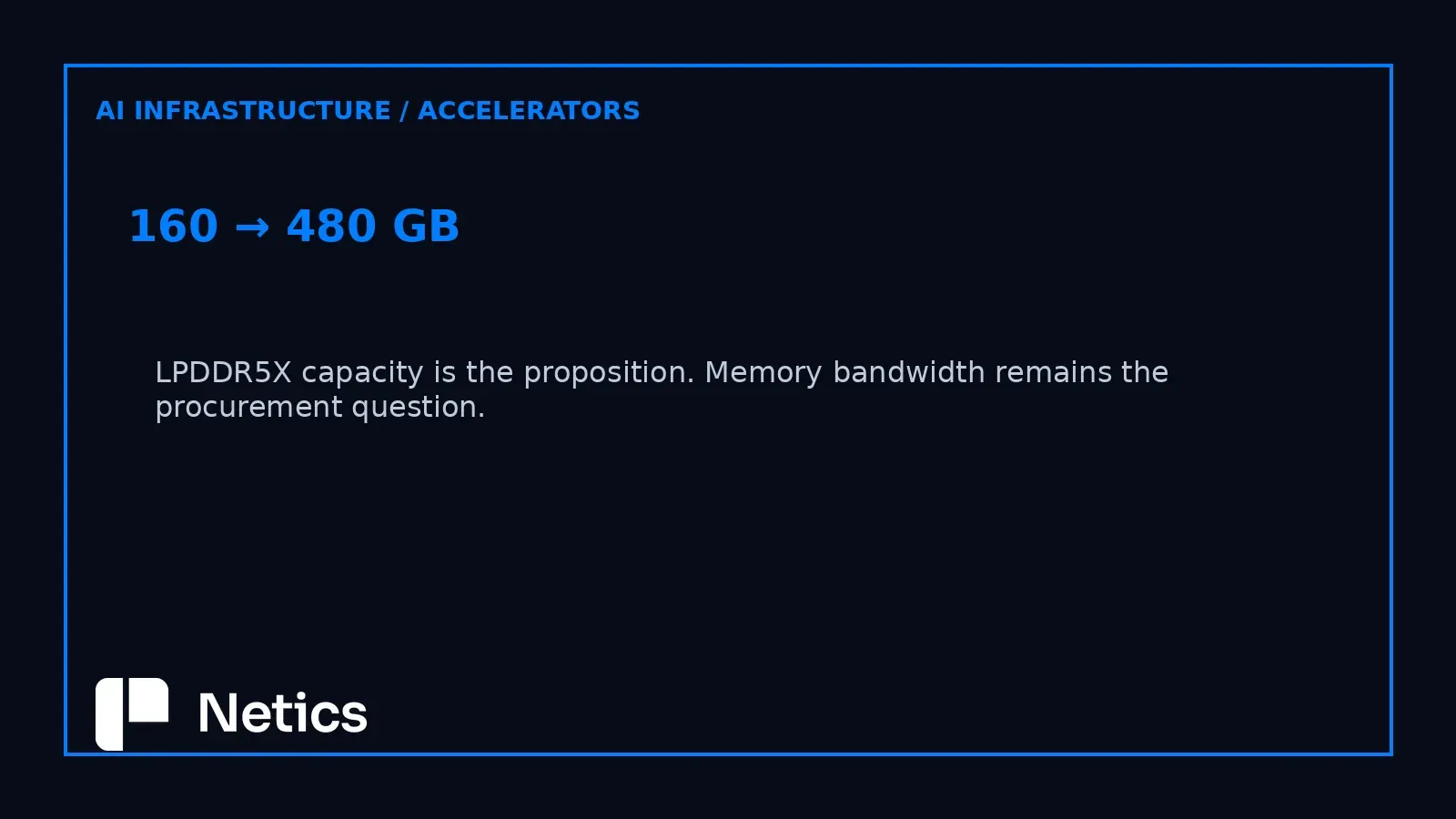
Intel positions Crescent Island as a PCIe inference GPU for agentic AI, with 160GB of LPDDR5X on the presented card and partner designs up to 480GB. That could matter for long-context models and concurrent sessions. But memory capacity is not a measurement of bandwidth, tokens per watt or total cost. The central procurement question remains open.
Intel is selling capacity first
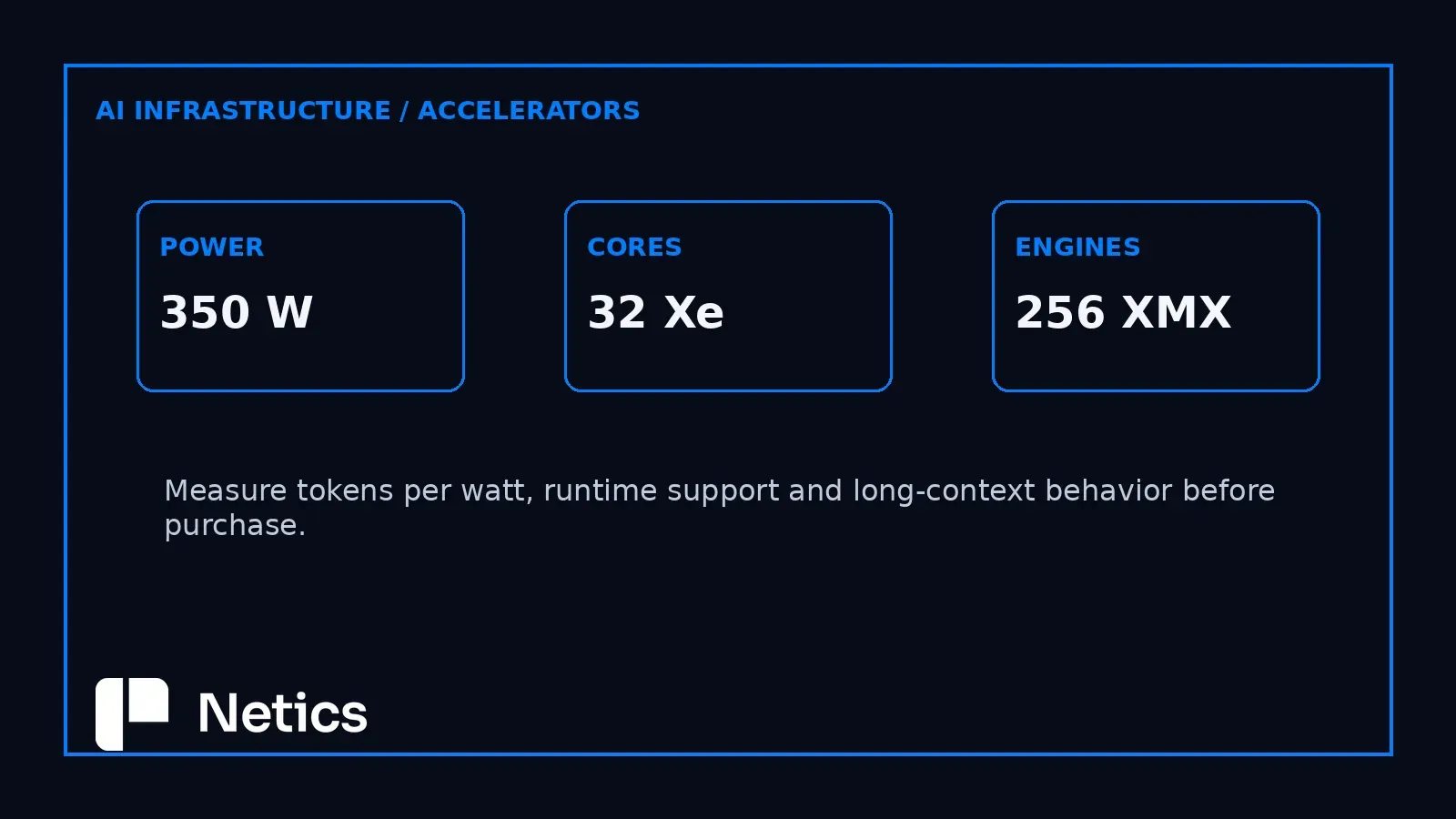
The presentation emphasizes a 350W air-cooled PCIe form factor, 32 Xe cores, 256 XMX engines and 160GB of LPDDR5X, with partner options up to 480GB. For agentic inference, that capacity can reduce pressure from model weights and KV cache. It does not, by itself, prove faster responses or lower cost.
The software list is strategically important
Intel names vLLM, SGLang, llm-d and NVIDIA Dynamo as associated software paths. That matters more than a logo on a slide: it describes an attempt to fit the accelerator into existing inference paths. But “supported” must become a test: runtime version, available operators, precision, CPU fallback and behavior under load.
A platform team should not accept compatibility as a checkbox. Run the same model, context length, batching policy and failure behavior across the candidate accelerator and the incumbent. The benchmark needs to include the orchestration cost around the GPU, not only the kernel.
Power is useful, but not enough
Intel cites 50W or less active idle and around 10W in a low-power idle state. That is useful for server sizing, but it is not a cost-per-token result. A card that idles efficiently can still be a poor choice if it delivers fewer useful tokens per watt or requires more hosts to meet latency.
The missing number is the procurement story
The report highlights an important unknown: the presentation does not provide enough detail about memory bandwidth. That is the number that would connect capacity to inference performance. Without it, comparison with accelerators using faster memory remains incomplete. Real results on vLLM, SGLang or llm-d also matter because software integration can move the bottleneck.
Netics recommendation
Treat Crescent Island as an architecture hypothesis, not a validated purchase. Ask for four things before a pilot: measured memory bandwidth, tokens per watt on your model, long-context behavior and software-path maturity. The 160GB-to-480GB capacity may solve a memory problem. It does not yet answer the total cost of a reliable service.
The capacity story also changes server design. A 160GB card may keep weights and cache together where a smaller accelerator would need more cards, but the result depends on batch size, context length, interconnect and the host path. More memory can simplify placement while moving pressure to the fabric or CPU.
That is why the first pilot should measure the whole serving path: loading time, prefill, decode, queueing, host-to-device movement, failure recovery and power under the actual duty cycle. A presentation architecture can define a promising hypothesis. Only a repeatable workload can define a procurement decision today. The procurement conversation should also separate availability from suitability. A partner card or a future production design may add cooling, firmware and host constraints that are absent from a conference presentation. Those details belong in the pilot record. The goal is not to dismiss a large-memory accelerator, but to make the missing measurements visible before the capacity headline becomes an architecture decision. *Source: ServeTheHome, “Intel Crescent Island 160GB to 480GB LPDDR5X AI GPU at Hot Chips 2026” — servethehome.com, 25 August 2026.
Netics applies this source-led analysis to practical infrastructure decisions. Explore Netics infrastructure work.