
IBM's K-12 AI Study Finds Adoption Moving Faster Than School Readiness
IBM's September 2026 K-12 study shows classroom AI use is advancing faster than training, governance and parent understanding. The operational gap is the story.

TL;DR
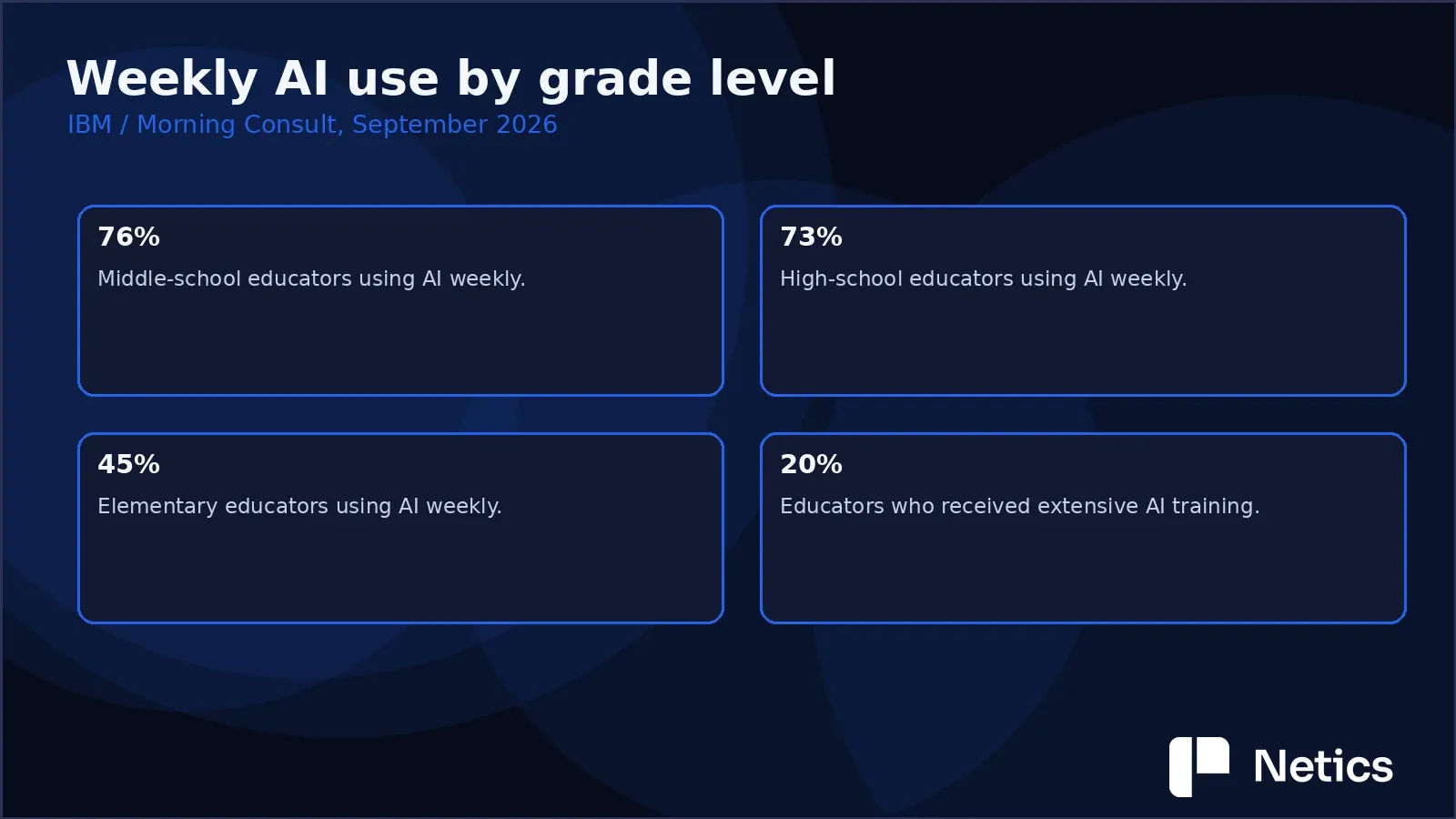
IBM's September 2, 2026 study, commissioned by IBM and conducted by Morning Consult, describes a K-12 system where classroom use is becoming routine before the operating model around it is ready. IBM reports weekly AI use among 76% of middle-school educators and 73% of high-school educators, compared with 45% of elementary educators, while only 20% of K-12 educators say they have received extensive AI training. The useful conclusion is not that schools should slow innovation. It is that adoption must be treated as an institutional change programme: define who may use which tools, train teachers, protect student data, procure for exit as well as access, evaluate learning effects, and make failures reversible. For European and French institutions, the study is U.S. evidence, not a local benchmark. Its operational question travels well: can a school explain and control an AI system before placing it in everyday learning?
The headline gap is a control-plane problem

IBM's announcement is built around a clear contrast. AI is already entering classrooms, but the systems supporting responsible use are catching up. The underlying survey covered 2,048 U.S. adults: 1,019 K-12 education professionals and 1,029 parents of K-12 students. IBM says the survey was conducted online in July 2026, weighted to target populations, with a margin of error of plus or minus 3 percentage points for both samples.
The signal is still operationally sharp. IBM reports that 76% of middle-school classroom educators and 73% of high-school classroom educators use AI at least weekly, compared with 45% of elementary educators. Nearly half of high-school educators, 45%, report daily or almost-daily use. Yet only 24% of educators and 16% of parents say the U.S. education system is adapting very well to AI advances.
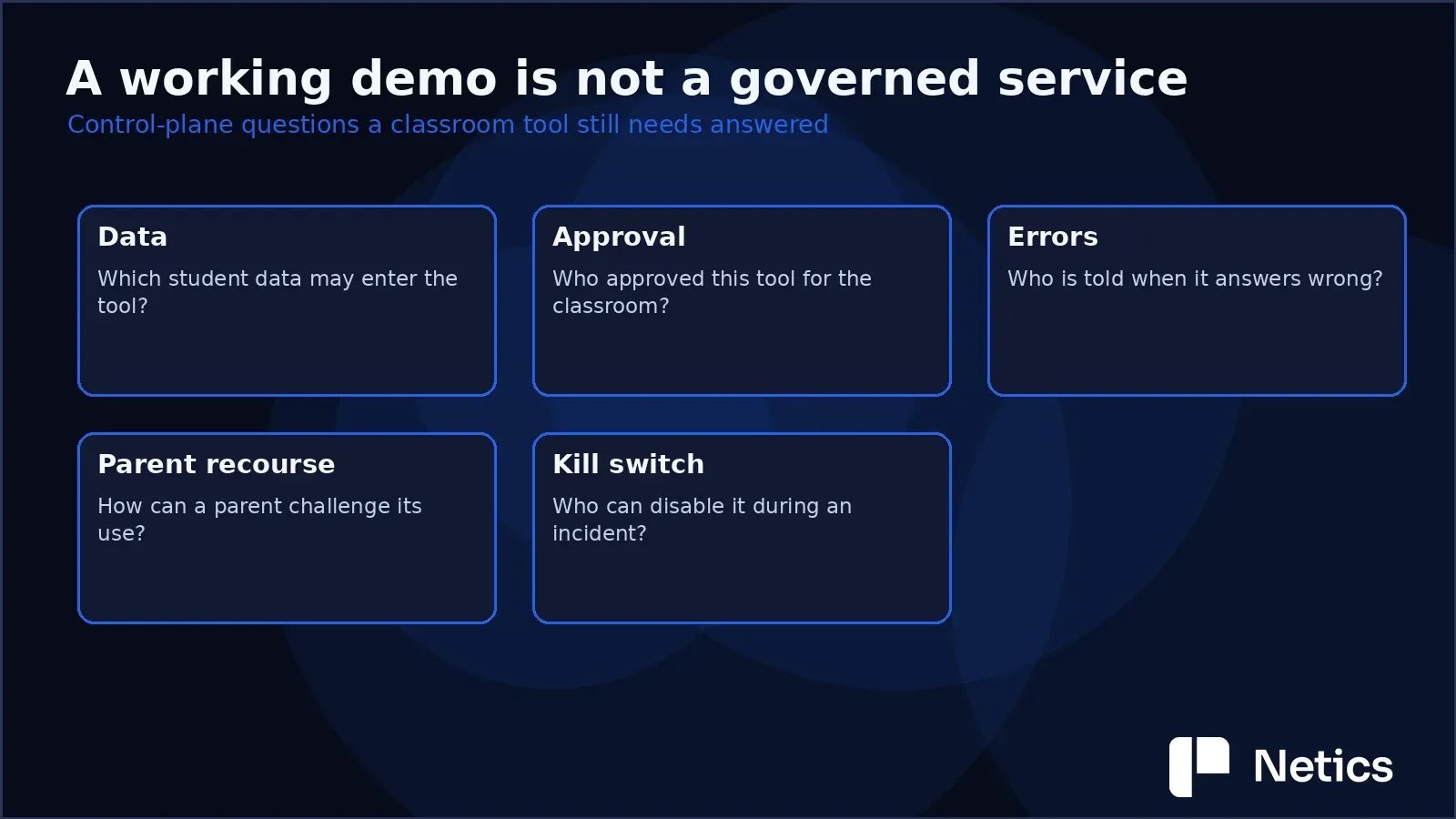
That is not simply a training deficit. It is a control-plane deficit. A school can have enthusiastic teachers, useful classroom experiments and a growing list of approved or unofficial tools while still lacking a reliable answer to basic questions: Which data may enter a service? Who approved it? What happens when its answer is wrong? How does a parent challenge its use? Who can disable it during an incident?
A working classroom demo is not the same thing as a governed educational service. Netics has made the same distinction in production AI: a model that works is not automatically ready for production. Schools need the educational version of that discipline.
Teacher training cannot be a launch-day webinar
IBM reports that only 20% of K-12 educators say they have received extensive AI training. Educators identify lack of training or professional development as the leading barrier to supporting AI literacy, at 42%, followed by limited AI curriculum and instructional materials at 34%.
The practical failure is to treat training as a product tutorial. Showing a teacher how to prompt a chatbot does not establish when that chatbot is appropriate, how to check an answer, what student information must never be pasted into it, or how to explain its use to a family. It teaches interaction while leaving judgment unsupported.
A credible programme should train three different capabilities. First is classroom practice: how AI can support lesson preparation, feedback, accessibility or differentiated activities without replacing the teacher's responsibility for the learning objective. Second is critical evaluation: how educators and students identify fabricated references, biased outputs, weak reasoning and false confidence. Third is incident handling: what to do when a tool exposes sensitive information, produces harmful content, discriminates against a student or becomes unavailable during an assessment.
IBM reports that 41% of educators and 41% of parents who believe AI has a place in education identify middle school, grades 6-8, as the point when students should first learn about it. That is a useful convergence, but it does not define a curriculum. Institutions need observable outcomes: students can distinguish generated text from evidence, disclose AI assistance, challenge an unsupported answer, and understand why personal data should not be used as a prompt.
Training should therefore be continuous and role-based. A teacher needs a different operating guide from a district administrator or a school data-protection officer. The fellowship IBM announced, with an inaugural cohort of up to 100 superintendents, education leaders and educators from the greater New York area, is aimed at this leadership layer. IBM says it plans to expand to additional U.S. states during the first year. The important test is whether learning becomes local policy and repeatable practice rather than a certificate attached to a launch.
Privacy has to be designed before procurement
The parent findings expose why governance cannot stay inside an IT department. IBM says 77% of parents want input on how AI is used in their child's classroom, but only 20% clearly understand the AI guidance their child receives at school. Parents identify clearer guidelines, at 51%, and greater transparency about classroom AI use, at 48%, as the steps most likely to increase confidence.
For a French school, rectorate or local authority, this is where European obligations and institutional trust meet. The right approach is not to paste U.S. survey percentages into a French policy. It is to map each proposed use to the applicable data-protection, child-safety, accessibility and public-sector governance requirements, then record the decision. French institutions should identify the data controller and processors, restrict collection to what the educational purpose requires, document retention and access, and provide a route for human review when an AI-assisted decision affects a student.
A system that drafts a teacher's feedback is not equivalent to one that ranks students, recommends support, flags misconduct or influences access to a programme. The more consequential the use, the stronger the justification, testing, transparency and human authority must be. A school should be able to stop a tool without losing the underlying student record or the ability to continue teaching.
Procurement must buy an operating model
IBM's survey records a difference between classroom teachers and administrators. Teachers rank student dependency on AI at 52% and cheating or plagiarism at 47% as leading concerns. Administrators are more likely to cite insufficient training, 26% versus 19% for teachers, and the cost of AI tools, 22% versus 11%.
These are not competing anxieties. They describe different layers of the same procurement decision. A teacher sees behaviour and learning integrity. An administrator sees skills, budget and institutional risk. A purchase that answers only one layer creates a problem for the other.
A school or education authority should evaluate an AI service against an operational specification, not a feature list. The specification should cover identity and role-based access, approved use cases, data residency and processing, audit logs, accessibility, age-appropriate safeguards, service availability, export and deletion, model or feature changes, support response, and a documented exit path. It should distinguish a tool for teacher preparation from a tool that directly interacts with students or influences assessment.
For French and European public institutions, procurement should preserve room for interoperability and contestability. Avoid making a single vendor's account system, prompt format or export limitations the hidden architecture of classroom practice. Pilot one bounded workflow, retain a non-AI alternative, and write down the conditions under which the service will not be renewed.
Evaluation should measure learning, not excitement
IBM reports that 42% of K-12 educators overall believe students are prepared for future jobs in an AI-driven economy and ready to think critically before accepting AI outputs. Confidence rises among middle- and high-school educators: 56% of both groups say students are prepared for future jobs, while 56% of middle-school educators and 59% of high-school educators say students are ready to think critically about AI outputs.
These figures describe perceptions, not demonstrated learning outcomes. A student may be comfortable using an AI tool without being able to verify it. A teacher may save preparation time without improving comprehension. A district may report high adoption while shifting correction and fact-checking work onto educators.
Evaluation needs a baseline and a counterfactual. Before introducing a tool, define the educational task, the expected benefit and the risk of failure. Compare AI-supported work with the existing approach over a bounded period. Measure more than usage: time saved, learning progression, quality of student reasoning, accessibility outcomes, teacher workload, error rates and the distribution of benefits across students. Record where the tool is not used and why.
Do not accept vendor satisfaction metrics as evidence of educational impact. A polished interface can increase adoption while weakening independent reasoning. A modest tool that reduces administrative burden may create real value even without a dramatic engagement graph. The institution's evaluation question should be: did this use improve the intended learning or operating outcome without creating a larger unpriced risk?
Safe deployment means reversible deployment
The safest school AI programme is not the one with the most tools. It is the one with a visible inventory, named owners and a clear response when reality disagrees with the rollout plan.
Start with a small number of use cases. Classify them by consequence. Keep human approval for outputs that affect assessment, discipline, safeguarding or access to support. Log the tool, version, purpose, data category and responsible owner. Test representative prompts, including failure cases. Give teachers a way to report incidents and families a way to ask questions. Set review dates so a pilot does not become permanent by inertia.
A deployment plan should include expiry conditions. If a provider changes its model, terms, retention policy or interface, the institution should be able to pause the service and reassess it. If a model produces unreliable outputs, the fallback should be a known process, not a frantic search for another application. Safe deployment is change management with a stop button.
IBM's announcement frames its fellowship as a way to give education leaders practical knowledge and tools, support educators and strengthen engagement with parents. That is the right direction. The independent Netics test is stricter: can those ideas become a district-level operating system that a teacher can understand, a parent can question and an administrator can audit?
For European and French institutions, IBM's study should be used as a prompt for that work, not as a local readiness score. Adoption will continue at classroom speed. Readiness has to catch up in data boundaries, procurement clauses, evaluation design, training time and the authority to stop. The schools that manage this transition well will not be the ones that ban experimentation or deploy everything. They will make responsible use easier than unmanaged use.
Netics helps institutions turn promising AI use cases into controlled operations; the Netics homepage is the starting point for that conversation.
Sources
- New IBM Study Finds AI Adoption Is Outpacing K-12 Readiness — IBM Newsroom, September 2, 2026.
- AI Readiness in U.S. Schools Report — IBM and Morning Consult, August 2026.