
Google Managed Agents Turn Tool Hooks Into an Operating Control Plane
Gemini Managed Agents add hooks, budgets, model selection, and scheduled triggers. Netics examines what this changes for production governance.

TL;DR
Gemini Managed Agents add hooks, budgets, model selection, and scheduled triggers. Netics examines what this changes for production governance. The article covers: Managed agents are becoming infrastructure, not a prompt wrapper; Hooks move policy next to execution; The sandbox is not the governance model; Budgets are a reliability control; Model selection creates a new compatibility surface; Scheduled triggers demand ownership; The Netics position; A production readiness test.
Managed agents are becoming infrastructure, not a prompt wrapper
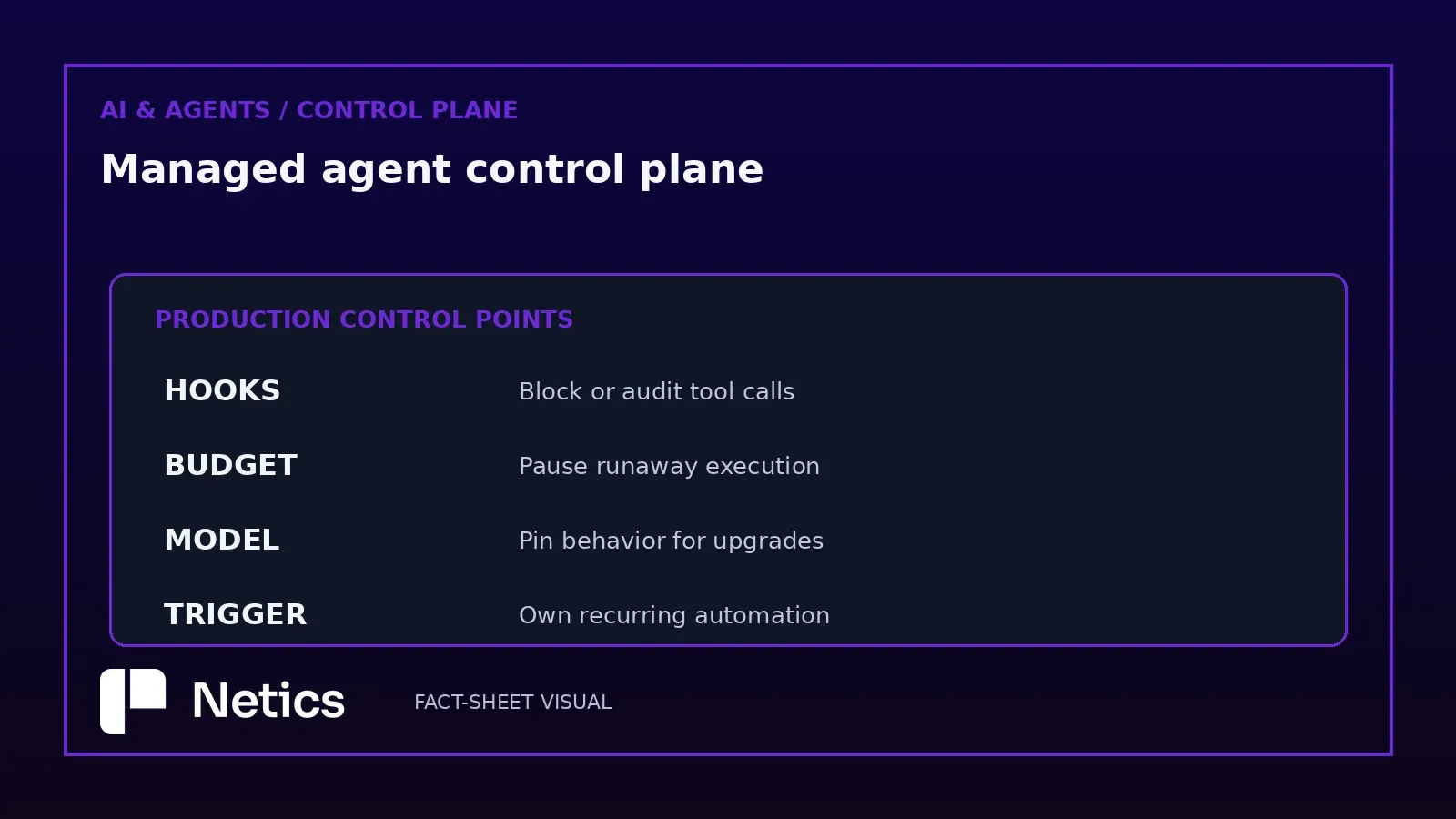
Google’s July update changes the operational shape of Gemini Managed Agents. Gemini 3.6 Flash becomes the default for the antigravity preview agent, developers can select another supported model, environment hooks can run before or after tool calls, budgets cap total tokens, and scheduled triggers can launch recurring work. The important shift is not the feature count. It is that a managed agent now exposes more of the control plane that production teams need to govern autonomous execution.
Figure: Managed agents are becoming infrastructure, not a prompt wrapper.
Hooks move policy next to execution
A pre-tool hook can block, lint, or audit an action inside the sandbox. That matters because policy evaluated outside the execution environment often sees only the request, not the exact tool call and working context. A hook can inspect the command, file path, or action parameters before execution, then deny it or record a decision. The trade-off is that the hook becomes part of the agent’s trusted computing base. It needs versioning, tests, timeouts, and an owner just like the agent itself.
The sandbox is not the governance model
Google describes a remote environment that coordinates reasoning, code execution, package installation, file management, and web retrieval. Isolation is useful, but it does not answer which network destinations are allowed, which secrets are mounted, how files leave the sandbox, or how a scheduled run is stopped. Environment rules and hooks must be reviewed together. A sandbox can reduce blast radius while still permitting an agent to perform an unacceptable workflow inside that radius.
Budgets are a reliability control
The max_total_tokens setting is presented as a way to prevent runaway tasks. Netics treats this as more than cost management. An agent that reaches a budget can return incomplete while preserving environment state, which creates a resumable boundary. Teams must decide whether resumption is safe, what artifacts are trusted, and whether the second interaction inherits the same policy. A budget should therefore be paired with maximum tool calls, wall-clock limits, data quotas, and an explicit incomplete-state handler.
Model selection creates a new compatibility surface
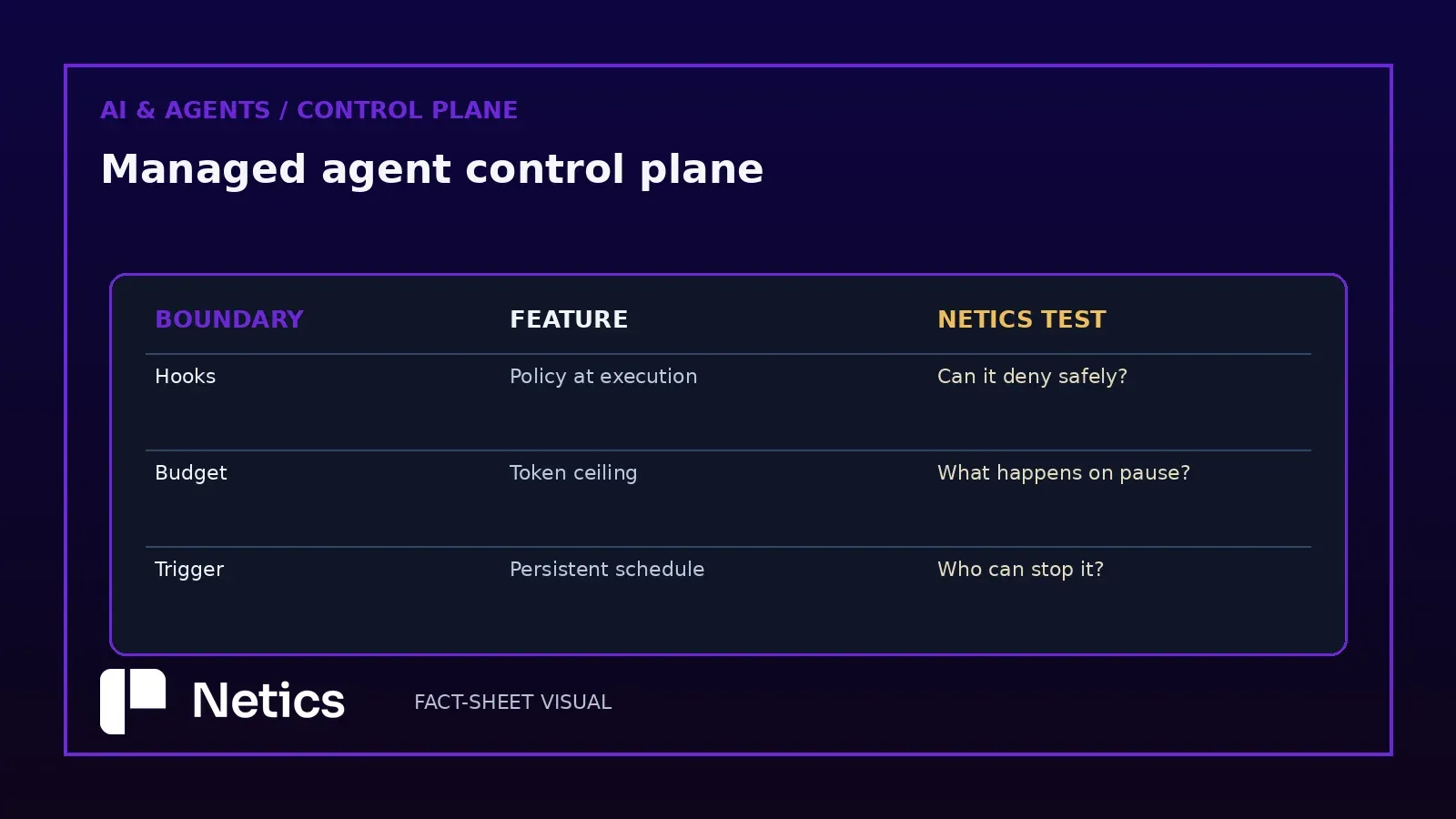
Managed Agents can default to one model while allowing an explicit selection such as a lower-cost Flash-Lite variant. That flexibility is valuable, but changing the model can change tool-use patterns, verbosity, refusal behavior, and the number of iterations. Pin the model for production workflows, test upgrades against a fixed task set, and record the selected model with every run. A model alias that silently moves is operational drift, not convenience.
Figure: Model selection creates a new compatibility surface.
Scheduled triggers demand ownership
Recurring agents are attractive for reports, dependency audits, and maintenance tasks. They are also persistent automation. Treat a trigger like a production cron job with an owner, service identity, change history, failure notification, and a disable path. The same sandbox being reused across runs may be convenient, but it also raises questions about stale files, residual credentials, and state contamination. Scheduled execution should begin with idempotent, read-only work.
Hooks need a fail-closed default, not fail-open
A hook that errors, times out, or cannot reach its policy service has to make a choice: block the tool call, or let it through. Fail-open is the tempting default because it keeps the agent working when the hook infrastructure has a bad day — and it is exactly backwards for anything that touches production. A hook is a security control, and security controls that degrade to “allow everything” under failure are not controls, they are availability theater. Design the hook’s own failure mode explicitly: what happens when the hook itself is unreachable should be a documented decision, not whatever the default happens to be.
Idempotency is not optional for scheduled agents
A scheduled trigger that fires again after a partial failure — a timeout, a budget cutoff, a transient network error — will re-run the same task against a sandbox that may already hold partial results. If the task writes anything (a file, a database row, an external API call), a retry without an idempotency key produces duplicate side effects, not just duplicate work. This is the same discipline any retry-safe API integration already needs: the trigger should carry a stable key per scheduled run, and the write path should check that key before acting, not just wrap the whole task in a try/except and hope it does not fire twice.
The Netics position
Google is moving managed agents in the right direction by exposing hooks, budgets, model selection, and triggers. But these features do not automatically create governance. They create control points that an organization must connect to its own policy, logging, identity, and incident process. Our recommendation is to deploy hooks before autonomy: deny dangerous tool patterns, log every decision, cap budgets, pin models, and make scheduled work read-only until the evidence proves that the workflow is bounded. The most important agent feature is not a smarter loop; it is a loop that can be stopped and explained.
A production readiness test
Pick one recurring task and define its allowed tools, network rules, maximum budget, expected artifacts, and stop conditions. Test a denied command, an incomplete interaction, a model change, a stale sandbox file, and a trigger failure. Store the hook decision beside the run result. If the team cannot reconstruct why a tool call was allowed, the workflow is not ready for production. For an architecture review, visit Netics.
For an architecture review, visit Netics or Book a free 30-minute audit.