
Google ADK for Kotlin 1.0 Makes Agents Portable — Not Operationally Identical
Google’s ADK for Kotlin 1.0 unifies server and Android agent development around Kotlin Multiplatform. Netics examines where that parity ends.

Source: Google Developers Blog — Announcing ADK for Kotlin 1.0: Building Production-Ready AI Agents in Kotlin, Android, and Beyond — Sept. 9, 2026.
TL;DR
Google has released ADK for Kotlin 1.0 as a general-availability toolkit built around a Kotlin Multiplatform core. The release brings the core feature set into alignment with ADK 1.0 Core while adding Android-focused paths for on-device execution, hybrid cloud workflows, persistent sessions, and indexed memory. KSP-generated tools, human-in-the-loop confirmation, and resumable sessions make the package more than a model wrapper. The important qualification is architectural: a shared Kotlin agent core can reduce code divergence, but it does not make a server agent and a mobile agent the same operational system. Runtime location, storage, connectivity, model backend, and failure ownership still matter.
Google’s announcement is therefore best read as a portability release with an Android execution strategy attached. That is a stronger proposition than “Kotlin support,” but a narrower one than a universal agent runtime. Netics’ assessment is that the useful boundary is not Kotlin versus Java or Android versus server; it is shared orchestration versus separately owned operations.
The release closes the Kotlin feature gap
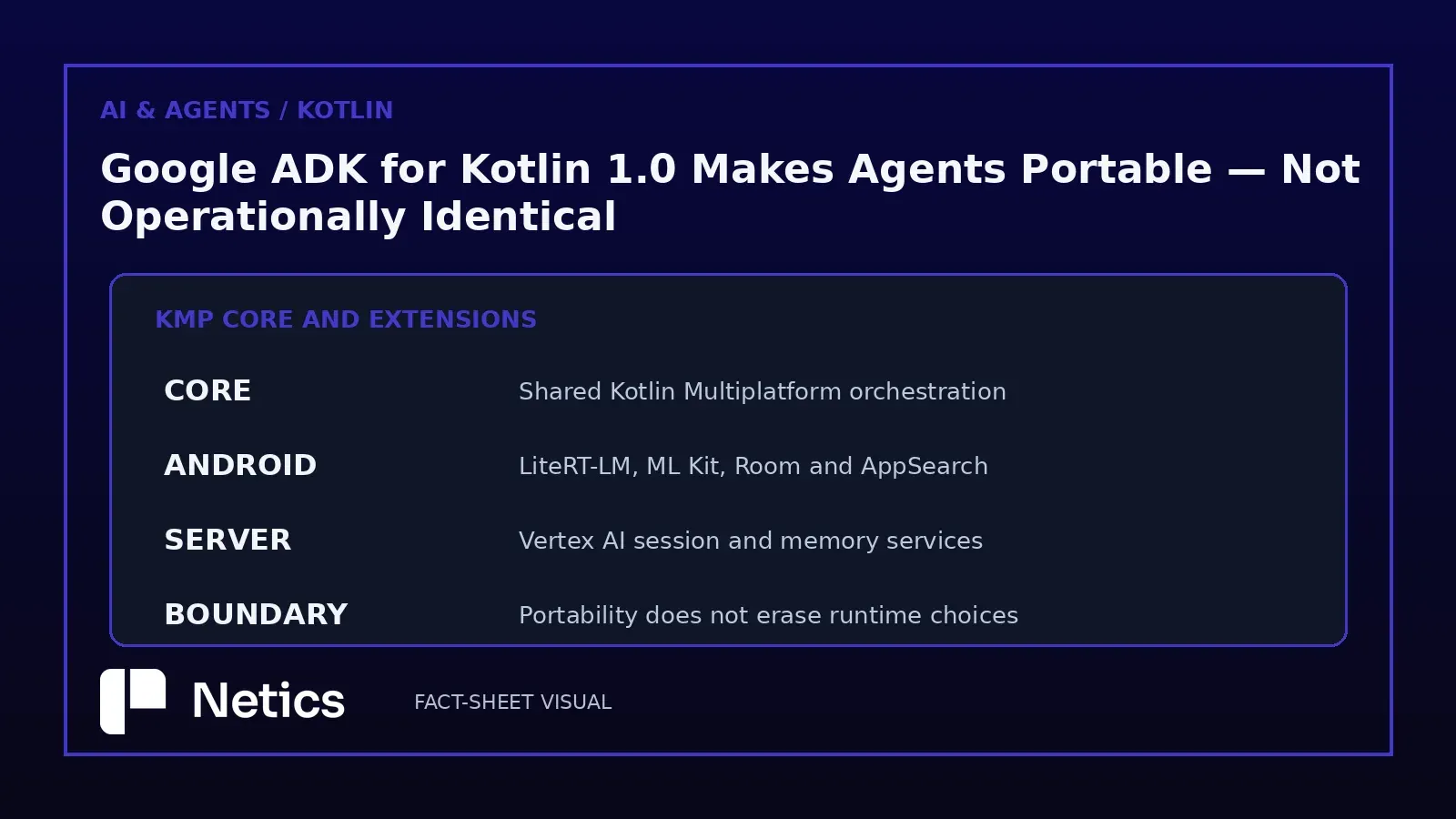
The announcement positions ADK for Kotlin 1.0 as the general-availability step after version 0.1.0. Its headline promise is full feature parity with ADK 1.0 Core, alongside Android-first and on-device extensions. The core is described as Kotlin Multiplatform and agnostic to specific model backends, session providers, and memory systems. That separation is the release’s most consequential design choice: it gives teams a common orchestration layer without forcing every deployment to use the same model or state service.
The parity list is substantial. Google names hierarchical multi-agent systems, context compaction for multi-turn conversations, human-in-the-loop confirmation flows, long-running and annotation-based tools, session resumability, first-party Java interoperability, and Vertex AI session, retrieval-memory, and memory-bank services. In practical terms, Kotlin developers are not being offered a thin Android convenience API. They are being offered the same kinds of coordination and state transitions expected from a fuller agent framework.
That still needs to be read as framework parity, not deployment parity. A server-side agent can assume a more stable process and a different storage boundary. An Android agent has to handle process death, local data, intermittent connectivity, user approval in a UI, and the consequences of on-device execution. The shared core is valuable precisely because those differences can be isolated rather than denied.
KSP moves tool safety into the build
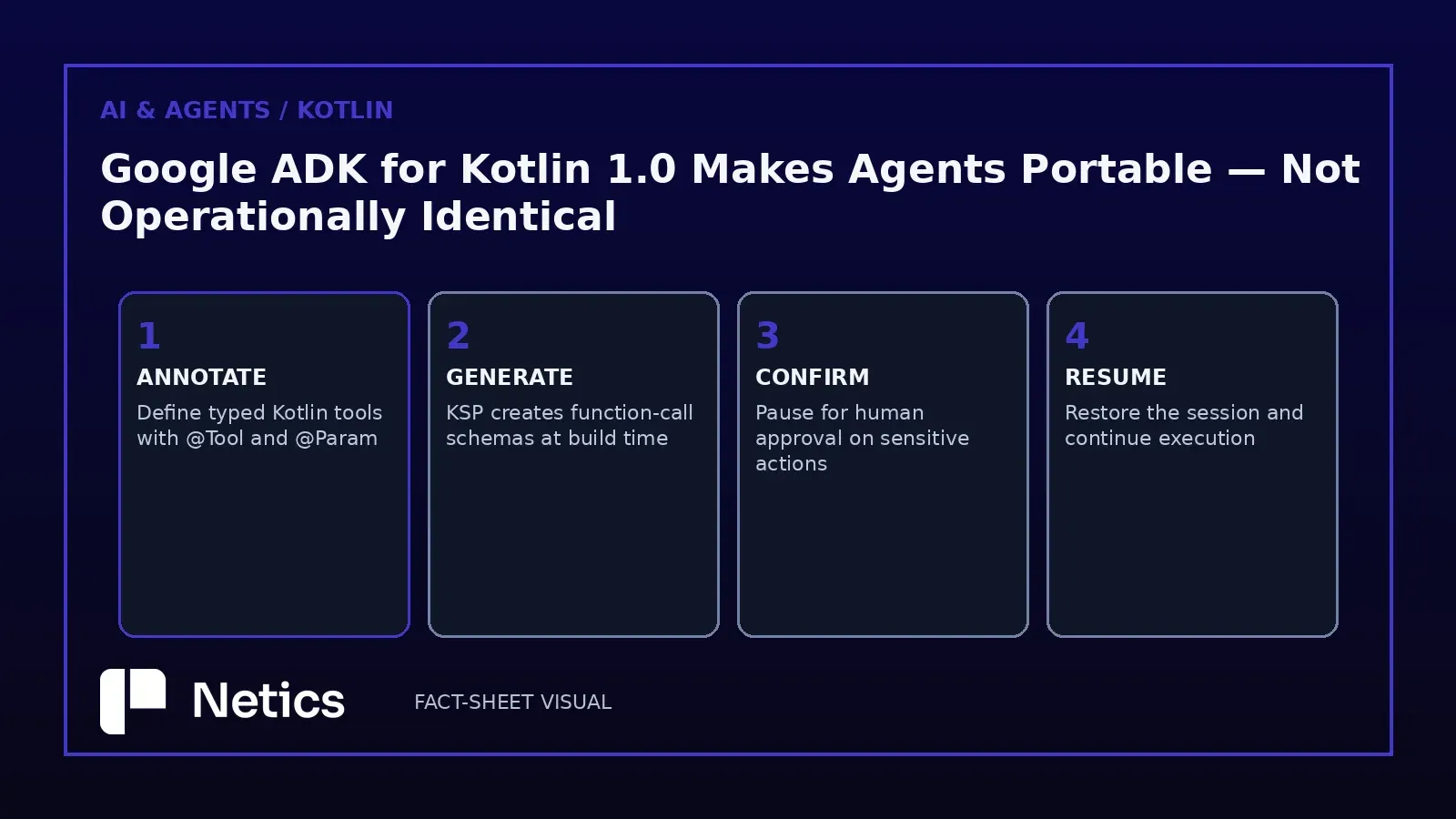
The release’s tool model is unusually concrete. Developers annotate Kotlin functions with @Tool and parameters with @Param; Kotlin Symbol Processing then generates function-call definitions at compile time. Google highlights type-safe schemas, support for suspend functions, and zero runtime reflection.
That is more than a syntax preference. The generated schema becomes a build-time contract between ordinary Kotlin services and the agent’s tool-calling surface. A tool can query metrics, retrieve deployments, or notify an on-call channel while remaining a typed Kotlin function rather than a hand-maintained JSON description. For teams that already treat compilation as a useful correctness boundary, this is the most credible route in the announcement to reducing accidental drift between implementation and declared capability.
The source’s database-incident example makes the pattern legible. A service defines typed data classes for metrics and deployment information, then exposes diagnostic and notification functions through annotations. KSP generates the extension used to provide those tools to an agent. Skills add a second layer: procedural knowledge can live in a SKILL.md file, with allowed tools and supporting resources loaded progressively rather than placed into every prompt.
Netics’ reading is that ADK for Kotlin is trying to separate capability from procedure. Kotlin code owns what the system can execute; skills describe how an agent should approach a class of work. That division is useful, but it creates a review obligation. Generated schemas can make a tool structurally clear without making the action safe. The annotation tells the runtime what a function accepts. It does not decide whether the function should be available to a particular agent, user, or environment.
Android adds state, privacy, and approval as first-class concerns
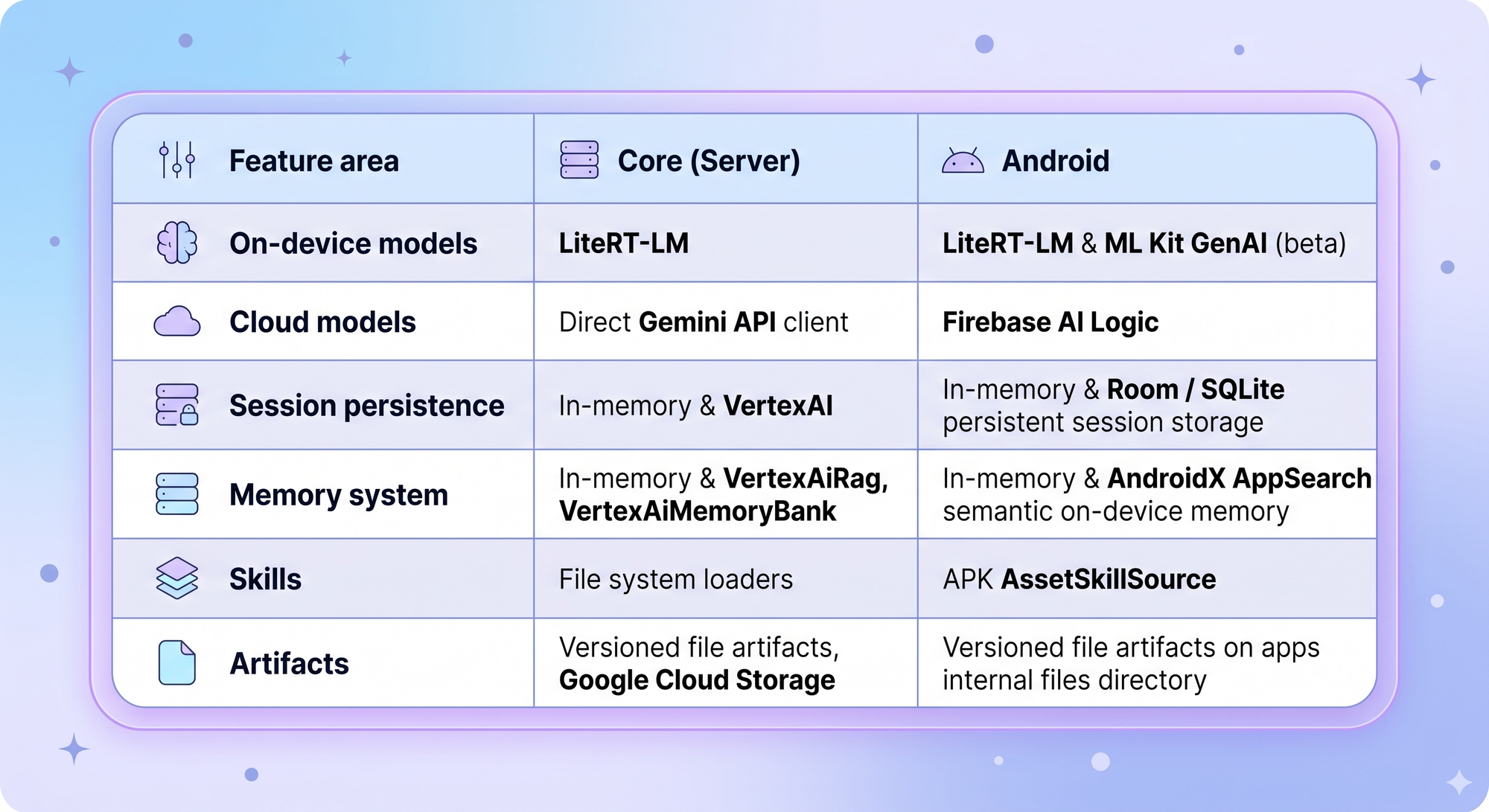
The Android extensions are where the release becomes materially different from a server-only Kotlin framework. Google names LiteRT-LM and ML Kit (beta) for fast or private on-device agents, Firebase AI Logic for hybrid cloud workflows, and Room and AppSearch for persisted sessions and indexed memory. The architectural message is clear: an Android agent is expected to have a lifecycle, not merely a request and a response.
The financial-assistant example demonstrates that lifecycle. A bank-transfer function is annotated with an explicit confirmation requirement. The agent pauses when a transfer is requested, emits a confirmation request, waits for a user action in the Android interface, and resumes the interaction only after the approval response is returned. Room stores chat-session state across reboots or process death; AppSearch provides on-device indexed memory; Android file storage handles generated artifacts.
This is the right shape for sensitive mobile actions. A confirmation step that exists only in prose is not a control. A confirmation request represented in the execution flow can be inspected, surfaced to a user, and resumed as a distinct turn. The difference matters when a mobile agent is allowed to do more than answer questions.
But Google also supplies the caveat that should stay attached to the demo: the example is for demonstration purposes and is not designed to meet compliance requirements. That line is not a footnote to skip. It is the operational boundary between a framework capability and a production control system. Room persistence does not by itself define retention policy. AppSearch indexing does not by itself establish data minimization. A confirmation button does not by itself prove authorization, fraud resistance, or audit completeness.
The server-versus-mobile boundary is the real adoption decision
ADK for Kotlin 1.0 makes a sensible case for using Kotlin as the common language across server and Android agents. The KMP core can hold orchestration logic, tool contracts, and session concepts while platform-specific modules supply execution details. Java interoperability also gives existing JVM applications a direct path to Kotlin agents rather than requiring a wholesale language migration.
The danger is treating that common layer as evidence that the two environments can share the same operational policy. They cannot be assumed to. On-device LiteRT-LM has a different model and connectivity profile from a cloud workflow through Firebase AI Logic. Room and AppSearch have different durability and query boundaries from Vertex AI session and memory services. A mobile confirmation flow has a human-interface dependency that a server incident agent may not. The source establishes these components; the conclusion about their separate operational ownership is Netics’ analysis.
Teams evaluating the release should draw the boundary before they draw the class diagram. Which tools are safe to expose on-device? Which state is allowed to remain local, and which state must be recoverable centrally? What happens when a process dies between a confirmation request and the user’s response? Which agent skills are portable, and which embed assumptions about server-only credentials or network access? A shared API can make these questions easier to ask, but it cannot answer them for the team.
This is where an independent Netics architecture analysis belongs: not in counting how many integrations appear in a launch post, but in identifying which control moves with the shared core and which remains owned by the runtime.
What Kotlin developers should test first
The release is available through the documented dependency set: the Kotlin core and KSP processor are published at version 1.0.0, while the Android ML Kit extension is identified as 1.0-beta and the LiteRT-LM and Firebase Android modules as 1.0.0 in Google’s example. That version distinction is worth preserving during evaluation; “Android extensions” is not one uniform maturity label.
A sensible first test is not a broad autonomous agent. Start with one typed tool, one persisted session, and one confirmation boundary. Run the same orchestration path in an in-memory or server runner and in an Android runner backed by Room and AppSearch. Then force the uncomfortable cases: process death, a rejected confirmation, a missing network, a stale session, and a tool that must not be callable from the mobile build. The goal is to discover which parts are genuinely shared and which parts only look shared in source code.
Do not use the announcement’s incident or banking examples as performance evidence. They are demonstrations of the framework’s mechanisms, not benchmarks or compliance certifications. The value of ADK for Kotlin 1.0 will be decided by whether teams can make those mechanisms observable, testable, and appropriately constrained in their own environments.
Netics’ assessment
ADK for Kotlin 1.0 is a meaningful release because it treats Kotlin as a cross-runtime agent language rather than as an Android-only client wrapper. KMP, core feature parity, compile-time tool generation, HITL flows, and Android persistence form a coherent architecture. The release also avoids the weakest version of the mobile-AI pitch: it does not rely only on a cloud call hidden behind a native UI.
Its limit is equally clear. Portability reduces duplication; it does not remove operational boundaries. The server and the phone can share agent concepts while disagreeing about storage, connectivity, model locality, authorization, and recovery. Teams that keep that distinction visible have a useful adoption path. Teams that mistake a shared Kotlin API for a shared production boundary will inherit the complexity later, after the agent has access to more consequential tools.
Sources
- Google Developers Blog — Announcing ADK for Kotlin 1.0: Building Production-Ready AI Agents in Kotlin, Android, and Beyond (published Sept. 9, 2026;
Source: Announcing ADK for Kotlin 1.0: Building Production-Ready AI Agents in Kotlin, Android, and Beyond — developers.googleblog.com, Sept. 9, 2026.