
Gemini 3.8 Live turns voice agents into continuity systems

TL;DR
Google’s September 15 announcement introduces Gemini 3.8 Live and Gemini 3.8 Live Extended Thinking as near-real-time reasoning models for more natural voice interaction. The announcement highlights interruptions, language switching, real-time visual context, background tools and API calls, and an Extended Thinking mode that can keep the dialogue moving while it works through a complex task. Google attributes benchmark results including 82.6 on Artificial Analysis’ Speech to Speech Quality Index, 68.6% on τ-Voice, 35.1% on Sierra’s τ-Voice-banking benchmark and 97.7% on Big Bench Audio to the Extended Thinking model. Our position is narrower and less celebratory: fluent continuity changes the reliability problem. A voice agent that never visibly “stops” can also hide when it misunderstood, delegated work, changed state or resumed with stale context. Observability has to follow the conversation, not just the final answer.
Google is selling two related capabilities. Gemini 3.8 Live is described as the scalable, cost-efficient option, combining conversational intelligence, fluid dialogue and visual grounding. Gemini 3.8 Live Extended Thinking targets high-complexity, multi-step work. Both are presented as useful foundations for production voice agents, and Google says they are available across the Gemini app, Google Workspace and Search.
Google says these models are available to developers through the Gemini API and Google AI Studio, with Gemini Enterprise in private preview. For everyone, the announcement names Search Live; it also lists Workspace surfaces including Docs, Gmail and Keep. That breadth matters because each surface can expose a different boundary between a spoken request and an external action.
The useful breakthrough is not “voice”; it is negotiated continuity
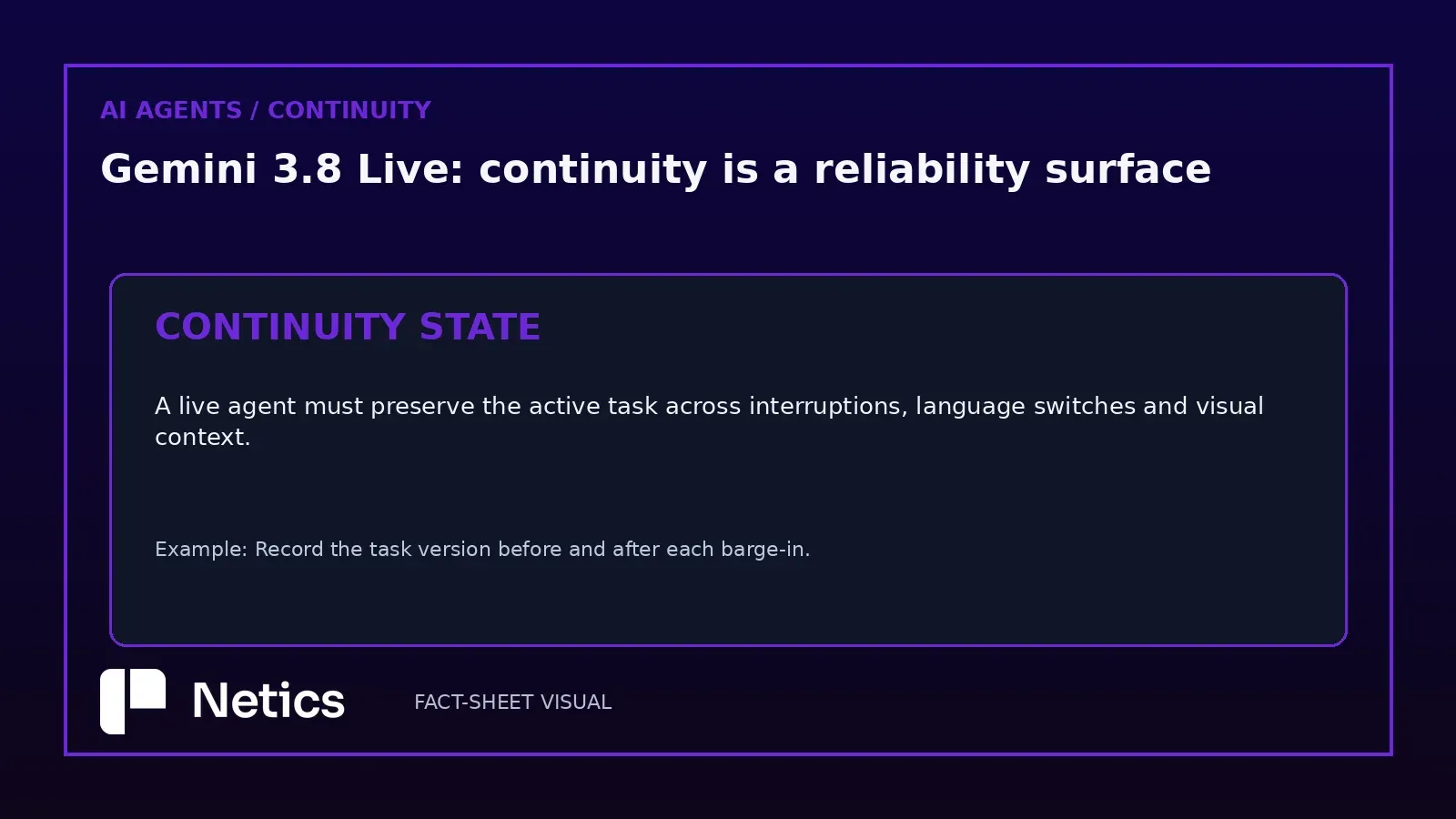
A conventional voice assistant often makes its state visible through turns: the user speaks, the system transcribes, the model answers, and the exchange ends. Gemini 3.8 Live is framed around a less tidy interaction. The user can interrupt. The conversation can switch languages. Visual context can become part of the exchange. The agent can keep a task moving in the background instead of forcing the user to wait in silence.
This is closer to collaboration than question answering. It is also harder to specify. An interruption can be a correction, a new instruction or a side comment. A language switch can change the intended meaning, not merely the output language. Visual grounding can add useful context while introducing a second interpretation channel. The product experience becomes more natural precisely because it accepts ambiguity.
For builders, “natural” should therefore be translated into explicit state transitions. Record what the agent believed the active task was before an interruption, what changed after the interruption, which language and visual references were used, and whether an earlier tool result was still valid. Without that record, a smooth conversation can conceal a broken handoff.
Background tools make the voice surface look simpler than the system is
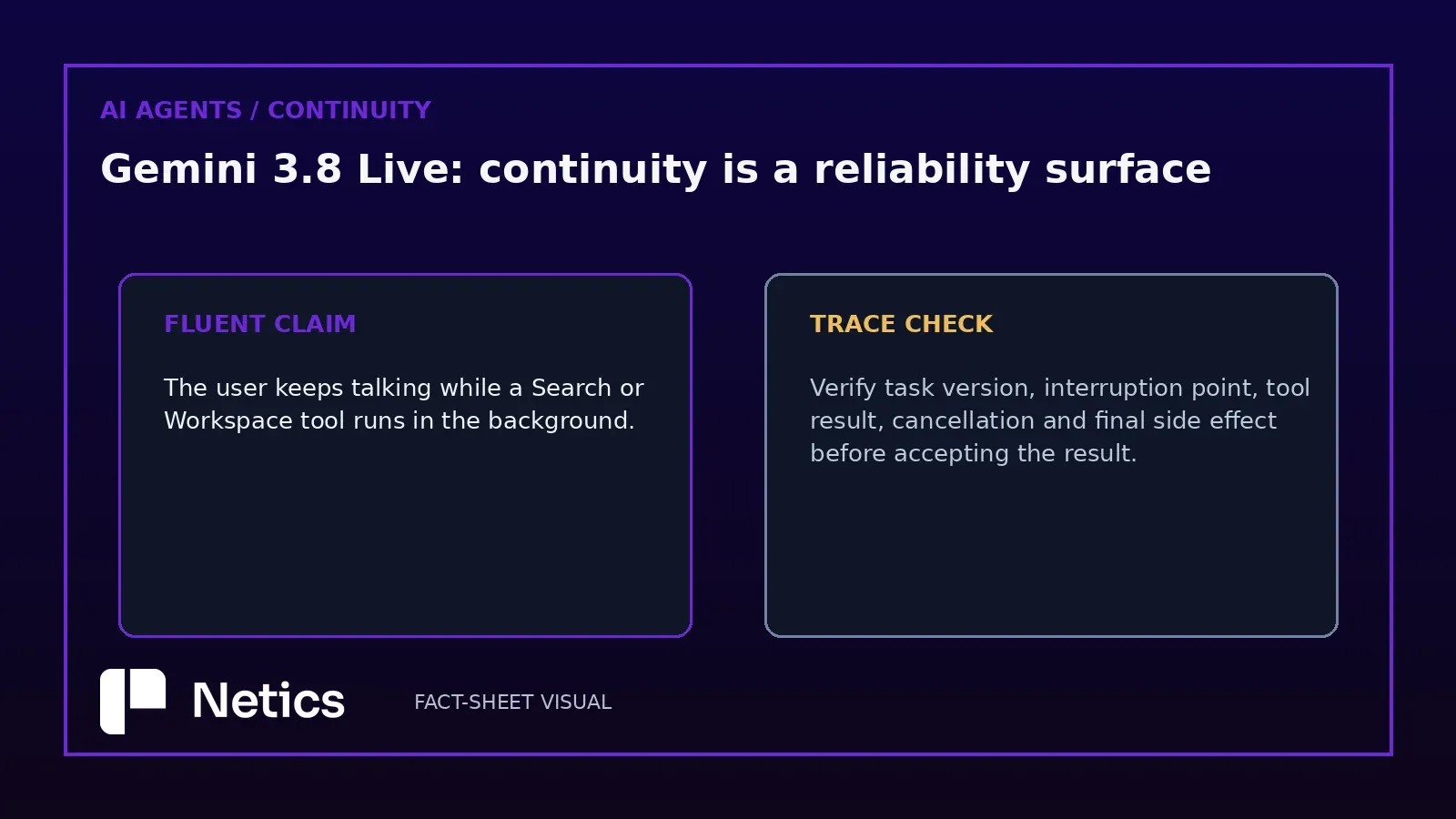
Google says these models can manage tools in the background while the user keeps talking. That is a compelling interaction pattern. A person can ask for a plan, interrupt with a constraint, and continue the conversation while a lookup or API call runs. The agent does not need to turn every operation into a blocking “please wait.”
The operational trade-off is concurrency. The spoken layer may be handling a new utterance while the tool layer is returning an older result. A result can be correct for the question that started it and wrong for the conversation after two interruptions. The agent needs correlation IDs, cancellation semantics, freshness rules and an explicit policy for what it is allowed to say before a background call completes.
Take a marked hypothetical: someone asks a voice agent to prepare a business plan, then interrupts to change the target market while a Search lookup and a Workspace document operation are running. A plausible spoken response is not evidence that the old lookup was cancelled or that the document will use the new market. The reliability check is the trace: task version, interruption point, tool call, returned data, decision and final side effect.
This is where voice-agent observability differs from ordinary chat logging. Text gives operators a visible transcript and often a natural turn boundary. Continuous speech needs event timelines that include partial utterances, barge-ins, model responses, tool starts, tool completions, cancellations and state versions. A transcript alone is not enough.
Extended Thinking should speak carefully about what it is doing
The Extended Thinking model is the more interesting product claim. Google positions it for complex tasks and says it can keep the conversation flowing while it performs multi-step reasoning. That does not require the user to hear private chain-of-thought. It does require a useful status contract: what the system is doing, what it knows, what is pending and what can still be changed.
Speaking while reasoning creates a new failure mode: premature confidence can sound like progress. If the agent narrates a provisional answer while the deeper task is still running, the user may treat the narration as a commitment. If it remains silent, the interaction feels broken. The design problem is neither “show all reasoning” nor “hide everything.” It is to expose bounded progress and decision points without presenting speculation as a result.
A production voice agent should separate at least three channels: conversational acknowledgements, safe progress updates and committed actions. Each should carry a task version. A spoken “I’m checking that” is not the same event as “I changed the document.” That distinction needs to survive the model, orchestration layer and audit log.
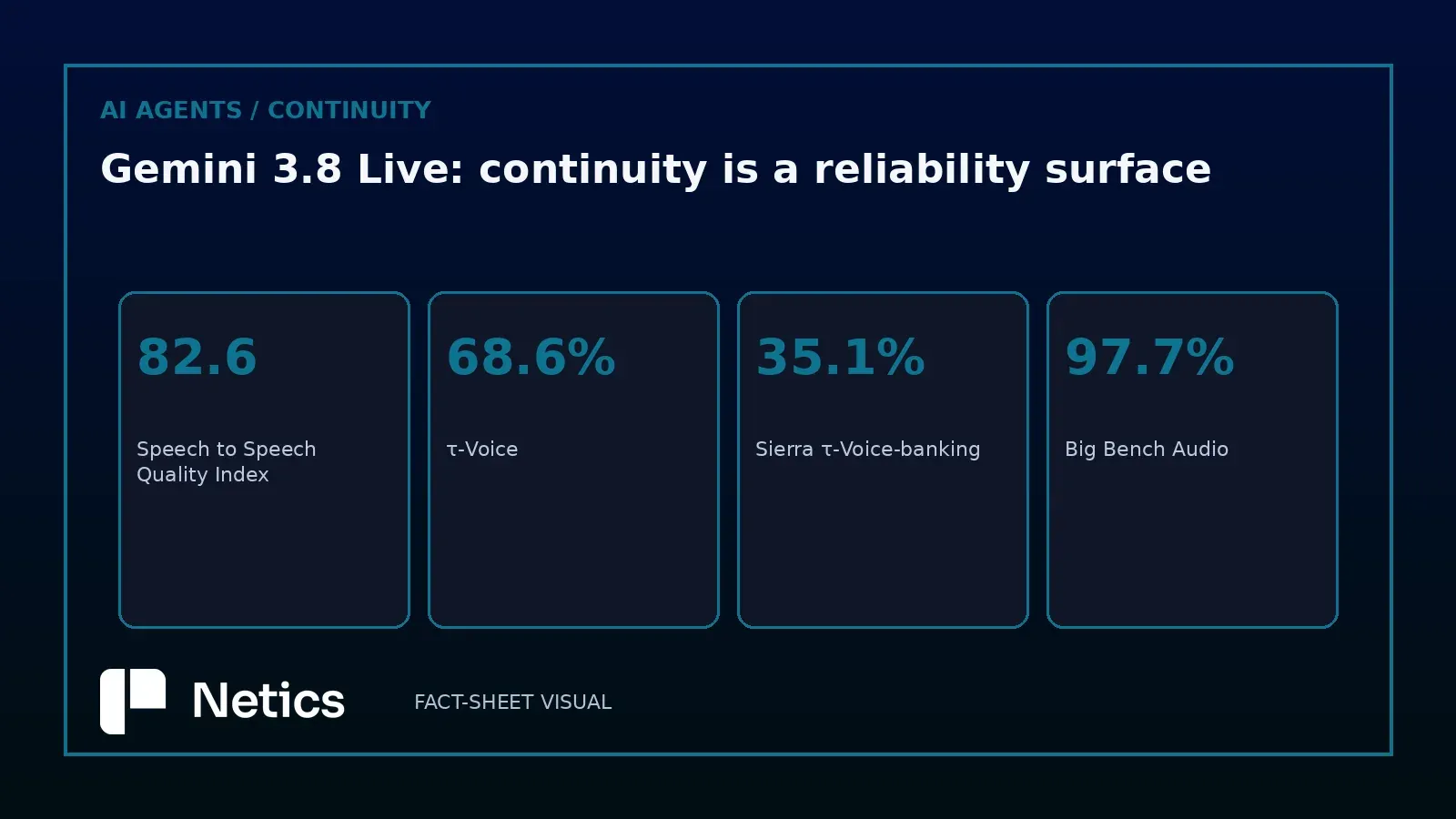
Google’s benchmark claims are relevant but limited. The announcement attributes 82.6 to Artificial Analysis’ Speech to Speech Quality Index and cites 68.6% on τ-Voice, 35.1% on Sierra’s τ-Voice-banking benchmark and 97.7% on Big Bench Audio. Those numbers can support a comparative launch claim. They do not, on their own, prove that an enterprise can reconstruct every interruption, stale result or side effect in a live deployment. A benchmark score is evidence about a test; it is not an observability design.
Deployment surfaces turn a model launch into a governance question
The developer and enterprise surfaces make a common event vocabulary more important. Teams should distinguish the Gemini API and AI Studio path, Gemini Enterprise’s private preview, Search Live, and Workspace actions in Docs, Gmail and Keep. The more places the model appears, the more important it becomes to trace the boundary between a spoken request and an external action.
At minimum, teams should be able to answer: which user utterance authorized this tool call? Which context version did it use? Did an interruption supersede it? Was the result shown, spoken, stored or acted upon? Which system recorded the final decision? If those questions have different answers across the API, AI Studio, Enterprise, Search Live and Workspace integrations, “the same model” does not mean the same reliability contract.
The practical recommendation is modest. Before deploying a continuous voice agent, instrument interruption and background-work paths before optimizing latency. Test language switches and visual references as state changes, not demo flourishes. Measure cancellation and stale-result rates. Preserve a user-readable activity summary alongside the detailed trace. Then use the smooth conversation as the outcome of control, not as proof that control is unnecessary.
For an audit of your voice-agent architecture and traces, book a 30-minute audit. For a broader Netics perspective on moving AI systems from prototype to dependable operation, visit Netics Labs.
Sources
- Google, “Introducing Gemini 3.8 Live and 3.8 Live Extended Thinking,” September 15, 2026: https://blog.google/innovation-and-ai/models-and-research/gemini-models/gemini-3-8-live-gemini-3-8-live-extended-thinking
Source: Introducing Gemini 3.8 Live and 3.8 Live Extended Thinking — blog.google, September 15, 2026