
DoW Instruction 8430.01: Agent Traceability, Human Approval of Changes to Critical Functions and Data Boundaries
"DoW Instruction 8430.01 has required traceable AI, verified code and bounded data since 8 September 2026, which moves the proof of AI authorship into the delivery pipeline and exposes where

TL;DR
- Department of War Instruction 8430.01 is a policy document titled Accelerated Mission Software, and it sets how software is modernised, built and evidenced across the department.
- It took effect on 8 September 2026, was issued by DoW CIO Kirsten Davies, and applies to every DoW organisation plus any acquisition programme that includes software, regardless of cost.
- The text attaches three conditions to AI use: a traceable role, code that is verified so developers stay accountable, and approved boundaries for government data.
- Condition one asks the audit record for the model name and version, and an agent with its own service account puts the commit in the same log as a person's commit.
- Condition two applies the same gates to agent and developer, with a named reviewer on protected paths and protected branches that stop an agent merging past people.
- Condition three asks for data boundaries a team can demonstrate, which in practice means self-hosted models or a gateway the customer operates.
- The unresolved evidence gap is dataset provenance: GitLab says datasets must be traceable and does not identify the delivery artifact that records them; its five-stage standard separately calls for an audit trail down to each prompt.
What Instruction 8430.01 requires from a software programme
GitLab's account of the instruction, published on 6 November 2026 by Elisabeth Burrows, is the source available here, so every detail below comes from GitLab's summary and from the Security Standard page it links to. The instruction is titled Accelerated Mission Software, took effect on 8 September 2026, and was issued by DoW CIO Kirsten Davies. Its scope covers every DoW organisation and any acquisition programme that includes software, with no cost threshold attached.
This analysis follows those conditions into three delivery controls: a distinct identity for each agent, named human approval on protected paths, and inspectable boundaries for government data. The instruction directs teams to automate testing and security scanning, to reuse what already works, and to produce evidence while software is built. It also encourages AI, describing AI-assisted development as a major force multiplier for speed and quality, and then attaches three conditions: the AI's role is traceable, its code is verified so developers stay accountable, and government data stays within approved boundaries.
Condition one: an audit record that names the model
Traceability is the condition a delivery platform can satisfy today, and the post describes the mechanism precisely. Software on DoW networks needs proof of what is in it and how it was built, and when AI is involved that proof has to cover the model, the version and the datasets used to write or test the code.
Three artifacts carry the claim in GitLab's description. Dependency Scanning produces the software bill of materials, audit events and deployment records are generated during delivery, and Duo agents act through their own service account tied to the developer who started them, so a commit appears in the log as an agent acting for a named person. A SIEM can then filter that activity, and the record survives a change of model under managed policy.
The design decision here is worth borrowing whatever platform a team runs. An agent's own identity makes its commits attributable. When the agent uses a developer's credentials, the commit is recorded as that developer's work. The instruction asks for the model name in the record, and the identity design decides whether that record can exist at all.
Condition two: the same gates for agent and developer
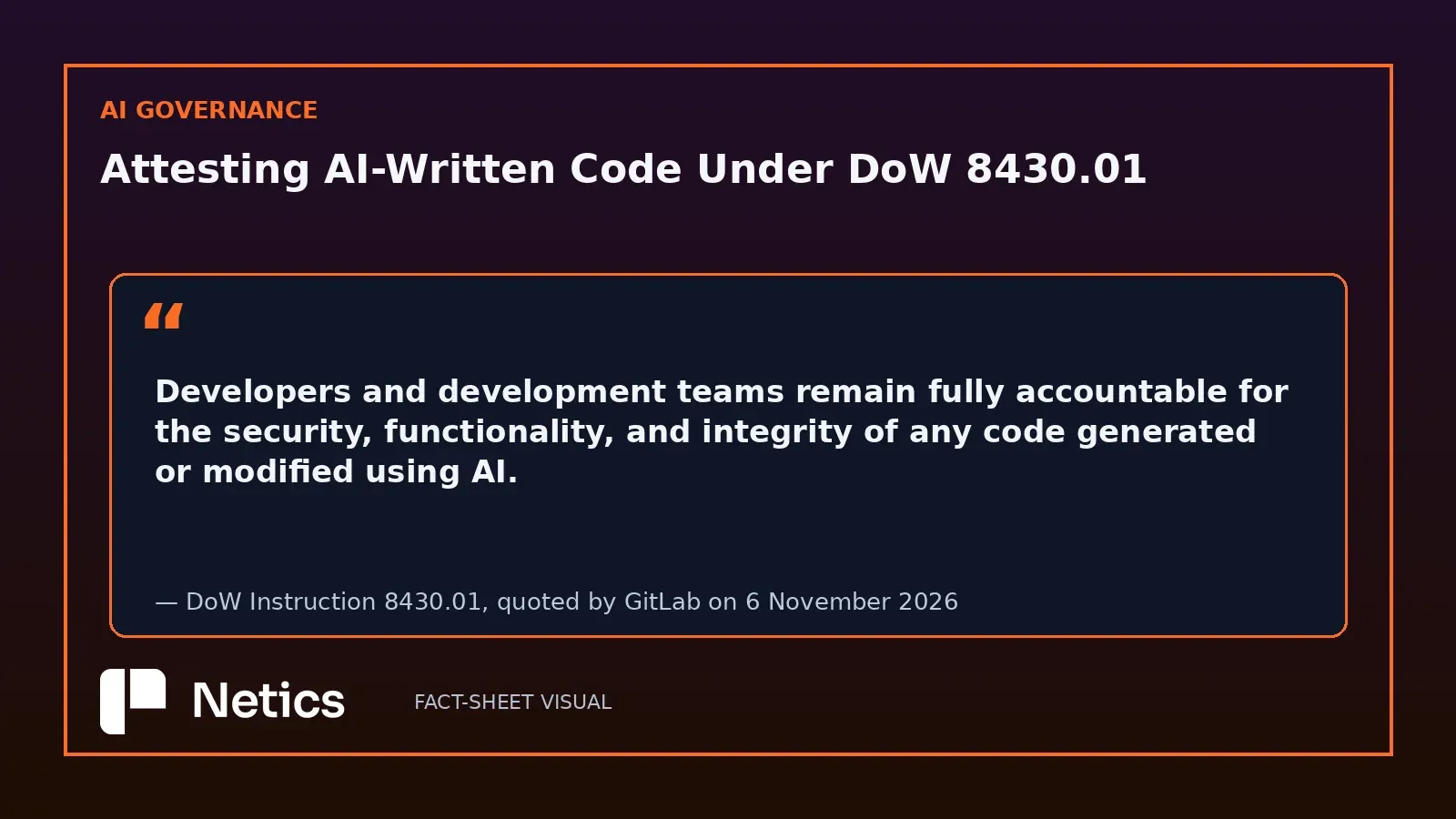
Verification requires policy-enforced gates throughout the pipeline. AI-generated or AI-modified code counts as unverified input, and a person has to approve changes to security-critical functions and to safety-critical ones. GitLab quotes the instruction directly: "Developers and development teams remain fully accountable for the security, functionality, and integrity of any code generated or modified using AI."
The mechanics it describes are ordinary gates applied without exception. Scans, tests and approval rules run in the same pipeline for every change, whichever actor wrote it. Merge request approval policies can require a named reviewer when a change touches a protected path or introduces a vulnerability, and protected branches let an agent propose a change and stop it merging past the people designated in the policy. Dependency Scanning Auto-Remediation, in beta, proposes dependency upgrades and build fixes that wait at the existing gates, and a multi-step flow pauses for a human before a merge or a deploy.
Condition three: data boundaries you can demonstrate
Data boundaries are the condition with the clearest procurement consequence. Approved AI services have to guarantee that government data and prompts are not used to train external models, and non-public DoW information has to stay on approved systems. A team therefore has to control which models it uses and where those models run.
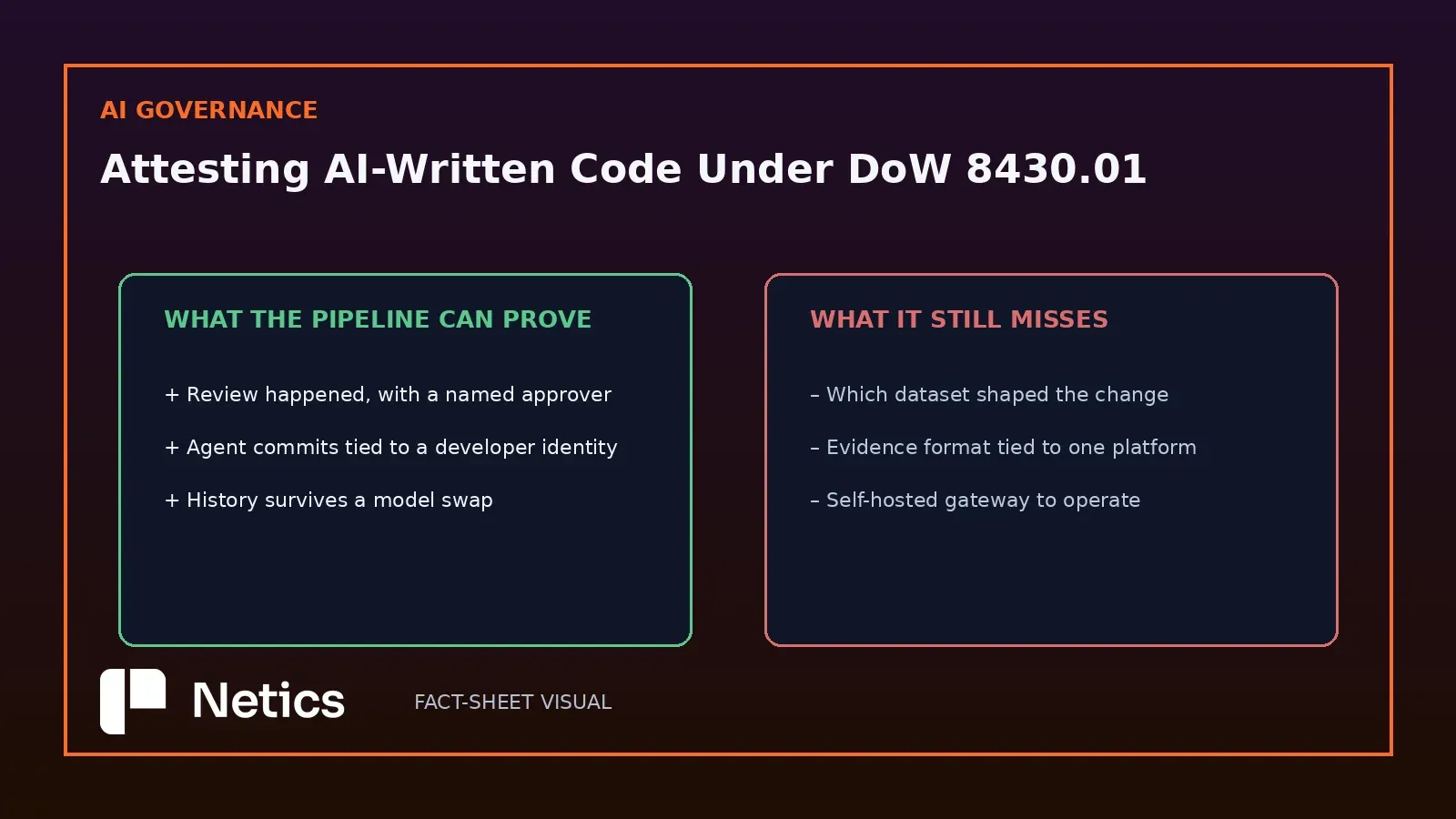
GitLab's own answer is a self-hosted deployment: Duo Agent Platform Self-Hosted runs on infrastructure the customer controls, air-gapped networks included, with a choice of supported models on premises or in a private cloud and the ability to swap models without rebuilding workflows. Requests route through an AI Gateway the customer deploys, so prompts and responses stay inside the environment, and for Dedicated for Government customers that gateway runs in their own environment connected to the model provider of their choice.
Two sentences in that description carry the weight. A gateway the customer operates is an architecture fact an auditor can inspect, and a model list the customer controls is a document a procurement officer can read. Auditors need inspectable architecture and procurement records to verify those assurances.
The evidence gap: datasets and prompts leave no artifact
The instruction asks for the datasets used to write or test the code, and GitLab's account does not identify which delivery artifact records them. A commit records the author and the diff. A model name can be recorded if the agent has an identity. Our analysis is that the dataset that shaped a change, and the prompt that produced it, usually live in a session log that nobody retains, and often in a tool that is not part of the delivery platform at all.
GitLab's framing that the evidence stays in the platform, so models can change without erasing history, is an honest description of what its own product can do. It also names the boundary of that claim: the platform records what happened inside the platform. Retrieval corpora, fine-tuning sets and prompt templates require their own provenance records, and the instruction's phrase about datasets points straight at that space.
A five-stage ladder published as a standard
GitLab published its Security Standard on 6 October 2026, and it organises agent autonomy as five stages: Authorize, Isolate, Verify, Release and Respond, on a base of policy, audit and ownership, with the stages mapped to OWASP SAMM, the OWASP Top 10 for Agentic Applications, MITRE ATLAS and NIST SSDF and SP 800-53.
The document serves a practical and a commercial purpose. The stage list and framework mapping give security teams a checklist and shared vocabulary for governing agent autonomy. GitLab presents that checklist through the controls its platform sells and supports it with growth statistics from its own customer base. The standard gives security teams a useful checklist. Auditors retain responsibility for the compliance judgment.
What a team outside the DoW can take from it
Instruction 8430.01 applies to the Department of War, and its three conditions describe a problem every organisation meets once agents write code: who is accountable, what record exists, and where the data went. A private company meets the same three questions without an auditor arriving, and the answers are cheaper to build before a customer asks.
The practical sequence is small. Give every agent its own identity so commits are attributable. Require a named approver on protected paths and on anything that touches authentication, payments or infrastructure state. Record the model name and version with the change. Then keep the dataset evidence requested by the instruction and the prompt evidence specified by the Security Standard in the same store so an auditor can inspect their provenance. The earlier Netics piece on the evidence gap in software supply chains covers the same shape of problem for dependencies, and running it as part of self-hosted AI agent operations keeps the record inside the estate.
Sources
- The Pentagon wants to know who checks code when AI writes it, GitLab blog, 2026-11-06, about.gitlab.com
- The GitLab Security Standard, GitLab, published 2026-10-06, about.gitlab.com
Source: the GitLab blog post of 6 November 2026 by Elisabeth Burrows and the GitLab Security Standard page, both read in full on 6 November 2026. The instruction number and title, the 8 September 2026 effective date, the CIO's name, the scope, the three conditions and the quoted sentence come from GitLab's account of the instruction; the five stages, the policy-audit-ownership base, the 6 October 2026 publication date and the framework mapping come from the Security Standard page. This article does not quote the instruction directly.