
Cloudflare OS Shows Why Agent Access Should Be Capability-Based
Cloudflare OS replaces ambient agent access with capability-based Gatekeepers, delayed approvals, and per-resource control. Here is what operators should copy.

TL;DR
Cloudflare OS is an open-source AI productivity environment built around private "Gadgets," sandboxed application spaces, and Gatekeepers that mediate every call to an external service.[2] The interesting part is not the "OS" branding. It is the decision to treat access as a capability introduced for one specific resource at a time, instead of a standing list of tools available to every conversation by default.[2] That single design choice targets a failure class that appears whenever an agent retains ambient access nobody remembers granting. The project is early access and openly under heavy development, so it is a design reference right now, not a production certification — teams still need to verify isolation, OAuth rotation, and log behavior independently. The pattern worth copying either way: introduce resources deliberately with a lifetime attached, log the action and resource together, and never let a deferred-approval queue be mistaken for committed state. The Netics discipline is the same: scope access before execution, then leave operators with a boundary they can audit.
What Cloudflare OS actually ships
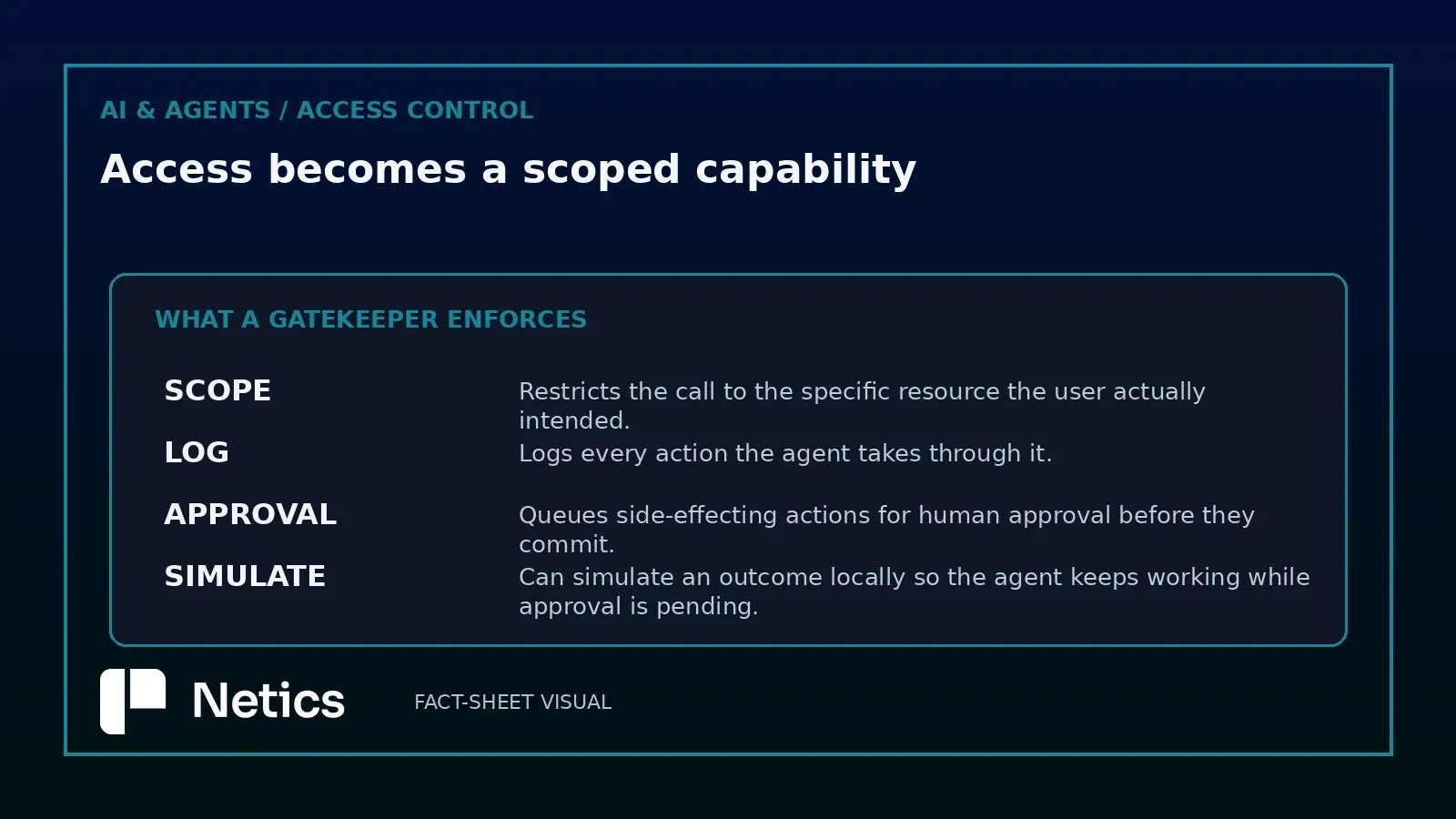
The repository describes an agent workspace built around company context, a sandboxed environment for developing agent applications, and a security framework wrapped around both.[2] Each user runs a private copy of a Gadget rather than sharing one instance with everyone else's data and history. External services sit behind Gatekeepers, which expose a clean API over Cap'n Web, handle authorization such as OAuth, restrict calls to the specific resource the user intended, log every action, and can hold side-effecting actions for human approval before they commit.[2] The runtime underneath runs on Durable Objects and Dynamic Workers — a detail worth naming mainly because it means the isolation is structural, built into the runtime, rather than a convention a team is trusted to follow.[2]
None of this is exotic in isolation. What makes it worth writing about is that Cloudflare built the constraint into the plumbing instead of leaving it to a system prompt. That is the same argument this blog has made about signed writes for agent-initiated database changes: the model should never be the thing enforcing the boundary, because a boundary the model can be talked out of is not a boundary.
Ambient access is the actual operational problem
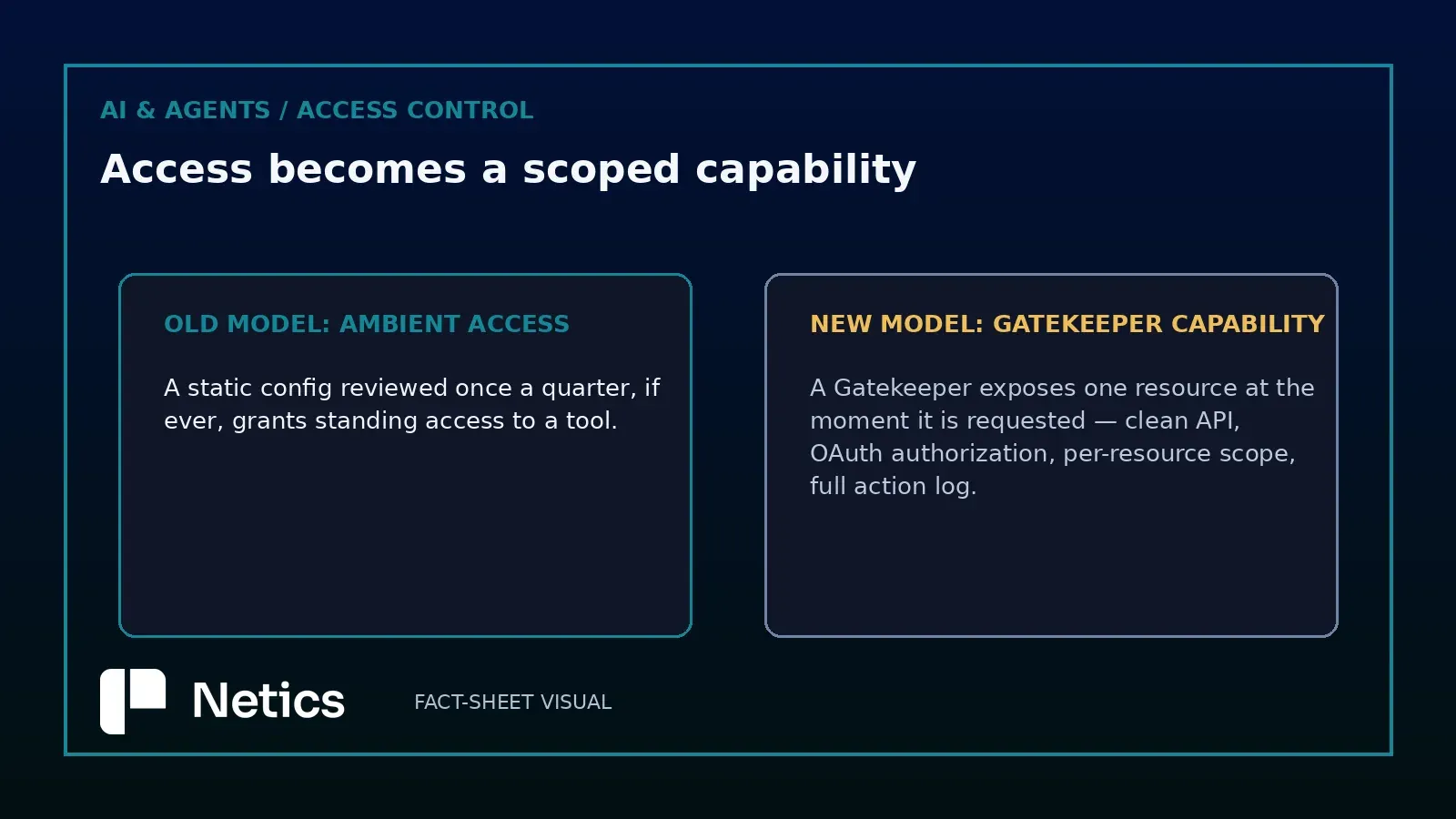
A common design risk is handing an agent a menu of tools before the task has established what it actually needs.[2] That is convenient for a demo and expensive in production. A compromised context, a confused user, or a connector configured too broadly can turn one prompt into access to repositories, tickets, documents, or production APIs that have nothing to do with the original request.[2] Prompt injection gets the attention, but permission drift is the quieter operational failure worth testing explicitly. Access granted for last month's integration project is still live for this month's unrelated task, because nobody revoked it and nothing in the system forced the question.
Ambient access does not need an attacker to become a liability. It just needs time, and most agent stacks have plenty of it.
Gatekeepers turn permission into a resource decision
Cloudflare's Gatekeeper model forces the resource into the open at the moment access is requested, rather than baking it into a static config reviewed once a quarter, if ever.[2] A Gatekeeper provides a clean API, handles authorization, enforces narrow access to only the resource the user intended, logs the action, and can queue human approval for anything with a side effect.[2] That gives the permission map a concrete unit. Not "the GitHub connector" — this repository. Not "the CRM" — this account, this record.
For a small or mid-sized company, that granularity maps onto how responsibility is actually assigned better than a role-based system does. A person owns a customer account or a specific project. A broad label such as "the CRM connector" is often a poor unit for reasoning about the risk of one specific account or record.
Deferred approval is a real design choice, not a shortcut
The repository describes a Gatekeeper that can simulate the outcome of an action locally so the agent keeps working, then queues the real action for a human to approve or reject afterward.[2] That solves a genuine usability problem. Synchronous approval interrupts the agent at the first risky step. Deferred approval can preserve usability, but only if the real commit remains impossible before approval and proposed state cannot be mistaken for applied state. Deferred approval keeps the agent moving without giving up the human decision.
But the trade-off has to be made explicit, not assumed. Simulation is only safe if the real commit is structurally impossible before approval lands, and if the simulated state can never be mistaken for committed state by a downstream step reading from the same source.[2] A queue needs an immutable action record, an expiry, a named owner, and — the part teams tend to skip — a schema where "proposed" and "applied" are two different fields, not two different mental states someone has to remember to keep straight.
Netics already runs a version of this discipline
A useful hypothetical is a workflow that can reach an internal system: define its allowed hosts, resources and credential scope before execution, then log the action and its result. That is the same discipline Cloudflare is now building into a runtime: decide what automation can reach before it runs, not after something goes wrong.
Cloudflare OS matters because it applies that discipline to a much larger surface — arbitrary external services an arbitrary agent might decide to call — and tries to make it the default, instead of the thing a careful team bolts on after an incident.
What operators should copy, with or without the product
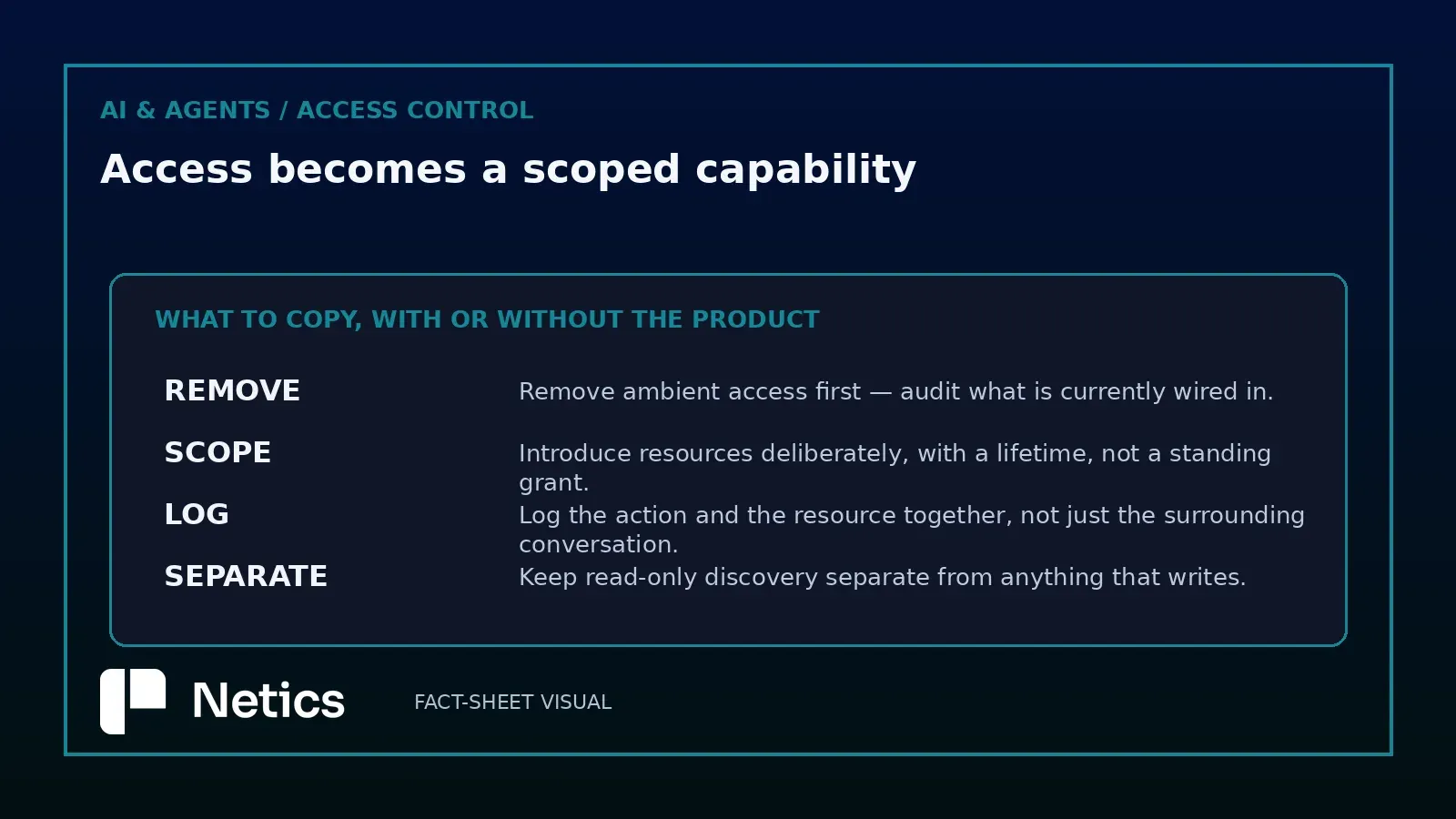
You do not need to run Cloudflare OS to take the pattern. Remove ambient access first — that is the single highest-leverage change, and it is often postponed because it means auditing what is currently wired in and admitting some of it should never have been. Introduce resources deliberately, with a lifetime attached, not a standing grant that outlives the reason it was created. Log the action and the resource together, not just the surrounding conversation: a transcript does not answer "what actually changed" when someone is running an audit at 6pm on a Friday. Keep read-only discovery separate from anything that writes. And when you defer approval for the sake of usability, make sure the queue can never be confused with committed reality — that confusion is exactly the failure mode that turns a sensible idea into an incident report.
This complements the signed-write pattern in Netics' zero-trust agent analysis: capability scope answers what the agent may reach, and a signed write answers who actually changed the state once it did.
What Cloudflare OS does not prove
The repository presents the project as early access and says plainly that it remains under heavy development.[2] That is not a knock — it is useful honesty, and it means the repository is a design reference right now, not a production certification. Teams evaluating it still need to check isolation guarantees independently, review how OAuth clients are configured and rotated, confirm what the action log actually captures under failure conditions, and test what happens when a Gatekeeper itself misbehaves. Capability-based access closes one class of risk. It says nothing about secret storage, host hardening, or what happens when the sandbox itself has a bug — worth remembering before anyone treats "capability-based" as a synonym for "secure."
Where this leaves operators
Cloudflare OS is worth watching less for what it ships today than for the default it argues for: an AI agent is an operating-system concern with its own identity, accountable to a human but restricted by what it is actually allowed to reach. That default is copyable long before the project itself is production-ready. Start with explicit resource introduction, short-lived permissions, durable action logs, and approval that a deadline cannot quietly bypass. If your current agent stack still hands out access by default and revokes it by exception, that is the thing worth fixing first — with or without Cloudflare OS in the stack. Netics can help design that boundary.
Sources
[2] https://github.com/cloudflare/cloudflare-os — Cloudflare OS repository and Gatekeepers documentation
Source: Cloudflare OS repository — 2026-08-26. Netics analysis.