
Anthropic Turns AI Adoption Into a Training Programme for Customer Engineers
Anthropic launched Claude Frontier Academy on 2 October 2026 with a $100 million commitment and a target of 10,000 Frontier Deployed Engineers by the end of 2027. The programme pairs a four-

TL;DR
- Claude Frontier Academy is a training and credential programme that Anthropic runs for engineers employed by its customers and partner firms, and its first track is a supervised residency on a live deployment at the engineer's own employer.
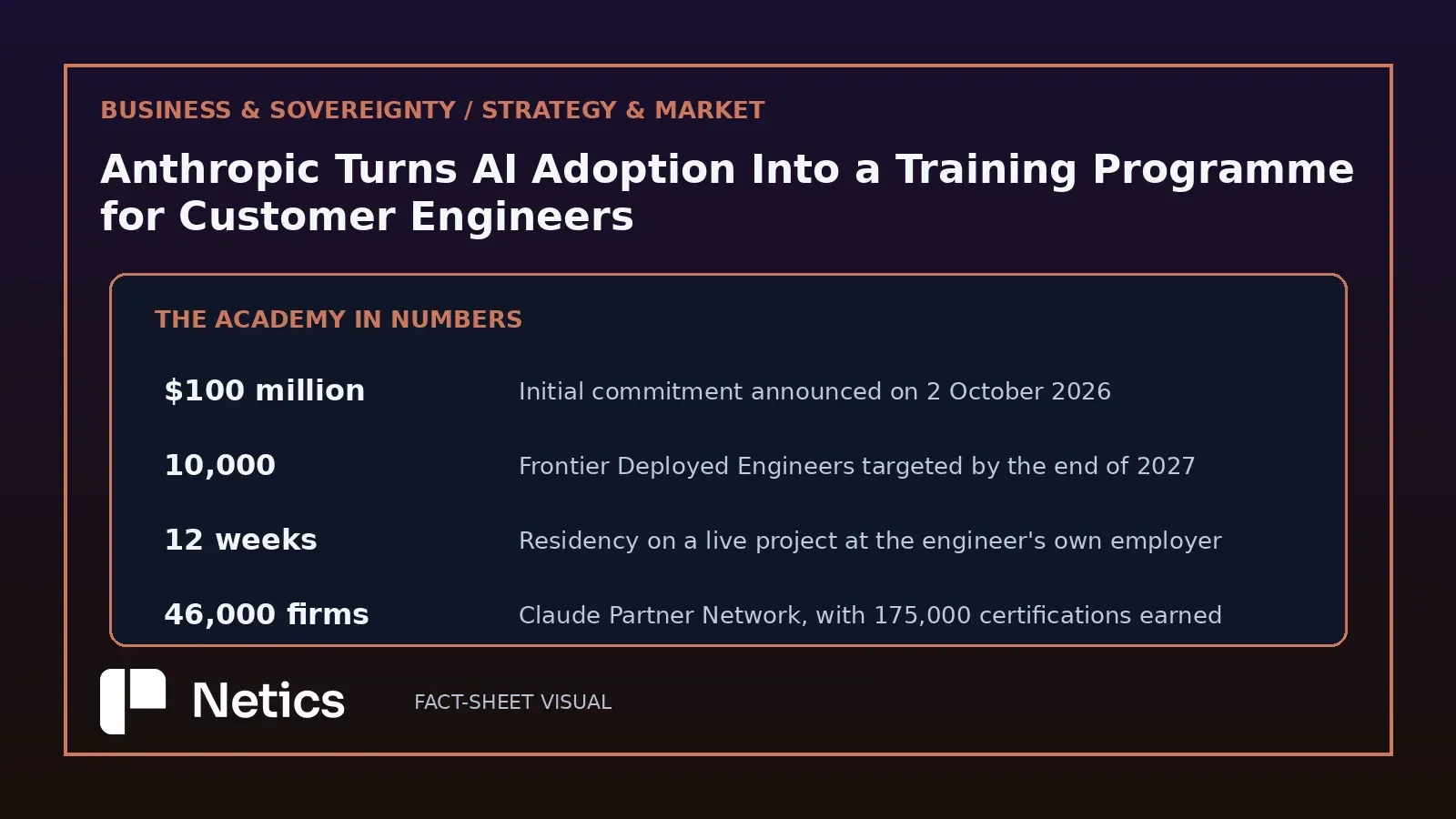
- Anthropic announced it on 2 October 2026 with a $100 million commitment and a target of 10,000 Frontier Deployed Engineers by the end of 2027.
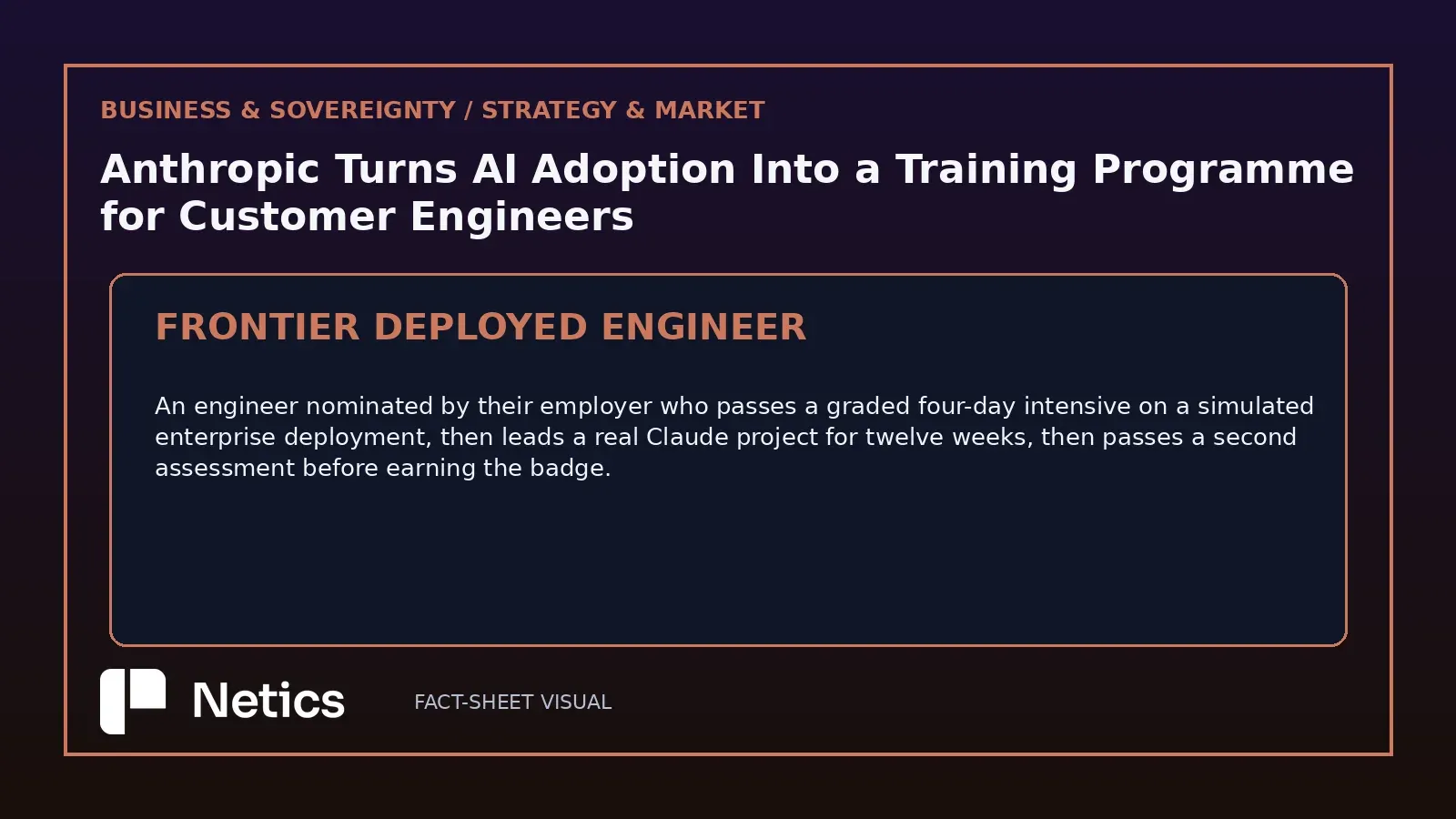
- The Claude programme page describes a four-day intensive, with three days building a Claude system for a simulated enterprise and a graded fourth day on a new scenario, followed by 12 weeks leading a real deployment and a final practical.
- The first cohorts draw engineers from Accenture, Bain, Capgemini, Commonwealth Bank of Australia, Deloitte, McKinsey, Morgan Stanley and Novo Nordisk, and cohorts run in San Francisco, New York and London.
- The programme builds on a network where professionals across 46,000 firms have earned more than 175,000 Claude certifications; Anthropic's target is 10,000 Frontier Deployed Engineers by the end of 2027.
- Claude Academy is open to everyone. Residency participation is in early access and takes nominations through an account team or partner manager.
- A small firm can copy the working shape here: a named project before the training starts, a graded handover, a real deployment with a mentor, and a second assessment after the live run.
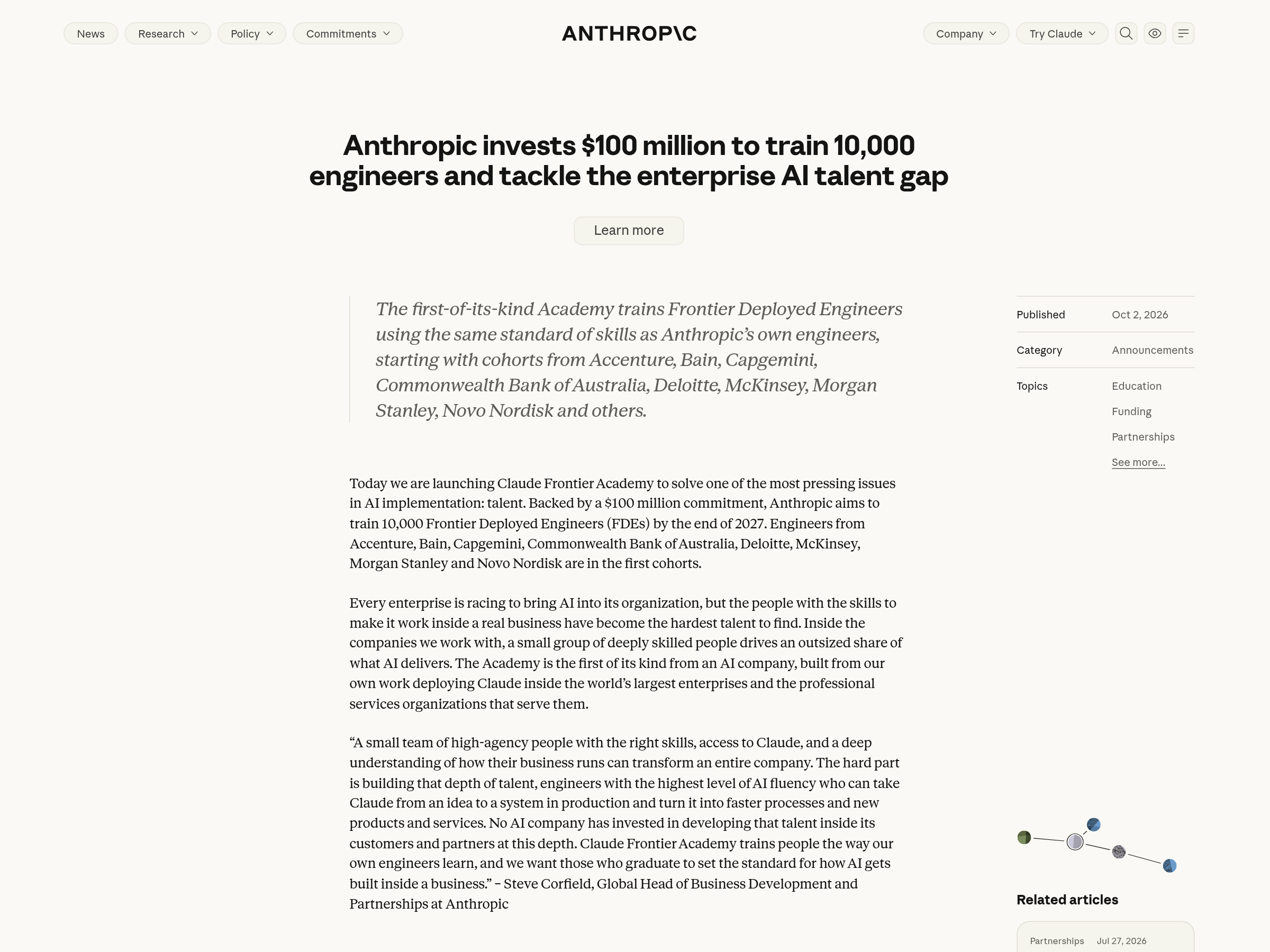
Anthropic's announcement names the problem in its first sentence: every enterprise is racing to bring AI into its organisation, and the people with the skills to make it work inside a real business have become the hardest talent to find. That framing is a vendor talking about its own customers, and it lands on something concrete. A model subscription gives a team access to the model. Hiring and training determine whether a team can turn a vague internal process into a system built on the company's own data, pass security review and teach the method to the next team.
What the residency puts an engineer through
The programme's own description is specific enough to be copied. The programme page lists the intensive at 4 days: three days in person building a Claude system for a simulated enterprise, from the first customer request through security review to handover, then a fourth day graded on a new scenario. Passing earns the Claude Resident Engineer badge and a place in the residency itself.
The residency then runs 12 weeks, during which the engineer leads a Claude deployment at their own organisation with cohort-based mentorship and support from Anthropic engineers. A final practical ends the programme and earns the Claude Frontier Deployed Engineer badge, with the first expected in early 2027.
The announcement adds the entry criteria: hands-on software engineers with strong fundamentals, a record of building with LLMs and experience helping others adopt AI, and prior experience building agents is optional. Each nominated engineer arrives with a named Claude project to lead on return.
The firms that supplied the first cohorts
The first cohorts name Accenture, Bain, Capgemini, Commonwealth Bank of Australia, Deloitte, McKinsey, Morgan Stanley and Novo Nordisk, and the cohorts run in San Francisco, New York and London. Read that list as a description of who the programme is built for: large employers with engineering benches deep enough to release someone for twelve weeks, and consultancies whose business is doing this work inside client organisations.
Steve Corfield, Anthropic's Global Head of Business Development and Partnerships, frames the target in the announcement as a depth problem: the company wants graduates to "set the standard for how AI gets built inside a business". That sentence describes a credential backed by a curriculum in which handover and assessment are explicit stages.
More than 175,000 certifications alongside a target of 10,000 engineers
The announcement places the Academy on top of an existing structure: the Claude Partner Network, where professionals across 46,000 firms have earned more than 175,000 Claude certifications, and nearly 4,000 people have completed Basecamp, an immersive programme that teaches the same curriculum Anthropic's Applied AI teams receive.
Those numbers reframe the target. Anthropic's target of 10,000 Frontier Deployed Engineers by the end of 2027 sits alongside more than 175,000 existing Claude certifications, two figures covering different qualifications. The programme page separates the layers explicitly: Claude Academy open to everyone, certifications and Partner Basecamp for partner organisations, the residency for nominated engineers, Claude Marketplace for teams already using the product.
Two doors into Anthropic's training
The distinction that matters commercially sits in two lines of the programme page. Claude Academy is open to everyone. The Frontier Deployed Engineer Residency is in early access with a select group of customers and partners, and interest is registered through an Anthropic account team, or through a partner manager for partner organisations.
Claude Academy is open to everyone, and residency interest is registered through an Anthropic account team or partner manager. The announcement puts the same condition in plainer terms: participation is by nomination, and organisations can ask their account team whether they are eligible.
The commitment a nomination asks of an employer
The nomination model carries an obligation that the brochure language hides. An engineer steps away from delivery work during the 4-day intensive, then spends twelve weeks leading a project at their own company, with a cohort and Anthropic engineers attached. That is twelve weeks of a senior person's attention, committed before anyone knows whether the project will survive contact with a security review.
The named project requirement is the part that makes the commitment legible. A nomination without a project becomes training for its own sake, so the programme has each engineer arrive with the thing they will build when they return. For an employer, choosing that project is the real decision, and it belongs to whoever owns the process the project is meant to change.
What a twenty-person firm can copy from the residency
Take a hypothetical case. Consider a small logistics firm whose finance team reconciles supplier invoices by hand. The residency's early-access route is limited to a select group of customers and partners. The following sequence adapts the programme's published stages to a small firm's scale.
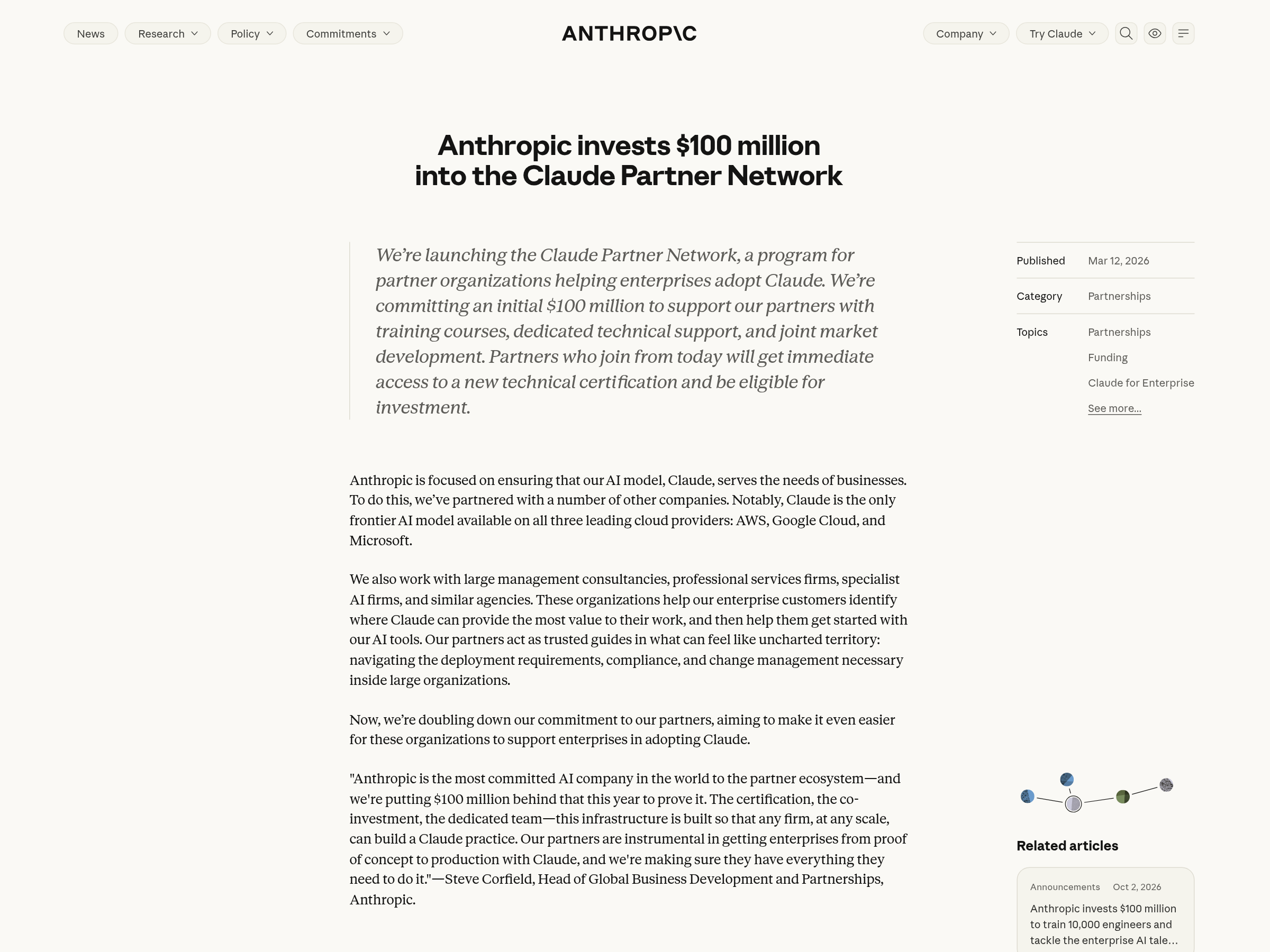
Name the project in writing before anyone starts: which process, which data, which owner, what the handover looks like. Then build the thing on a simulated case first, with the real spreadsheet and the real exceptions, and grade it against a scenario nobody rehearsed. Then put it into production with a named mentor and a fixed review date, and assess it again at a second review. The production-readiness review pattern covers the approval step that a finance process needs at the end of that sequence.
The order is the transferable asset: real data, a graded dry run, a live deployment with a deadline, a second look when the novelty has worn off. The production readiness argument describes the engineering work involved; a small firm can run the same sequence without a partner network.
Anthropic's offer combines this sequence with access through its customer and partner channels and an Anthropic badge. Each stage of this sequence can be run in-house, including [a production-readiness review](https://blog.neticslabs.com/ai-prototype-production-ready-because-model-works/). The mechanics underneath fit on one page, and running them gives a firm direct evidence about its own processes. The final approval step is a production-readiness review.
The production-readiness analysis develops the approval step used in this sequence.
Sources
Source: Claude Frontier Academy: $100M to train 10,000 engineers — Anthropic, anthropic.com/news/claude-frontier-academy, dated 2 October 2026 on Anthropic's announcements index (anthropic.com/news/announcements), retrieved 2026-10-23 (a $100 million commitment to train 10,000 Frontier Deployed Engineers by the end of 2027; first cohorts from Accenture, Bain, Capgemini, Commonwealth Bank of Australia, Deloitte, McKinsey, Morgan Stanley and Novo Nordisk; the medical model for the residency; hands-on software engineers with strong fundamentals, a record of building with LLMs and experience helping others adopt AI, with prior agent-building experience optional; organisations nominate their strongest engineers, each arriving with a named Claude project to lead; a multi-day in-person programme with a simulated enterprise deployment and a graded practical on a new scenario for the Claude Resident Engineer badge; a 12-week residency leading a real Claude use case with a second assessment for the Claude Frontier Deployed Engineer badge, first expected in early 2027; cohorts in San Francisco, New York and London; nomination through an Anthropic account team or Partner Account Manager; the Claude Partner Network with 46,000 firms, more than 175,000 certifications and nearly 4,000 Basecamp completions; the Steve Corfield quotation).
Source: Claude Frontier Academy — Claude by Anthropic, claude.com/programs/frontier-academy, retrieved 2026-10-23 ($100M initial investment starting with the Frontier Deployed Engineer Residency; 10,000 Frontier Deployed Engineers by the end of 2027; additional programmes to be announced in 2027; nomination only with a high bar; designed by Anthropic practitioners and grounded in real work; small cohorts with peers from other organisations; an Anthropic credential at the end; the intensive is 4 days with three days in person building a Claude system for a simulated enterprise from first customer request through security review to handover, and a graded fourth day on a new scenario; the residency is 12 weeks with cohort-based mentorship and support from Anthropic engineers; a final practical earns the Claude Frontier Deployed Engineer badge; the FDE Residency is in early access with a select group of customers and partners and interest is registered through an account team or partner manager; Claude Academy is open to everyone, certifications and Partner Basecamp serve partner organisations, and Claude Marketplace serves teams using Claude).
Source: Anthropic's Claude Frontier Academy announcement of 2 October 2026 and the programme page on claude.com, both retrieved 2026-10-23 — every figure, role name and programme stage above traces to one of those two pages. Images are captures of the two Anthropic pages plus two Netics editorial diagrams. Related analysis: production-readiness review. Netics editorial, neticslabs.com.