
Fortinet Schedules a Hardening Release and Credits AI-Assisted Testing
Fortinet scheduled fixes for FortiOS, FortiManager and FortiAnalyzer for 22 October 2026, says its frontier AI-assisted testing program found the vulnerabilities, and will not publish the advisor

TL;DR
- The Fortinet security hardening release is a coordinated set of security updates for FortiOS, FortiManager and FortiAnalyzer.
- The company scheduled a coordinated security hardening release across those three product families for 22 October 2026, following recent FortiMail and FortiAuthenticator releases, and it says the vulnerabilities behind the fixes came from a frontier AI-assisted testing programme.
- Fortinet gives four reasons for treating the change as urgent: the severity of the fixes, faster weaponization of published patches, patch diffing, and the chaining of lower-severity flaws into a severe one.
- The public advisories arrive on Patch Tuesday, 10 November, after the scheduled 22 October release, so the CVE detail that normally drives prioritisation arrives well after the 22-23 October change windows Fortinet recommends.
- What an operator can do in the meantime runs to inventory, change windows on 22 and 23 October, as Fortinet recommends, configuration backups and log monitoring, with administrative interfaces restricted where a device cannot move immediately.
- A reusable inventory of product branch, management reachability, authentication configuration and change owner gives operators a basis for handling future hardening releases.
Fortinet published the release note one day before the builds. The post is signed by chief information security officer Carl Windsor, names the products FortiOS, FortiManager, FortiAnalyzer, FortiMail and FortiAuthenticator, gives the fixed version for every affected branch, and states that the fixes address vulnerabilities identified through the company's frontier AI-assisted security testing programme.
What Fortinet scheduled for 22 October across three product families
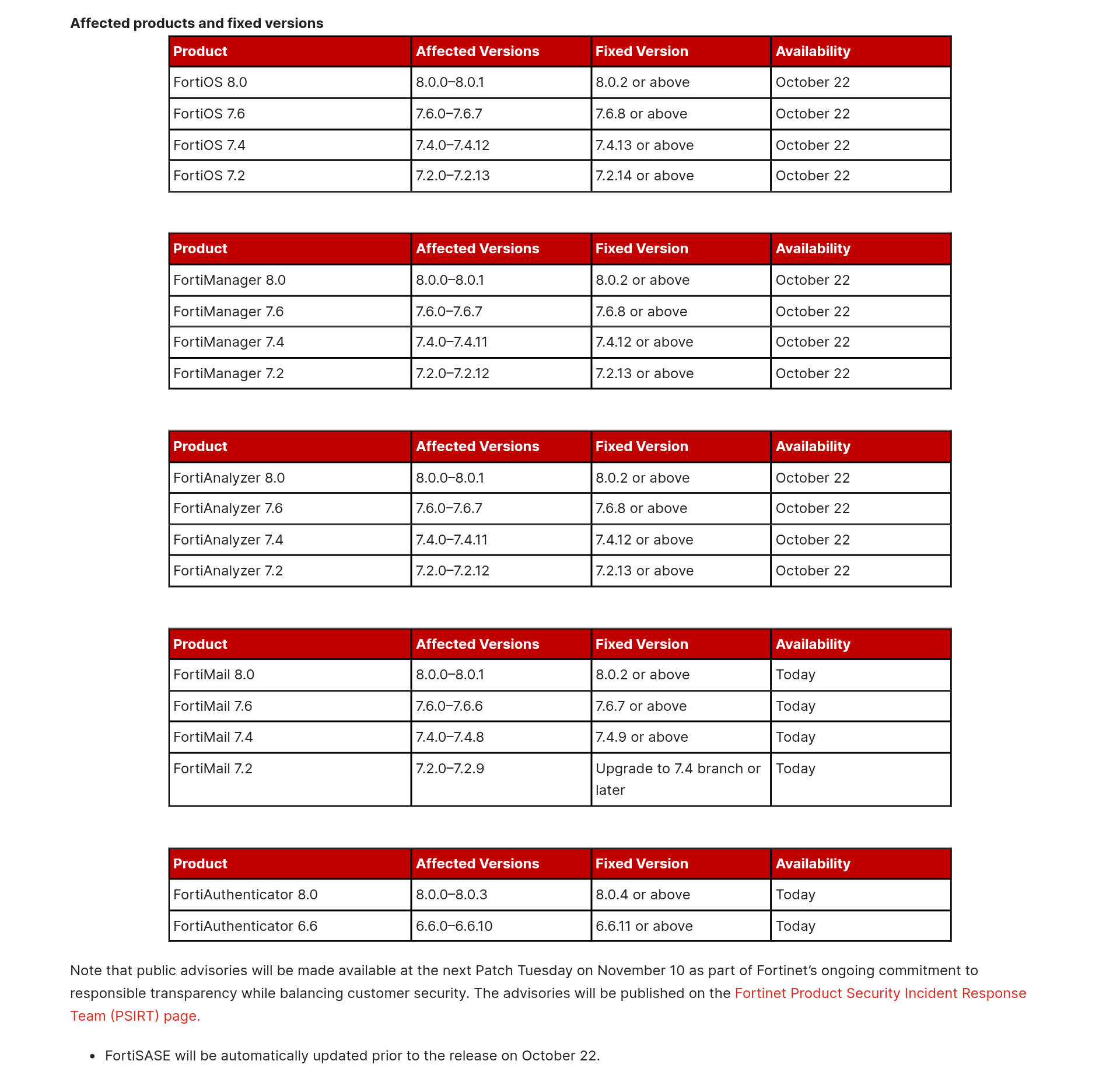
The release covers FortiOS, FortiManager and FortiAnalyzer. FortiOS moves to 8.0.2 from 8.0.0-8.0.1, to 7.6.8 from 7.6.0-7.6.7, to 7.4.13 from 7.4.0-7.4.12 and to 7.2.14 from 7.2.0-7.2.13. FortiManager and FortiAnalyzer share a slightly different ladder: 8.0.2, 7.6.8, 7.4.12 and 7.2.13.
Fortinet's post lists the FortiMail and FortiAuthenticator updates as already available, which is worth noting for sequencing. On FortiMail 7.2 the fix is an upgrade to the 7.4 branch or later.
Frontier models inside the vendor's own code review
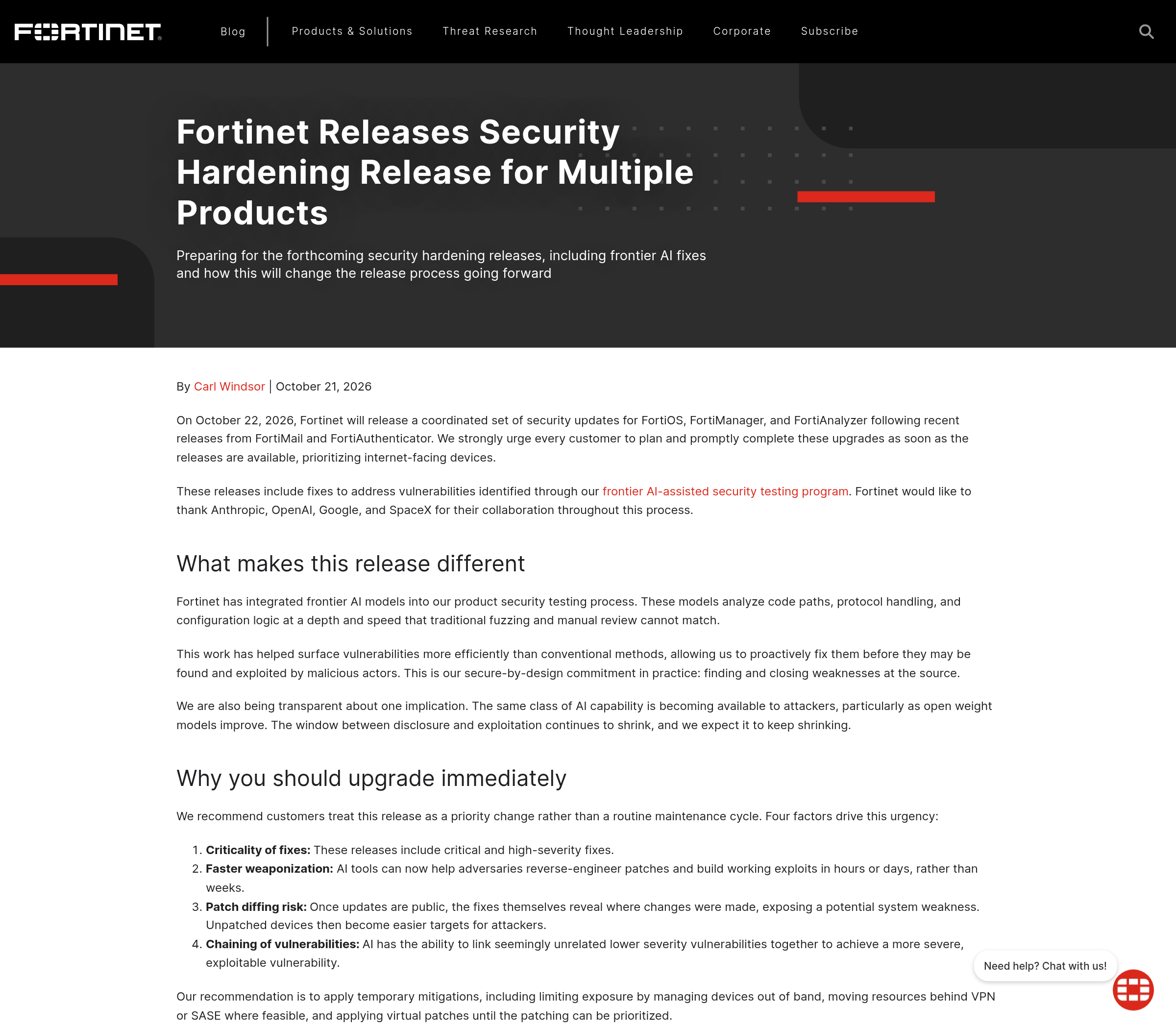
Fortinet says it has integrated frontier AI models into its product security testing process, and that those models analyse code paths, protocol handling and configuration logic. The post thanks Anthropic, OpenAI, Google and SpaceX for their collaboration.
Fortinet's AI-testing claim remains vendor-reported: the post provides no benchmark, validation method or flaw-level detail with which readers can assess the claimed efficiency, and the advisories do not appear until 10 November. Fortinet says these models surface vulnerabilities more efficiently than conventional methods, allowing it to fix them proactively. Fortinet also states the obvious consequence in the same paragraph: the same class of capability is reaching attackers as open-weight models improve.
Four reasons Fortinet gives for treating this as urgent
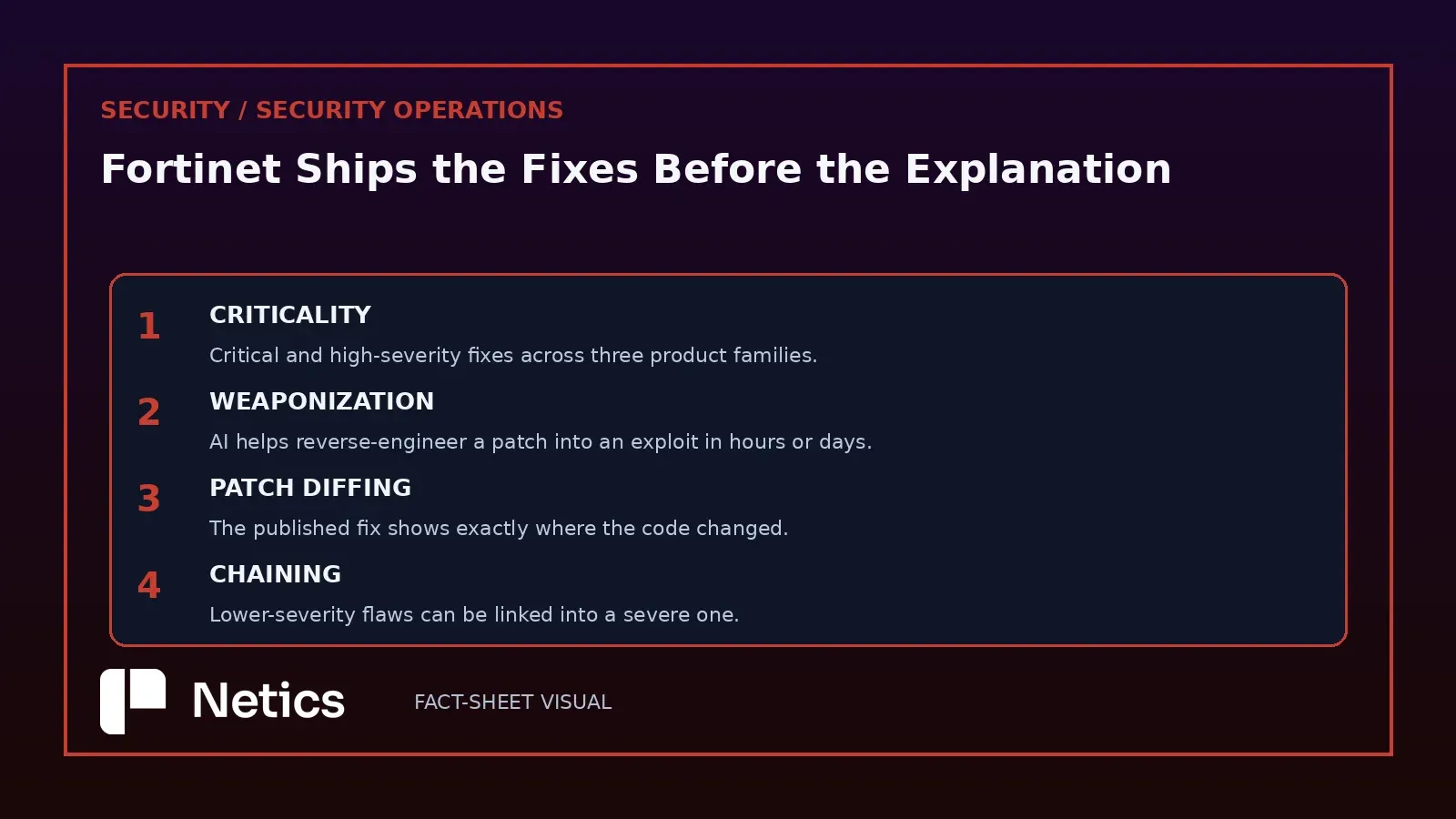
The four factors are laid out as a list, and three of them describe a world where the fix is the starting gun. Faster weaponization means AI tools help adversaries reverse-engineer a patch and build a working exploit in hours or days. Patch diffing means the published update itself shows where the code changed. Chaining means lower-severity flaws get linked into something severe.
The fourth is severity. The release carries critical and high-severity fixes, and Fortinet recommends interim controls where a device cannot move at once: manage it out of band, put resources behind VPN or SASE, apply virtual patches.
The advisories arrive after the fixes
The disclosure schedule deserves scrutiny because it gives customers fixed builds before the flaw-level evidence needed to rank exposure independently. Fortinet will publish the public advisories at the next Patch Tuesday on 10 November. The fixed builds were scheduled for 22 October. Between those two dates the operator has a version number, a severity band in aggregate, and no CVE description to rank against their own exposure.
The usual workflow reads a CVE, checks whether the affected feature is switched on, and decides. That workflow has nothing to read in this window. During this window, operators can use the configuration to rank exposure: which management interfaces are reachable from the internet, which remote-access services face the internet, whether the administrative accounts use MFA, and which branches are still running 7.2.
The management plane deserves its own line in the plan. Fortinet's interim advice specifically addresses the management plane. Fortinet's own interim advice reflects that: keep FortiManager administration off the internet.
What an operator can do between the fix and the write-up
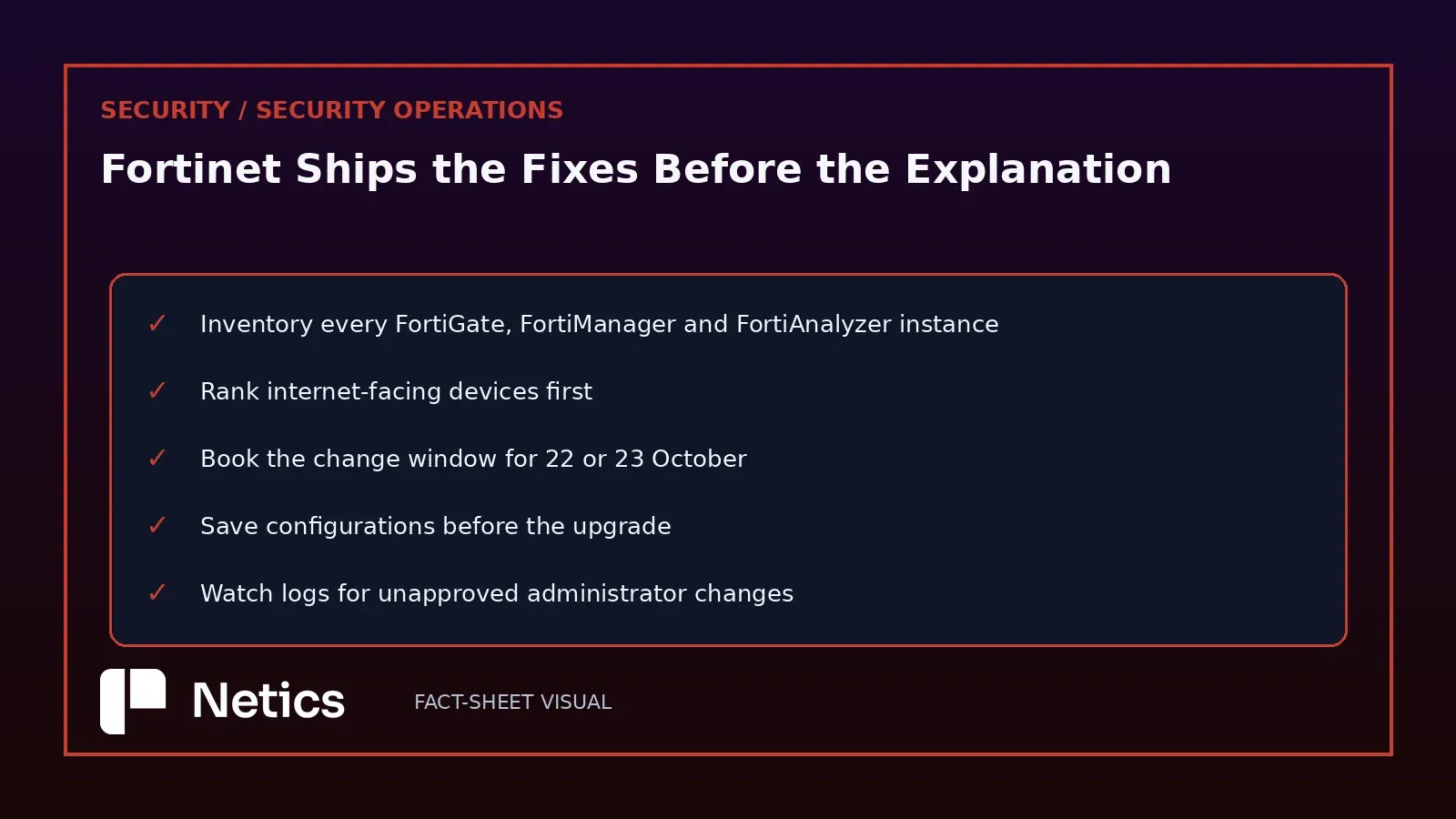
The post's own action list is short and specific. Inventory every FortiManager device and FortiOS instance, prioritising the ones exposed to the internet. Schedule the change windows for 22 and 23 October. Back up configurations before upgrading. Watch logs for unusual administrative access and unapproved configuration changes, before and after.
Two logistics items are easy to miss. FortiSASE is updated automatically before the release, removing it from the manual queue and changing the tenant without operator action. FortiManager Cloud builds are available by 22 October and may still need a manual update, and updates for public cloud instances are pushed out through the relevant cloud partners.
An inventory that survives the next hardening release
The interesting question is what happens to the next one. When fixed builds arrive before their advisories, the asset record becomes the unit of work. For this release window, a useful asset record covers the product and branch, management reachability, authentication configuration and the owner who books the window.
Those details can also structure security work on a firewall estate. The article's operational inference is that a coordinated release on a fixed date gives operators a planning point once the inventory exists to receive it.
Teams that want the surrounding discipline written down can use the security audit checklist, a separate Netics article.
Sources
Source: Fortinet Releases Security Hardening Release for Multiple Products — Fortinet CISO Collective, Carl Windsor, fortinet.com/blog/ciso-collective/fortinet-releases-security-hardening-release-for-multiple-products, 21 October 2026, retrieved 2026-10-22 (coordinated security updates for FortiOS, FortiManager and FortiAnalyzer on 22 October 2026 following releases from FortiMail and FortiAuthenticator; fixes addressing vulnerabilities identified through the frontier AI-assisted security testing program, with thanks to Anthropic, OpenAI, Google and SpaceX; frontier AI models integrated into the product security testing process analysing code paths, protocol handling and configuration logic at a depth and speed traditional fuzzing and manual review cannot match; the same class of capability becoming available to attackers as open weight models improve and the window between disclosure and exploitation shrinking; the four urgency factors of criticality, faster weaponization, patch diffing and chaining; interim mitigations including out-of-band management, VPN or SASE and virtual patches; FortiOS 8.0.0-8.0.1 to 8.0.2, 7.6.0-7.6.7 to 7.6.8, 7.4.0-7.4.12 to 7.4.13 and 7.2.0-7.2.13 to 7.2.14; FortiManager and FortiAnalyzer 8.0.0-8.0.1 to 8.0.2, 7.6.0-7.6.7 to 7.6.8, 7.4.0-7.4.11 to 7.4.12 and 7.2.0-7.2.12 to 7.2.13; public advisories at the next Patch Tuesday on November 10 on the Fortinet PSIRT page; FortiSASE updated automatically prior to the release; FortiManager Cloud releases available by 22 October with possible manual update; cloud instances pushed through cloud partners; the inventory, change-window, backup and log-monitoring actions; the interim restrictions on administrative interfaces and the requirement to keep FortiManager administration off the internet).
Source: Fortinet's security hardening release post of 21 October 2026, retrieved 2026-10-22 — every version number, product name, date and quoted claim above traces to that page. Both images are captures of it. Related Netics page: security services.