
China Proposes Export Controls for Large AI Models
China's commerce and science ministries published a draft revision on 16 October 2026 that adds 40 technologies to the export catalogue, 23 of them AI. Models above a two-trillion-par

TL;DR
- China's export control catalogue is the legal list of technologies whose transfer abroad is banned or requires a licence.
- On 16 October 2026 the Ministry of Commerce and the Ministry of Science and Technology published a draft revision adding 40 technologies across AI, biomedicine and solar power, of which 23 are AI items covering large models, AI agents, computing clusters and information processing.
- China Daily and Global Times report that 14 of the 40 additions would be prohibited outright and 26 restricted under licence, and the Associated Press reports that models with two trillion parameters or more, or with certain world-leading capabilities, could be restricted.
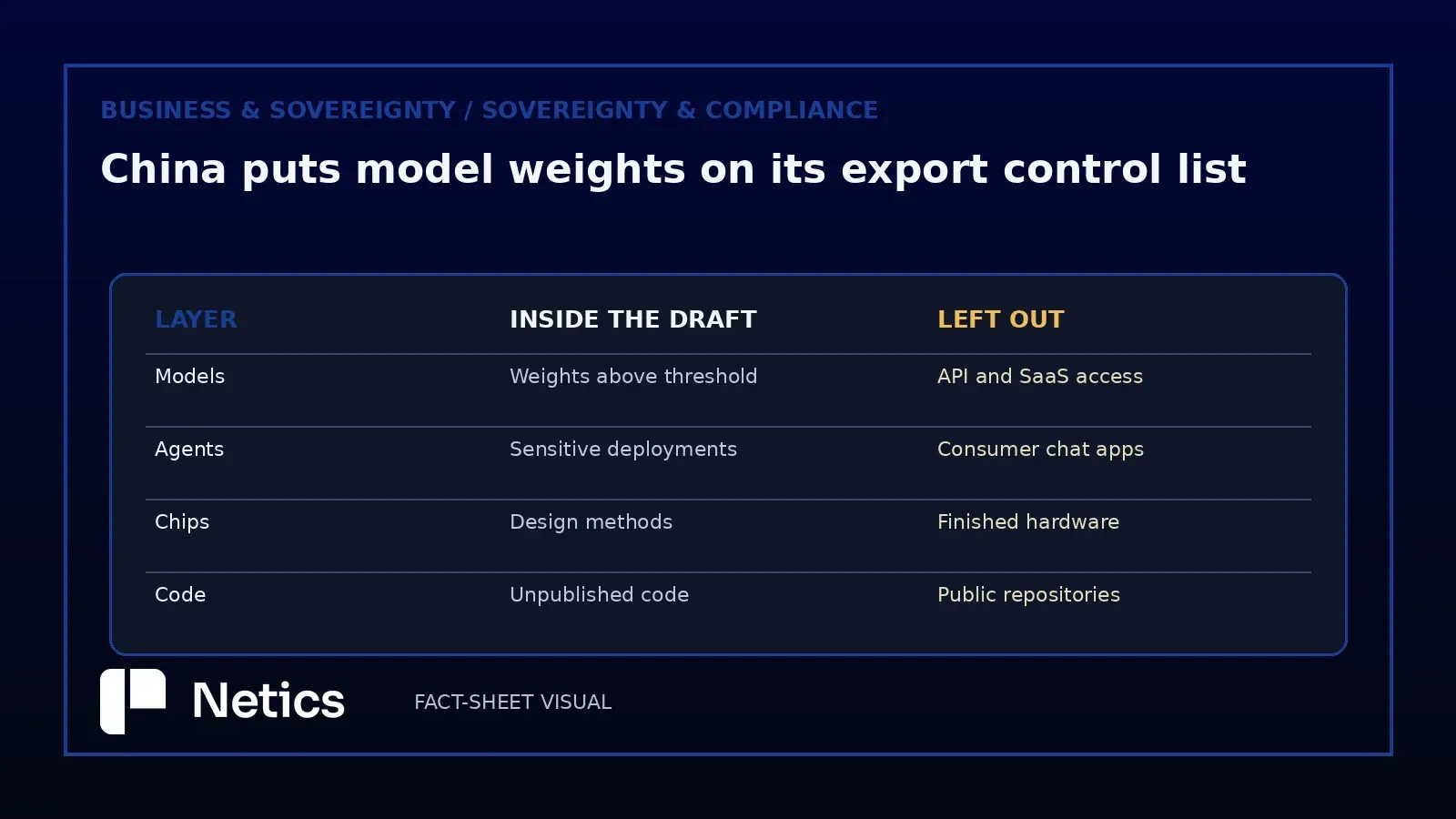
- Reuters reports that the draft covers overseas deployment of a restricted model and excludes access through APIs, websites, apps and software-as-a-service. The exclusion comes from Reuters and the threshold from Associated Press; the published ministry notice describes the 40 technologies at category level.
- Technology already in the public domain through open-source release or academic publication is excluded, and Reuters and China Daily report simplified licensing for open-source exports.
- Registration of covered transfers applies from 16 October, before the catalogue is final, and public comment closes on 15 November 2026.
What the draft catalogue adds
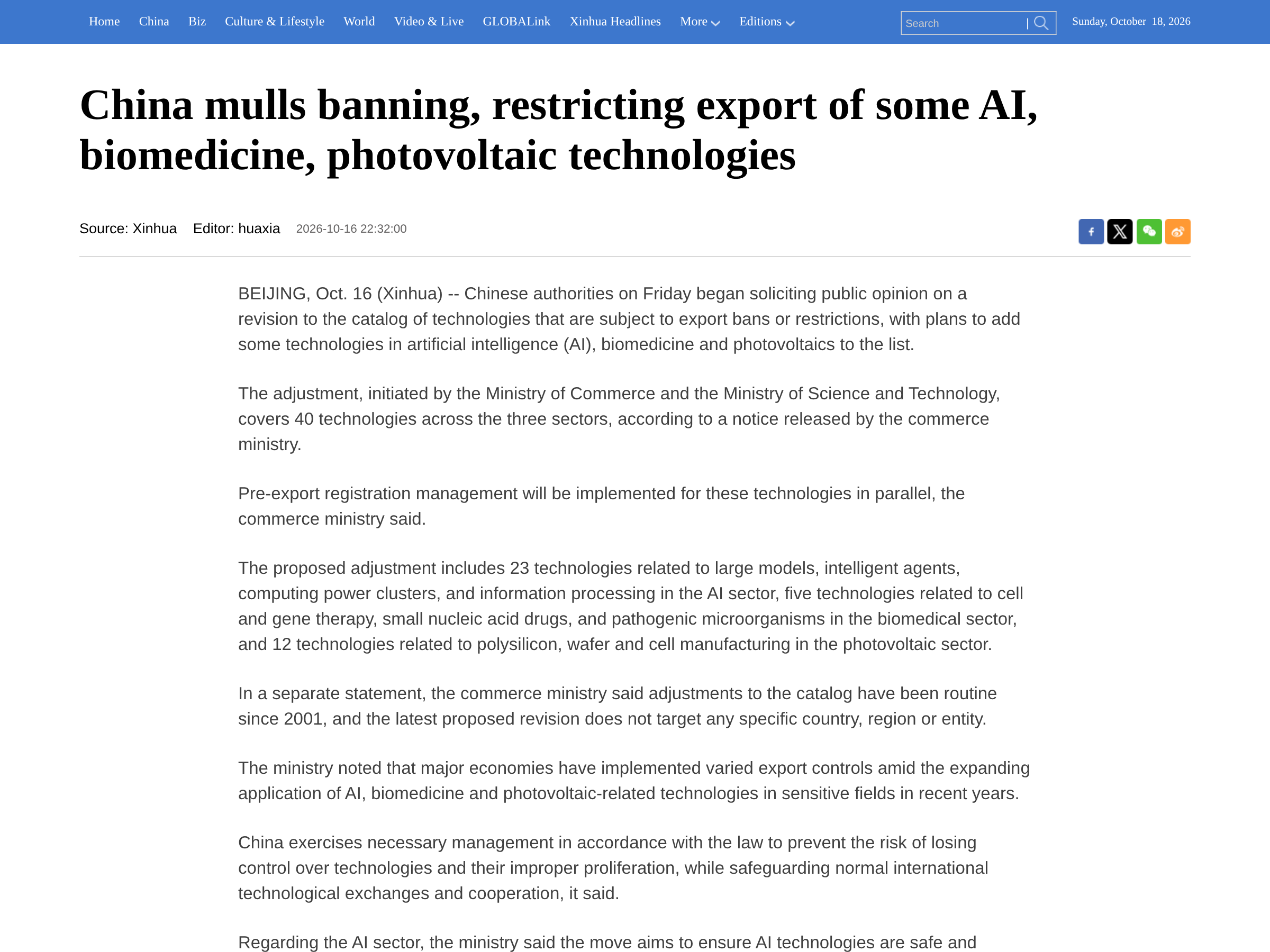
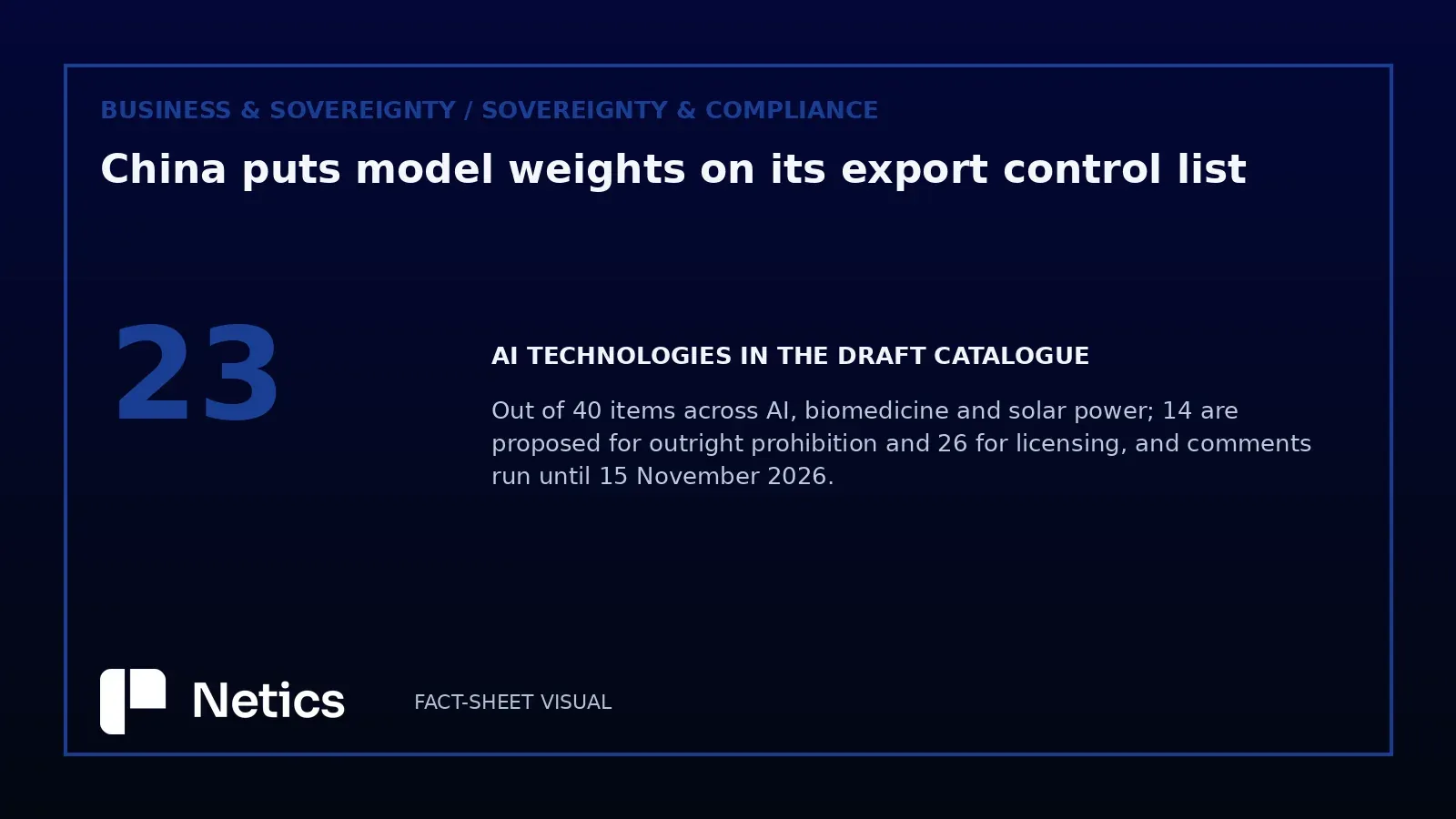
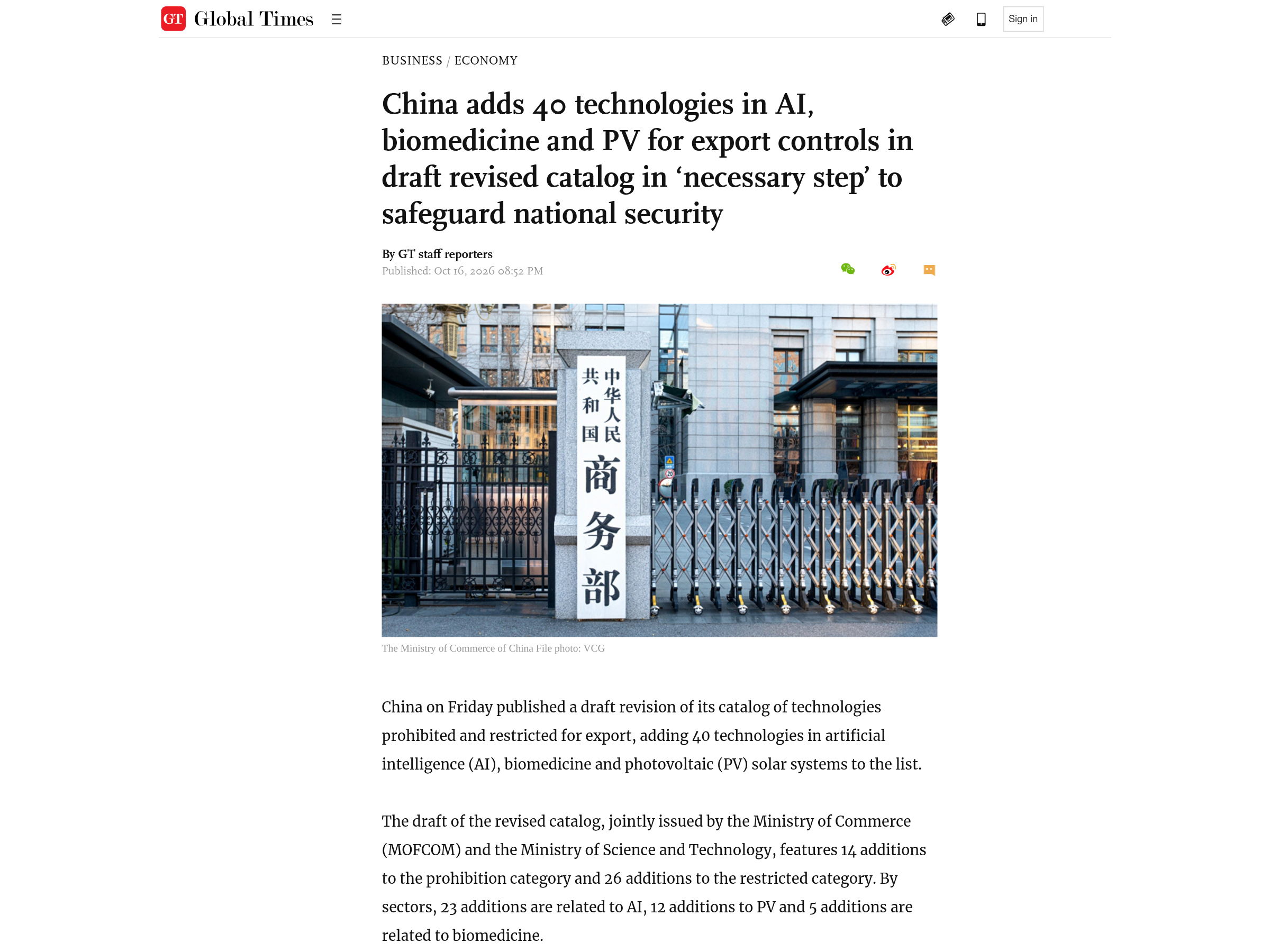
The two ministries published the draft on Friday 16 October 2026 as a proposed adjustment to the catalogue of technologies whose export is banned or restricted. The additions total 40: 23 in artificial intelligence, 12 in photovoltaics and 5 in biomedicine, according to Global Times' account of the announcement and China Daily's reading of the ministry statement.
The AI items are grouped around large models, AI agents, computing clusters and information processing. Within the 40, China Daily and Global Times report 14 proposed for outright prohibition and 26 for restriction, which in this catalogue means a licence is required before the technology can leave the country. Global Times adds detail that sits in the draft annex: design technologies for 2.5-dimensional and 3-dimensional AI chips and for 3-dimensional flash memory are on the restricted side, alongside AI information processing and voiceprint recognition technologies.
On the prohibition side, the Associated Press reports that exports of core technologies of AI large models trained using sensitive national data would be prohibited, along with AI agents designed for highly sensitive environments such as national defence and critical information infrastructure. The Associated Press adds that a commerce ministry spokesperson called the measure necessary, and that the ministry's statement framed it around reinforcing the security bottom line and keeping AI under human control.
Press reports place the threshold on the model itself
The operative detail for anyone outside China is where the line is drawn, and press reports place it on the model itself. The Associated Press reports that exports of AI models with parameter counts of 2 trillion or above, or with certain world-leading capabilities, could be restricted, and notes that Moonshot's Kimi K3 and Alibaba's Qwen 3.8-Max sit above that parameter count while the proposal names no specific model.
A parameter threshold is a crude instrument. The Associated Press also reports a test based on certain world-leading capabilities, a phrase that supplies no operational measure in the report. The ministry notice confirms a public-domain exclusion. Reuters and Eastern Herald separately report exclusions for APIs, hosted services and lightweight on-device deployment; those exclusions are absent from the notice. The available texts therefore leave unresolved where public weights end, deployment know-how begins and operation of the same model becomes a hosted service; the final rules need to define those boundaries. Reuters reports that the proposals cover the overseas deployment of AI models containing restricted technology, a phrase that reaches the act of running such a model on foreign infrastructure.
The cluster side of the list matters for the same reason. Computing cluster architectures and chip design methods are process knowledge, the kind of material that travels in an engineer's head or in a design file. Global Times reports that the catalogue now names design technologies for 2.5-dimensional and 3-dimensional AI chips and for 3-dimensional flash memory, which puts design knowledge on the list.
How press reports describe model transfers and hosted access
The carve-out that decides most commercial questions is the treatment of hosted access. Reuters reports that the proposals exclude access through application programming interfaces, websites, apps and software-as-a-service platforms. The Eastern Herald, reading the ministry's question-and-answer note, adds that offering a model through an API, an app, a website or software as a service, or through lightweight on-device deployment, does not count as large-model technology export.
The duties in the draft fall on the Chinese exporter, which must register the transfer and, for a restricted technology, obtain a licence. On these press readings, a transfer of a restricted, unpublished model for deployment abroad is the controlled case, and hosted access to the same model is excluded as drafted. On the same readings, a European organisation that runs open weights already published, and so in the public domain, on its own servers stays outside that scope, and so does an organisation that calls the same model over an API.
Reuters draws the commercial conclusion: the distinction could allow Chinese developers such as DeepSeek and Alibaba to continue expanding internationally. The ministry spokesperson, in China Daily's account, said the proposed controls cover a narrowly defined range of AI technologies and that the vast majority will remain freely exportable once the revision takes effect.
The registration duty that is already in force
Registration of covered transfers already applies while the catalogue is still a draft. China Daily reports that alongside the consultation, which runs through 15 November, the ministries introduced temporary pre-export registration requirements effective immediately and lasting until the revised catalogue takes effect. Global Times' framing of the same measure calls the update routine and describes restrictions as compatible with continued compliant export.
The Eastern Herald's reading of the notice sets out what registration covers: transferring ownership of the technology abroad, licensing a technology for use overseas, and giving a foreign party ownership or control of the domestic owner. The form asks for the recipient, destination, intended use and estimated value, and exports that have begun but not completed are covered as well.
That last clause is the one with teeth for deal teams. The ministry notice covers exports begun but not completed, and the facilitation measures that the Eastern Herald, Reuters and China Daily describe, namely automatic licensing for a restricted model run on a Chinese firm's own overseas servers and simplified licensing for open-source exports and overseas joint research, remain proposals whose eligibility criteria and procedure require confirmation in the final rules.
The open-source carve-out carries the argument
Every account of the draft carries the same exclusion. Reuters reports that technology already in the public domain through open-source releases or academic papers would be outside the proposed controls. Global Times states the same rule, and China Daily reports that the draft provides for automatic licensing and streamlined procedures for eligible AI exports including open-source releases.
Reuters and Global Times report that technology already in the public domain is excluded, so on their reading a model whose weights are already public falls outside the draft.
Reuters reports that Chinese AI models gained ground abroad on lower prices and improving capabilities since DeepSeek's R1 emerged, a competitive frame worth holding next to the legal text. Omdia's chief analyst Lian Jye Su told the Associated Press that the move can be seen as a response to Western countries posting sovereignty requirements on AI, robotics and telecommunications.
What a European buyer verifies before signing
The first thing to establish is which artefact the contract moves. Contracts may cover support, an API subscription or a transfer of weights, each with a different compliance position. The press readings place the controlled case on the transfer of weights, and the ministry notice lists ownership transfers, overseas licensing and changes of ownership or control as registration cases, so each of the three deserves a check against the notice. Start by reading the agreement's schedule for the word weights, then check the relevant catalogue entry.
The second is the counterparty's own compliance position. A Chinese vendor that must register a transfer has a filing obligation with its own deadline, and a European buyer absorbs that delay. Asking for the registration reference and the vendor's written basis for any claimed automatic-licensing eligibility documents its interpretation during the consultation period.
The third is the deployment plan. An organisation that intends to fine-tune and run a restricted, unpublished model obtained under a transfer agreement depends on its vendor's licence, and it should price that licensing risk into the project before signature. Teams planning sovereign infrastructure and cloud exit projects can settle the question of who holds the artefact before the compute is bought.
Gary Ng of Natixis told the Associated Press that the world is getting more fragmented in trade and investment, and also in access to technologies. According to those press reports, a model artefact transfer may trigger control. Hosted use may remain available. Public-domain technology is excluded. This structure regulates custody of weights and may leave practical access to capability available through hosted services. Buyer documentation records the resulting uncertainty, and the final rules need to resolve it.
Sources
Source: China Moves to Curb Tech Exports, Including AI, Citing National Security Risks — Associated Press, published by U.S. News, 16 October 2026, retrieved 2026-10-18 (the 40 technologies spanning AI, chips and solar, the 23 AI technologies from advanced large models to agents, prohibited exports of core technologies of AI large models trained on sensitive national data and of AI agents for highly sensitive environments including national defence and critical information infrastructure, the two-trillion-parameter and world-leading-capability threshold for restrictions, Kimi K3 and Qwen 3.8-Max above that count with no model named in the proposal, the inclusion of AI processing and memory chip design technologies, the ministry statement on the security bottom line and keeping AI under human control, Lian Jye Su of Omdia on the response to Western sovereignty requirements, and Gary Ng of Natixis on fragmented access to technologies).
Source: Beijing seeks tighter grip on AI exports amid US rivalry — Reuters, by Eduardo Baptista, 16 October 2026, published by whbl.com, retrieved 2026-10-18 (export controls proposed on 23 AI technologies including models, agents and computing clusters, coverage of overseas deployment of AI models containing restricted technology with API, website, app and software-as-a-service access excluded, the effect on DeepSeek and Alibaba, Chinese models gaining ground since DeepSeek's R1, most AI technologies remaining freely exportable with simplified licensing for open-source exports and for Chinese companies operating their own computing centres overseas, public-domain technology outside the proposed controls, the broader revision of 40 technologies, and registration of certain overseas transfers from Friday pending final rules after consultation closes on 15 November).
Source: China Orders AI Export Registration, Spares Chatbot Access — Eastern Herald, 16 October 2026, retrieved 2026-10-18 (the interim registration rule running from the notice's issue date until a final catalogue takes effect, API, app, website, software-as-a-service and lightweight on-device deployment not counting as large-model technology export, the three cases that require registration including giving a foreign party ownership or control of the domestic owner, the registration form fields, automatic licensing for a restricted model run on a Chinese firm's own overseas servers, 14 items banned and 26 licensed, and the AI examples running from malicious-code generation to AI-assisted vulnerability discovery).
Source: Draft revision aims to better streamline tech exports — China Daily, 17 October 2026, retrieved 2026-10-18 (the 40 technologies with 14 prohibitions and 26 restrictions, automatic licensing and facilitation measures, the consultation through 15 November with temporary pre-export registration effective immediately, the spokesperson's statement that the revision is a routine part of technology trade management and does not target any specific country, region or entity, the 23 AI technologies, the statement that the vast majority will remain freely exportable, and streamlined procedures for eligible AI exports including open-source releases and overseas joint research and development).
Source: China adds 40 technologies in AI, biomedicine and PV for export controls in draft revised catalog — Global Times, 16 October 2026, retrieved 2026-10-18 (the 40 additions with 14 to the prohibition category and 26 to the restricted category, the split of 23 AI, 12 PV and 5 biomedicine, the proposed prohibition on core technologies of AI large models trained with national key sensitive data and on AI agents serving key national information infrastructure, national defence and core government affairs, restricted design technologies for 2.5-dimensional and 3-dimensional AI chips and 3-dimensional flash memory, AI information processing and voiceprint recognition technologies added to the restriction catalogue, the exclusion of technology in the public domain through open source or published papers, and analysts describing routine catalogue updates as necessary for national security).
Source: the draft revision announced on 16 October 2026 as reported by the Associated Press, Reuters, Eastern Herald, China Daily and Global Times — the counts, thresholds, exclusions, deadlines and quotations above trace to those pages. Images are captures of Xinhua's English report and Global Times' report, plus two Netics editorial diagrams. The ministry's announcement (Ministry of Commerce and Ministry of Science and Technology Announcement 2026 No. 48), fetched on 2026-10-22, confirms the 40 technologies, the 23 AI items, registration from 16 October, the 15 November deadline, the exclusion of technology in the public domain and the coverage of exports begun but not completed. It states no numeric parameter threshold and no exclusion for API or software-as-a-service access, which rest on the press reports and the question-and-answer note. More analysis is published on neticslabs.com.