
Vertiv Sells a Rack-Scale AI Package Validated Before It Ships
Vertiv's SmartIT arrives as one order covering rack, DC power conversion, direct-to-chip cooling and monitoring, validated at the factory, and the work it leaves behind sits with the buildin

TL;DR
- Vertiv SmartIT is a pre-engineered rack package for high-density AI deployments, and it bundles rack infrastructure, DC power conversion and distribution, direct-to-chip liquid cooling, in-rack cooling distribution and monitoring into one factory-validated design.
- Vertiv announced it on 26 October 2026 and says it is available now, aimed at enterprises, research institutions and colocation providers that run AI hardware in existing buildings as well as new ones.
- Factory validation moves the assembly work out of the data hall: Vertiv states that commissioning narrows to the facility connections, and that brownfield enterprise space and Class A commercial buildings can carry AI-class density without full reconstruction.
- The package lists four NVIDIA systems, GB300 NVL72, Vera Rubin NVL72, DGX Rubin NVL8 and HGX Rubin NVL8, on the MGX and OCP ORV3 reference architectures, which sets the density a buyer can promise before any site survey.
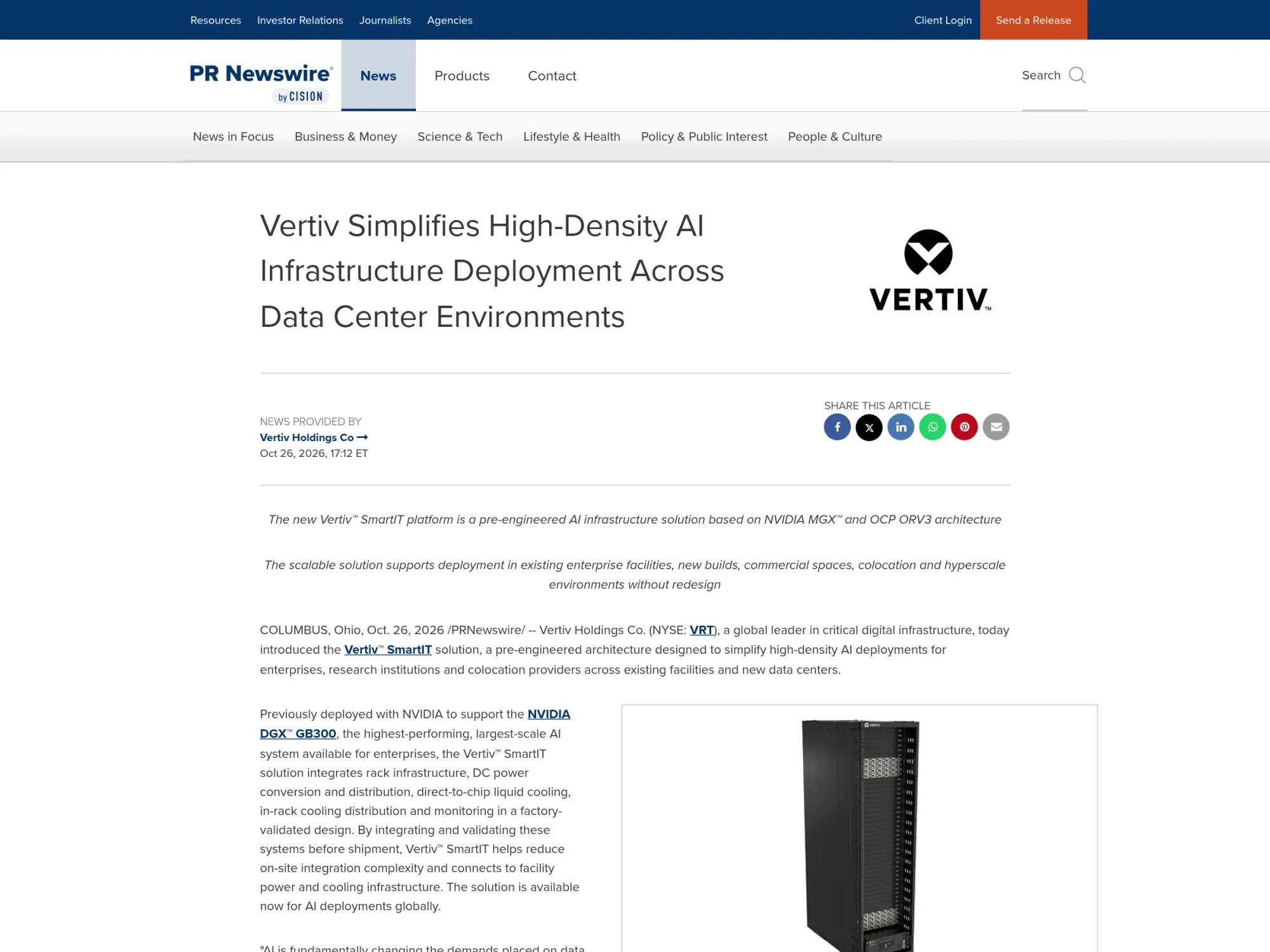
- The facility end stays with the building: the power feed, the cooling loop and heat rejection, floor loading, and the network uplinks are the buyer's scope, and a single rack is the smallest unit Vertiv describes while a full pod is the largest.
- Nothing in the announcement gives a measured power envelope, a cooling capacity or an independent cost comparison, so the useful reading is a scoping document for what to ask before ordering.
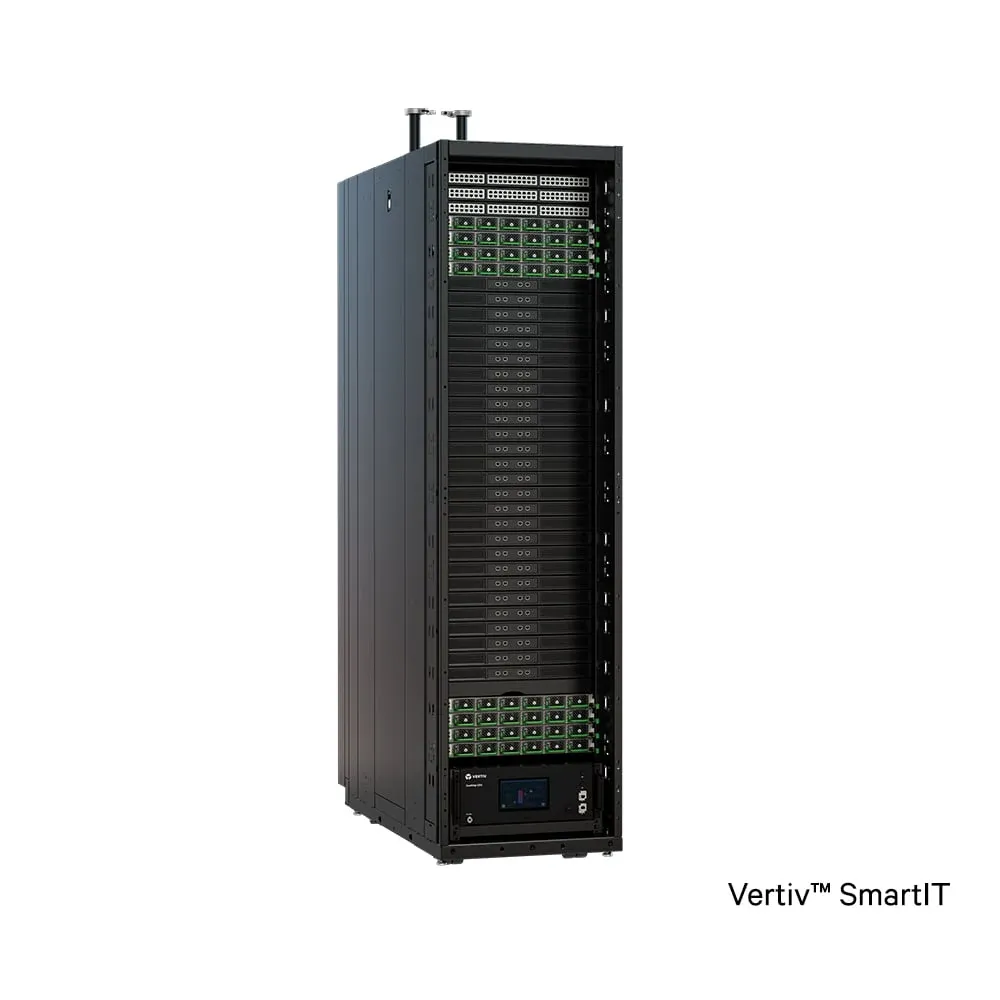
Vertiv builds the parts that keep a data hall alive: power distribution, cooling, racks. Its new product combines engineering with a packaging decision, and that packaging is what a buyer of AI hardware actually faces. Buying accelerators has become routine, and making the room around them work remains difficult. SmartIT is Vertiv's answer to that second problem, sold as one item.
The rack ships as one validated package
The press release describes a single order covering rack infrastructure, DC power conversion and distribution, direct-to-chip liquid cooling, in-rack cooling distribution and monitoring, integrated and validated before shipment. The product page repeats the framing and adds the operational detail that matters to whoever will run it: monitoring support for Redfish, SNMP and Modbus, proactive leak detection, automated shunt-trip, and a one-year limited warranty under Vertiv's standard terms.
Scott Armul, Vertiv's chief product and technology officer, frames the product around coordination: AI is changing what data center infrastructure has to do, and the answer is bringing power, cooling and IT together in one validated architecture. That sentence names the actual problem. In a conventional build, the rack vendor, the power vendor and the cooling vendor each validate their own box, and the seams between them get validated by whoever is on site with a clipboard.
The list of supported systems does more work than a marketing paragraph would. GB300 NVL72, Vera Rubin NVL72, DGX Rubin NVL8 and HGX Rubin NVL8 are named on NVIDIA's MGX and OCP's ORV3 reference architectures, and Vertiv says it already deployed the platform with NVIDIA to support the DGX GB300, and showed a unit alongside an HGX Rubin NVL8 demonstration system at NVIDIA GTC Berlin in October. A buyer reading that list learns which generations the vendor expects to sit inside this enclosure, which confirms compatibility and leaves capacity unspecified.
What factory validation leaves with the facility team
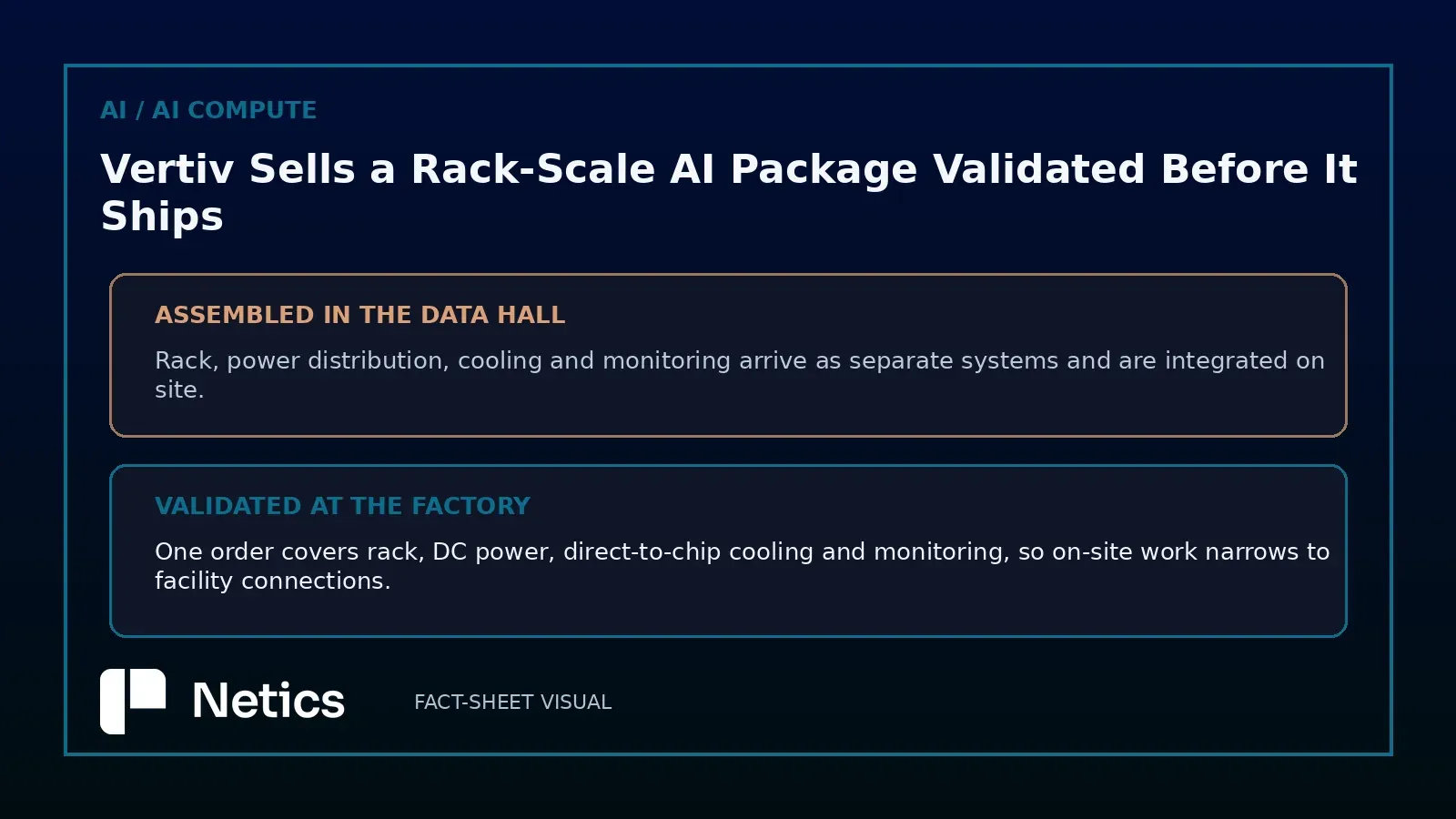
Factory validation transfers a precisely defined part of the work away from the site. The release is explicit that the commissioning scope narrows to the facility connections. Everything upstream of those connections is now a building problem, and buildings vary more than racks do.
Direct-to-chip liquid cooling makes that split sharper than air cooling did. A rack that expects a coolant loop needs a supply temperature, a flow rate, a pressure budget, a fluid specification and a path for the heat to leave the building. Vertiv's package carries the in-rack distribution and the leak detection that shuts the flow; the heat rejection plant, the pipework to the row and the floor's structural rating sit outside the order.
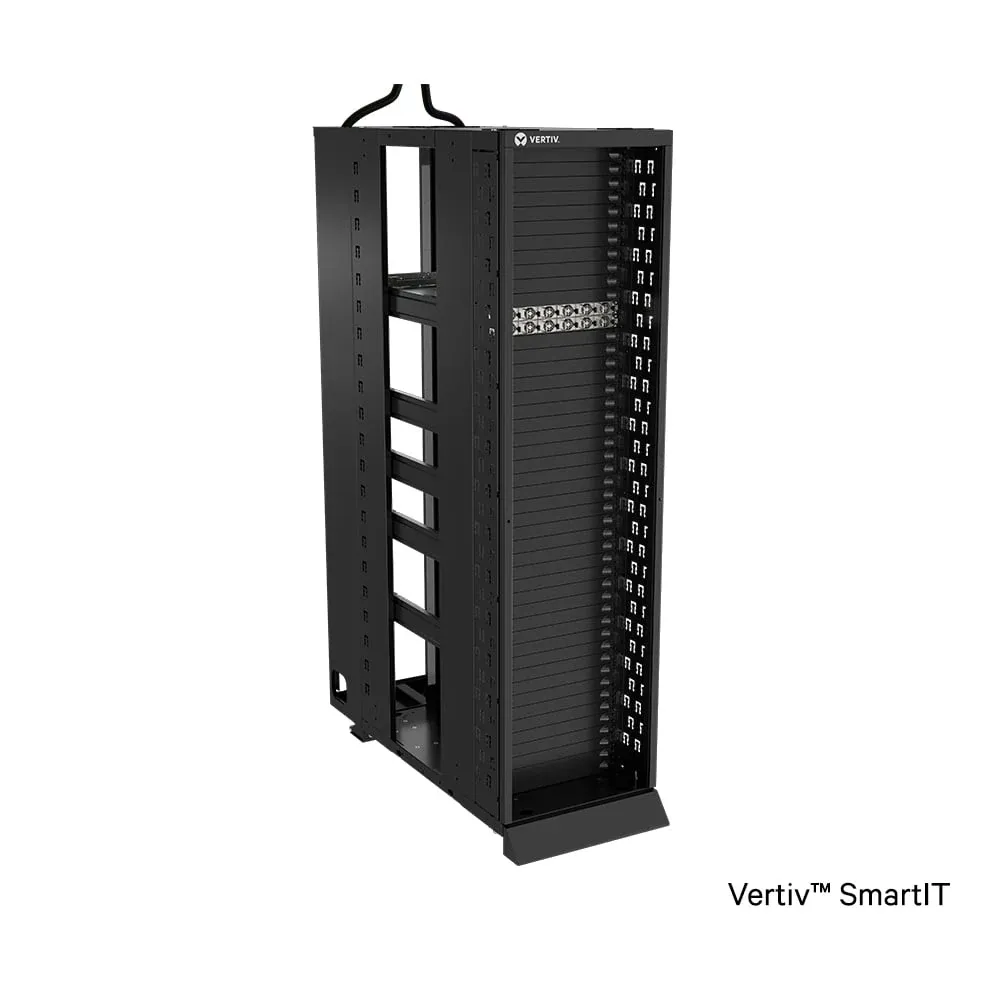
Vertiv claims a specific benefit here that is worth separating from the rest: brownfield enterprise facilities and Class A commercial buildings can support AI-class density without full reconstruction. That claim covers the enclosure and the cooling it brings with it. The building's available electrical capacity remains unspecified, a figure that is frequently the binding constraint in an office block designed for desks.
The supported systems set the density you can promise
Four systems across two reference architectures is a wide compatibility statement, and compatibility is where a procurement conversation usually starts. Facility planning requires per-rack power and heat figures, both unspecified in the release.
A vendor listing four accelerator systems in one enclosure is telling you the enclosure, the power shelves and the coolant distribution are sized for a family of loads. How wide that band runs, and which configuration sits at the top of it, is the number a facility engineer needs before signing a lease or ordering a feed upgrade. Vertiv's own product page states the deployment range as a single rack to a full pod and leaves per-rack power and heat unspecified.
Where a pre-engineered rack fits in a small estate
Smaller organisations rarely buy one of anything. A first AI deployment often lands in a room that already does something else, which is the case this product is pointed at: the same building block from a single rack to multi-rack, without a redesign between phases.
Planning a phased build around a validated block changes the internal conversation. The capacity decision splits into two tracks that can run in parallel: the room, which the facilities team owns, and the compute, which the platform team owns. Teams that keep the AI capacity inside their own walls usually treat that as a sovereign infrastructure and cloud exit question first, and the earlier piece on DGX Spark at 64GB: What $4,999 of Local Compute Buys a Small Team covered the other end of the same decision.
Vertiv sells adjacent pieces for that row: SmartRun for integration across the row, rack PDUs for distribution and metering, and Unify for monitoring and controls across power and thermal infrastructure. A buyer who takes the rack package and stops there inherits a monitoring boundary: the enclosure reports on itself, leaving the row without monitoring coverage. That boundary is worth naming in the purchase order.
What the announcement leaves unproven
Three things are missing, and their absence is normal for a launch release.
There is no measured power envelope per configuration, no coolant flow or heat rejection figure, and no independent test of the factory-validation claim. The one-year limited warranty is a short window for capital equipment built to stay in place, and its terms are Vertiv's standard terms, which a buyer should read before comparing prices.
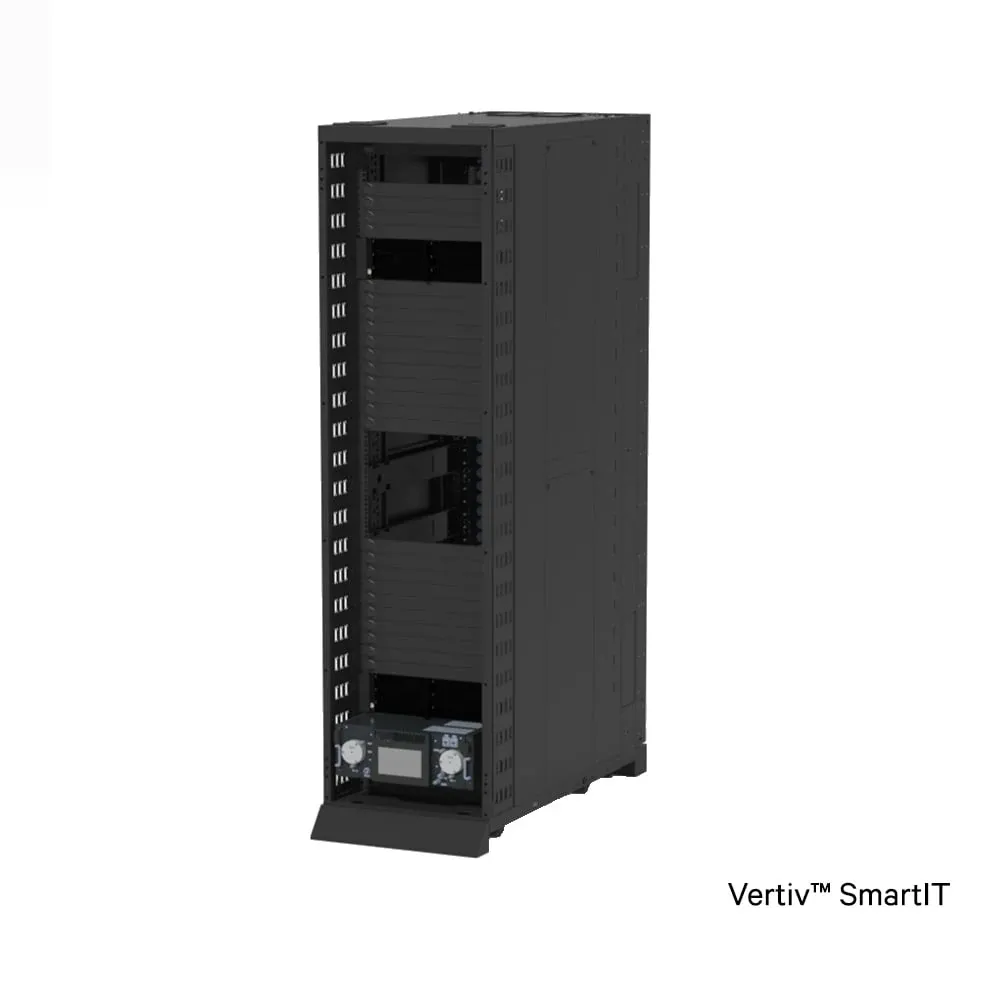
There is also no published price, which turns the comparison into a scoping exercise with each vendor's sales team. The honest summary of SmartIT is a packaging claim with a concrete bill of materials attached: rack, DC power, coolant distribution, monitoring and leak response, validated as one item. Facility readiness remains the buyer's responsibility. That is a useful thing to be able to order. The teams that get value from it are the ones who already know what their building can supply.
Sources
Source: Vertiv Simplifies High-Density AI Infrastructure Deployment Across Data Center Environments — investors.vertiv.com, 2026-10-26. Product detail: Vertiv SmartIT product page — vertiv.com, retrieved 2026-10-26. Distribution: PR Newswire release 302919919 — prnewswire.com, 2026-10-26.