
CERN and Mistral Plan Flare, a Foundation Model for Collider Physics
CERN and Mistral signed a statement of intent on 15 October 2026 to build Flare, a single pretrained model for collider physics trained on billions of simulated LHC collisions, with no budge

TL;DR
- Flare is a foundation model that CERN and Mistral intend to train on billions of simulated proton-proton collisions from the Large Hadron Collider, so that one pretrained network handles several reconstruction tasks that a chain of specialised algorithms performs today. A foundation model is trained once on a large dataset and then reused across many jobs.
- CERN and Mistral signed a statement of intent on 15 October 2026, which establishes a long-term strategic partnership for foundation models in science and gives the Paris-based lab access to one of the world's largest scientific datasets.
- The model is designed to reconstruct collisions, identify particles, flag unexpected signals and evaluate future detector designs, learning across a whole chain that currently runs as a sequence of separate tools.
- CERN holds about one exabyte, or one million terabytes, of LHC experimental data, and the number of collisions is expected to rise tenfold once the HL-LHC starts operating around 2030.
- No budget and no timeline were disclosed for Flare; separately, Reuters reported that the open-weight model Mistral unveiled in October will be released to the public on 27 October.
- The pattern a smaller organisation can borrow has three parts: a dataset large enough to train on, labels produced by simulation or by an existing pipeline, and an evaluation that a third party can repeat.
What CERN and Mistral signed on 15 October
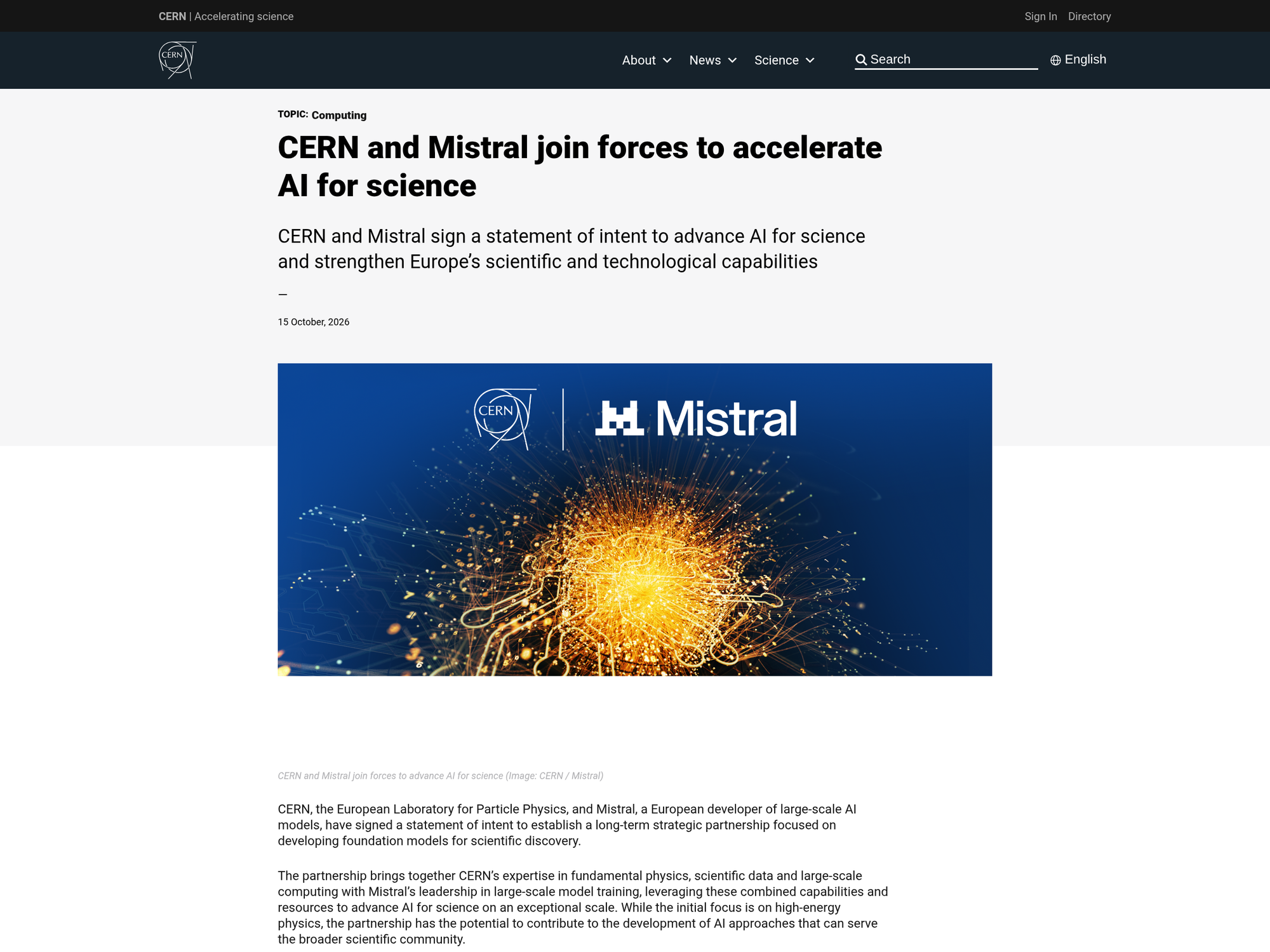
CERN and Mistral signed a statement of intent on 15 October 2026 establishing a long-term strategic partnership focused on foundation models for scientific discovery, according to CERN's announcement. The partnership pairs CERN's work in fundamental physics, scientific data and large-scale computing with Mistral's work in large-scale model training. Reuters reported the same day that the arrangement gives the French company access to one of the world's largest scientific datasets.
A statement of intent is the earliest formal step in a partnership, and CERN and Mistral disclosed neither a budget nor a timeline for the work. Reuters quoted CERN chief information officer Enrica Porcari saying the partnership would "advance AI capabilities that can serve the whole physics community and be shared".
Mistral's chief executive has argued the same point elsewhere. Arthur Mensch wrote in Le Monde that frontier models were "now indispensable to scientific progress" and criticised companies that keep their advantages to themselves, according to Reuters. Our reading is that the partnership and that argument point in the same direction: a lab that wants scientific credibility needs access to data it does not own.
Flare replaces a chain of specialised algorithms with one model
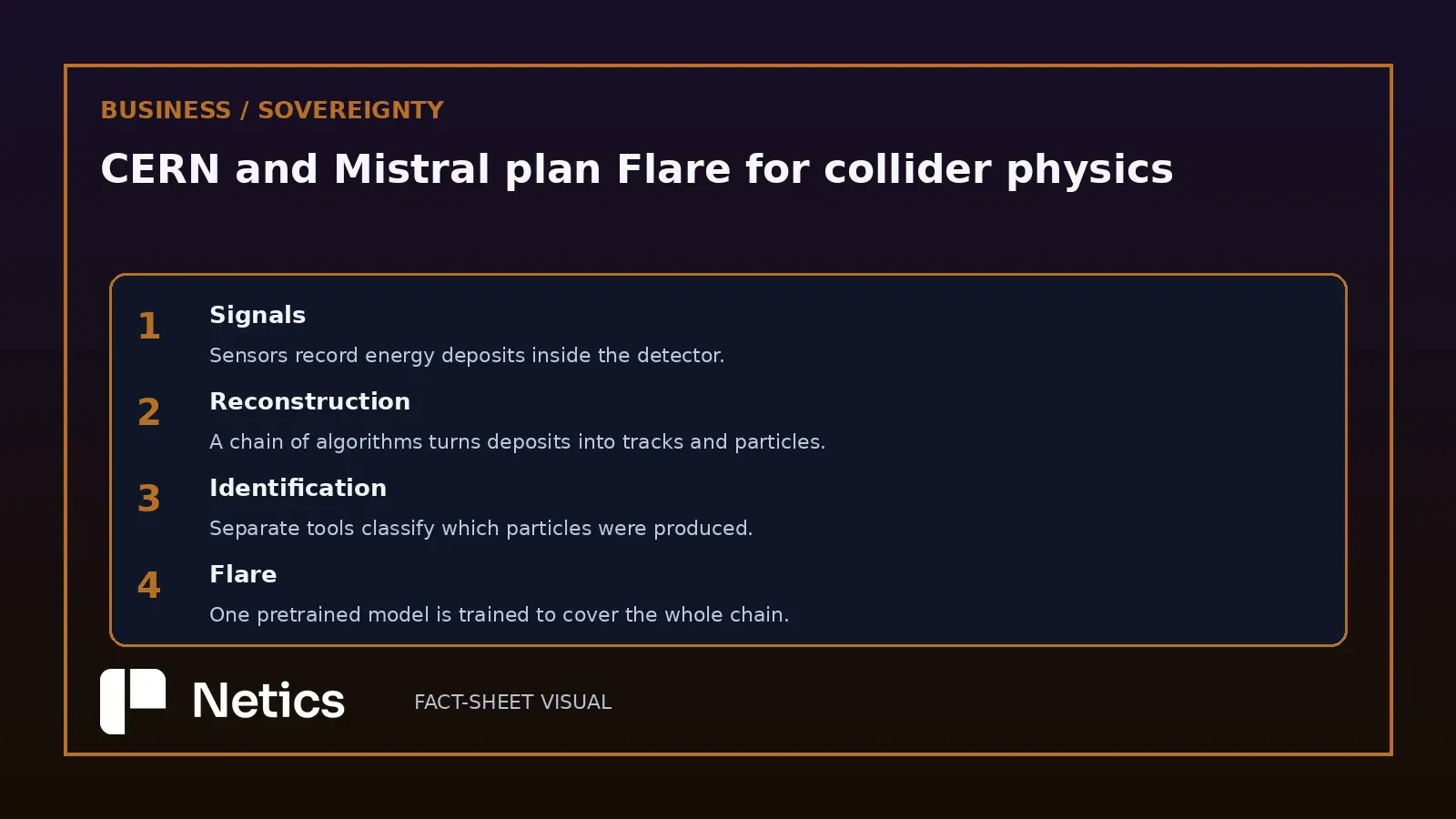
Reuters reports the model's name, Flare, and quotes CERN describing it as "the first foundation model for collider physics, trained on billions of simulated particle collisions". CERN's own page calls the project a Large Physics Model. The tasks it is built for are reconstruction, particle identification, flagging unexpected signals and evaluating future detector designs.
The architectural argument is worth understanding, because it is the reason a physics laboratory would pursue a foundation model at all. Today, CERN turns detector signals into physics objects through a chain of specialised algorithms, each transforming the output of the previous step, with machine learning improving performance inside several of those steps. A single pretrained model would learn across the whole chain and serve multiple tasks at once. A CERN spokesperson told Reuters the model uses the same idea as the large language models behind generative AI, trained on collision data in place of text.
Simulation carries the labelling burden. Billions of simulated collisions supply training examples where the correct answer is known by construction, which is a luxury most industrial datasets lack and the reason physics is a good place to test the approach.
One exabyte stored, and ten times more collisions after the upgrade
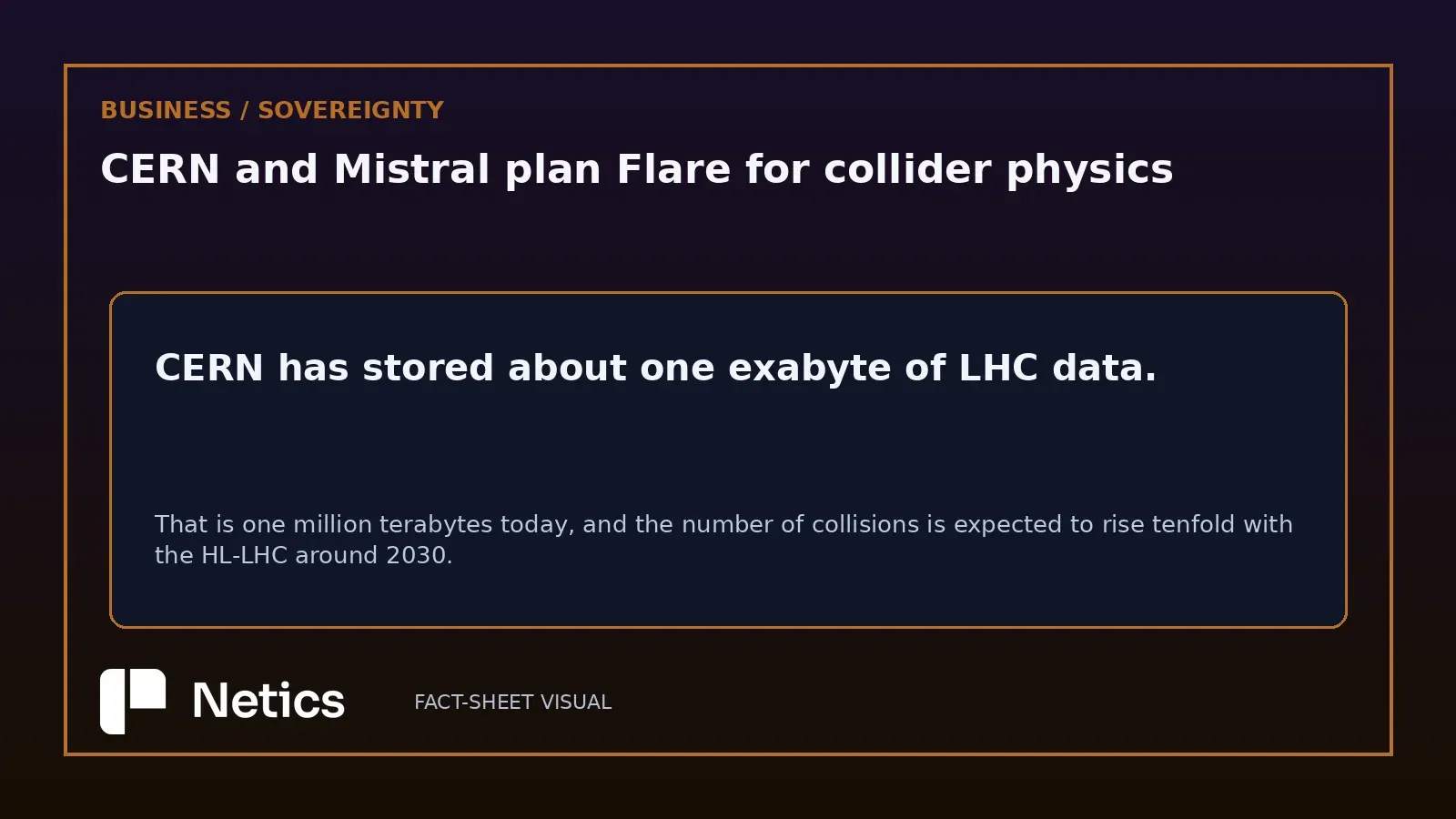
The scale is the part of this announcement that could not be replicated elsewhere. CERN holds around one exabyte, or one million terabytes, of experimental data from the Large Hadron Collider. The number of collisions is expected to increase tenfold once the High-Luminosity LHC begins operation around 2030. Our reading is that this date sets the real deadline, because a chain of specialised algorithms gets harder to run as that volume arrives.
CERN's chief information officer framed the laboratory's value in terms of testing conditions. High-energy physics, Porcari said, "provides a unique environment in which artificial intelligence can be developed and tested with exceptional rigour". In our reading, rigour here means a measurable ground truth, repeated runs and a physics community that checks published results.
The dated release sits apart from the statement of intent
Two announcements travelled together and they carry different weights. Reuters reported that Mistral this month unveiled a new open-weight model it says can challenge its rivals, and that the model will be released to the public on 27 October 2026. That release has a date. Flare has a statement of intent, a description and no schedule.
The distinction matters to anyone evaluating Mistral as a supplier. An open-weight release is something a customer can download, run and benchmark on its own hardware. A partnership with CERN is a research commitment whose outputs may never be published as weights, and CERN describes the intent that the capabilities serve the whole physics community and be shared. Both can be true at once, and a procurement decision should rest on the dated item.
The partnership also continues a direction Mistral has been building. The Next Web reported that the company acquired Emmi AI, a physics AI startup, and launched an industrial engineering product, and that Johannes Brandstetter, now Mistral's vice president of AI for engineering, co-founded Emmi AI.
What an SME can copy from the pattern
A small company will not train a physics model, and the structure of this project is still worth copying, because it describes how a domain model gets built.
Start from a task chain, and count the steps. CERN's reconstruction pipeline is a sequence of specialised tools, and the value of one model comes from learning across the boundaries between them. The equivalent inside a company is the path from an incoming invoice to a posted accounting entry: several tools, several handoffs, and errors that appear at the joins.
Then ask where the labels come from. Physics simulates its training data. A company can simulate a smaller version of the same thing by replaying historical documents whose correct outcome is already recorded, and by generating edge cases deliberately. Without labels the project has no evaluation, and without evaluation it has no way to show that the model is better than the chain it replaces.
Evaluation is the third part. Our test, borrowed from how physics results are checked: a third party should be able to repeat the measurement and get the same answer.
Data at this scale also moves through infrastructure somebody controls. The terms of Mistral's access to CERN's data were not disclosed. Netics runs sovereign infrastructure and cloud exit engagements for European organisations that need compute next to data they are unwilling to hand over.
Flare has no published schedule. The announcement gives no benchmark, no evaluation against the existing reconstruction chain and no word on whether the weights will be published.
Sources
Source: CERN and Mistral join forces to accelerate AI for science — home.cern press release, 15 October 2026, retrieved 2026-10-17 (the statement of intent establishing a long-term strategic partnership for foundation models for scientific discovery; the ambition of a single pretrained Large Physics Model as the first foundation model for collider physics, trained on billions of simulated proton-proton collisions and supporting reconstruction, particle identification, unexpected-signal flagging and detector-design evaluation; today's reliance on a chain of specialised algorithms with machine learning improving performance across specialised tasks and foundation models offering to learn across the whole chain; around one exabyte, or one million terabytes, of experimental LHC data stored, with collisions set to increase tenfold with the HL-LHC around 2030; the quotations from Enrica Porcari, CERN Chief Information Officer, and Johannes Brandstetter, Vice-President of AI for Engineering at Mistral; Mistral described as a France-headquartered lab building open-weight models, products and infrastructure).
Source: Cern and Mistral partner to build 'Flare', a new AI model for physics — Reuters, published by businessday.co.za, 15 October 2026, retrieved 2026-10-17 (the statement of intent giving the French company access to one of the world's largest scientific datasets; Arthur Mensch's Le Monde article calling frontier models indispensable to scientific progress and criticising companies that keep their advantages to themselves; Porcari's statement that the partnership would advance AI capabilities that can serve the whole physics community and be shared; the name Flare and CERN's description of it as the first foundation model for collider physics trained on billions of simulated collisions; the spokesperson's explanation that it uses the same idea as large language models trained on collision data and is meant to replace some specialised reconstruction and identification algorithms; a decade of AI use with multiple tools per step; about one exabyte of stored data and a tenfold rise in collisions after the upgrade around 2030; no timeline or budget disclosed; the open-weight model unveiled in October and due for public release on 27 October).
Source: CERN and Mistral plan an AI foundation model for particle physics — thenextweb.com, 16 October 2026, retrieved 2026-10-17 (the statement of intent signed on 15 October for a Large Physics Model that CERN calls the first foundation model for collider physics, trained on simulated LHC data with no budget or timeline disclosed; a foundation model trained once on a huge dataset and then used for many jobs; today's chain of separate tools and the prospect of one model learning the whole chain; Mistral's acquisition of Emmi AI and its industrial engineering product; Johannes Brandstetter as Mistral's vice president of AI for engineering and co-founder of Emmi AI).
Source: CERN's press release, Reuters' report and The Next Web's account, 15 and 16 October 2026 — the partnership terms, model description, data volumes, quotations and release date relied on above, retrieved 2026-10-17. Images are CERN's own press release page and official press image for this announcement, plus three Netics editorial diagrams.