
BlueField-4's Scale-In Bet: Faster Networking, a New Control-Plane Dependency
NVIDIA cites up to 1.45x throughput and a 7.2Tb/s aggregate interface for BlueField-4's Scale-In architecture. Before that offload lands in production, buyers need to price the control-plane

TL;DR
NVIDIA is positioning Scale-In as a fifth pillar of AI networking — alongside scale-up, scale-out, scale-across, and scale-down — built on BlueField-4 DPUs, the DOCA software stack, and Spectrum-X Ethernet. The pitch is CPU offload: move networking, security, storage, data movement, and telemetry work off host CPUs and onto the DPU, with NVIDIA citing a 7.2Tb/s aggregate interface figure in a Vera Rubin context and up to 1.45x throughput against off-the-shelf Ethernet for a stated storage path. That offload is a real architectural pattern with genuine benefits — protected host CPU cycles, cleaner tenant isolation, centralized observability. It also concentrates networking, security, storage, and telemetry behind one vendor's control plane. Buyers evaluating Scale-In need operational ownership, documented failure procedures, independent observability, and a real exit path before this becomes infrastructure they depend on.
NVIDIA’s BlueField-4 Scale-In architecture offloads infrastructure work from host CPUs; this analysis focuses on control-plane ownership, acceptance testing, and the Netics decision.
What NVIDIA is building
BlueField-4 extends a pattern NVIDIA has pursued since earlier BlueField generations: a data processing unit that sits between the host CPU and the network, running infrastructure functions in a dedicated environment rather than on general-purpose compute. NVIDIA frames Scale-In as the newest of five networking pillars for agentic AI factories, built specifically around BlueField-4 DPUs, the DOCA developer framework, and Spectrum-X Ethernet working together.
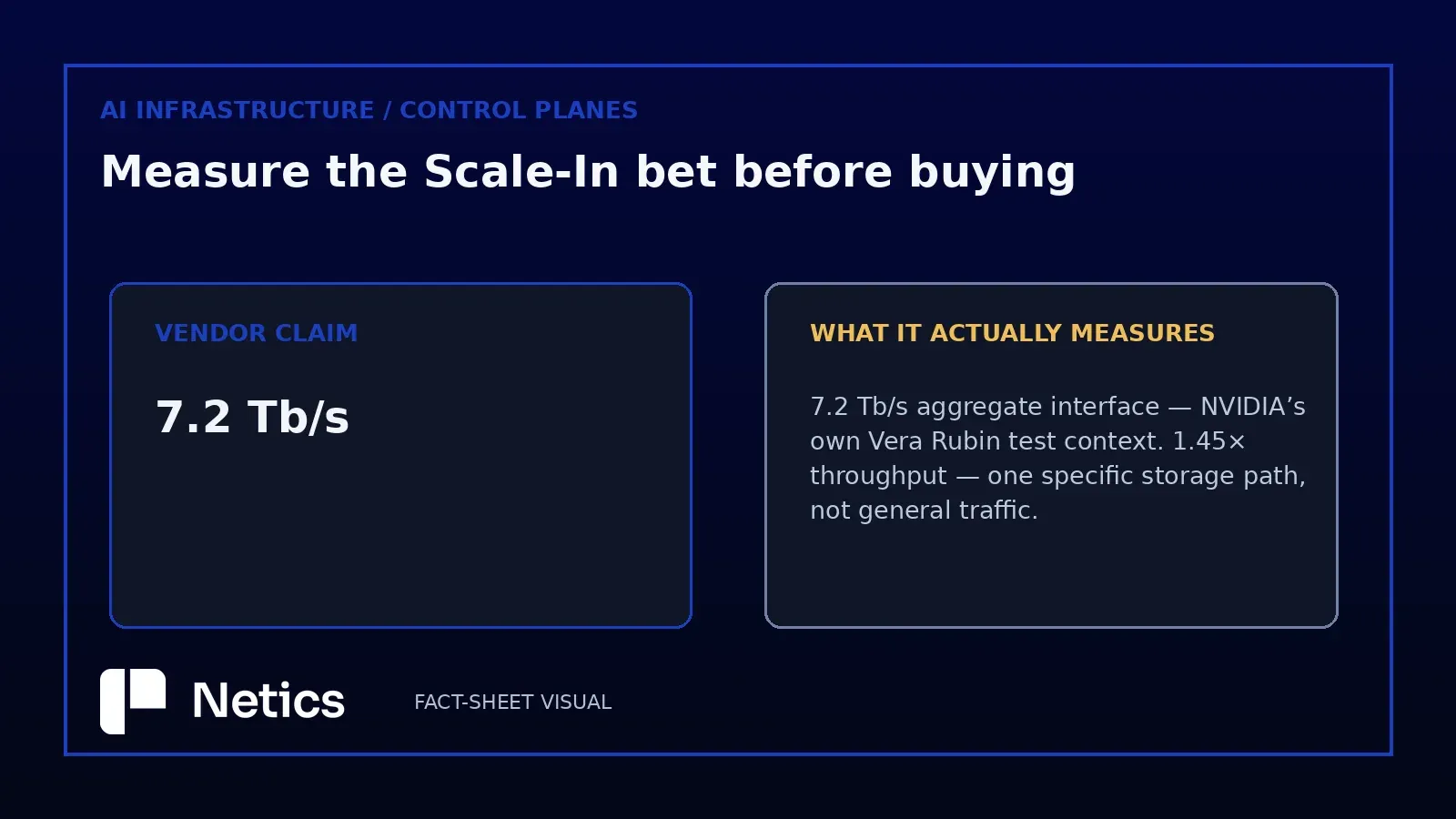
The stated goal is straightforward: agentic AI workloads generate networking, security, storage, data-movement, and telemetry overhead that would otherwise compete with the host CPU for cycles that should be running the actual workload. NVIDIA describes moving that overhead onto BlueField-4, which handles tenant isolation, infrastructure services, and observability as dedicated functions. In a Vera Rubin system context, NVIDIA cites a 7.2Tb/s aggregate interface figure, and for a stated storage path, up to 1.45x throughput compared to off-the-shelf Ethernet. Both figures describe NVIDIA's own architecture and test conditions rather than an independent comparison.
Why offload is a genuine architectural gain
It is worth being direct about what BlueField-4 gets right before getting to the caveats. Running networking, security, and storage functions on general-purpose host CPUs alongside AI training or inference workloads is a real source of contention and a real security-isolation weakness — a compromised or noisy host process can, in principle, interfere with both the workload and the infrastructure functions running alongside it on the same CPU. A dedicated processing environment for infrastructure functions is a defensible response to that problem, and it is not a new idea: it is the same logic that has driven SmartNIC and DPU adoption across the industry for several years, applied here at the scale and with the throughput figures agentic AI factories require.
Tenant isolation specifically benefits from this pattern in multi-tenant environments, where infrastructure functions running in a dedicated, more constrained environment are harder for a workload in one tenant to reach or disrupt than functions sharing the host CPU with that workload. Centralized observability across networking, security, storage, and telemetry in one place is also operationally valuable, when the buyer actually has access to that observability data on their own terms.
The dependency the offload creates
That last qualifier is the whole story. Moving networking, security, storage, data movement, and telemetry onto a single vendor's DPU and software stack means those functions now depend on that stack's firmware, its update cadence, its documented (and undocumented) failure modes, and its API surface for observability. This is a control-plane concentration, not just a compute-offload decision, and it should be evaluated with the same rigor a team would apply to any other single point of dependency in a production architecture.
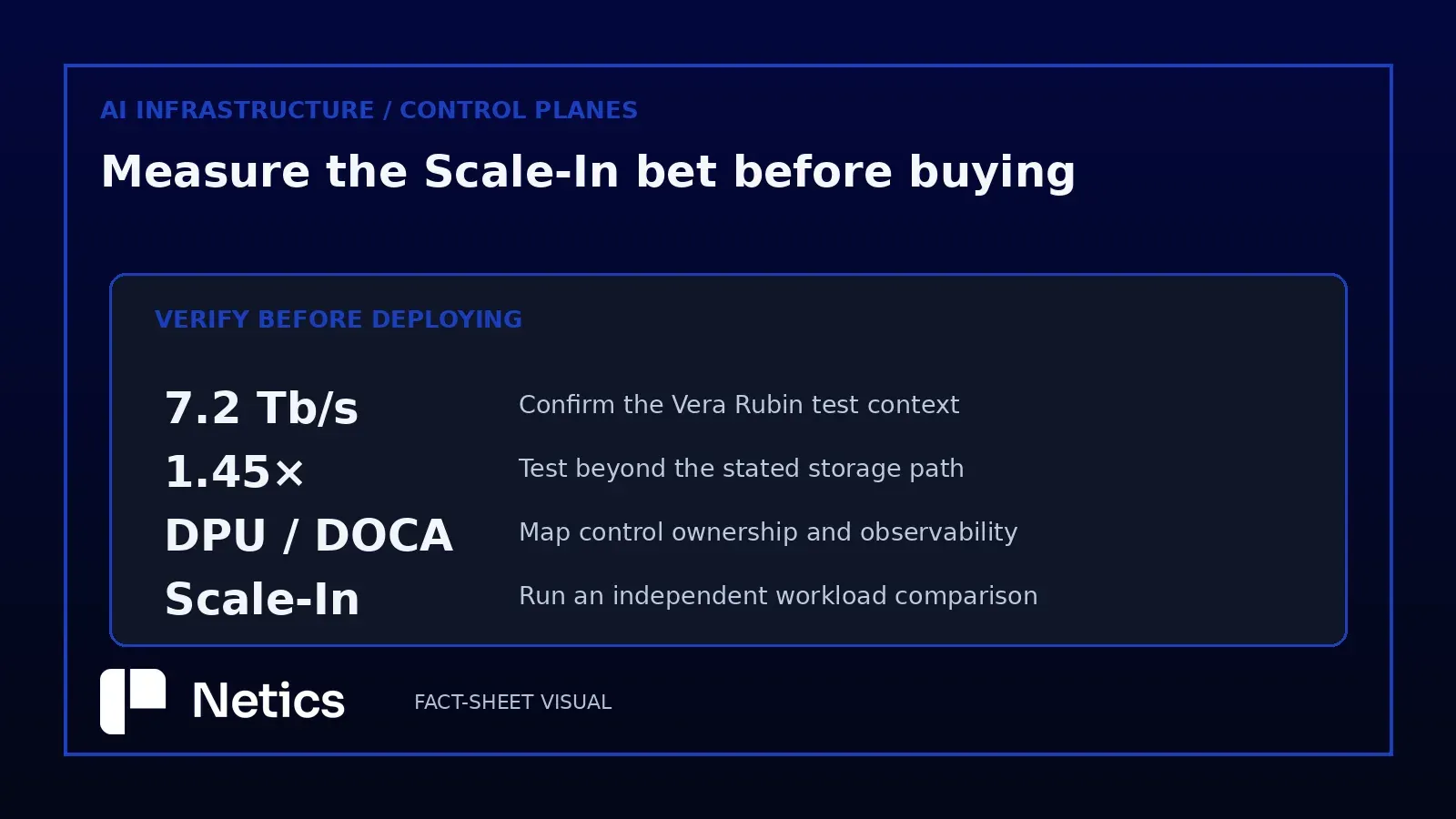
The operational questions a buyer needs answered before adopting BlueField-4 at scale are concrete. Who has access to raw telemetry when something goes wrong — is observability actually independent of the DPU vendor's own tooling, or does every incident investigation route through NVIDIA's stack by default? What is the documented failure procedure when a BlueField-4 unit fails or misbehaves — does workload traffic degrade gracefully, or does the loss of the DPU take networking, security, and storage down together, since all three now share the same hardware and firmware? What is the actual exit path if a team later needs to move workloads off BlueField-4-dependent infrastructure — is there a realistic migration route, or has the architecture become load-bearing in a way that makes vendor lock-in a practical, not theoretical, constraint?
The same trade-off, one layer down the stack
This is the same trade-off Netics has flagged in evaluating AI-factory network fabric decisions more broadly: a vendor's performance mechanism working in its own test conditions is a hypothesis, not a purchasing conclusion, and that discipline applies with more force, not less, when the mechanism in question also becomes the security and control boundary for the infrastructure sitting on top of it. BlueField-4's isolation and observability claims deserve the same scrutiny as its throughput claims — validated against a buyer's own failure scenarios, not accepted because the architecture is coherent on paper.
That control-plane question connects directly to how agent workloads running on this infrastructure get their own authority enforced. If BlueField-4 becomes the layer that determines tenant isolation and infrastructure-level policy, it sits below the same enforcement boundary Netics has described as the place security decisions actually need to live in an AI agent stack — which makes understanding exactly what that boundary can see, control, and recover from a precondition for trusting it, not an afterthought.
Netics' conclusion
BlueField-4's Scale-In architecture is a coherent, well-motivated response to a real problem: host CPUs contending with infrastructure overhead in agentic AI factories. NVIDIA's throughput and interface figures are specific enough to test. The part that needs a buyer's own diligence, not a vendor's slide, is what happens operationally when the offloaded layer fails, who can see inside it independently, and what it costs to leave. Offload the overhead. Own the control plane's failure modes before you depend on it.
Book a free 30-minute audit if your AI factory network architecture needs a clear ownership, failure, and exit boundary around a DPU-based control plane.