
Eight Atlassian Data Center Products Share One File-Read Flaw and One Patch Clock
CVE-2026-21589 reads files without a login across eight self-hosted Atlassian products, and a public proof of concept turned that read into Jira administrator access within two days.

TL;DR
- Atlassian Data Center is the self-hosted edition of Atlassian's collaboration software, the version a company runs on its own servers, and its eight members cover code hosting, project tracking, a team wiki, a build server and a central user directory.
- Atlassian published an advisory on 5 October 2026 for CVE-2026-21589, rated 9.3, that lets an unauthenticated attacker read specific files inside the web application root directory of every version issued before the fixed releases.
- The flaw reached all eight products because they share a web-resource library, and the exploit path turns a double colon sequence into a forward slash to build a directory traversal request through plugin resource endpoints.
- Reading one file was the first step. In Crowd-integrated deployments the read reaches credentials that lead to administrator access in Jira, Confluence and Bitbucket, which watchTowr demonstrated end to end.
- The patch clock then started. A public proof of concept landed on 7 October 2026, and a honeypot network recorded exploitation attempts within two hours of publication.
- Atlassian cannot confirm whether an individual instance was affected, so detection sits with the customer: review access logs for the traversal pattern and treat every hit as a file that was read.
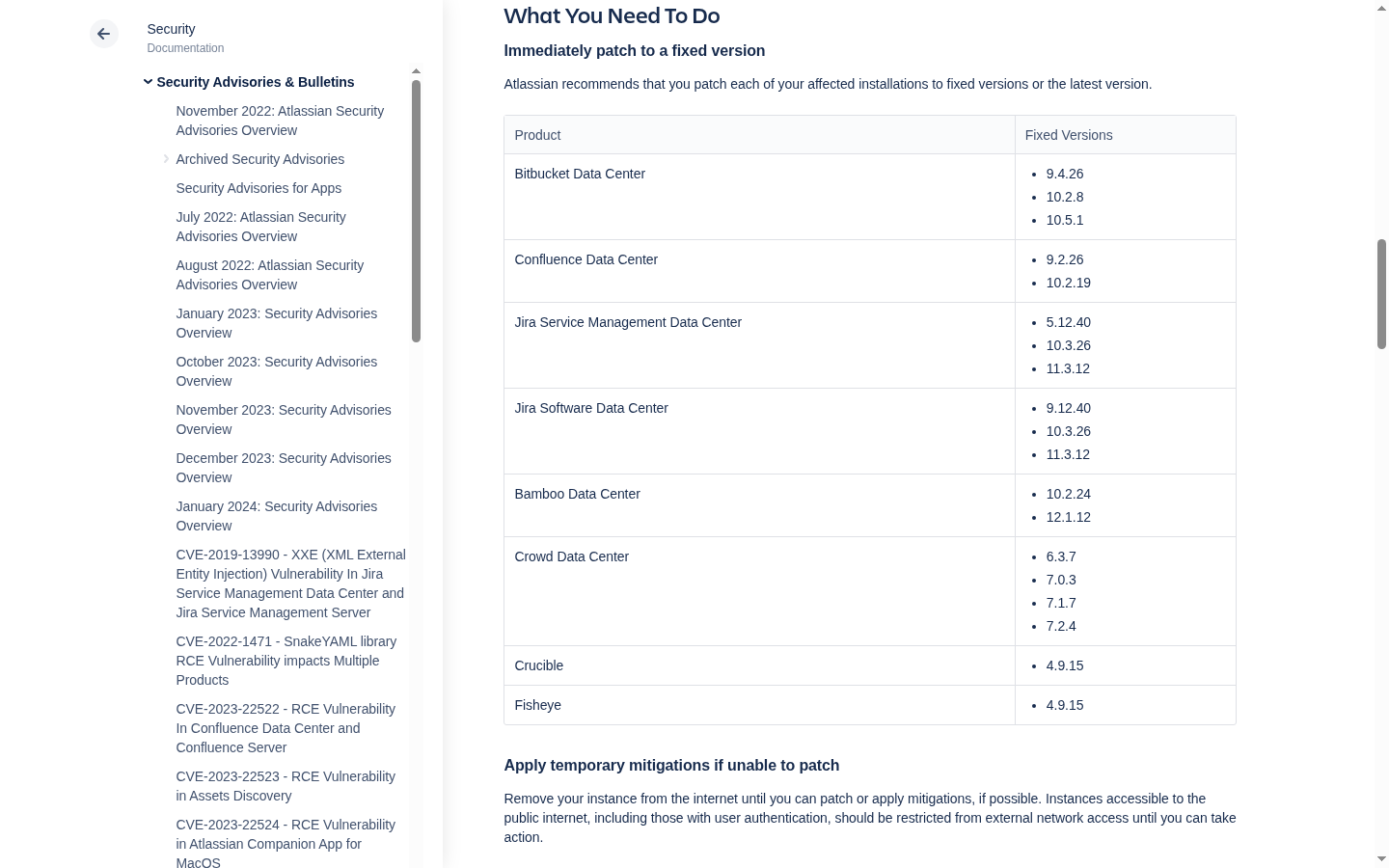
- Temporary mitigations are a WAF or proxy rule, a Tomcat RewriteValve rule on five of the products, and a urlrewrite.xml rule for Bitbucket, applied to every cluster node, mirror and mirror farm node.
- The structural point for a self-hosted team is that Atlassian ships fixes as maintenance releases, which makes the work an upgrade project with an owner and a window.
One shared library behind eight products
Atlassian's advisory states the affected set without ambiguity: all versions of Bitbucket Data Center, Confluence Data Center, Jira Service Management Data Center, Jira Software Data Center, Bamboo Data Center, Crowd Data Center, Crucible and Fisheye shipped before the fixed releases. The company rates the flaw Critical at 9.3 under CVSS 4.0 with a vector that reads network reachable, no privileges and no user interaction.
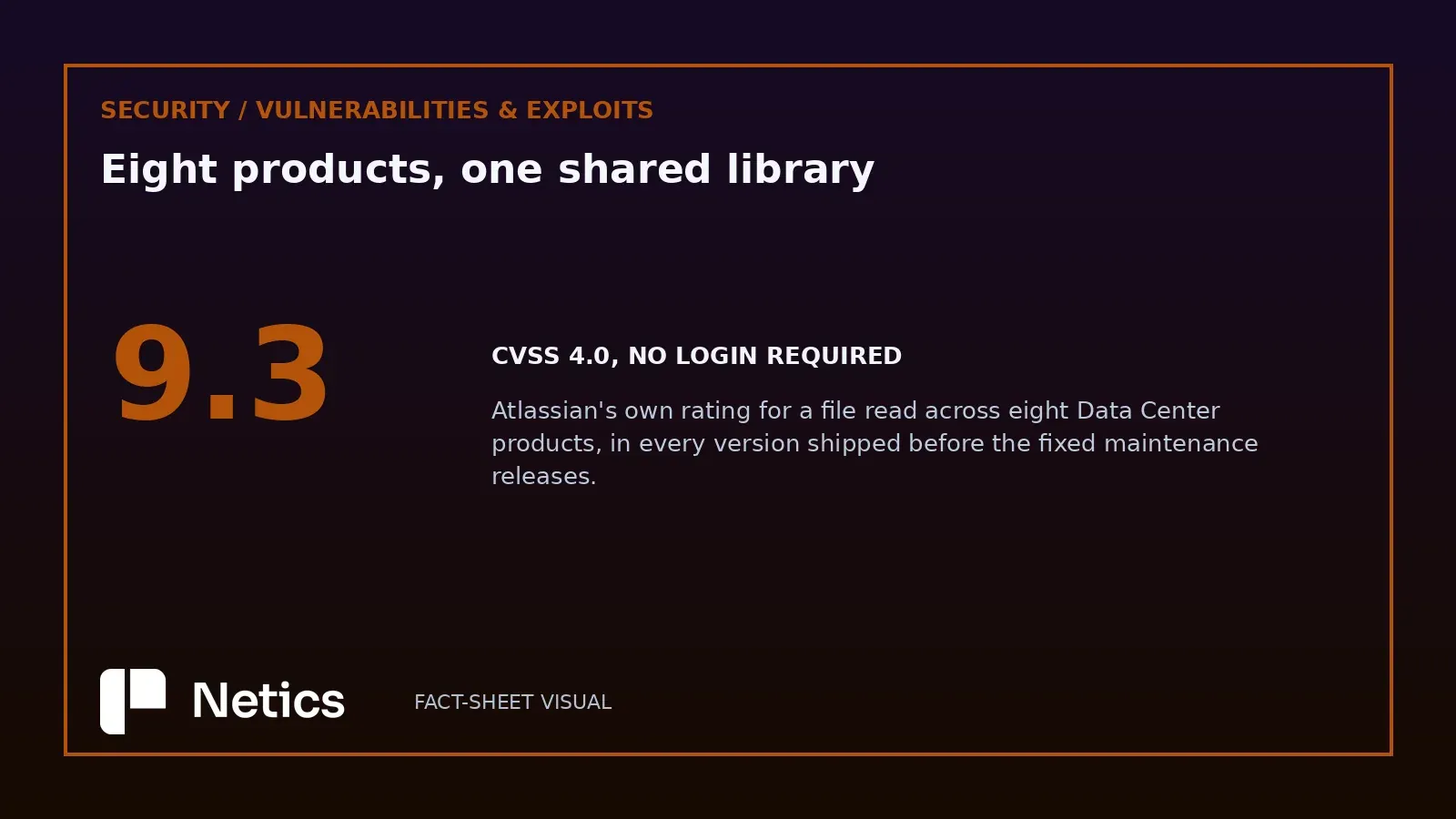
The scope explains the interest it attracted. These products hold source repositories, internal documentation, sprint history and the identity records that tie them together, and Atlassian's own wording keeps the impact honest: "Exploitation requires prior knowledge of the target file's exact name and path; this vulnerability does not allow attackers to enumerate or list directory contents." A read primitive with a known filename is a narrower thing than a general file browser, and in a folder that holds configuration and secret material it is still useful.
The single-component origin is what makes the story instructive. watchTowr Labs traced the difference between vulnerable and patched installations to one archive, atlassian-plugins-webresource, moving from version 6.0.7 to 6.0.8. A routing helper in that library replaces a double colon with a forward slash, and a request built as a chain of double colons therefore arrives at the file system as a directory traversal. Eight products inherited the flaw because eight products inherited the library.
What the advisory required and what the chain added
The advisory describes a file read. The research describes what that file read becomes on a real deployment, and the difference is worth following because it explains the urgency better than the score does.
The path runs through plugin resource endpoints, where a user-controlled resource name reaches a resource factory that resolves it against the local file system. Two files matter in the chain: the archive that maps a web resource to a file, and the configuration that maps a product to its identity provider. In Crowd-integrated deployments, reading the second one hands over credentials for the central directory, and from there the researchers created a user, added it to the administrators group, and closed with a line that says more about the pattern than any severity score: "You can be proud of yourself, pal. You just got promoted to Jira Administrator."
Two caveats keep the picture accurate. The technique could not traverse outside the Tomcat application context, and a Crowd installation that restricts access by IP address makes the final step considerably harder. What remains true is the sequence: a read-only flaw in a collaboration product can end in administrative control of the systems that product documents.
The patch clock started when the proof of concept landed
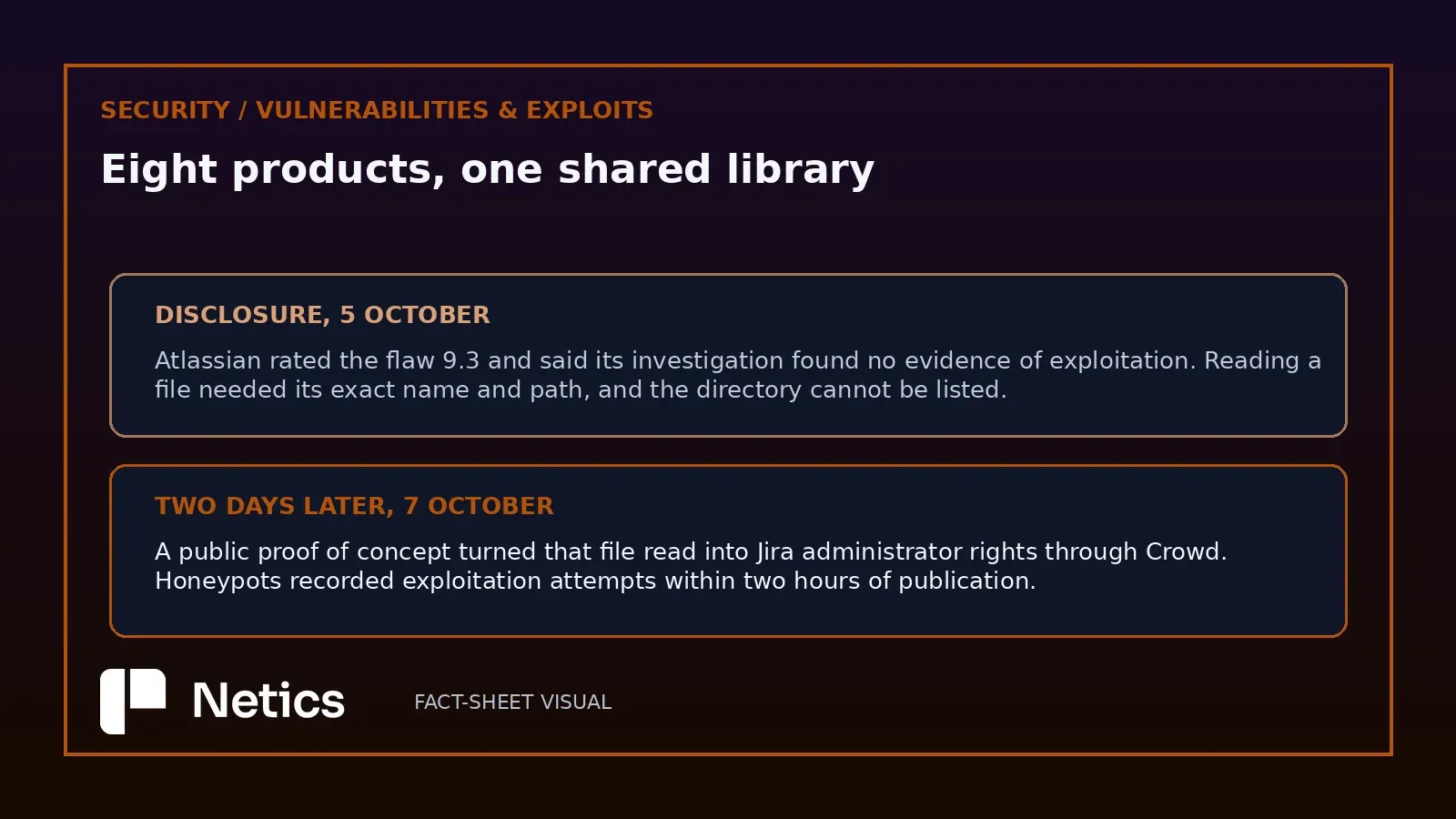
Atlassian published the advisory on Monday 5 October and said its investigation had found no evidence of exploitation. That assessment aged quickly. A detailed technical report with a public proof of concept arrived on 7 October, and Previdian's honeypot network recorded exploitation attempts within two hours of publication, as its researcher Ryan Dewhurst told BleepingComputer.
The mechanism is familiar to anyone who runs internet-facing software. A precise write-up plus a working exploit converts a narrow flaw into a scanning template, and the breadth of the product list gives scanners a large address space. Dewhurst expects the activity to grow. Atlassian's position is the honest one: it cannot determine whether an individual customer instance has been compromised, which places the detection burden on the team that runs the server.
Detection here is log work with a published pattern. Decode each request line, up to twice, and look for a pair of dots next to a forward slash, a backslash or a pair of colons, including the URL-encoded forms. Any hit deserves the treatment of a breach rather than a nuisance, because a file that was read may have contained the credential that unlocks the rest. Verified private advisories from the vendor count as the primary record for this class of work, and our own write-up of the Zammad exploit chain and its conflicting affected-version lists covers why the vendor ticket beats the aggregate databases when the two disagree.
What self-hosted teams should do this week
The upgrade path has one awkward property: Atlassian no longer ships binary patches, so fixing this means moving to a new maintenance release. For a team that has postponed upgrades, that turns into a project with a test window, a rollback plan and somebody accountable.
Where an upgrade cannot happen this week, the advisory's three mitigations cover the cluster properly. A WAF or proxy rule blocking traversal patterns works across all eight products. Five of them can also block the requests with a Tomcat RewriteValve rule on every node, followed by a restart. Bitbucket uses a rule in urlrewrite.xml applied to every node, mirror and mirror farm node, also followed by a restart. Crucible and Fisheye have the firewall option alone.
Two operational details deserve attention before anyone calls the work done. Instances behind a login page still need attention, because an unauthenticated flaw never asks for a password. And end-of-life releases are affected versions too, so a fleet audit will surface installations that no longer receive fixes at all, which is the point where migration conversations become concrete.
Where this leaves the self-hosted patch model
Self-hosted software buys control over data and configuration, and it also buys the patch calendar. A vendor organisation with a cloud fleet patches once and moves on. A company running the same product on its own hardware inherits a schedule, a blast radius and a choice about how long it accepts the risk.
That choice is where most of the exposure lives. The gap between an advisory and a running fix is the window an attacker gets, and the two days between disclosure and observed exploitation attempts on this flaw show how narrow that window has become. The practical response is to treat exposed management interfaces as a category with an owner, a list and a review cadence, which is the same discipline behind infrastructure monitoring with plain-language alerts: know which services are reachable from outside, and know it before a proof of concept makes the question urgent.
Sources
Source: CVE-2026-21589 - Arbitrary File Access Vulnerability impacts Multiple Products — confluence.atlassian.com/security/cve-2026-21589-arbitrary-file-access-vulnerability-impacts-multiple-products-1870495748.html, Atlassian, advisory release date 5 October 2026, retrieved 2026-10-07 (the eight affected Data Center products with all versions before the fixed releases, the unauthenticated file access within the web application root directory, the requirement to know the exact file name and path with no directory listing, the Critical 9.3 rating and the CVSS:4.0 vector, the fixed versions for Bitbucket, Confluence, Jira Service Management, Jira Software, Bamboo, Crowd, Crucible and Fisheye, the WAF or proxy rule, the Tomcat RewriteValve rule and the urlrewrite.xml rule, the instruction to remove instances from the internet, the access-log review paths, and the statement that Atlassian cannot confirm whether an instance has been affected). Source: You Won't Hear About These, Even In Myths (Atlassian Jira, Confluence (and more) Pre-Auth Arbitrary File Read CVE-2026-21589) — labs.watchtowr.com, published 7 October 2026, retrieved 2026-10-07 (the atlassian-plugins-webresource archive at 6.0.7 against 6.0.8, Router.unescapeSlashes replacing double colons with forward slashes, the ..::..:: traversal pattern through plugin resource endpoints, ResourceServingHelpers.getResourceRelativeToWebResource and ResourceFactory reading local files, the reach into Crowd credentials and administrator rights in Jira and Confluence, the Crowd IP allowlist caveat, the inability to traverse outside the Tomcat application context, and the free detection tool for Jira, Confluence and Bitbucket). Source: Atlassian warns of critical file-access flaw in Jira, Confluence — bleepingcomputer.com, published 7 October 2026, retrieved 2026-10-07 (the vendor advisory summary, the fixed versions, the instruction for self-hosted administrators, the statement that cloud customers need no action, and the mitigations including coverage of every cluster node, mirror and mirror farm node). Source: Hackers exploit critical Atlassian flaw after public PoC release — bleepingcomputer.com, published 7 October 2026, retrieved 2026-10-07 (Previdian's honeypot detection within two hours of watchTowr's publication, Ryan Dewhurst's expectation of an increase in activity, the watchTowr report and free scanner, the Cloud products already patched, and Atlassian's inability to determine individual instance compromise).
Source: Atlassian's advisory for CVE-2026-21589 — confluence.atlassian.com, 5 October 2026; watchTowr Labs' technical analysis — labs.watchtowr.com, 7 October 2026; BleepingComputer reporting on the advisory and the exploitation that followed — bleepingcomputer.com, 7 October 2026. All retrieved 2026-10-07. Figures: the advisory fixed-versions capture from confluence.atlassian.com and the Crowd product page capture from atlassian.com, plus two Netics editorial diagrams rendered from the same sources.