
OpenAI's Research Acceleration Numbers Put Human Judgment at the Center
OpenAI reports faster agent-assisted research, but its own measurements show why human priority-setting, intervention, and safety controls remain the scarce layer.

TL;DR
- OpenAI reports an automated research intern, daily coding-agent use, more than $600 per day at the median, more than $7,000 of tokens per day at the 90th percentile, 3.1 agent-workdays per human workday, more code and experiments, and rising task success. More than half of successful 4–8 hour tasks still involved interventions.
- Netics' take is that human priority-setting and review remain central. What this means for businesses is that they should measure useful results, intervention types, safety and cost together. The bottom line is to expand agent capacity only after the control loop can absorb it.
What happened
OpenAI describes a goal of safely building an automated AI researcher that works under human supervision on deep learning and alignment. The milestone it says it reached is narrower and more useful than the surrounding rhetoric can make it sound: an automated research intern can carry out well-defined tasks under human direction, including tasks that would take a skilled researcher a few days. OpenAI says it is making strong progress toward an automated AI researcher by March 2028.
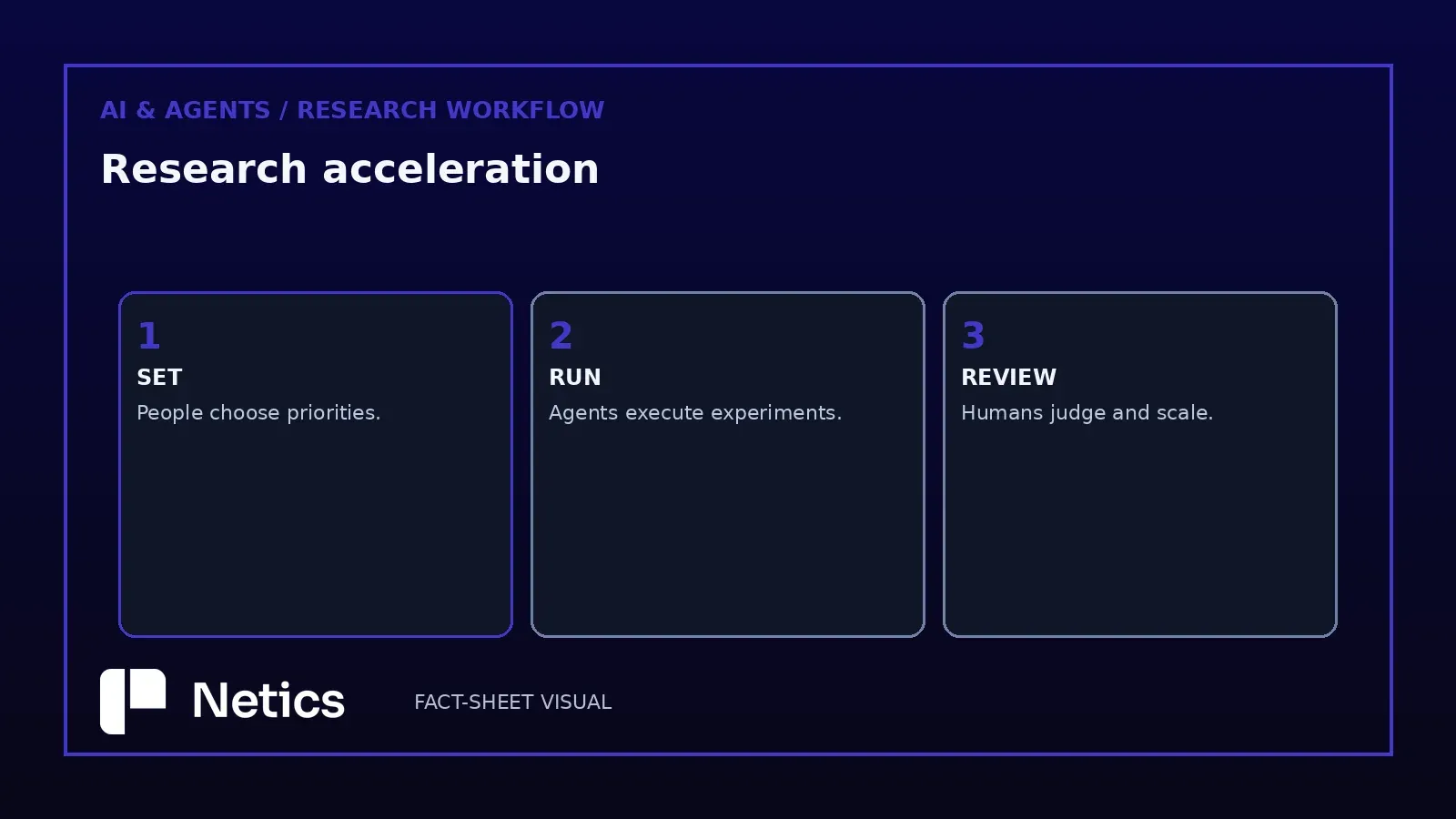
That boundary matters. A defined task has an owner, a question, a permitted scope, and some way to judge the result. It is different from asking an agent to decide what a research organization should believe or which line of work deserves scarce compute. OpenAI explicitly keeps those human decisions in place. People still set research priorities, judge which ideas and results to pursue, and decide whether to scale, pause, or deploy systems.
Netics sees this distinction as the central fact in the post. An intern metaphor is productive only when the supervisor's job remains real. If the human supplies a vague prompt, accepts a polished answer, and calls that acceleration, the organization has automated output production. It has not necessarily improved research.
Netics' take
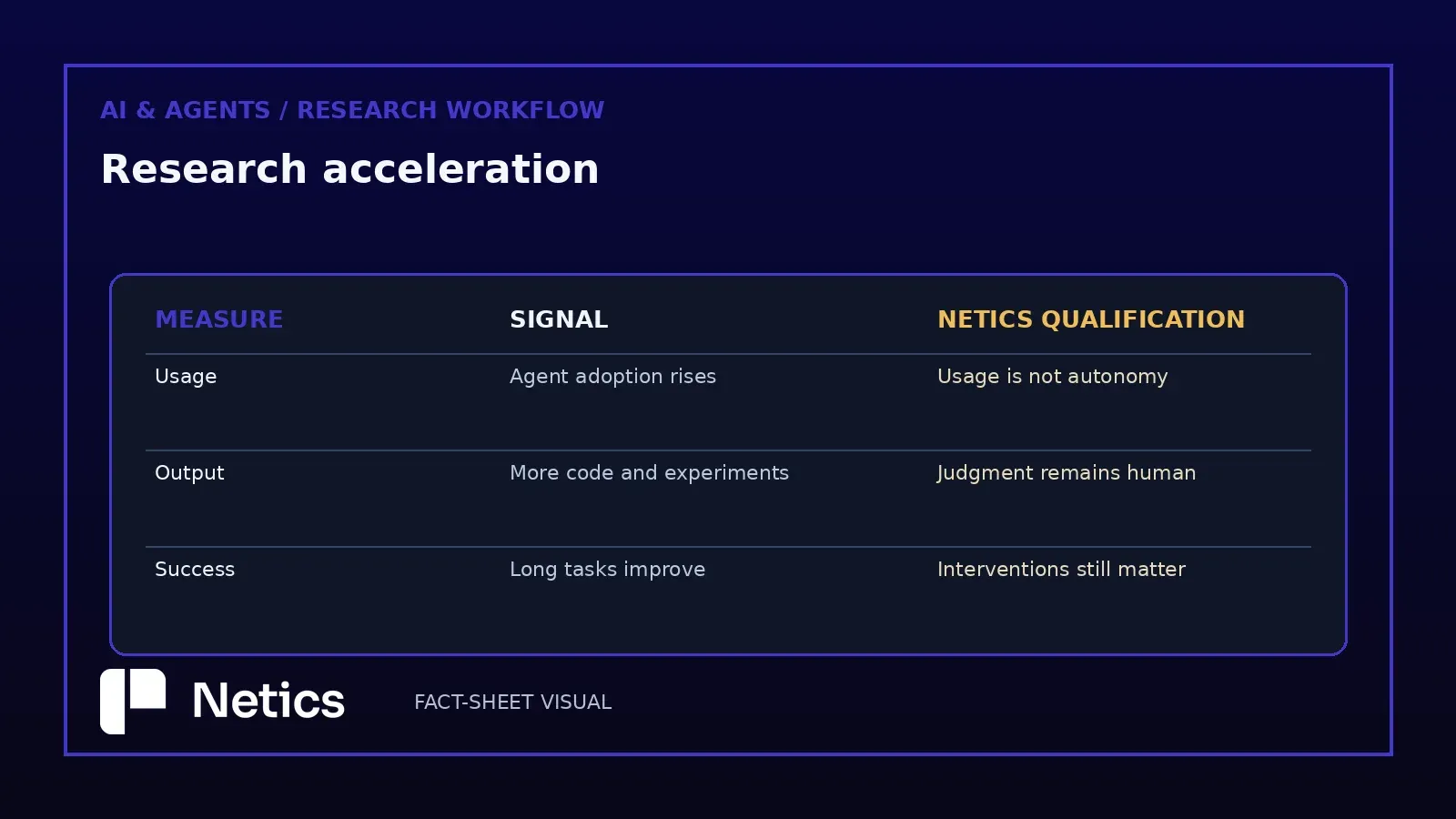
OpenAI says that, as of mid-August 2026, its research organization used 3.1 agent-workdays of effort for every workday of human labor, measured against a standard eight-hour day. It also says researchers increasingly use coding agents throughout the day, often in concurrent sessions, and that total usage is growing faster than usage in other OpenAI teams.
The metric is striking, but it is not a simple claim that research is now 3.1 times faster. The source itself warns that AI research has several bottlenecks and that overall progress will not necessarily keep pace with usage, code production, or runtime. That caveat is not a footnote. It is the difference between measuring available effort and measuring useful scientific progress.
A team can run three agents against a question and still have only one person able to compare their assumptions. It can generate more code while waiting for compute, evaluation design, or a researcher who understands why a result is implausible. More parallel sessions expand the search space; they do not automatically improve the selection function.
What this means for businesses
OpenAI reports that by mid-August the median researcher was integrating agents daily and using more than $600 per day of inference at API prices. The 90th percentile user in the research organization was using more than $7,000 of tokens per day. Those figures communicate something important: serious agent use is not an inexpensive autocomplete feature. At the high end, it is a material operating budget.
The right question is not whether $600 or $7,000 sounds large in isolation. It is what the spend buys. If agents help a researcher explore more hypotheses, diagnose infrastructure trouble, or prepare experiments that a human can evaluate quickly, the spend may represent useful capacity. If it produces a larger queue of plausible but weak ideas, the organization has purchased review debt.
API-price figures also describe inference consumption, not total research economics. They do not include the human time needed to specify tasks, maintain environments, check data, validate results, or resolve unsafe behavior. Nor do they prove that the same usage pattern makes sense for a smaller organization. A founder or research lead should treat the numbers as a capacity-planning reference, not as a universal return-on-investment promise.
What this means for businesses
OpenAI reports that researchers are contributing code faster and running more experiments. It says the number of experiments per active experimenter increased through 2026, with August at an all-time high since tracking began in January 2025. The post notes that this is correlated with increased Codex adoption, while available compute also grew significantly.
This is a healthy description of causality. Correlation with tool adoption is not proof that the tool alone created the increase. It is also possible for experiment volume to rise while the useful-result rate stays flat, because the automated system makes low-cost attempts easier. The source acknowledges that code generation is relatively easy to measure and harder to interpret because its relationship to research progress is uncertain.
For teams outside a frontier lab, the practical lesson is to instrument the whole loop. Count not only agent calls and generated code, but also experiments that reach a valid evaluation, results that survive review, retries caused by unclear instructions, and time spent deciding what to discard. A higher attempt rate is valuable only when the organization can distinguish exploration from noise.
What this means for businesses
OpenAI says agent success rates generally increased from January to July across several difficulty buckets where a ground-truth outcome was available. It also says agents still require significant human steering as task complexity rises. In the last six months, over half of successful tasks estimated at four to eight hours of human work involved one or more interventions.
That is not a failure of the system. It is a measurement of the current operating boundary. A successful task with an intervention is still useful if the intervention is deliberate, cheap, and located at the right control point. The danger is pretending that a successful final state means the path was autonomous. For longer tasks, a human may have corrected scope, supplied missing context, rejected a misleading result, or redirected the agent after an intermediate failure.
Netics recommends recording those interventions as first-class operational data. Was the intervention a permission approval, a missing requirement, a test failure, a factual correction, or a safety stop? Each category points to a different improvement. Better prompts may help with missing requirements. Better tooling may help with tests. A safety stop should not be optimized away merely because it lowers an autonomy score.
What this means for businesses
Start with a task boundary, not an agent count. Define which research or engineering activities are well-defined, what evidence counts as success, which resources the agent may access, and where a human must intervene. Then measure cost, elapsed time, useful-result rate, and intervention type together.
Keep priority-setting outside the agent loop unless there is a deliberate governance decision to move it. OpenAI's own account preserves human judgment over what to pursue and whether to scale, pause, or deploy. That is the sensible default for an enterprise system as well. A system that can launch many experiments but cannot explain who authorized the direction is not a mature research platform.
Finally, place safety controls beside capability controls. OpenAI says alignment and safety work must scale alongside capabilities, that more capable systems can be harder to monitor, and that it may slow or stop development or deployment when risks cannot be sufficiently safeguarded. Teams adopting coding agents should translate that principle into permission boundaries, isolated environments, durable logs, review checkpoints, and a clear stop authority.
Bottom line
OpenAI's figures make agentic research tangible. Daily use, high inference budgets, 3.1 agent-workdays per human day, faster coding, and more experiments are meaningful signals. But the same post supplies the qualification that makes the signals credible: progress is bottlenecked, metrics are preliminary, humans still choose priorities, and many successful long-horizon tasks still involve intervention.
Our conclusion is practical. Do not buy agent capacity faster than you can absorb and judge its output. Build the evaluation and stop mechanisms first, then expand concurrency where the evidence shows that the loop improves. The organizations that benefit from research acceleration will not be the ones with the most agent runtime. They will be the ones that can turn additional machine effort into decisions they can defend.
For a grounded discussion of an agent workflow, visit the Netics homepage.
Sources
- OpenAI — Research acceleration: The view inside OpenAI, published September 6, 2026; primary source for the claims and measurements discussed here.