
Agentic Commerce Needs a Bounded-Authority Model
Cloudflare's new Wallets and cloudflare.pay give AI agents a stable identity and a spending cap. That solves payment mechanics — it doesn't settle who an agent is allowed to act for, or who

TL;DR • On August 4, 2026, Cloudflare announced Cloudflare Wallets and cloudflare.pay, giving AI agents a stable identity tied to a Cloudflare account's web address and a wallet system built around Account Wallets and per-agent Virtual Wallets. The wallets ship with a spending cap, an approved merchant list, and a maximum transaction size. Handle reservation is open now; full wallet access, including onramping, offramping, and issuing Virtual Wallets, is coming in the following months. That's a real step toward letting businesses see who is behind an agent and letting agents pay safely on a human's behalf. But identity plus a spending limit is not the same as a complete trust system — it doesn't by itself resolve who an agent is authorized to act for, whether a merchant should honor that authorization, or who is accountable when a transaction goes wrong. Businesses evaluating agentic commerce should treat this as useful plumbing, not a finished framework. This also covers what this means for businesses.
TL;DR: This article covers: What happened, Netics' take, What this means for businesses, Bottom line.
What happened
Cloudflare, described in its own release as "the leading connectivity cloud company," announced Cloudflare Wallets and cloudflare.pay on August 4, 2026. The stated goal is to give AI agents deployed on Cloudflare a stable identity and the ability to make purchases online within limits set by their human creators.
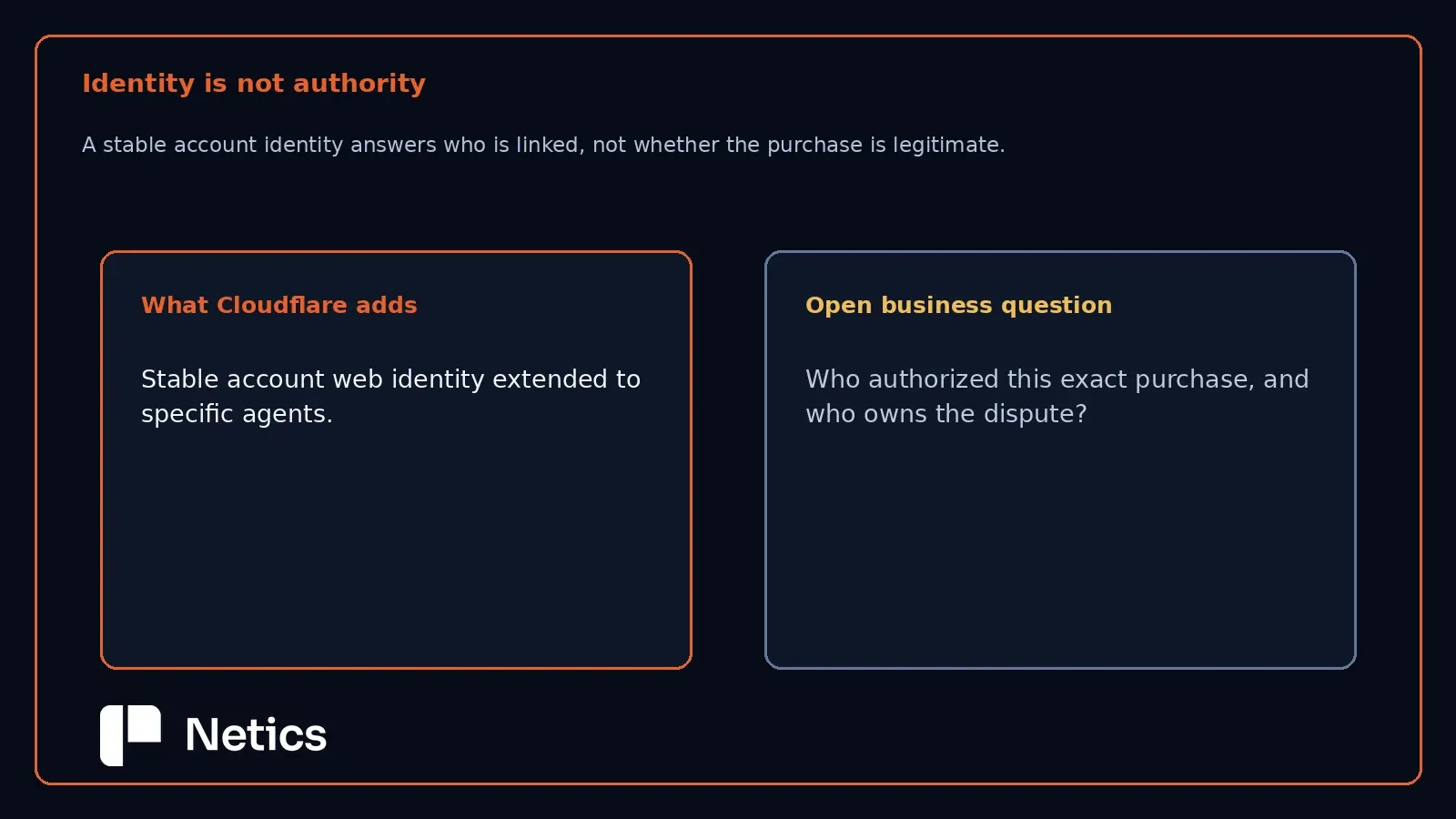
The mechanism has two parts. First, every Cloudflare account gets a unique web address that functions as a stable ID. Account owners can then extend that identity to specific agents, so a business receiving a request from an agent can see exactly who authorized it. Second, a Cloudflare "Account Wallet" acts as a central balance capable of receiving, holding, and managing stablecoins. From that central balance, users can assign "Virtual Wallets" to individual agents, letting each agent spend on online resources within boundaries the user sets.
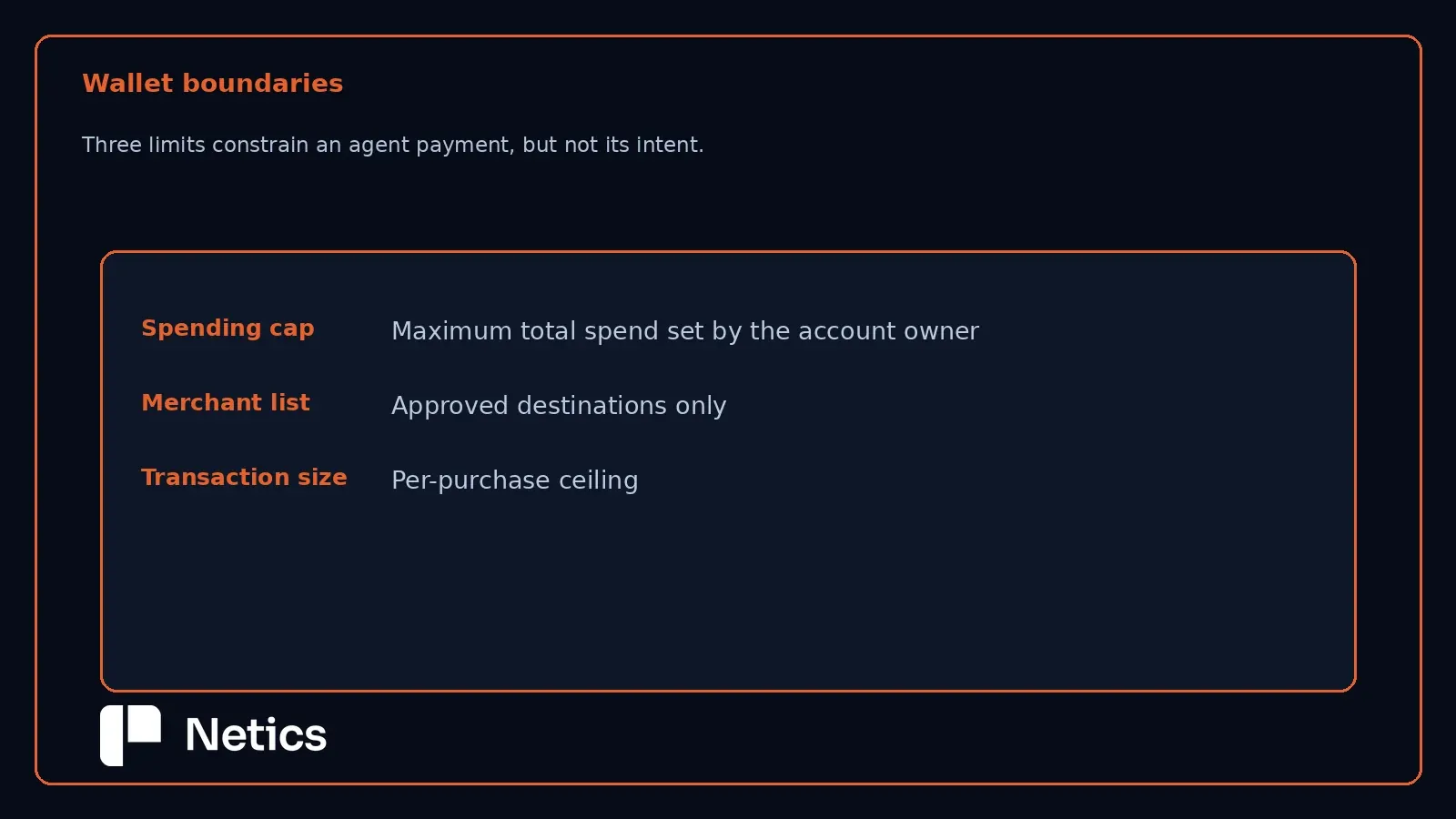
Those boundaries are the core of the product: a spending cap, an approved merchant list, and a maximum transaction size the agent cannot exceed on its own. Cloudflare frames this as the missing infrastructure for a shift it says is already underway — from human-driven browsing to agent-driven commerce, where CEO Matthew Prince argues businesses currently have no reliable way to tell a legitimate agent from a bad actor gaming the system, because bot-detection tools were built for search crawlers, not transacting agents.
Rollout is staged. Cloudflare Wallet handle reservation opened the same day as the announcement. Full wallet access — including onramping and offramping funds, and the ability to issue Virtual Wallets — is described as coming "in the coming months," not available at launch. Cloudflare also points to a pairing with its existing Monetization Gateway to complete what it calls a two-sided agentic payment market, though the press release does not detail how that pairing works mechanically.
Netics' take
Identity and a wallet are the right primitives to build, and Cloudflare is right that the underlying problem is real: a business today genuinely cannot tell whether an agent hitting its site is a customer's assistant or something else entirely, and generic bot-detection built for crawlers doesn't help. Giving an agent a stable, traceable link back to the account that owns it is a reasonable first move, and giving that agent a bounded wallet rather than open access to a payment method is an obviously sane default.
But read the mechanism carefully and the announcement is narrower than the framing suggests. What's described is: identity resolves to an account, and a wallet enforces a spending cap, a merchant allowlist, and a per-transaction ceiling. That's authorization by dollar amount and by destination, not authorization by task or intent. A spending cap tells a merchant an agent cannot spend more than $X — it says nothing about whether the agent was actually supposed to make this particular purchase, on this particular account's behalf, at this particular moment. Two agents with identical wallets and identical caps could be doing completely different things with completely different levels of legitimacy, and the wallet mechanics as described don't distinguish them.
The merchant side of the equation is similarly underspecified. The release says an agent's identity resolves back to a human or organization owner, and that a business "can see exactly who authorized" a request. What it doesn't say is what a merchant is supposed to do with that information — how to verify it, how to weigh it against fraud signals, or what recourse exists if the identity checks out but the transaction still turns out to be unwanted, mistaken, or fraudulent upstream of Cloudflare's system. A stable ID reduces one kind of uncertainty (is this a real, traceable actor) without touching another (should I trust what this actor is telling me to do).
Dispute accountability is the biggest gap. Nothing in the announcement addresses what happens when a transaction goes wrong — an agent buys the wrong item, exceeds intended scope within its cap, or a merchant later disputes a charge. Spending caps and merchant allowlists are preventive controls; they don't answer the after-the-fact question of who is responsible for unwinding a bad transaction, and that question matters more as transaction volume and dollar amounts grow.
Finally, the rollout itself is a source of near-term risk that businesses should weigh honestly. Handle reservation is open, but full wallet access — onramping, offramping, and issuing Virtual Wallets — isn't shipping yet; it's "coming months" away. Any business planning around this today is planning around a system that is not yet feature-complete, and the details that matter most for risk management (how disputes are handled, how identity verification actually works in practice, how the Monetization Gateway pairing functions) aren't in the announcement at all.
What this means for businesses
For businesses evaluating agentic commerce readiness, the practical takeaway is to treat Cloudflare's identity and wallet layer as necessary plumbing rather than a complete answer. Reserving a handle now costs nothing and keeps the option open, but nothing about payment limits or an identity link automatically resolves the harder questions: what authority does this agent actually have to act on behalf of its owner, should a given merchant trust a given identity claim without independent verification, and who is accountable when a bounded transaction still turns out to be the wrong one.
Businesses on the merchant side, in particular, should not treat "this agent has a verified identity and a capped wallet" as equivalent to "this transaction is safe to honor." Those are different guarantees. A spending cap protects against runaway costs; it does not protect against a legitimate-looking agent making an illegitimate request. Any operational plan built around this system should keep dispute-handling and authority-verification as open questions to solve separately, not assumptions the wallet infrastructure already covers.
Given that full wallet functionality is still months out, the near-term move is evaluation rather than commitment: watch how the Monetization Gateway pairing is actually specified, watch what Cloudflare says about dispute handling as the feature matures, and treat the current announcement as a signal of direction rather than a system ready to bear real transaction risk today. Organizations building or advising on AI strategy — including teams working with Netics on agentic deployments — should factor bounded authority and accountability into their own agent design regardless of what payment infrastructure eventually standardizes underneath it.
Bottom line
Cloudflare's Wallets and cloudflare.pay give AI agents a stable identity and a capped wallet, which is genuinely useful groundwork for agentic commerce. But a spending cap, a merchant allowlist, and a maximum transaction size are payment guardrails, not a settled answer to authority, merchant trust, or dispute accountability — and with full wallet access still months away, businesses should treat this as an early building block to watch, not a finished trust framework to build on yet.
Source: Cloudflare, "Cloudflare Gives AI Agents an Identity and a Wallet," press release, August 4, 2026.
Source: Cloudflare, 4 August 2026 — https://www.cloudflare.com/press/press-releases/2026/cloudflare-gives-ai-agents-an-identity-and-a-wallet/