
AWS AgentFlo Shows What Production AI Agents Actually Need
AgentFlo's AWS architecture is less interesting as a chatbot story than as a permissions, state, and operations story. The useful pattern is the separation between agent reasoning, tools, po

TL;DR • AgentFlo describes a commerce-agent architecture built around recipes, tools, context, memory, channels, policy, and observability—not just a model and a system prompt.[1] • Its most important design choice is the separation of reasoning from tool execution and authorization: Gateway manages integrations and credentials while policy decides which sessions may call which tools.[1] • The lesson for businesses is simple: the hard part is not making an agent answer. It is making the agent act repeatedly, safely, and predictably across real systems. The sections cover What happened, Netics' take, and What this means for businesses.
What happened
AWS's architecture post describes AgentFlo, a commerce service from Salesflo that deploys sales, support, and ordering agents across channels including WhatsApp. The agents can understand intent, search products, check inventory, create carts, place orders, raise tickets, and trigger follow-ups.[1]
The post says AgentFlo serves merchants managing more than $300 billion in annual transacted value, according to Salesflo. That is a vendor-reported figure, not independent evidence, but the architecture is still useful to study because it makes the production problem visible.[1]
The agent is not presented as a single model endpoint. It is a system with a messaging layer, guardrails, runtime isolation, tool routing, data stores, policy, and observability.
Netics' take
AgentFlo maps the usual agent components to operational responsibilities. The model handles intent and decisions. Instructions define the role. Tools perform actions. Knowledge grounds responses in merchant data. Memory preserves conversation, cart state, and preferences. Policy prevents unsafe or unauthorized actions. Observability tracks cost, performance, conversion, and conversation quality.[1]
That decomposition matters because each component has a different failure mode. A model can be accurate while the inventory tool is stale. A tool can be correct while the policy allows the wrong session to call it. A conversation can be coherent while the cart state is wrong. Calling all of these “the AI” makes the system impossible to operate.
The post's architecture uses Fargate for message handling, Bedrock AgentCore Runtime for agent execution, AgentCore Gateway for tool calls, Lambda functions for cart and product operations, DynamoDB and Aurora for state, S3 and a Bedrock Knowledge Base for merchant data, and observability services for logs and traces.[1]
The names are AWS-specific. The separation is not.
Permissions belong beside the tools The strongest part of the design is that OAuth tokens and platform credentials live in the Gateway, not in individual agent sessions. Policy sits beside the Gateway and applies fine-grained Cedar-based authorization independently of model reasoning. The source gives a concrete example: a sales agent should not be able to call customer-support-only APIs.[1]
That is the right boundary. The model can propose an action, but the authorization decision should not be delegated to the model's good intentions. The tool layer should know who is asking, which workflow is active, what data is being touched, and whether the action is allowed.
This is also where many agent projects become misleading. Teams spend weeks improving prompts and only days mapping permissions. They build a more persuasive system before they build a more governable one. AgentFlo's architecture at least puts credentials, tool routing, policy, state, and observability on the same diagram.
The recipe model is another useful idea. A merchant chooses a preconfigured recipe with persona, language, tools, knowledge sources, response packs, and business rules. The platform generates a configuration, packages it, deploys it, and connects it to a defined set of Gateway policies.[1]
Recipes can reduce deployment cost, but they also create a new governance obligation: every reusable recipe becomes a permission template. A mistake in the recipe can scale across merchants faster than a mistake in one custom deployment.
What to challenge before copying it First, ask who owns the policy. The architecture says policy is independent of model reasoning, which is good. But a policy engine is only as good as its identity model, tool inventory, approval workflow, and audit trail. “Fine-grained” is not a control until a team can inspect and test the rules.
Second, ask how state is corrected. AgentFlo describes stateful sessions of up to eight hours and persistent cart and conversation context. Long-lived state helps the customer experience, but it also increases the blast radius of a wrong assumption. A stale preference, an abandoned cart, or an instruction injected early in a conversation can remain influential later.
Third, ask how observability becomes action. Logs and traces are necessary, but a dashboard that shows a bad tool call after the fact is not prevention. The important questions are: which calls require approval, which credentials are short-lived, which actions are reversible, and who can stop an agent mid-session?
Fourth, do not confuse a cloud-native implementation with a business-ready control plane. AgentCore, Lambda, DynamoDB, Aurora, and MCP can provide useful primitives. The business still needs a source-of-truth inventory, ownership for each tool, data-retention rules, and a process for changing permissions without breaking the customer journey.
What this means for businesses
- Start with one bounded workflow, not a general assistant.
- Map every read, write, approval, and irreversible action before selecting the model.
- Put credentials behind a tool boundary and keep them out of prompts and agent memory.
- Make policy decisions independent of model output.
- Treat recipes as deployable software and review them like code.
- Test stale state, prompt injection, tool failure, duplicate orders, and handoff to a human.
- Measure business outcomes and control failures separately. Conversion does not prove safety.
Bottom line
AgentFlo's story is useful because it shows the unglamorous work behind a commercial agent: state, tools, identity, policy, isolation, deployment, and observability. The model is one component in that system.
The strategic lesson is not “use Amazon Bedrock AgentCore.” It is “stop calling a prompt connected to an API a production agent.” Production begins when the system can explain what the agent may touch, why it may touch it, what happened afterward, and how a human can stop or reverse it.
Book a free 30-minute audit if you are turning an internal assistant into a system that can act on customer or company data.
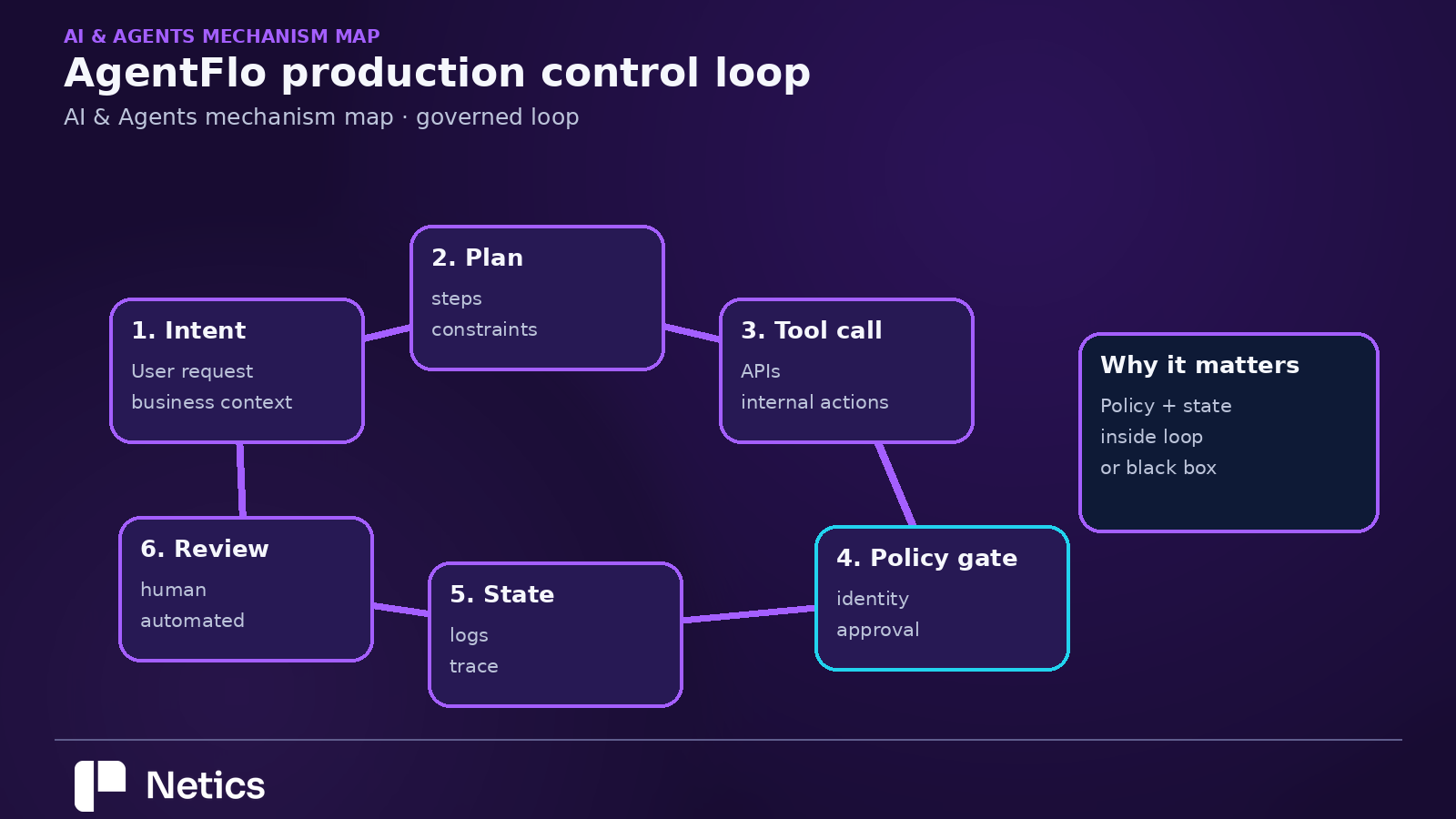
Original Netics diagram: the model proposes, policy decides, and tools act across a controlled production workflow.
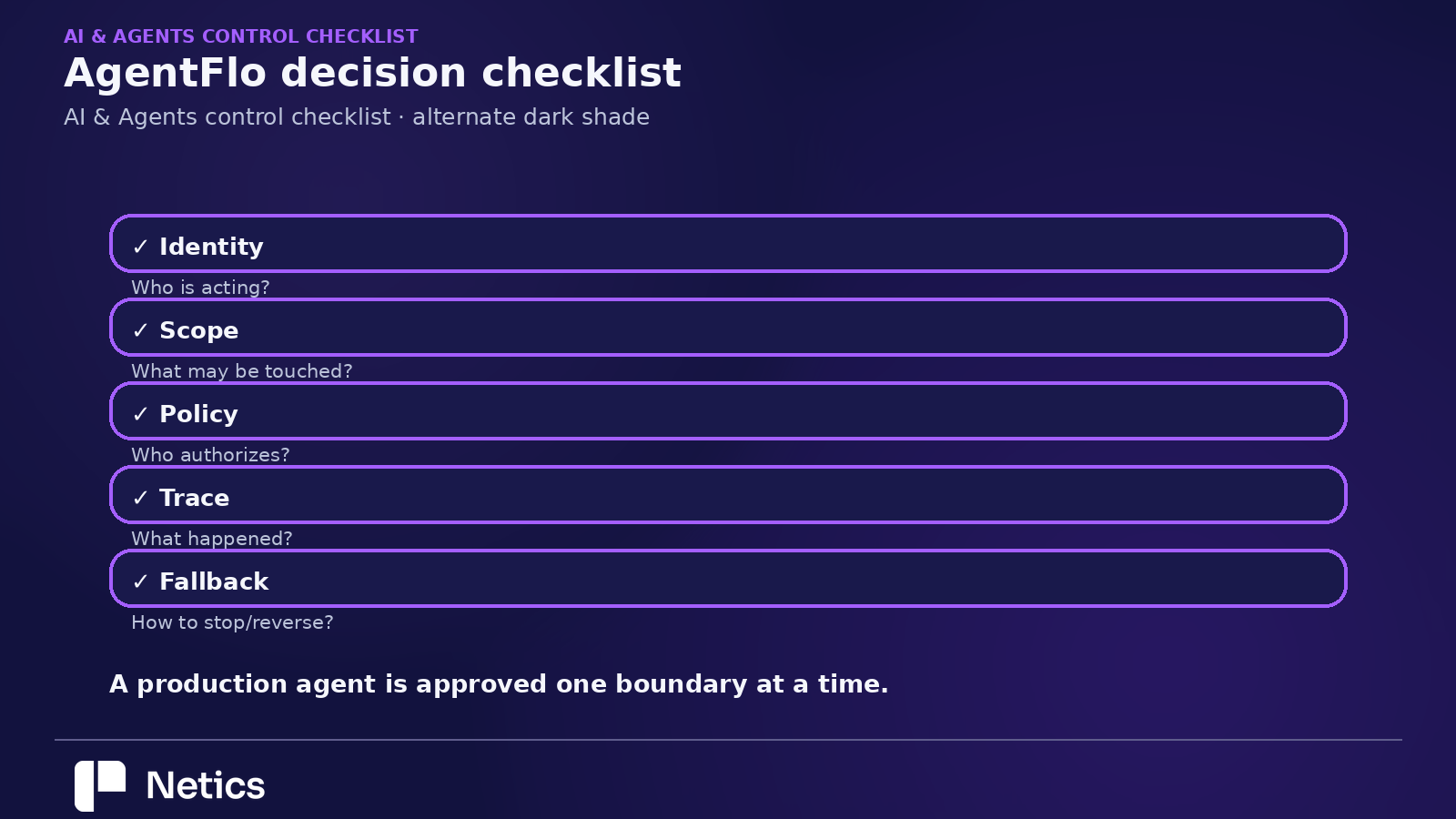
Original Netics diagram: every production tool call is also a policy decision.
Source: How AgentFlo built AI sales agents with Amazon Bedrock AgentCore – Part 1 — AWS Architecture Blog, 2026-08-20.
Explore Netics for practical infrastructure and AI operations guidance.