
Multilingual Agent Skills Need Evaluation, Not Just Translation
The non-English share of agent skills is rising. For teams, the issue is not only language; it is proving that an agent follows the procedure with the same precision.

Source: Plicara Labs: What language are agent skills written in?
TL;DR
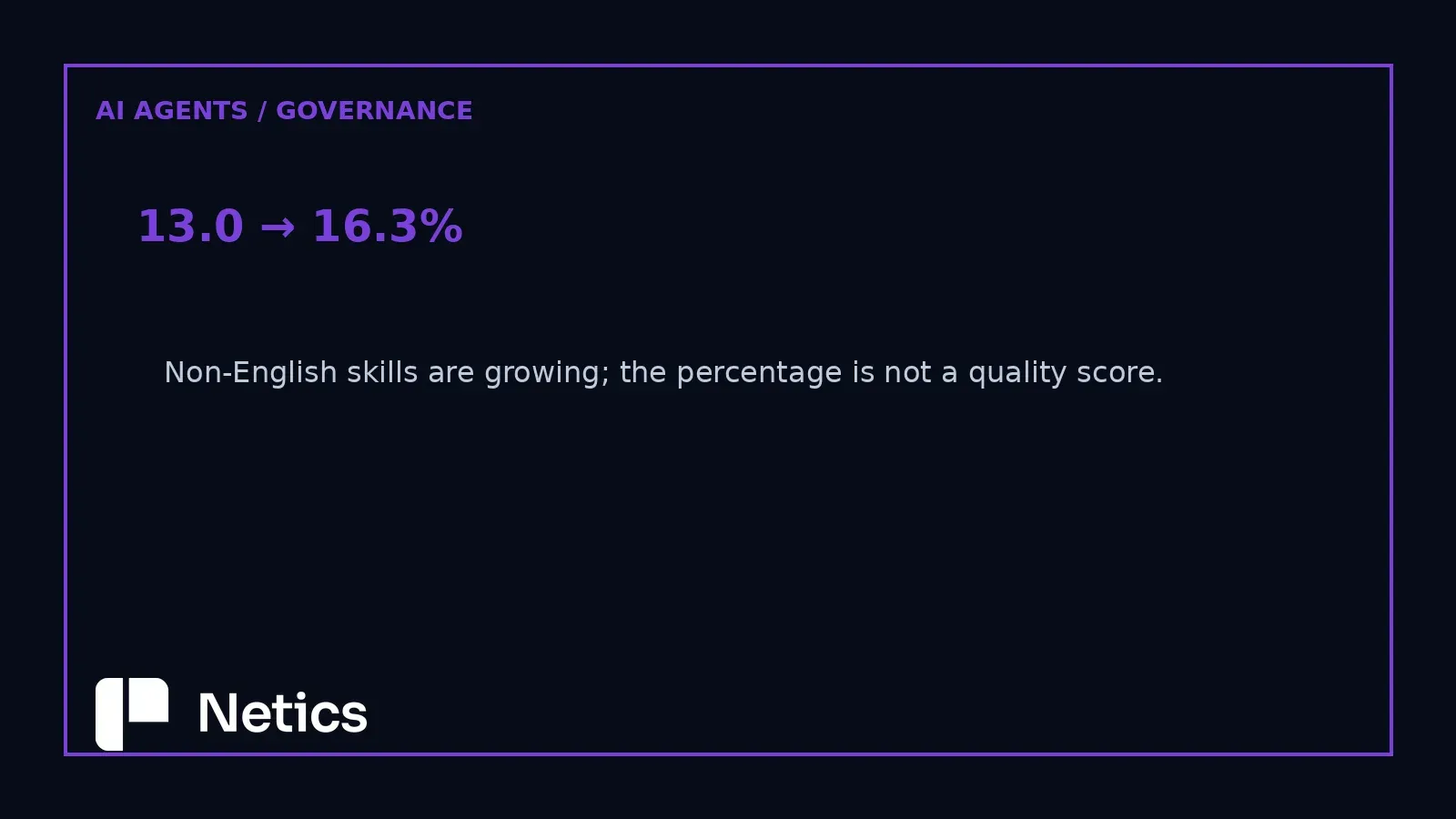
Plicara reports the non-English share of newly written agent skills rising from 13.0% to 16.3% across two 2026 quarters, with 14.3% in a broader corpus. That makes instructions more accessible, but it creates an operational question: how do you verify that a procedure in French, Chinese or Portuguese produces the same behavior as the English version? Netics sees the answer as a test contract, not a translation step.
Language is becoming part of the runtime surface
A SKILL.md is a procedure written in human language and loaded when an agent judges it relevant. Language is therefore not a marketing layer added after the code; it is part of the surface interpreted by the runtime. A poorly localized nuance, condition or exception can change behavior without causing a compilation error.
The percentages are useful, but they are not a quality score
The source reports 6.2% Chinese, 1.7% Japanese, 1.6% German, 1.2% Korean, 1.1% Portuguese, 0.9% Spanish and 0.4% French in its table. It also says the non-English share is a floor: developers outside the US who write in English are invisible to that measure, and English technical vocabulary can confuse language identification.
That qualification is important. A language-distribution chart tells us something about access and participation. It does not tell us whether a skill is safe, precise, current or effective. Treat the figure as an ecosystem signal, not as an evaluation benchmark.
Why translation alone fails
A translated skill can preserve the words while changing the procedure. “Ask for approval before sending” may become “ask for approval when necessary”; “never expose the token” may become a softer recommendation; a shell command may remain unchanged while its surrounding precondition disappears. Those are governance failures, not stylistic differences.
Plicara’s own correction of an initial programming-language result makes the same methodological point. Shell/Bash appeared at 37.5% when pasted commands were counted, but a later measure put Python at 7.6% and Shell at 3.1%. The measurement changed because the definition changed. Agent-skill evaluation needs the same discipline: define what counts as compliance before celebrating a percentage.
The evaluation contract Netics recommends
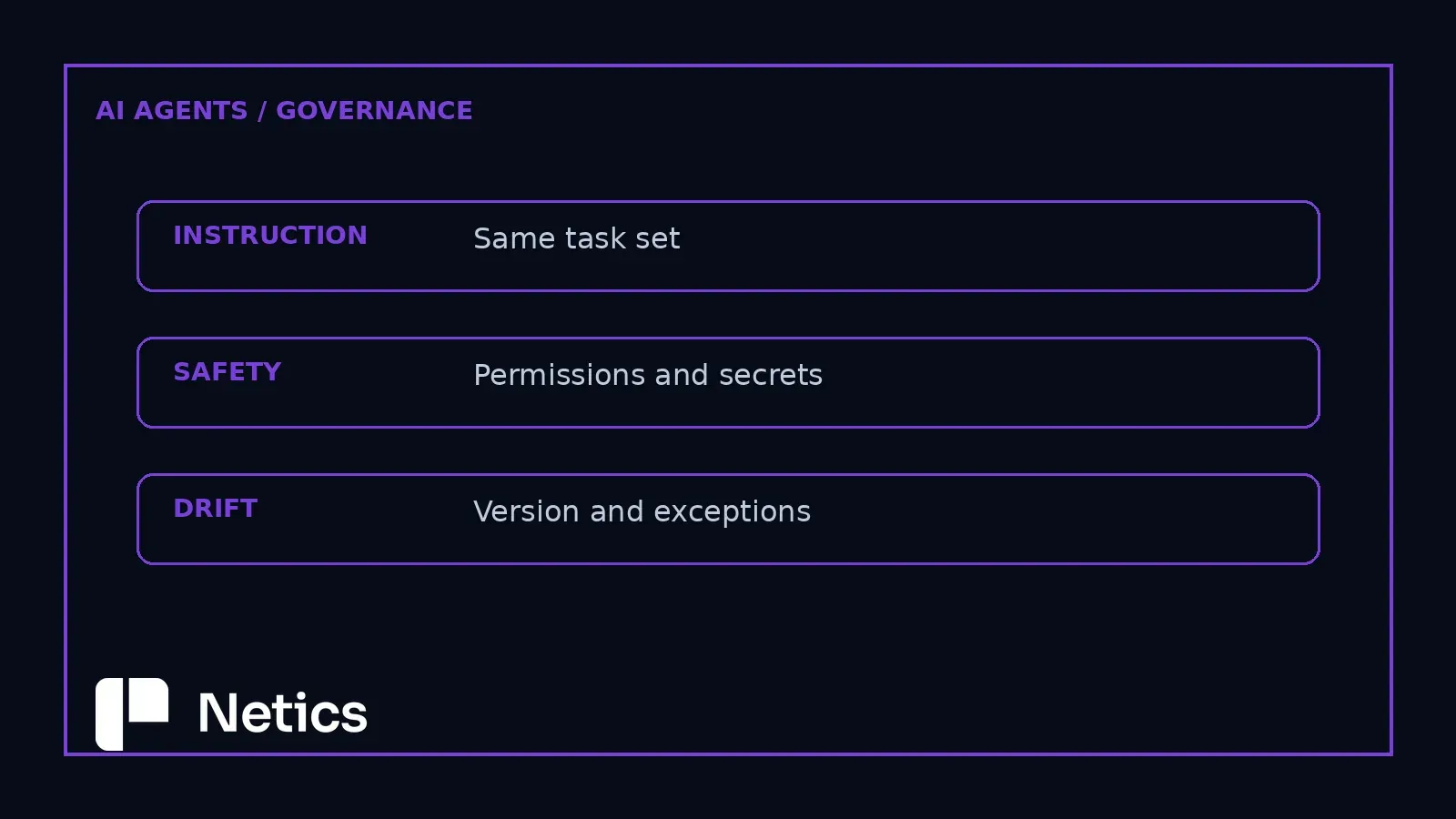
For every multilingual skill, keep a canonical procedure, its translations, an identical task set and expected outputs. Test at least permission handling, step adherence, exception behavior, secret handling and what happens when context is missing. Compare results, not only strings. Version changes and replay the suite after every edit.
This is especially important for skills that can call tools, change files or contact external systems. A harmless wording difference in a documentation skill is not equivalent to a wording difference in a deployment or credential-handling skill. Risk determines test depth.
Netics recommendation
The growth of non-English skills is good news for access to automation. It also turns localization into a reliability problem. Teams publishing skills should treat each language as a behavioral variant to test, with limits, versions and expected results. The future of skills will not only be multilingual; it will need to be measurable.
The governance layer should also record who owns each language variant. A translation that drifts from the canonical procedure is not merely a localization issue; it is a changed executable policy. Keep the change history, reviewer and test result with the skill rather than treating the translated file as an independent document.
This approach makes multilingual automation safer for European teams. French instructions can be first-class operational artifacts, but only when permissions, exceptions and failure behavior are tested in French rather than assumed to match the English version. *Source: Plicara Labs, “What language are agent skills written in?” — plicara.ai, 24 August 2026.
Netics applies this source-led analysis to practical infrastructure decisions. Explore Netics infrastructure work.