
Workload Identity Is the Missing Boundary in CI/CD Security
A practical explanation de workload identity ci cd.

TL;DR
A deployment workflow needs an identity, but that does not mean it needs a permanent cloud secret. GitHub Actions documents OpenID Connect (OIDC) tokens for workflows that authenticate to a cloud provider, while AWS IAM documents OIDC identity providers as the trust connection between an external identity provider and an AWS account. The important design work is the trust policy: it must constrain which repository, branch, environment, or workflow may assume a role. OIDC removes one class of long-lived credential from the repository; it does not eliminate the need for least privilege, protected environments, or auditability. The flow, remaining failure modes, Netics' take, and what this means for businesses is covered below.
The boundary a static secret hides
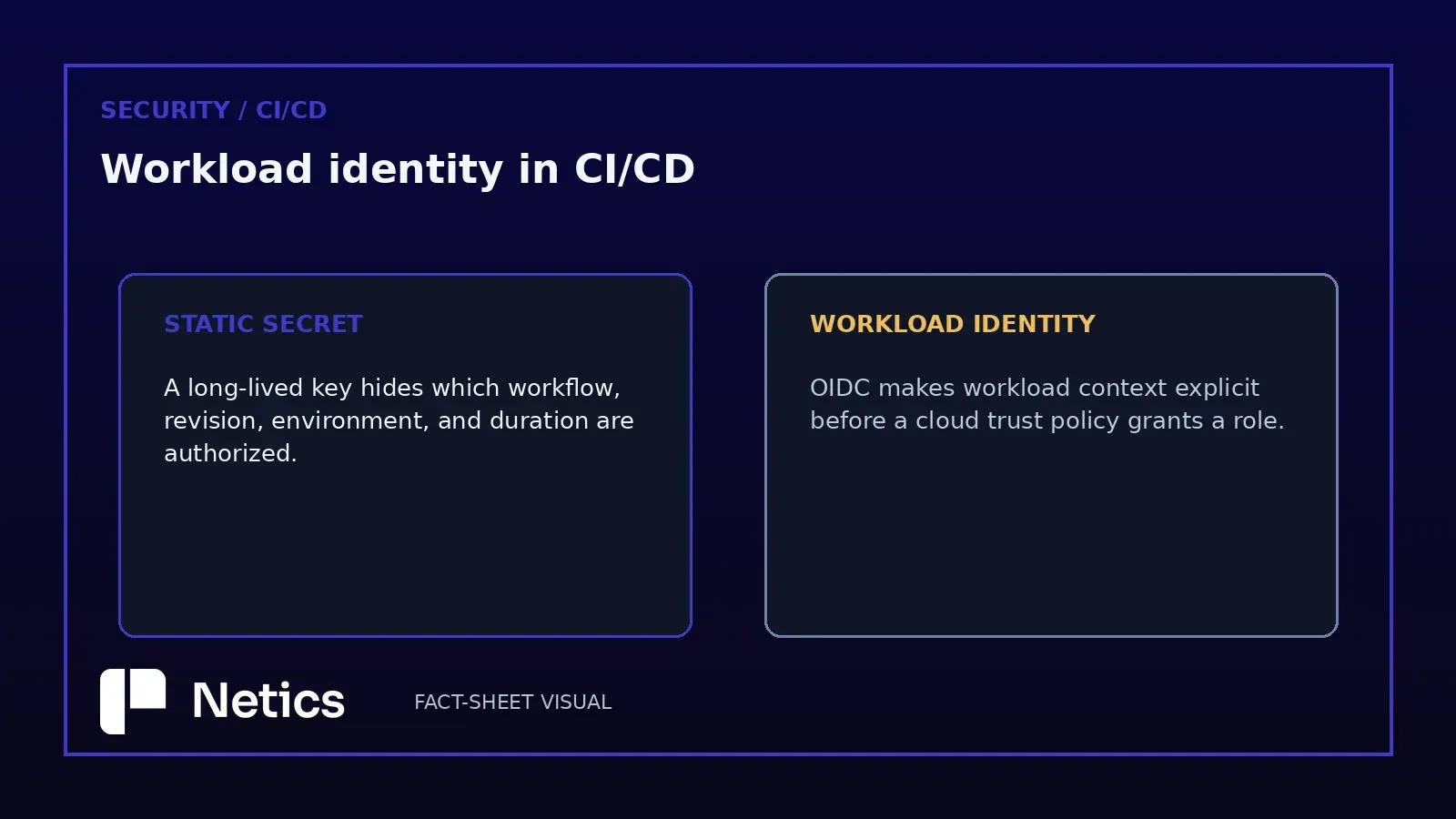
A long-lived deployment key compresses several questions into one opaque value: which workflow is acting, which revision triggered it, which environment is targeted, and how long the credential remains useful. If the key leaks, the cloud provider sees a credential that may be difficult to distinguish from any other authorized caller.
Workload identity makes those questions explicit. The workflow requests a short-lived identity assertion from its identity provider. The cloud trust layer validates that assertion, then allows a role or equivalent permission set only when its conditions match. The security boundary moves from “who knows the secret?” to “which workload is allowed to establish trust?”
GitHub’s OIDC hardening documentation [1] describes this pattern for Actions. AWS provides the corresponding IAM OIDC identity-provider model [2].
How the flow works
- A workflow starts from a defined event, such as a protected deployment environment.
- The workflow requests an OIDC token with claims describing its execution context.
- AWS IAM validates the issuer and token conditions through the configured OIDC provider.
- A role trust policy decides whether this particular workload may assume the role.
- The workflow receives temporary permissions scoped to the deployment task.
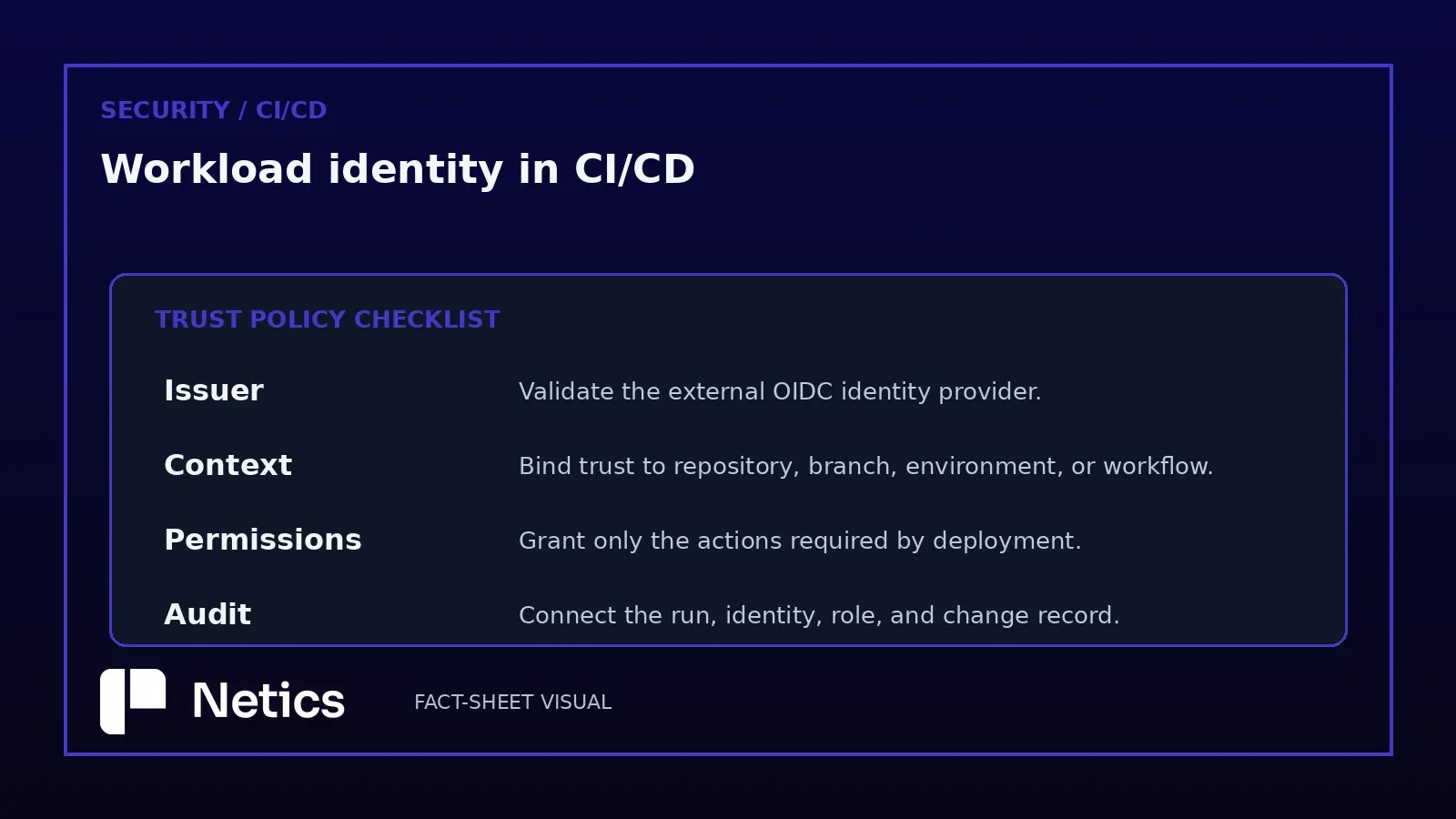
The trust policy is the part teams routinely underestimate. Merely accepting tokens from GitHub is not a policy. The policy should bind trust to the repository and the intended execution context. A production deployment role that accepts tokens from every branch has replaced a static secret with a dynamic but overly broad door.
Failure modes that remain
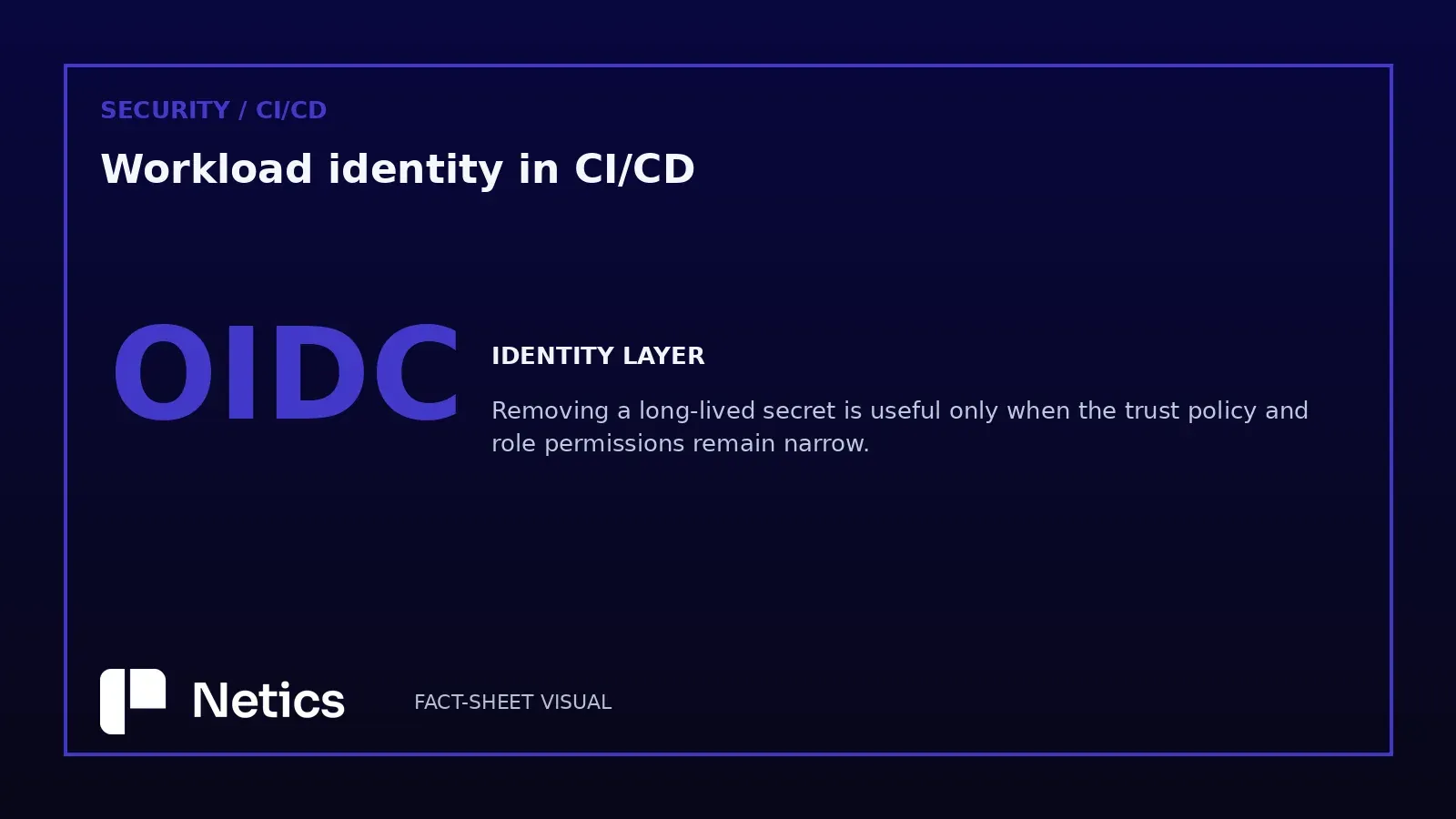
OIDC does not protect a compromised workflow. If an attacker can alter the workflow that is trusted to deploy, the identity mechanism may faithfully authenticate the attacker’s modified job. It also does not make excessive IAM permissions safe. A role capable of changing every production resource is still excessive when assumed with a temporary token.
The practical controls are therefore layered: protected branches and environments, narrow trust conditions, least-privilege role policies, review of workflow changes, and logs that connect the deployment to its repository and run context. OIDC is the identity layer, not the complete CI/CD security architecture.
GitLab CI/CD has the same mechanism, different syntax
GitLab CI/CD supports the same pattern through its id_tokens keyword, introduced to replace the older, coarser CI_JOB_JWT predefined variable. A pipeline declares an ID token with a specific audience claim in .gitlab-ci.yml, GitLab issues a short-lived signed JWT scoped to that job, and the cloud provider’s OIDC trust configuration validates it the same way it validates a GitHub Actions token — by checking issuer, audience, and claims like the project path and ref before allowing a role to be assumed. The trust-policy discipline this article describes does not change: a role that accepts any GitLab project’s token has the same overly broad exposure as one that accepts tokens from any GitHub branch. Teams running both platforms end up maintaining two OIDC trust configurations with the same design requirements, which is exactly the kind of duplicated policy surface worth documenting once rather than reviewing separately each time a new pipeline is added.
Netics' take
For most teams, workload identity should be treated as a boundary decision before it is treated as a credentials feature. Start by listing the deployment actions a workflow actually needs. Then define the smallest cloud role that can perform them, and finally write the trust policy that limits who may assume it.
This order matters. Starting with “how do we remove this secret?” can produce a technically modern but still dangerously broad role. Starting with “which workload may perform which action, in which environment?” produces a model that can be audited and changed.
The trust policy condition is the part worth reading carefully
The difference between a scoped and an overly broad trust policy often comes down to one condition line. AWS’s OIDC trust policy examples key on the token’s sub claim, which for GitHub Actions encodes the repository and ref (for example, a value scoped to repo:org/repo:ref:refs/heads/main rather than a wildcard covering every branch). A trust policy written against the wildcard pattern technically uses OIDC, but grants the role to any workflow run in that repository regardless of branch — including a developer’s feature branch. Reviewing this one condition during setup, and again whenever the workflow file changes, catches the gap between “we adopted OIDC” and “we adopted a scoped trust boundary,” which are not the same claim.
What this means for businesses
A small company does not need a large identity platform to begin. One production workflow, one constrained role, and one documented trust relationship are enough to replace a high-value static credential. The same pattern can then be extended to staging, infrastructure automation, and multi-account deployments without copying secrets across repositories.
For a practical architecture review, visit the Netics homepage or book a free 30-minute audit.