
SAP Starts Its Joule Work Rollout With Its Own Numbers Attached
SAP opened the customer rollout of Joule Work on 6 October 2026 with 110,000 of its own employees already working in it, and published the productivity numbers it measured internally.

TL;DR
- Joule Work is the AI interface SAP added to its business software, a layer where an employee asks a question or hands a task to an agent and the work happens inside the SAP applications that hold the data.
- SAP began the customer rollout of Joule Work at SAP Connect on 6 October 2026, and general availability for the new assistants and agents starts in October.
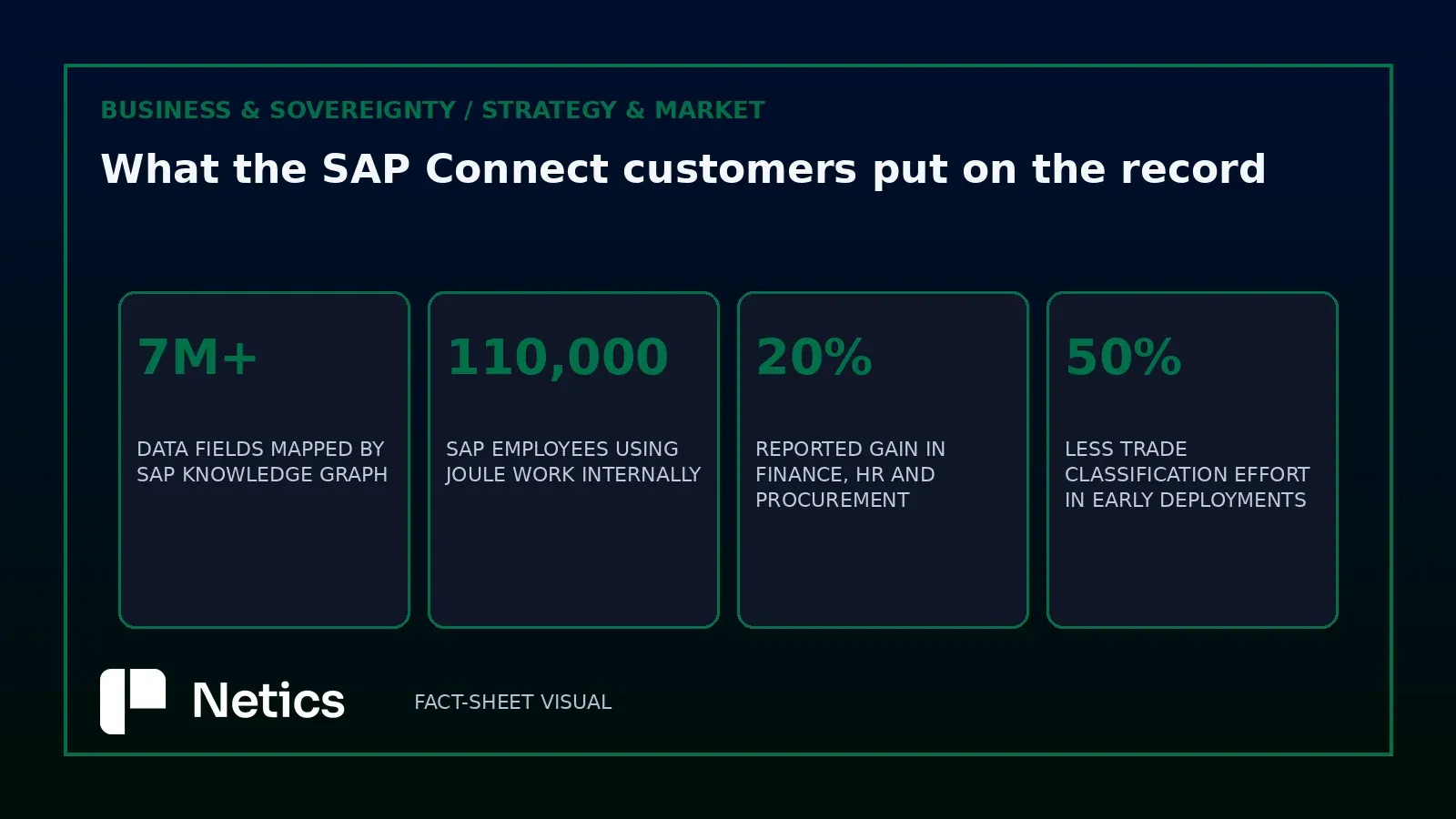
- Joule Work is already live with 110,000 SAP employees, and SAP reports 20% productivity gains across finance, HR and procurement from that internal deployment.
- The interface rests on three pillars SAP describes as conversations, spaces and Joule Studio, with customers controlling the level of autonomy given to what the assistants execute.
- The assistant is grounded in SAP Knowledge Graph, which SAP says maps more than 7 million data fields, and Joule can reach third-party agents through the Agent2Agent protocol.
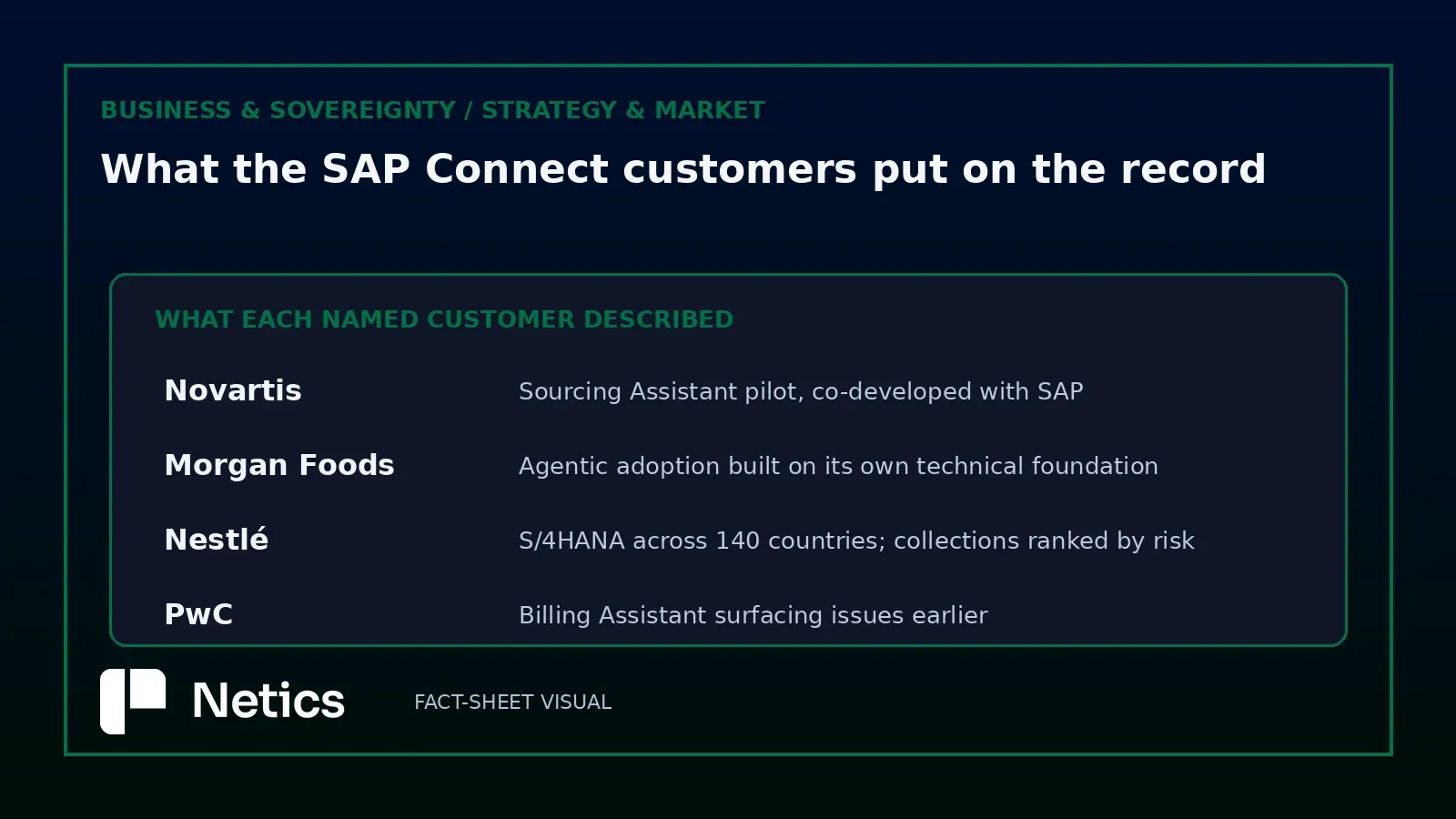
- Named customers put statements on the record at the event: Novartis described a Sourcing Assistant pilot, Morgan Foods described agentic adoption on its own technical foundation, Nestlé described collections ranked by risk, and PwC described earlier detection of billing issues.
- SAP also entered payments with SAP Pay, a service that executes and reconciles payment inside SAP Cloud ERP once an invoice is approved, generally available in the United States and the United Kingdom.
- A buyer evaluating this stack can ask for the same four things an internal rollout produces: a named owner for the data grounding, the audit trail for each executed action, the record of who approved the autonomy level, and the measurement plan that produced the productivity figure.
What SAP put on general release in October
SAP's press release from SAP Connect describes a rollout with dates attached. "Joule Work is beginning its customer rollout as a new AI user interface that lets employees interact with SAP solutions in their own language and complete work across SAP and third-party data," the release states, and the accompanying Innovation News Guide adds that general availability for these innovations starts in October.
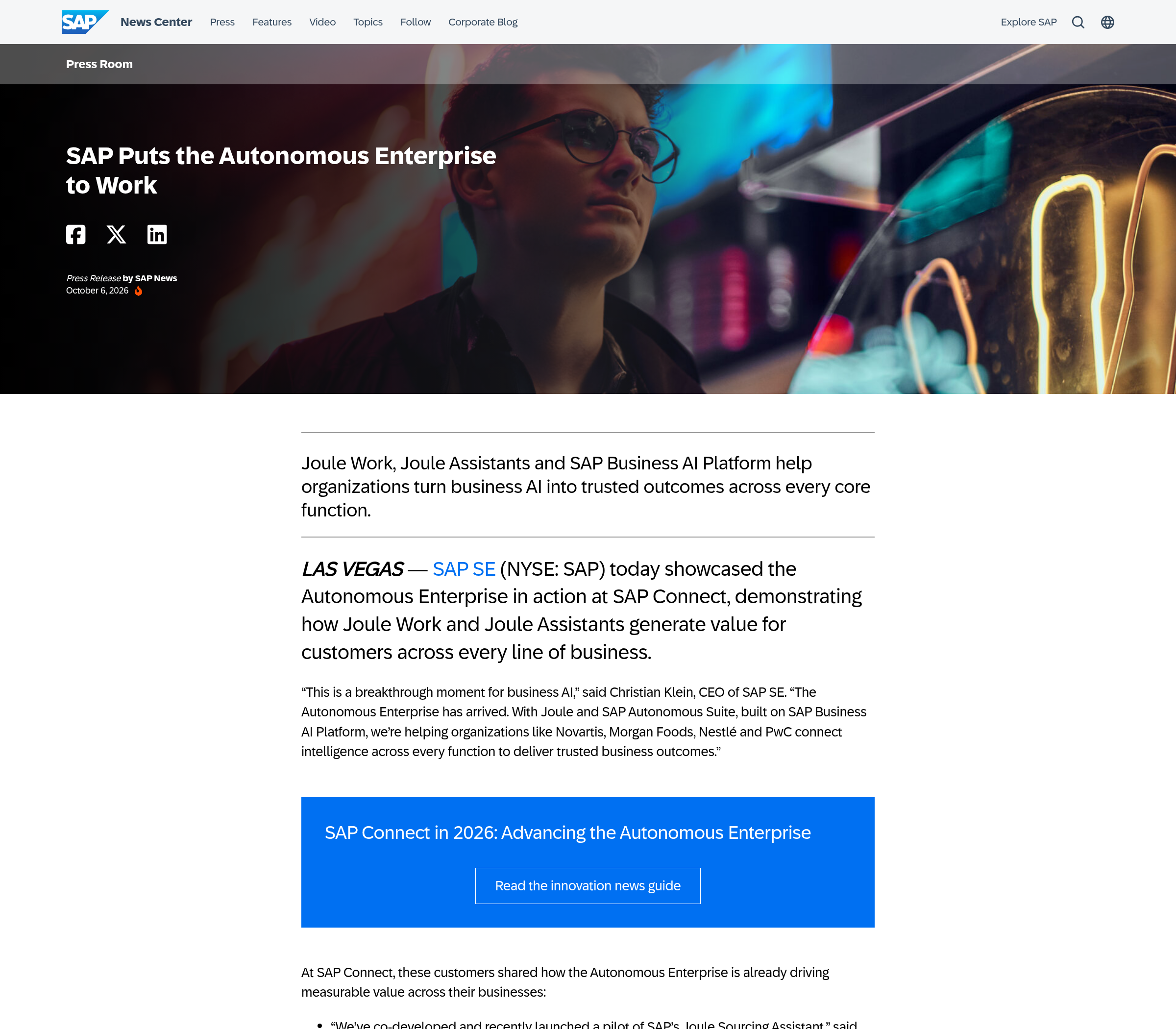
The reporting line inside SAP carries the interesting evidence. "At SAP, Joule Work is already live with 110,000 employees, with the company seeing 20% productivity gains across finance, HR and procurement," the press release states. Internal deployment at that scale gives a vendor something a customer reference cannot: a population large enough that the average is hard to dress up, measured on the vendor's own processes.
Christian Klein, SAP's chief executive, framed the customer promise at the keynote in the same terms, saying that from the rollout the more than 400 million SAP users can talk in their own language to SAP and Joule Work gets the job done. A promise of that size is the reason the released figures matter more than the released features.
The three pillars of Joule Work
SAP describes the product as three connected pieces, and the split is worth reading closely because it maps onto how a business group would adopt it. Conversations are where users ask questions and delegate tasks to agents. Spaces display content, insights and shared work. Joule Studio is where customers extend Joule or build agents for their own processes.
That third piece is the one that decides whether the rollout stays a licence and turns into a system. A team that can assemble an agent inside Joule Studio from its own process knowledge keeps the definition of the work, and the definition of the work is where the quality of the output is decided.
SAP's own framing of the assistant's reach goes one step further through the Agent2Agent protocol, which the press release says lets Joule connect with third-party AI and agents so that governed business context travels into broader AI workflows. Interoperability at that layer matters for a company that runs one vendor's ERP and another vendor's models, which describes most of the mid-size market we work with at Netics.
How SAP grounded the assistant in its own data
The grounding claim is the technical claim in this release. "Grounded in business context from SAP Knowledge Graph, which maps more than 7 million data fields, Joule provides information users can rely on," the press release states, and the keynote write-up expands the same graph to 50 million tables, more than 50,000 public and private APIs and 400 data products.
Two things follow from a knowledge graph that large. The first is that an answer can name the field it came from, which is what separates a grounded response from a fluent one. The second is the work it implies on the customer side: a graph of SAP's own data fields does not describe a company's warehouse locations, approval limits or payment terms until somebody maps them.
That mapping is the same discipline we build into automation pipelines that keep a human approval step, because an agent executing work inside an ERP touches money and obligations. SAP's own product split acknowledges the stakes when it says Joule Assistants "execute operational work directly within business workflows, using established data, authorizations and audit trails," with customers controlling the level of autonomy.
What the named customers describe
Six customers spoke at the event, and their statements describe how far each company has got with adoption, which makes them useful.
Novartis is in pilot: "We've co-developed and recently launched a pilot of SAP's Joule Sourcing Assistant," said Christoph Buerki, the company's head of procurement. Morgan Foods is building foundations, with its chief financial officer Steve Hankins saying the company is putting the pieces in place for agentic adoption through its technical foundation, and adding that its superpower will come from people on top of agents. Nestlé described an S/4HANA transformation across 140 countries that lets Joule and the Accounts Receivable Assistant prioritise collections work by risk. PwC described a Billing Assistant that identifies potential issues earlier in a process it calls error-prone.
Read together, the statements trace a maturity line from pilot to production process, and none of them quotes a cost saving for a customer. The productivity number in this release belongs to SAP itself.
SAP Pay moves payments inside the ERP workflow
The payments announcement sits further along the same reasoning. SAP Pay is a payment service embedded in SAP Cloud ERP workflows, powered by Tereina, a regulated payment-service provider SAP founded in April 2026. "When an invoice is approved in an SAP Cloud ERP application, SAP Pay automatically executes payment and reconciles it against the corresponding invoice or purchase order," the Innovation News Guide states, and the same page records that SAP Pay is generally available now in the United States and United Kingdom.
Payments are the place where an automated step has the least room for a wrong decision, which is why the design detail that matters here is the trigger: an approval that has already happened inside the ERP. Reconciliation then happens against the document that was approved, so the audit trail and the money movement share one system.
Elsewhere in the suite the release offers one customer-side number: early deployments of the International Trade Assistant reduced trade classification effort by up to 50%. That figure arrives with the qualifier "up to", which is the honest way to publish a range that depends on the tariff schedule in front of it.
What a buyer can check before signing
The rollout raises the same four questions our own clients ask about agentic software, and SAP's publication answers some of them better than a brochure would.
Ask for the record behind the productivity figure: which processes were measured, over what period, and whether the comparison baseline was a human-only workflow. Ask how the knowledge graph gets your data, and who owns the mapping when a warehouse moves or a payment term changes. Ask what the audit trail contains for an action the assistant executed, since an approver's name and a timestamp are the artifacts an auditor will request. Ask for the autonomy setting in writing, including who can raise it and what review period applies afterwards.
A vendor that has run this internally for 110,000 people has the material to answer all four. The published evidence so far covers the first question and describes the other three as product capabilities, which is normal at this stage of a rollout and worth tracking as customer deployments start producing their own numbers.
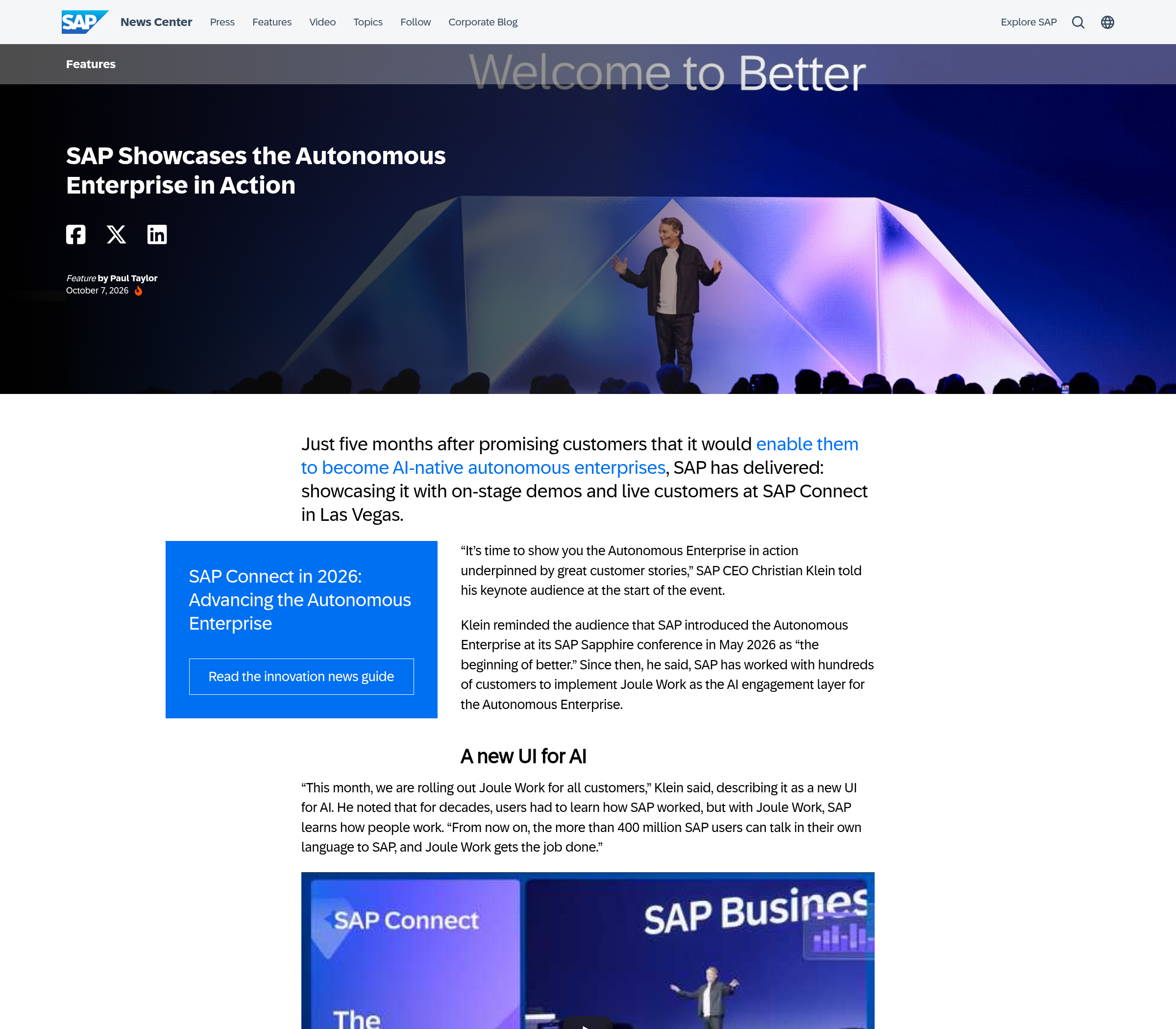
An ERP assistant arrives with the data model, the authorisations and the audit trail already in place, and that inheritance is the reason this rollout is worth watching. The vendor did the part that is hard to fake, which is running it on itself first, and the part that remains for every buyer is the mapping of their own processes and the measurement of their own before-and-after.
Sources
Source: SAP Puts the Autonomous Enterprise to Work — news.sap.com/2026/10/sap-connect-sap-puts-autonomous-enterprise-to-work/, SAP News, published 6 October 2026, retrieved 2026-10-09 (the start of the Joule Work customer rollout as a new AI user interface, the rollout across SAP and third-party data, the grounding in SAP Knowledge Graph and its more than 7 million data fields, the 110,000 SAP employees already using Joule Work with 20% productivity gains across finance, HR and procurement, the execution of operational work by Joule Assistants inside business workflows using established data, authorizations and audit trails, the customer control over the level of autonomy, the Agent2Agent protocol connection to third-party AI and agents, SAP Business AI Platform with more than 70 AI models, the up to 50% reduction in trade classification effort in early International Trade Assistant deployments, the entry into payment services with SAP Pay powered by Tereina, the execution and reconciliation of payment after an invoice is approved in SAP Cloud ERP, and the customer statements from Novartis, Morgan Foods, Nestlé, PwC, Maschinenfabrik Reinhausen and CONA Services).
Source: SAP Showcases the Autonomous Enterprise in Action — news.sap.com/2026/10/sap-connect-keynote-autonomous-enterprise-in-action/, SAP News, published 6 October 2026, retrieved 2026-10-09 (Christian Klein's statement that this month SAP is rolling out Joule Work for all customers, the three pillars described as conversations, spaces and Joule Studio, the knowledge graph dimensions of more than 7 million data fields, 50 million tables, more than 50,000 public and private APIs and 400 data products, and the more than 400 million SAP users statement).
Source: SAP Connect 2026 Innovation News Guide — sap.com/topics/events/connect/innovation-news-guide-2026, SAP, published 6 October 2026, retrieved 2026-10-09 (the composition of the Autonomous Enterprise from Joule Work, SAP Autonomous Suite and SAP Business AI Platform, the October start of general availability, the SAP Pay execution and reconciliation statement, and the United States and United Kingdom availability of SAP Pay).
Source: SAP's SAP Connect 2026 press release — news.sap.com, 6 October 2026; SAP's keynote write-up — news.sap.com, 6 October 2026; the SAP Connect 2026 Innovation News Guide — sap.com, 6 October 2026. All retrieved 2026-10-09. Figures: two captures of SAP's own published pages, plus two Netics editorial diagrams rendered from the same sources.