RAG vs. Fine-Tuning for Production AI: A Decision Framework
RAG vs fine-tuning helps IT leads choose between retrieval, model adaptation, or a hybrid architecture for production AI.

TL;DR
RAG and fine-tuning solve different production problems. RAG retrieves current custom documents for question answering and can cite sources; fine-tuning changes model behavior for style or additional tasks such as summarization. The decision covers what RAG and fine-tuning actually do, the advantages and disadvantages of RAG, the advantages and disadvantages of fine-tuning, when to choose each approach, whether they can be combined, and the Netics view.
What RAG and Fine-Tuning Actually Do
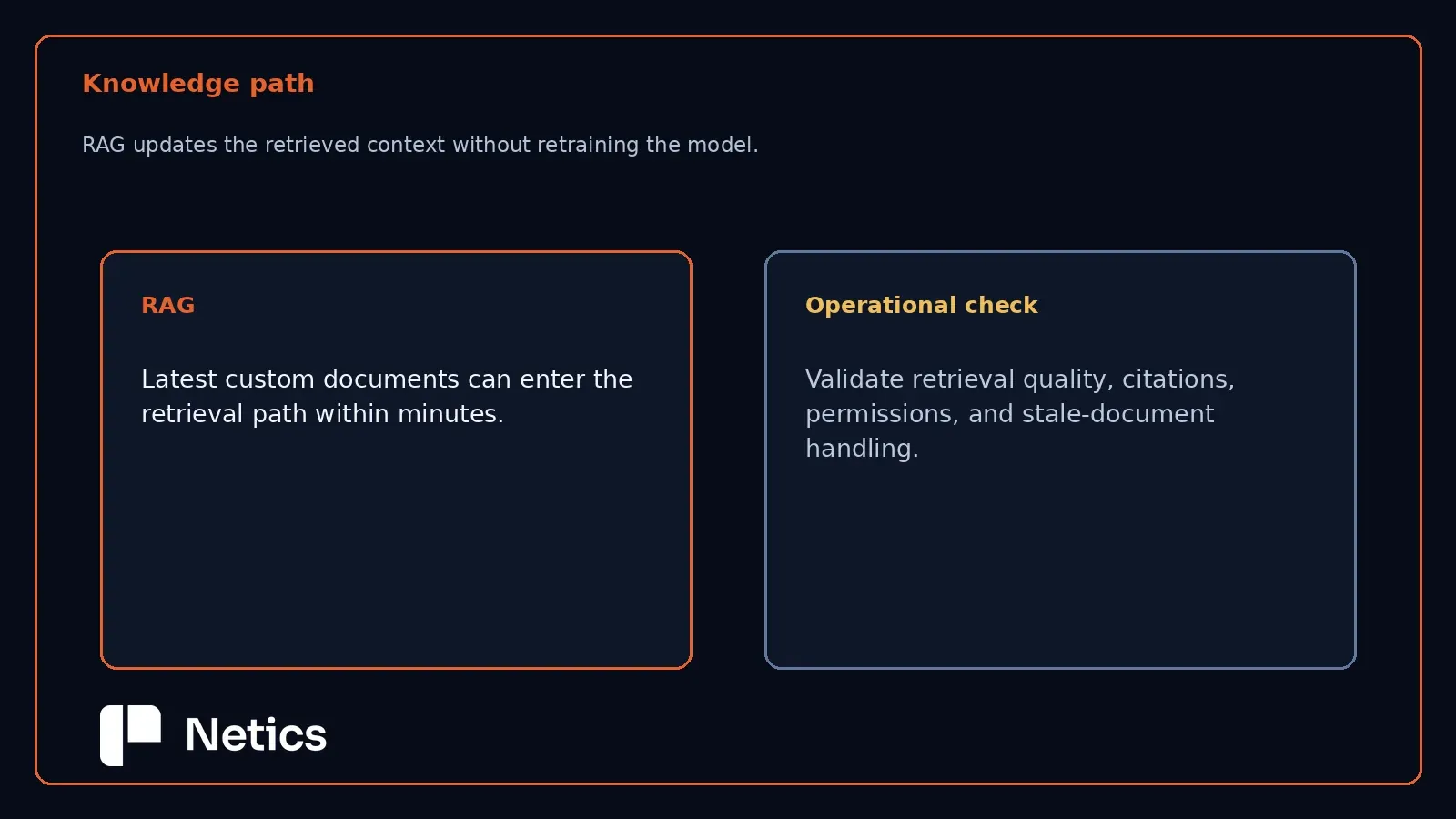
Both techniques adapt a general-purpose LLM to organization-specific knowledge, but they intervene at different points in the system. RAG leaves the model's weights untouched and instead retrieves relevant content from a vector search over custom documents at query time, then uses that retrieved context as the basis for the generated answer. Fine-tuning modifies the model itself by training it further on proprietary or task-specific data, changing its underlying behavior rather than what it can look up.
Advantages of RAG
Per AWS's comparison, RAG offers several concrete benefits for question-answering use cases, especially when documents change frequently and answers must remain traceable.
- It allows organizations to build a question-answering system over custom documents without any fine-tuning step.
- It can incorporate the latest documents within minutes, making it suited to frequently changing content.
- Fully managed RAG solutions are available (AWS cites its own offerings here), meaning no data scientist or specialized machine learning expertise is required to deploy one.
- Because RAG grounds its answers in retrieved context from a vector search, it carries a reduced risk of hallucination.
- RAG responses include a reference to the source of the information, giving users traceability.
Disadvantages of RAG
The source identifies one clear limitation: RAG does not work well when the task is to summarize information across entire documents, since it is built around retrieving and answering from relevant fragments rather than synthesizing a whole document.
Advantages of Fine-Tuning
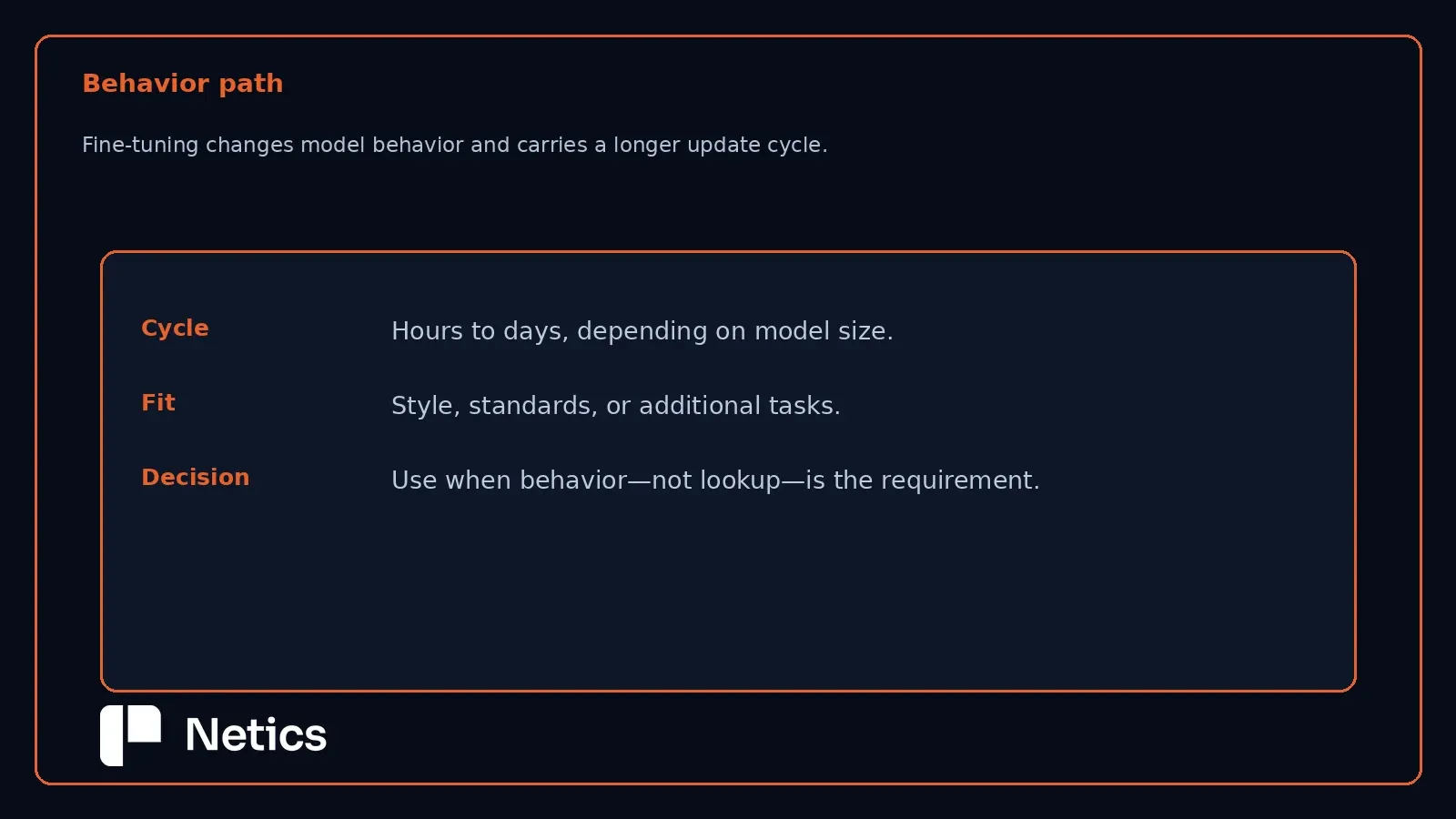
Fine-tuning has its own distinct strengths, particularly when the requirement is behavioral rather than retrieval-based.
- A model fine-tuned using an unsupervised approach can produce content that more closely matches an organization's specific writing style.
- A model fine-tuned on proprietary or regulatory data can help an organization align outputs with in-house or industry-specific data and compliance standards.
Disadvantages of Fine-Tuning
AWS lists several trade-offs that make fine-tuning a heavier commitment, from training time to specialist implementation knowledge.
- Fine-tuning can take a few hours to days depending on model size, which makes it a poor fit when custom documents change frequently.
- It requires familiarity with techniques such as low-rank adaptation (LoRA) and parameter-efficient fine-tuning (PEFT), and may require a data scientist.
- Fine-tuning is not available for all models.
- Fine-tuned models do not provide a reference to their source material in responses.
- There is an increased risk of hallucination when using a fine-tuned model to answer questions, compared to a retrieval-grounded approach.
When to Choose Each Approach
AWS's guidance is direct on this point: if the goal is a question-answering solution that references custom documents, start with a RAG-based approach. If the goal is for the model to perform additional tasks — summarization is the example given — fine-tuning is the recommended route instead.
Can You Combine Them?
Yes. AWS describes a hybrid pattern in which the RAG architecture is left unchanged, but the LLM that generates the final answer is also fine-tuned using the organization's custom documents. This combines the retrieval grounding of RAG with the behavioral adaptation of fine-tuning, and AWS points to it as potentially the optimum solution for some use cases. For readers who want the underlying research, AWS references the RAFT ("Adapting Language Model to Domain Specific RAG") work from the University of California, Berkeley as further reading on this combined approach.
Netics' Take
For most IT leads building an internal or customer-facing knowledge assistant, RAG is the more conservative and more maintainable starting point: it keeps pace with changing documents, requires less specialized ML expertise to stand up, and produces traceable, source-cited answers — properties that matter for auditability. Fine-tuning is not a first move; it is a deliberate second step reserved for cases where the requirement is genuinely behavioral (house style, compliance-driven phrasing) or where the task itself — summarization being the clearest example — falls outside what retrieval-based generation handles well. Treating fine-tuning and RAG as a hybrid to reach for by default, rather than a considered later addition once a RAG system's limits are actually felt, tends to add operational cost (training cycles, LoRA/PEFT expertise, model retraining discipline) without a corresponding benefit. Organizations evaluating this decision, or architecting the retrieval and data pipelines it depends on, can review the Netics blog for related infrastructure and AI-implementation guidance.
Sources
- AWS Prescriptive Guidance, "Comparing Retrieval Augmented Generation and fine-tuning"
Netics publishes practical infrastructure comparisons at https://neticslabs.com, helping technical teams connect documentation with operational constraints.
For a context-specific architecture review, book a free 30-minute audit with Netics.