
PostgreSQL or MySQL: Reading the Fine Print Before You Commit
PostgreSQL vs MySQL is compared through operational boundaries, permissions, execution, migration, and decision criteria.

TL;DR
There is no universal winner between PostgreSQL and MySQL. The right choice depends on how your team plans to replicate data, how granular your access-control needs are, and whether your workload leans toward semi-structured JSON documents or strict relational integrity. This article compares operational boundaries — not benchmarks, not pricing — because those numbers change with hardware, workload, and vendor packaging in ways a blog post can't responsibly claim. Netics' Position covers the trade-off; the Decision Matrix and Hypothetical Example make the recommendation concrete, followed by What We Actually Recommend.
Netics' Position
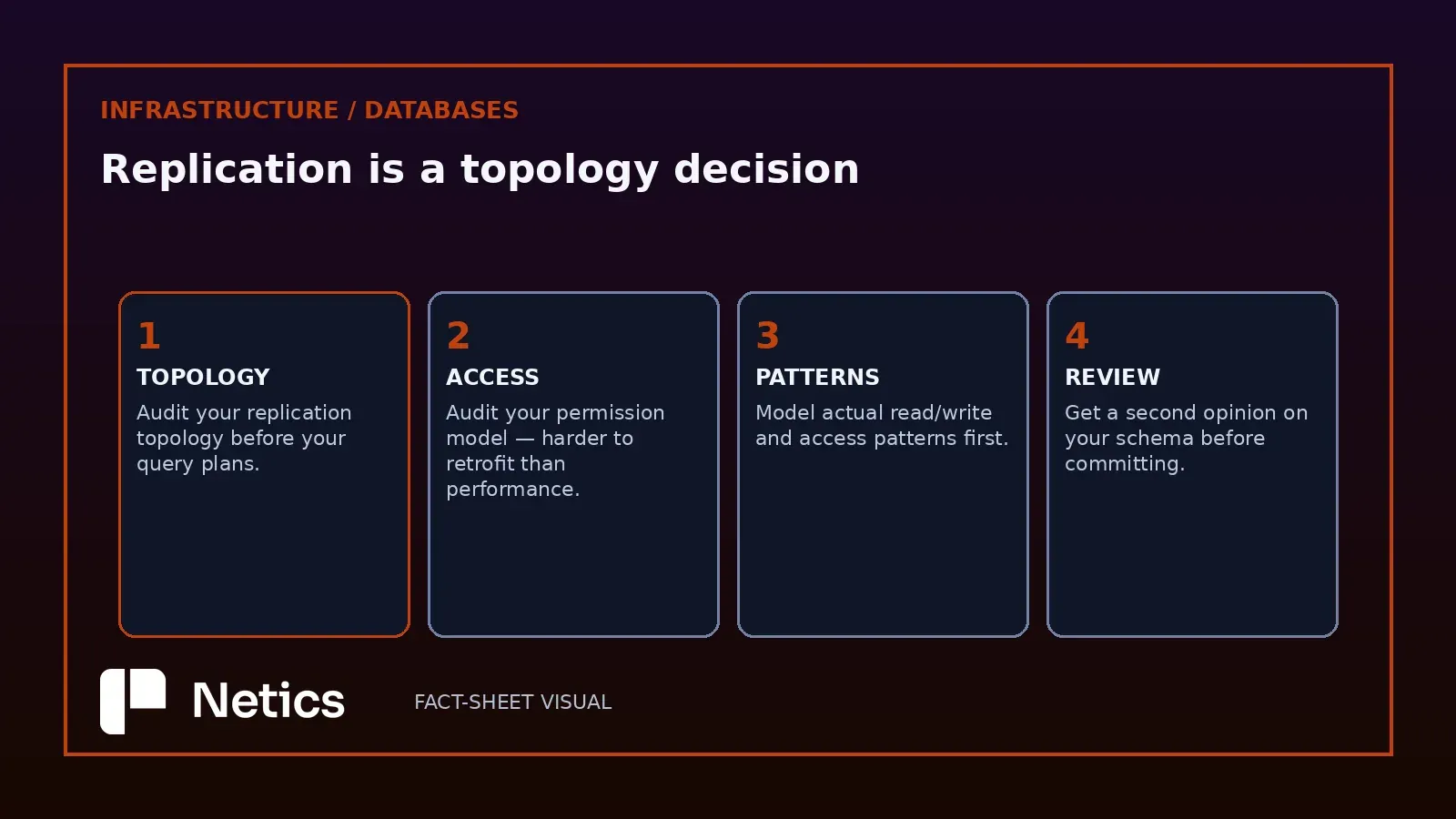
At Netics, we don't tell clients "always use Postgres" or "MySQL is legacy." We've shipped both, and the deciding factor is almost never raw speed — it's operational fit. Teams that need fine-grained, row-and-column-level replication control with strong transactional guarantees tend to gravitate toward PostgreSQL's logical replication model. Teams running WordPress-adjacent stacks, existing MySQL-fluent DBA teams, or workloads dominated by document-shaped JSON often do better sticking with MySQL rather than paying a migration tax for marginal gains. Our default advice: audit your replication topology and your permission model before you audit your query plans. Those two things are harder to retrofit than performance tuning.
PostgreSQL: Pros and Cons
Pros
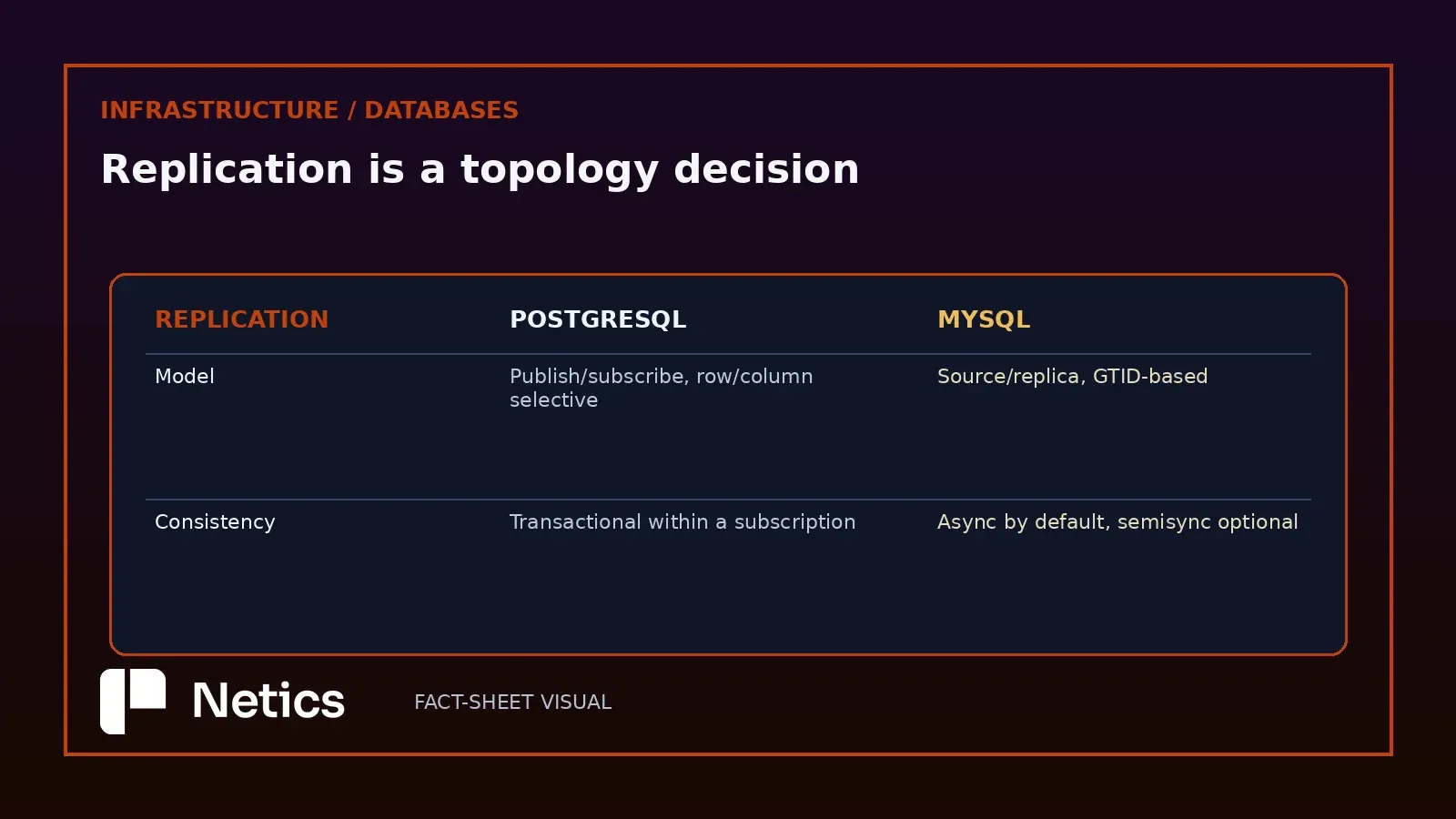
- Logical replication is built around a publish/subscribe model with initial snapshots followed by ongoing streamed changes, giving you row- and column-level selectivity within a subscription and clear transactional consistency boundaries, per the PostgreSQL logical replication documentation [1].
- Object ownership and privilege granularity —
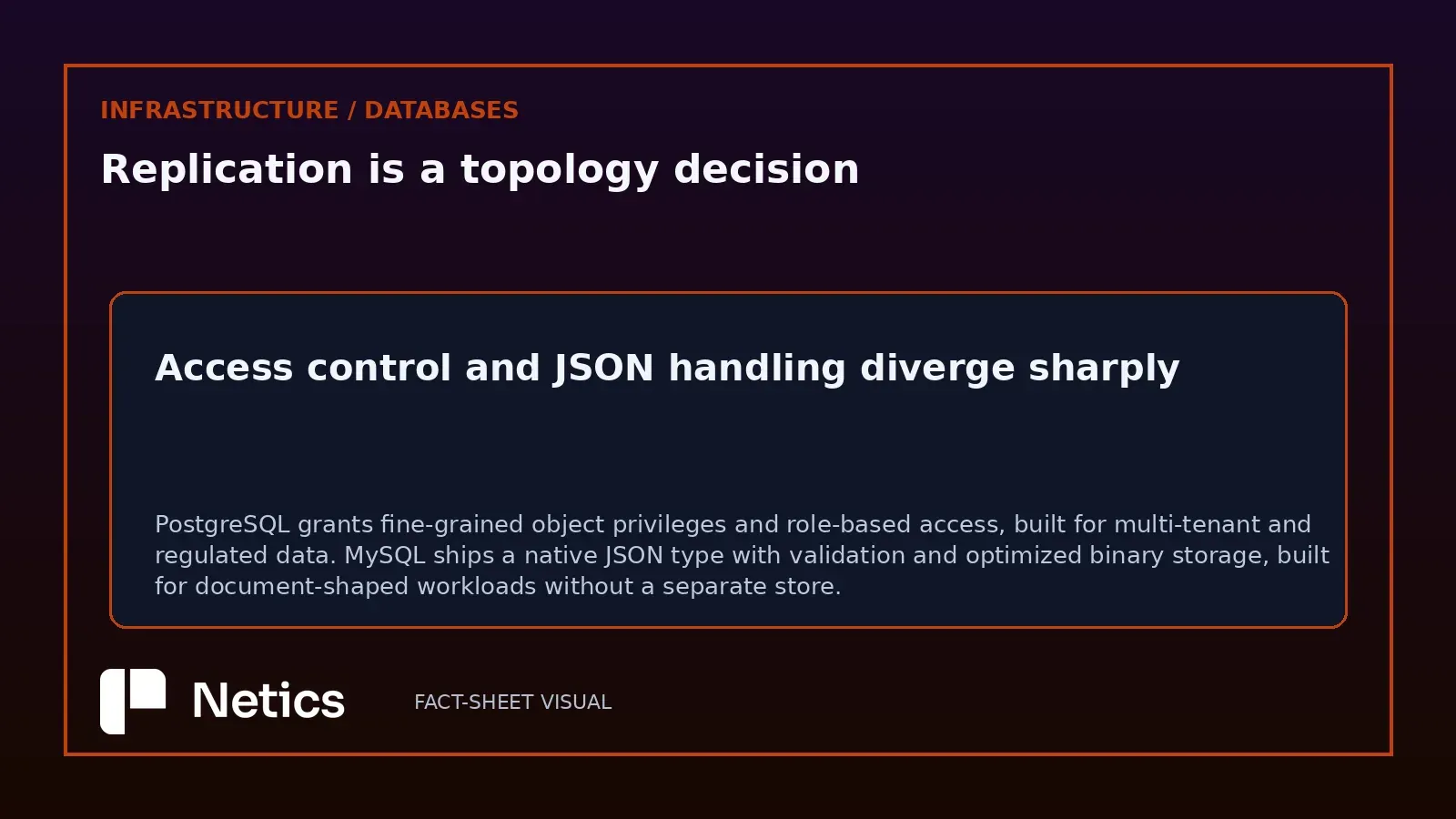
SELECT,INSERT,UPDATE,DELETE,CONNECT,CREATE, and role-based grants — are handled at a fine-grained level, as detailed in the PostgreSQL DDL privileges documentation [2]. This matters a lot for multi-tenant systems or regulated data. - Strong reputation for standards-compliant SQL and complex query support (window functions, CTEs, extensions like PostGIS).
Cons
- Logical replication has documented restrictions around what DDL and sequence data get replicated, and conflict resolution across subscriptions is something you must design for explicitly, not something that happens automatically.
- Historically weaker "it just works" JSON tooling compared to MySQL's native type, though PostgreSQL's JSONB is powerful once you learn its indexing patterns.
- Operationally heavier to tune for teams without prior Postgres experience — role/privilege design in particular has a learning curve.
MySQL: Pros and Cons
Pros
- Replication is asynchronous by default and supports replicating selected databases or tables, GTID-based coordination, and semisynchronous replication in source/replica topologies, per the MySQL 8.4 replication documentation [3].
- Native JSON type with document validation, optimized binary storage, dedicated JSON functions, and generated-column indexing patterns — see the MySQL 8.4 JSON documentation [4]. This is a genuinely smoother path for teams storing semi-structured payloads without wanting a separate document store.
- Broad familiarity across the hosting/CMS ecosystem, which lowers the bar for hiring and onboarding.
Cons
- Asynchronous replication by default means replicas can lag; achieving stronger consistency requires explicitly configuring semisynchronous replication and understanding its failover trade-offs.
- Selected database/table replication filters add operational complexity to reason about when debugging drift between source and replica.
- Permission model is less fine-grained at the object-ownership level compared to PostgreSQL's role system, which can matter for complex multi-tenant access patterns.
Decision Matrix
| Criterion | Favors PostgreSQL | Favors MySQL |
|---|---|---|
| Replication control granularity | Row/column selection within publish/subscribe | Database/table filtering with GTIDs |
| Consistency guarantees needed | Transactional consistency within a subscription | Semisynchronous mode available, async by default |
| Access-control complexity | Fine-grained ownership + role grants | Simpler, broader grants |
| Primary workload shape | Relational, complex joins, strict integrity | JSON-heavy, document-shaped, CMS-adjacent |
| Team's existing expertise | Postgres-fluent DBAs on staff | MySQL-fluent DBAs, WordPress/LAMP background |
| Migration risk tolerance | Willing to invest in schema/privilege redesign | Wants to preserve existing operational muscle memory |
This matrix is a starting conversation, not a scoring formula — weight the rows by what actually breaks your team's on-call sleep.
Hypothetical Example
Imagine a mid-sized SaaS company, "Fictional Ledger Co.," running a multi-tenant billing platform. Each tenant needs isolated read replicas in a different region for latency reasons, and finance requires that support engineers can SELECT on billing tables but never UPDATE or DELETE.
Under PostgreSQL, the team can define a subscription per region that replicates only the relevant tenant rows and columns, and grant support engineers a role with SELECT-only privileges scoped to specific tables — matching both the replication and access requirements natively, per the documented ownership/privilege model.
Under MySQL, the team would filter replication to the relevant databases/tables per region using the standard source/replica configuration, and rely on GRANT statements scoped to specific tables for the read-only support role. This works too — it just requires more manual discipline around keeping replication filters and grant statements in sync as new tenants are onboarded, since the object-level ownership model is less explicit than Postgres's.
Neither path is wrong. The Postgres path front-loads more schema/role design; the MySQL path front-loads less design but demands more ongoing operational vigilance as the system grows.
What We Actually Recommend
Don't start with "which database is faster." Start with two questions:
- What does your replication topology need to guarantee? If you need row/column-selective replication with clear transactional boundaries, read the PostgreSQL logical replication documentation [1] closely before deciding.
- How granular does your access control need to be, and how JSON-heavy is your workload? If your team already lives in MySQL and your data is mostly document-shaped, the MySQL JSON documentation [4] shows a viable path without a migration.
A migration between these engines is not a weekend project — schema semantics, replication topology, and privilege models all differ enough that a rushed move introduces more risk than the "better" engine's theoretical upside is worth. Model your actual read/write and access patterns first.
Talk to us if you want a second opinion on your schema before you commit — visit Netics.
Conclusion
Pour poursuivre la réflexion sur une décision d'architecture, consultez la page d'accueil de Netics ou réservez un échange avec Netics.