
OpenAI vs Anthropic for Production Workloads: A Netics Comparison
OpenAI vs Anthropic for production: compare documented models, limits, pricing, caching, and operational fit.

TL;DR
OpenAI and Anthropic offer different documented model lineups, limits, prices, caching and batch options, platforms, and tool support. There is no universal winner. The decision covers vendor claim model positioning, context window and output limits, pricing structure, prompt caching and batch processing, platform availability, tool support, neutral pros and cons, and the Netics decision framework.
Vendor claim: model positioning
OpenAI documents a three-tier flagship lineup under GPT-5.6: Sol ("frontier model for complex professional work," OpenAI's suggested default for complex reasoning and coding), Terra (balances intelligence and cost), and Luna (optimized for cost-sensitive, high-volume workloads). OpenAI states all latest models support text and image input, text output, multilingual capabilities, and vision, and are available via the Responses API. OpenAI also lists specialized models outside the general-purpose line: a cybersecurity model (GPT-5.6 Cyber) and "Daybreak" aliases for authorized security research/defense, an image generation model (GPT Image 2), and a set of realtime speech/transcription models.
Anthropic documents a four-model current lineup: Claude Fable 5 ("next-generation intelligence for long-running agents"), Claude Opus 5 (Anthropic's suggested starting point "for complex agentic coding and enterprise work"), Claude Sonnet 5 ("the best combination of speed and intelligence"), and Claude Haiku 4.5 ("the fastest model with near-frontier intelligence"). Anthropic states all current models support text and image input, text output, multilingual capabilities, vision, and tool use. A limited-availability model, Claude Mythos 5, appears in the pricing table but is gated behind a separate access page.
Both vendors document a "pick by tier" mental model — a flagship/frontier tier, a balanced tier, and a low-cost/high-throughput tier — but Anthropic additionally documents a fourth, slower/most-capable tier (Fable 5) sitting above its "recommended default" tier (Opus 5).
Context window and output limits
| OpenAI GPT-5.6 (Sol/Terra/Luna) | Anthropic Claude 5 family / Haiku 4.5 | |
|---|---|---|
| Context window | 1.05M tokens (documented for all three GPT-5.6 tiers) | 1M tokens (Fable 5, Opus 5, Sonnet 5); 200K tokens (Haiku 4.5) |
| Max output | 128K tokens (all three GPT-5.6 tiers) | 128K tokens (Fable 5, Opus 5, Sonnet 5); 64K tokens (Haiku 4.5) |
| Documented knowledge cutoff | Feb 16, 2026 (all three GPT-5.6 tiers, per model catalog) | Jan 2026 (Fable 5, Sonnet 5); May 2026 (Opus 5); Feb 2025 (Haiku 4.5) — Anthropic labels these "reliable knowledge cutoff" |
For workloads bound by document size or long conversational history, OpenAI's flagship tier and Anthropic's top three current models document effectively comparable context ceilings (~1M tokens) and identical max-output ceilings (128K tokens) at the tiers most likely to be used in production. Anthropic's cheapest/fastest model (Haiku 4.5) has a materially smaller context window (200K) and output ceiling (64K) than its own higher tiers, which is a tradeoff to model explicitly if a workload might later need to fall back to a cheaper Anthropic model under load.
Pricing structure
Base per-token pricing, as documented, is one input to the decision because sustained workloads amplify small unit-cost differences across many requests.
| Model | Input | Output |
|---|---|---|
| GPT-5.6 Sol | $5 / MTok | $30 / MTok |
| GPT-5.6 Terra | $2 / MTok | $12 / MTok |
| GPT-5.6 Luna | $0.20 / MTok | $1.20 / MTok |
| Claude Fable 5 | $10 / MTok | $50 / MTok |
| Claude Opus 5 | $5 / MTok | $25 / MTok |
| Claude Sonnet 5 | $2 / MTok | $10 / MTok |
| Claude Haiku 4.5 | $1 / MTok | $5 / MTok |
At comparable tiers, list pricing is close: OpenAI's mid-tier (Terra, $2/$12) and Anthropic's mid-tier (Sonnet 5, $2/$10) are nearly identical on input and close on output. Anthropic's top tier (Fable 5, $10/$50) is priced above OpenAI's top documented tier (Sol, $5/$30), but Fable 5 and OpenAI's Sol occupy different positioning statements ("next-generation intelligence for long-running agents" vs. "frontier model for complex professional work"), so the comparison is not necessarily like-for-like. Anthropic's documentation also notes that Claude 4.7 and later models (including the current lineup) use a newer tokenizer that produces "approximately 30% more tokens for the same text" than earlier Claude models — a factor to include when estimating real-world cost from list price alone. The OpenAI source material did not document an equivalent tokenizer-change note.
Anthropic additionally documents a data residency multiplier: pinning inference to the US via inference_geo: "us" applies a 1.1x multiplier on all token pricing categories for Claude 4.6+ models, on both the first-party API and Claude Platform on AWS (and the equivalent US Data Zone Standard option on Microsoft Foundry). The OpenAI source did not document an equivalent regional pricing multiplier.
Prompt caching and batch processing
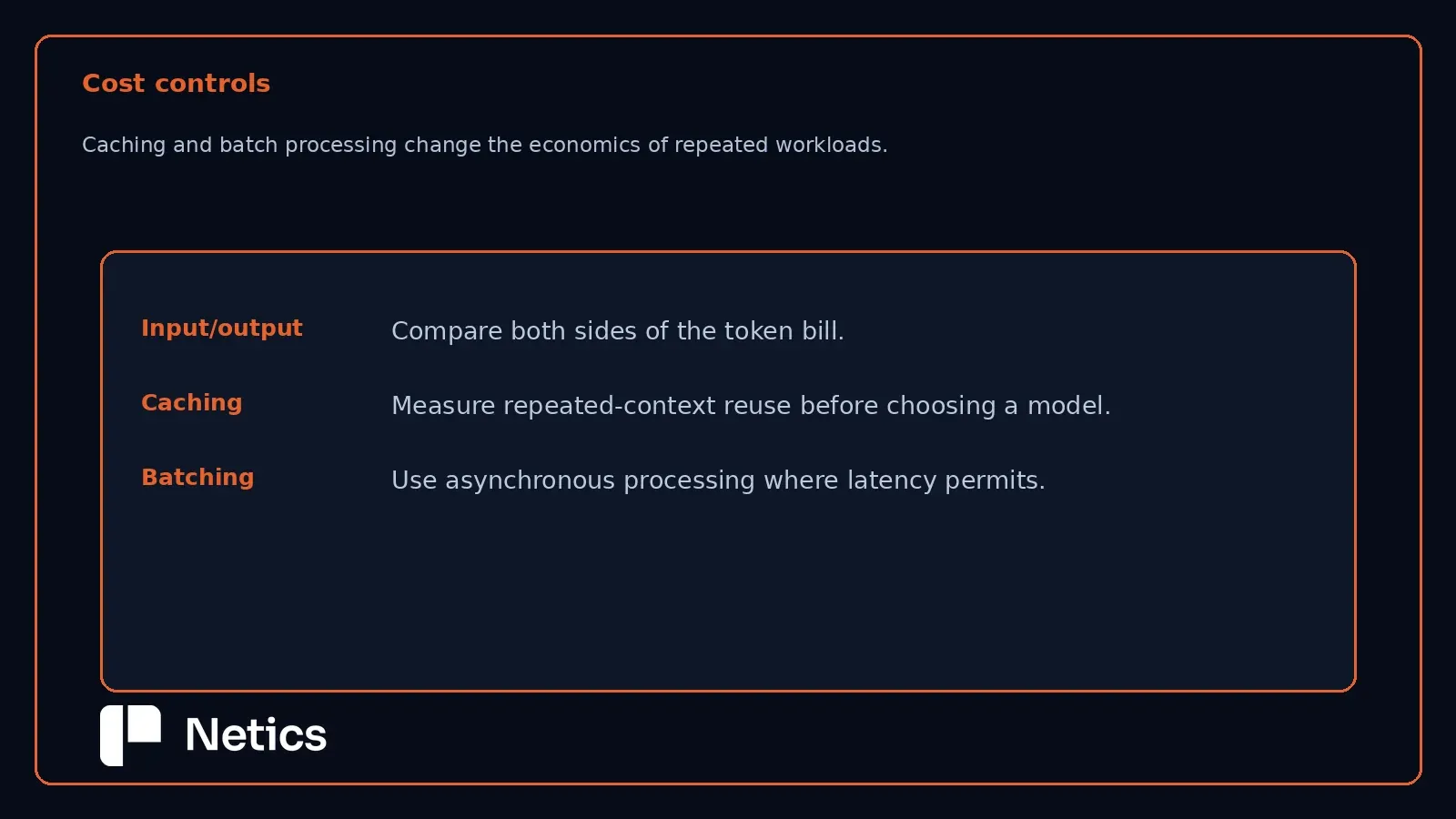
Anthropic documents prompt caching pricing multipliers relative to base input price: a 5-minute cache write costs 1.25x base input, a 1-hour cache write costs 2x base input, and a cache hit (read) costs 0.1x base input. Anthropic states these break even after one cache read (5-minute) or two cache reads (1-hour). Anthropic also documents a Batch API offering a 50% discount on both input and output tokens across its model lineup, and states that batch and caching discounts can be combined.
The OpenAI source material captured for this article (the Models catalog page) did not document prompt caching or batch pricing terms; it focused on model catalog listings, pricing per tier, and tool support. This is a gap in the source snapshot, not a claim that OpenAI lacks these features — buyers should verify OpenAI's current caching/batch terms directly before relying on this comparison for that decision.
Platform availability
Anthropic documents multi-cloud availability: the first-party Claude API, Claude Platform on AWS (billed via AWS Marketplace using Claude Consumption Units, billed hourly in arrears), Claude in Microsoft Foundry (billed via Azure Marketplace, same CCU model), Amazon Bedrock, and Google Cloud (Vertex AI) — each with documented pricing mechanics. Anthropic also documents "Claude Managed Agents," billed on both token usage and session runtime ($0.08 per session-hour while status is running).
The OpenAI source material documented access via the Responses API and OpenAI's Client SDKs, plus an API Dashboard, but did not include the multi-cloud marketplace detail present in the Anthropic pricing page. As with caching/batch, this reflects what was captured, not a confirmed absence on OpenAI's side.
Tool support (as documented)
OpenAI lists Functions, Web search, File search, and Computer use as supported tools for all three GPT-5.6 tiers in its model catalog. Anthropic's pricing documentation details per-tool token overhead for bash, text editor, computer use, browser use, web search ($10 per 1,000 searches, plus token costs), web fetch (no additional charge beyond token costs), and code execution (free when combined with web search or web fetch; otherwise billed by execution time). Anthropic's documentation is more granular on tool-cost mechanics in the sources reviewed, which may reflect the specific pages captured rather than a categorical capability difference.
Neutral pros and cons
OpenAI (as documented) The published model lineup is the relevant reference point for comparing capability tiers, context limits, and cost-sensitive deployment choices.
- Pros: A three-tier lineup with a wide price spread (Luna at $0.20/$1.20 down to Sol at $5/$30) documented for the same 1.05M-token context and 128K max output across all three tiers, simplifying tier-switching without a context/output tradeoff. Specialized models (image, realtime speech, cybersecurity) are documented under the same catalog.
- Cons: The captured source material did not document prompt caching, batch discounts, or multi-cloud marketplace availability — buyers need to check these separately before assuming parity with Anthropic.
Anthropic (as documented) The published model lineup is the relevant reference point for comparing capability tiers, context limits, caching, and batch-processing choices.
- Pros: Documented prompt caching (up to 90% discount on cache hits) and batch processing (50% discount) with source-cited multipliers; documented multi-cloud availability (AWS, Google Cloud, Microsoft Foundry) with explicit billing mechanics; per-tool token overhead is documented in detail.
- Cons: Its fastest/cheapest model (Haiku 4.5) has a smaller context window (200K vs. 1M+ on higher tiers) and output ceiling (64K vs. 128K), unlike OpenAI's tiers which share the same limits. The newer tokenizer used by Claude 4.7+ models produces roughly 30% more tokens for equivalent text, which affects real cost versus list price. Regional data residency carries a documented 1.1x multiplier.
Netics decision framework
- Start from workload cost sensitivity, not model reputation. If the workload is high-volume and latency-tolerant (e.g., large-scale document classification), compare Anthropic's Batch API (50% off) plus prompt caching against OpenAI's Luna tier pricing on a per-workload token estimate — list price alone will not predict real cost given Anthropic's tokenizer note.
- Check context/output ceilings against your data shape, tier by tier. If a workload might downgrade to a cheaper model under budget pressure, confirm the cheaper tier still meets context/output needs — this matters more for Anthropic (Haiku 4.5's lower ceilings) than for OpenAI (uniform ceilings across tiers, per the sources reviewed).
- Map required deployment surface before comparing price. If the organization already has committed spend or compliance requirements tied to AWS, Google Cloud, or Microsoft Azure, Anthropic's documented multi-cloud marketplace billing may simplify procurement; confirm OpenAI's current equivalent directly, since it was not present in the captured source.
- Model caching/batch savings explicitly, not as an afterthought. For workloads with repeated large system prompts or documents, Anthropic's documented cache-hit multiplier (0.1x base input) can materially change the economics versus uncached pricing — request the equivalent OpenAI caching terms in writing before comparing totals.
- Treat this comparison as a starting checklist, not a verdict. There is no universal winner in the source material — pricing, tiering, and caching mechanics change frequently, and vendor pages are dated snapshots (captured 2026-08-29). Re-verify current terms against live vendor documentation before a procurement decision.
Sources
- OpenAI — Models | OpenAI API
- Anthropic — Models overview - Claude Platform Docs
- Anthropic — Pricing - Claude Platform Docs
Netics publishes practical infrastructure comparisons at https://neticslabs.com.
For a context-specific architecture review, book a free 30-minute audit with Netics to discuss requirements, trade-offs, and implementation constraints.