
Skild AI S1 Turns a Robot Demonstration Into a New Task
Skild AI says S1 can execute unfamiliar robot tasks from one video without retraining. The real shift is faster adaptation, not autonomous production readiness.

TL;DR
Skild AI’s S1 robot foundation model is presented by NVIDIA as a system that can learn an unfamiliar, long-horizon task from a single video demonstration, without updating model weights or running task-specific post-training. NVIDIA says S1 can handle tasks lasting up to 10 minutes and involving dozens of manipulation steps; in one plant-potting test, the team moved from recording the demonstration to autonomous execution on hardware in 11 minutes. The reported 66% step-success rate versus 9% for a baseline is a vendor result, not a production guarantee. The important change for manufacturers is the interface: behavior can be specified by showing a job, but the factory still owns validation, recovery, safety and change control.
The programming interface is becoming a demonstration
Industrial robots have traditionally been excellent at repeating a known sequence and expensive to adapt when the sequence changes. A new product variant, tool, fixture or workstation can trigger a familiar chain of work: collect more examples, modify a policy, retrain or fine-tune, validate the result, and repeat the exercise on the target hardware. The model is not the only cost. The integration and acceptance process is the real schedule risk.
S1 takes a different route. An operator records the desired task and provides the video as a prompt. The model interprets the demonstrated intent, the objects involved and their sequence, then maps that understanding into actions for the robot in front of it. NVIDIA describes this as in-context learning: the model uses the supplied context to change its behavior for the current task without changing its weights.
The distinction is more than terminology. Weight updates make a capability part of the model’s learned parameters. In-context learning leaves the base model unchanged and supplies the task at runtime. For a manufacturer, that can turn adaptation from a model-development project into an operational procedure. It does not make the procedure trivial. It changes which team performs the first translation from human knowledge to robot behavior.
The operator’s video becomes a form of task specification. That is powerful because people often explain physical work more naturally by showing it than by writing a complete program. It is also ambiguous. A demonstration contains timing, camera perspective, object appearance, hand motion and incidental actions. A reliable system must infer which details express intent and which are irrelevant to the job.
This is the same reason a working AI model is not production-ready because the model works. Capability is the beginning of an operating decision, not its conclusion.
Long-horizon manipulation is the meaningful test
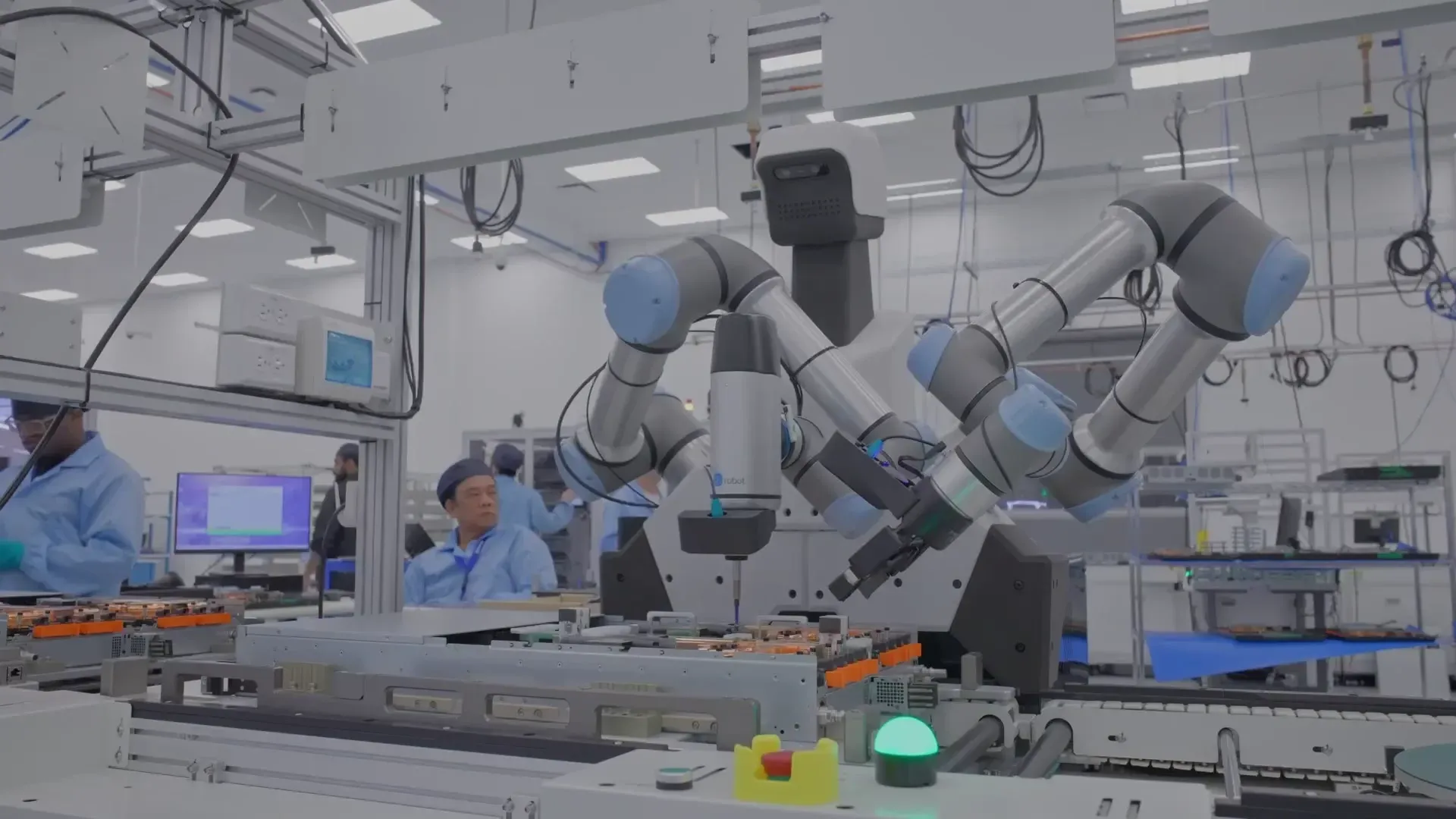
Copying one grasp is not the hard part of factory adaptation. The harder problem is maintaining the correct state across a sequence: identify the object, move it, use a tool, notice a change, recover from an error and continue without losing the objective. S1 is aimed at that longer horizon.
NVIDIA says the model can perform unfamiliar tasks lasting up to 10 minutes, including plant potting, pancake making, pour-over coffee brewing and kit assembly. These examples matter because each task can involve dozens of manipulation steps. The robot has to compose skills in sequences it has not previously performed rather than replaying one memorized trajectory.
The plant-potting demonstration is the clearest operational illustration. Skild’s team reportedly went from recording the demonstration to autonomous execution on hardware in 11 minutes. That is a compelling adaptation-time result: a human can provide a new behavior and see it transferred to a physical machine within the same work session.
The vendor also reports 66% step success compared with 9% for a baseline, and says the result is roughly equivalent to 380 hands-on examples. These figures should be read as evidence that the approach can improve adaptation under the tested conditions. They should not be read as a claim that a robot will complete 66% of any factory job safely. “Step success” is not the same as cycle-time compliance, product quality, damage rate, worker safety or uninterrupted line operation.
For a production manager, the useful question is therefore not whether S1 has learned the task in the abstract. It is whether the system can expose each step, detect uncertainty and hand control back to a human before an ambiguous action becomes a damaged part or a dangerous motion.
NVIDIA’s stack supplies the experience loop
The announcement is not only about a model. Skild built and researched S1 on NVIDIA AI infrastructure, with the collaboration spanning synthetic data generation, model training, simulation and physical deployment.
NVIDIA Cosmos and Cosmos Curator are positioned in the data and world-model side of the stack. Isaac Lab provides a simulation environment for robotics learning. Newton contributes physics simulation. Nsight supports profiling and performance analysis, while TensorRT addresses deployment inference. Taken together, these tools create a pipeline in which robot experience can be generated, curated, simulated, trained and then served on hardware.
The infrastructure loop is the less visible half of demonstration-driven robotics. A single video can specify a new task at runtime, but the model still needs broad prior experience to understand objects, contact, motion and recovery. Synthetic data and simulation help produce that experience at a scale that physical collection alone cannot match. Simulation-to-reality is consequently not a side feature. It is the bridge between a model that recognizes a demonstrated intention and a controller that can act under real friction, lighting, calibration error and object variation.
The bridge remains imperfect. Simulation can approximate contact dynamics without capturing every deformable package, worn gripper, reflective surface or human interruption on a live line. A policy that succeeds in simulation may fail when a part is slightly displaced or a tool has accumulated wear. The advantage of an in-context system is that it may adapt its task behavior quickly; the disadvantage is that fast adaptation can also produce fast, poorly understood failure.
For that reason, infrastructure visibility matters. Manufacturers evaluating this kind of system should ask where demonstrations are stored, how synthetic data is selected, which simulator version produced a policy, what runtime observes, and how a failed episode is reproduced. The physical robot is only the endpoint of a much larger evidence chain.
From a prompt to a controlled production cell
Demonstration-based behavior can reduce the friction of introducing a new product or low-volume variant. A technician could show a revised assembly sequence instead of waiting for a specialist to re-author every motion program. A warehouse could adapt to a changed package presentation. An inspection cell could receive a new handling procedure without changing the foundation model.
This is especially attractive where the work is variable but structured. High-mix manufacturing, kitting, inspection and assisted food preparation all contain tasks that are too fluid for a rigid script but too repetitive to justify full manual handling. A demonstration is a practical way to capture local knowledge that otherwise remains in the operator’s hands.
The operating model should still separate three actions: propose, validate and execute. The video proposes behavior. A test cell validates it against known objects, forbidden zones, force limits and quality criteria. Only then should the behavior be admitted to production, with a versioned demonstration, approved robot configuration and rollback path.
Do not let the convenience of a video erase the control plane. Access to a new demonstration should be restricted. The operator who can teach the robot should not automatically be able to approve its production release. Every execution should retain the task prompt, model version, robot embodiment, environment assumptions, intervention events and result. Without that record, a later failure will look like a mysterious model mistake instead of a change-control failure.
A manufacturer should also define what happens when the robot does not understand the demonstration. Safe behavior may mean stopping, slowing down, asking for a second example or switching to a known fallback. “Recover from errors” is useful only when recovery is bounded. An unreviewed improvisation around a jammed fixture is not resilience; it is an unowned safety decision.
The production boundary is still human and physical
NVIDIA and Skild say they are working with Foxconn on assembly deployment, which gives the announcement a credible path toward industrial use. It does not establish that S1 is a general-purpose factory worker or that the reported demonstrations cover every assembly condition.
Production acceptance has requirements the launch metrics do not answer. What is the safe stopping distance? How are humans detected? Which forces and speeds are allowed? How are incorrect placements measured? What is the maximum retry count? Can a supervisor inspect and approve the exact behavior before release? How quickly can the cell return to a previous policy? What happens when a camera, gripper or network connection degrades?
Long-horizon tasks multiply these questions because a small early error can change the state of every later step. The system may still complete the sequence while producing a hidden quality defect. A factory therefore needs step-level observability, not only a final success label. It needs tests for object variation, deliberate perturbations and failed demonstrations. It needs a human escalation path that is part of the normal design, not an emergency patch.
The strongest interpretation of S1 is therefore narrower and more useful than the headline promise. Demonstration-based in-context learning may lower the cost of teaching a robot a new behavior and make adaptation more accessible to plant teams. NVIDIA’s simulation and deployment stack may improve the experience and tooling required to make that behavior transferable. Neither development removes the physical world’s uncertainty.
For manufacturers, the next decision is not whether to replace programming with video. It is whether a demonstration can become a governed, testable and reversible production change. That is the threshold at which robot foundation models stop being impressive demos and start becoming infrastructure. Teams assessing that boundary can use the Netics homepage as a starting point for an architecture conversation.
Sources
- Skild AI Taps NVIDIA Physical AI to Teach Robots New Tasks From a Single Video — NVIDIA Blog, 10 September 2026.
- Introducing S1: In-Context Learning for Robotics — Skild AI, primary technical source.
Source: Skild AI Taps NVIDIA Physical AI to Teach Robots New Tasks From a Single Video — NVIDIA Blog, 10 September 2026.