
N-able Took Hosted N-central Offline After a 33-Issue Disclosure
"N-able pulled hosted N-central environments offline on 9 November 2026 after a disclosure named Able2Shell covered 33 issues with public exploit code, then shipped Hotfix 2 covering seven C

TL;DR
- N-central is a remote monitoring and management platform that service providers and internal IT teams use to administer endpoints, push patches and run scripts from one console.
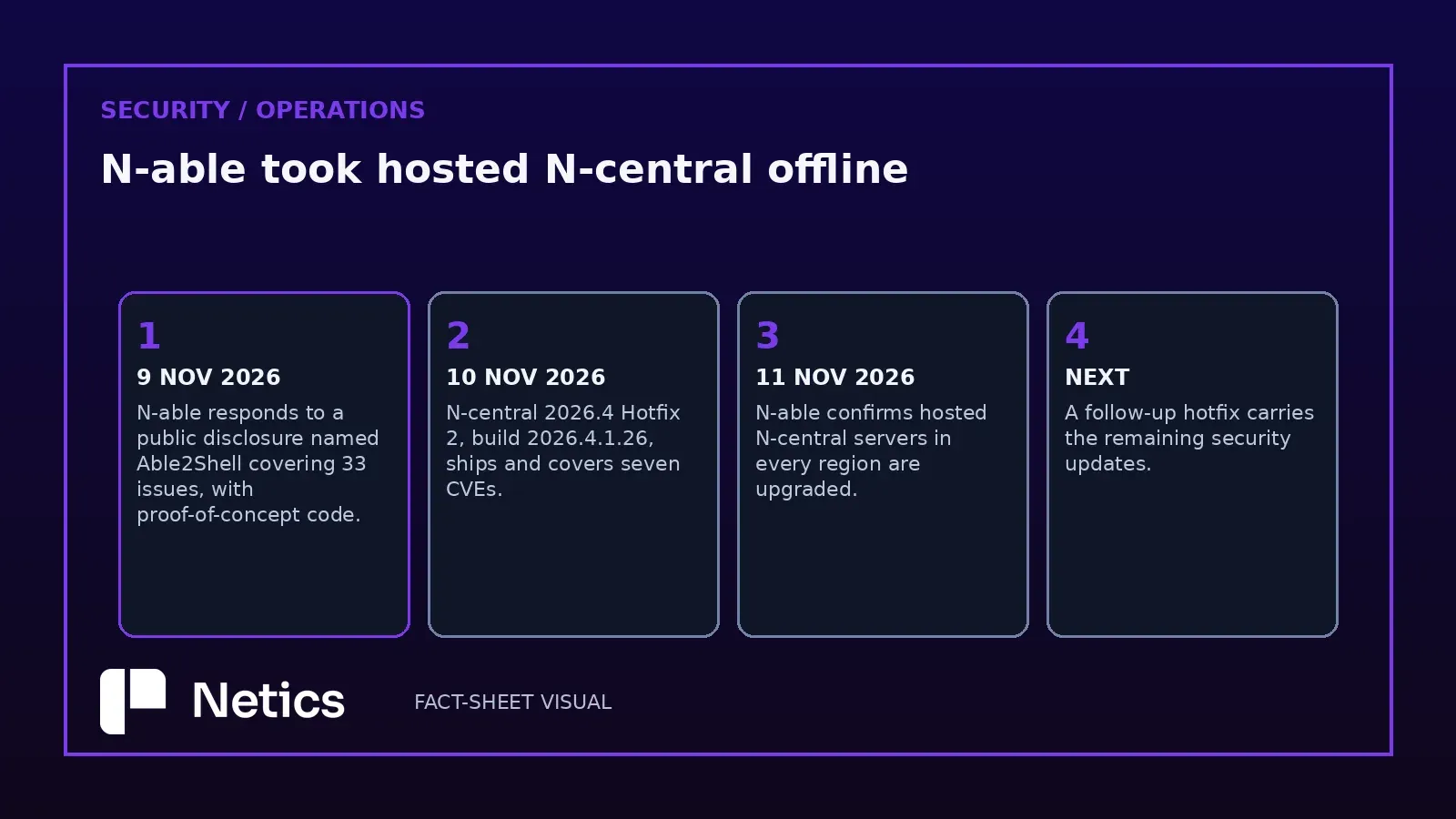
- N-able took its hosted N-central environments offline on 9 November 2026 after an independent researcher published a disclosure named Able2Shell covering 33 issues, with proof-of-concept code.
- The disclosed issues include unauthenticated remote code execution, privilege escalation to root, credential disclosure and unauthorized account creation.
- One unauthenticated chain combines XML external entity handling with session handling to execute code as the nable service account, and other chains need an administrator to view malicious patch metadata or need ProductAdmin credentials.
- N-able's Hotfix 2 release notes, published on 10 November, identify build 2026.4.1.26 and list seven CVEs fixed by the hotfix.
- N-able reported scanning activity tied to the published code before the fix existed and said it found no evidence that a customer environment had been exploited.
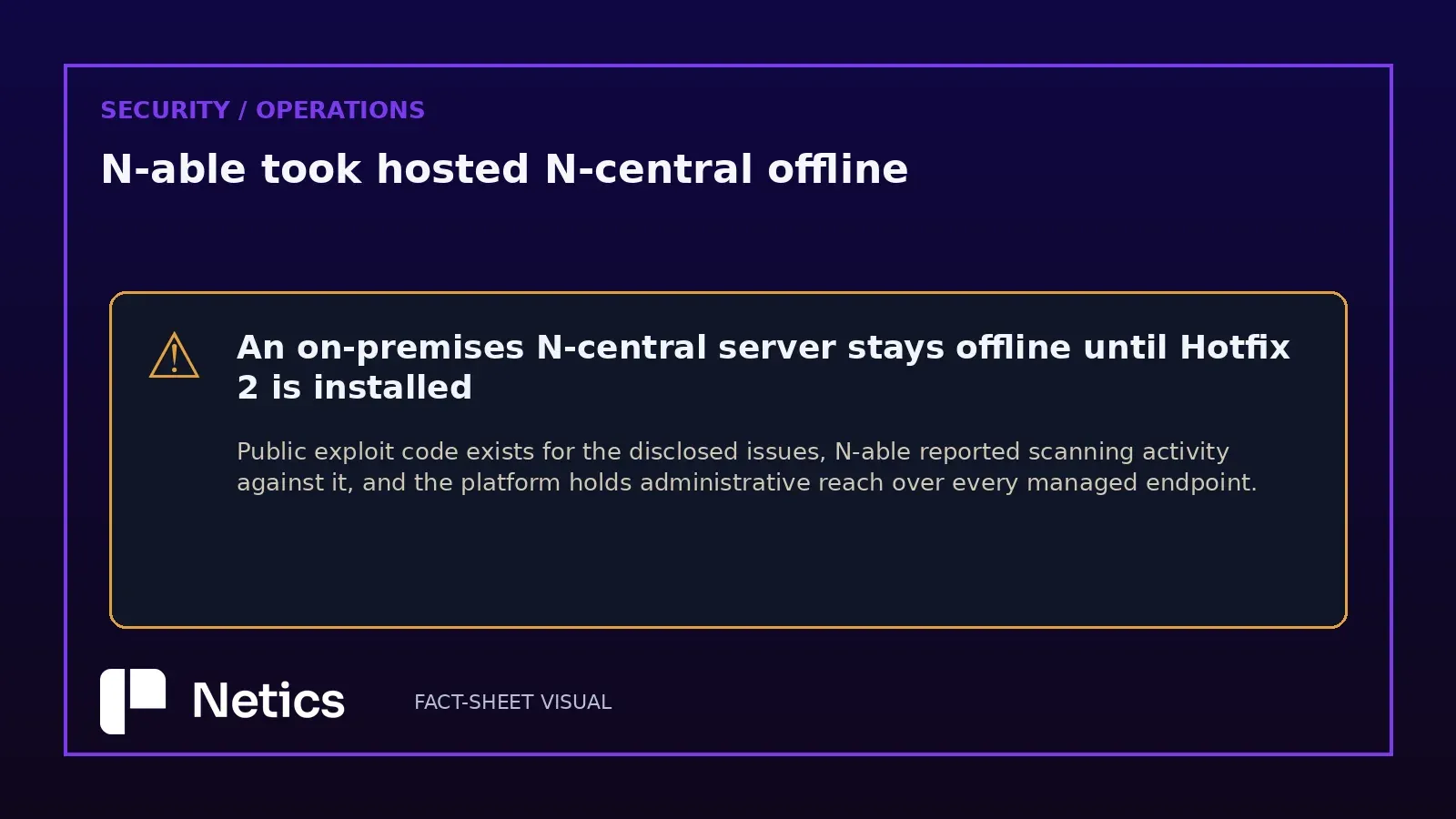
- N-able's Hotfix 2 release notes direct customers to upgrade Agents before Probes to preserve communication, and Rapid7 says an on-premises server stays offline until the hotfix is installed.
- The customers behind the console inherit the exposure, because an RMM server holds administrative reach over every endpoint it manages.
N-central is the console that reaches every managed endpoint
An RMM platform is the one system in a service provider's stack that already holds credentials and remote-control paths to every machine it manages. That is the product working as designed, and it is also the reason a flaw in the console is worth more to an attacker than a flaw on any single endpoint.
Rapid7 puts the consequence plainly: compromise of an RMM server can put downstream managed environments at risk. The same post notes that N-central was targeted earlier in 2026 through a separate authentication bypass, which tells an operator this platform has been on somebody's list for months.
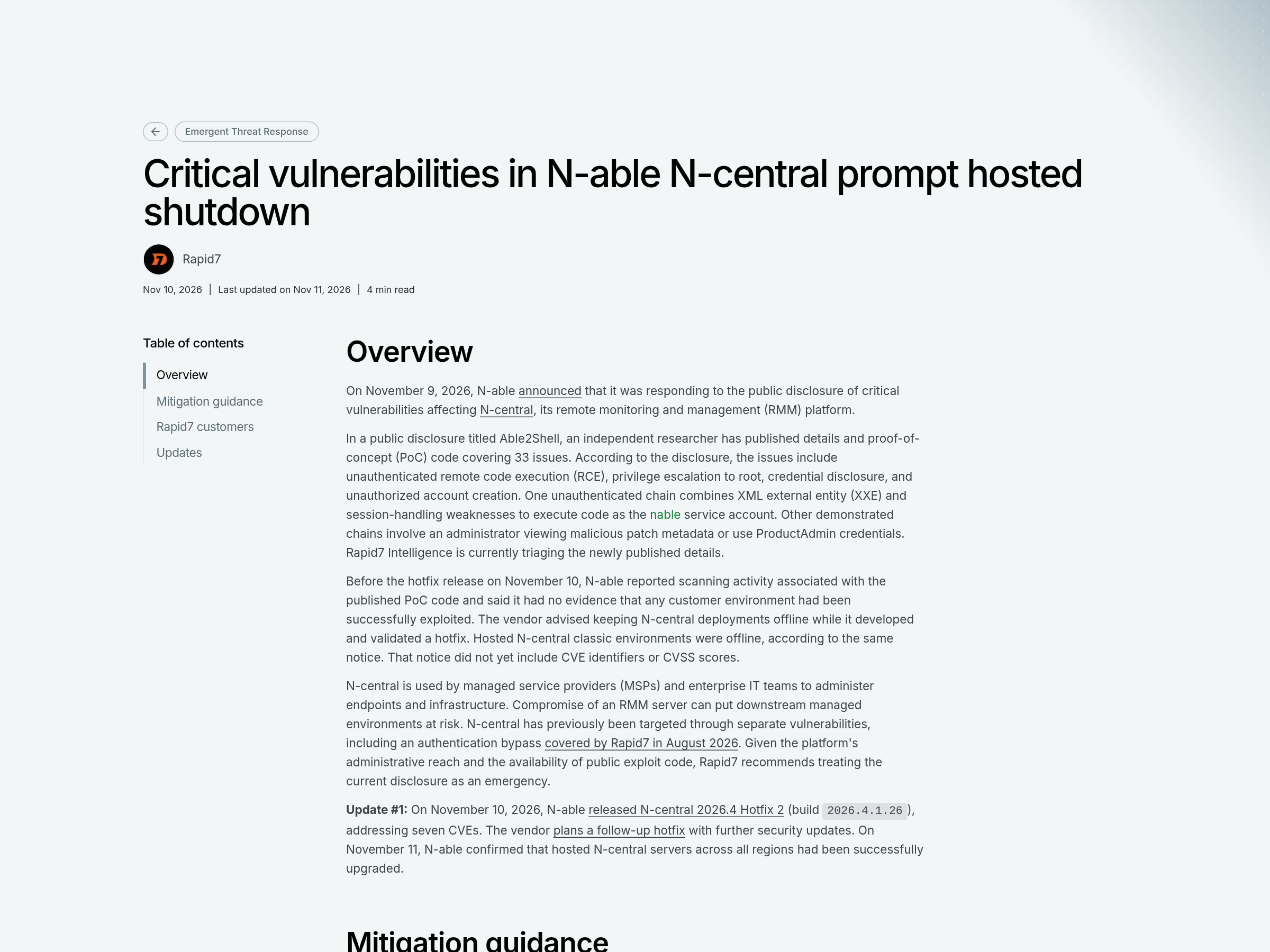
N-able's response followed the shape of a severe disclosure. Hosted N-central classic environments went offline, the vendor advised on-premises customers to keep deployments offline while it built and validated a fix, and no CVE identifiers or scores existed in the first notice.
Thirty-three issues arrived with public exploit code
The disclosure is credited to an independent researcher and carries 33 issues, with working proof-of-concept code published alongside. Rapid7 lists the classes: unauthenticated remote code execution, privilege escalation to root, credential disclosure and unauthorized account creation.
Two chains deserve attention because they read like ordinary administrator behaviour. One needs an administrator to open malicious patch metadata, which means the console's own patch view becomes the delivery path. Another works with ProductAdmin credentials, a platform-management role with a narrower privilege set than a full administrator.
The scariest is the unauthenticated one: XML external entity handling combined with session handling, ending in code execution as the nable service account. That account is the service identity the platform runs under, so code running as nable reads the same configuration the console reads.
Hotfix 2 covers seven CVEs
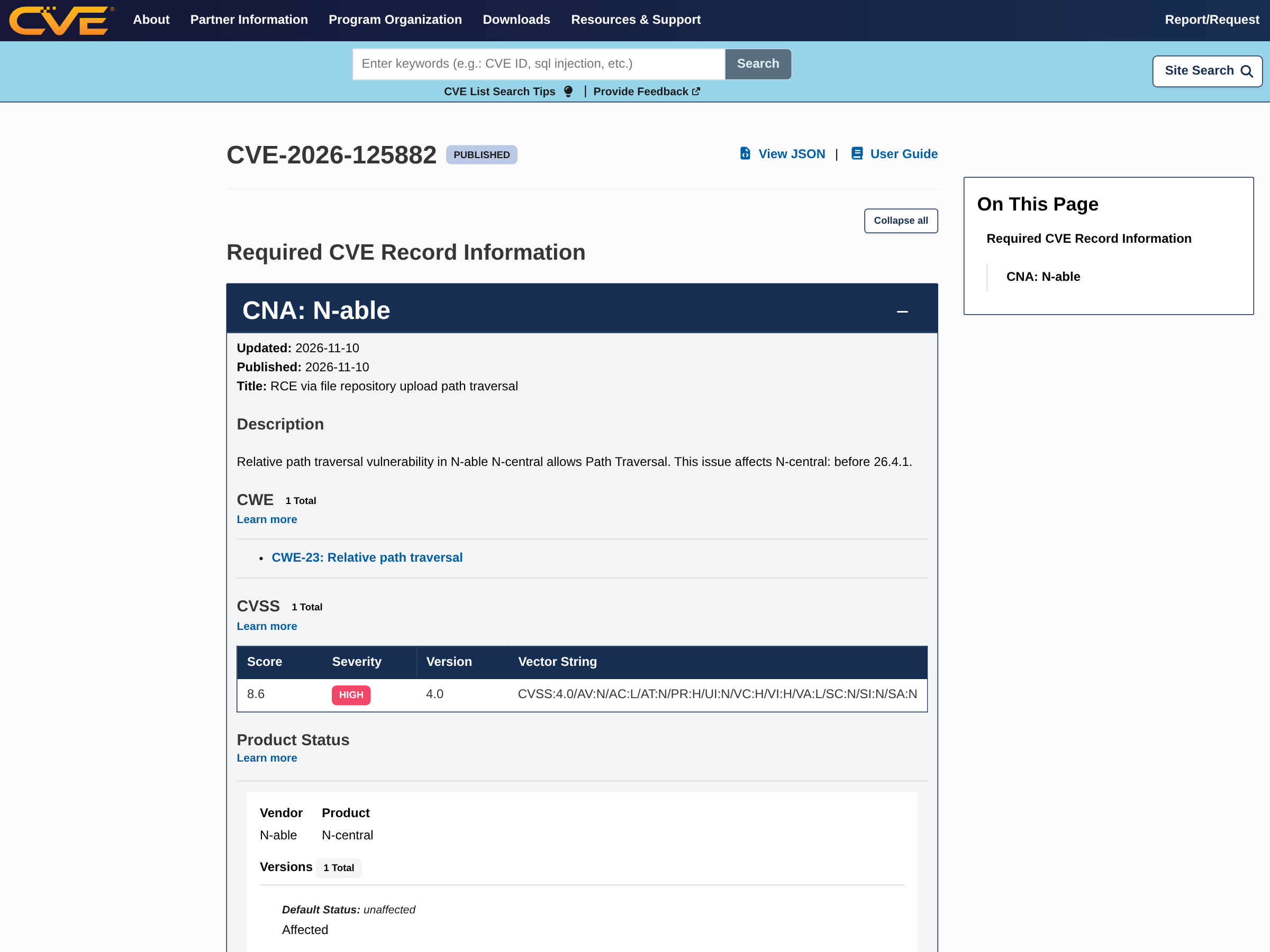
N-able's Hotfix 2 release notes, published on 10 November, identify build 2026.4.1.26 and list seven CVEs fixed by the hotfix. Seven identifiers against 33 disclosed issues is the arithmetic that matters here: the fix list is a partial map.
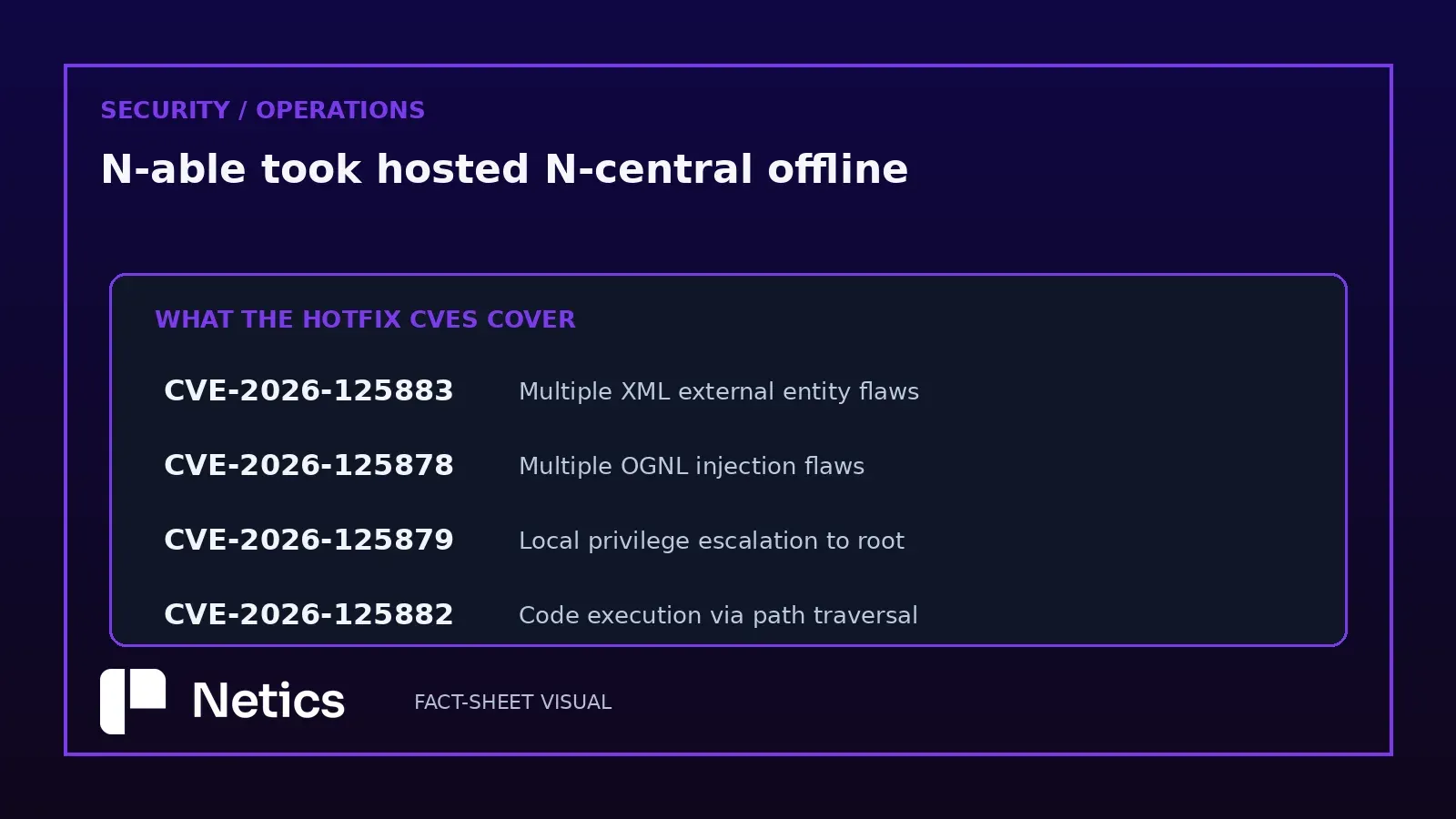
Read the seven as a spread of attack surfaces. XML external entity flaws, OGNL injection, local privilege escalation to root through a world-writable syslog-ng configuration, stored cross-site scripting through patch metadata, server-side request forgery through service-import schema validation, and the path traversal in the file repository upload.
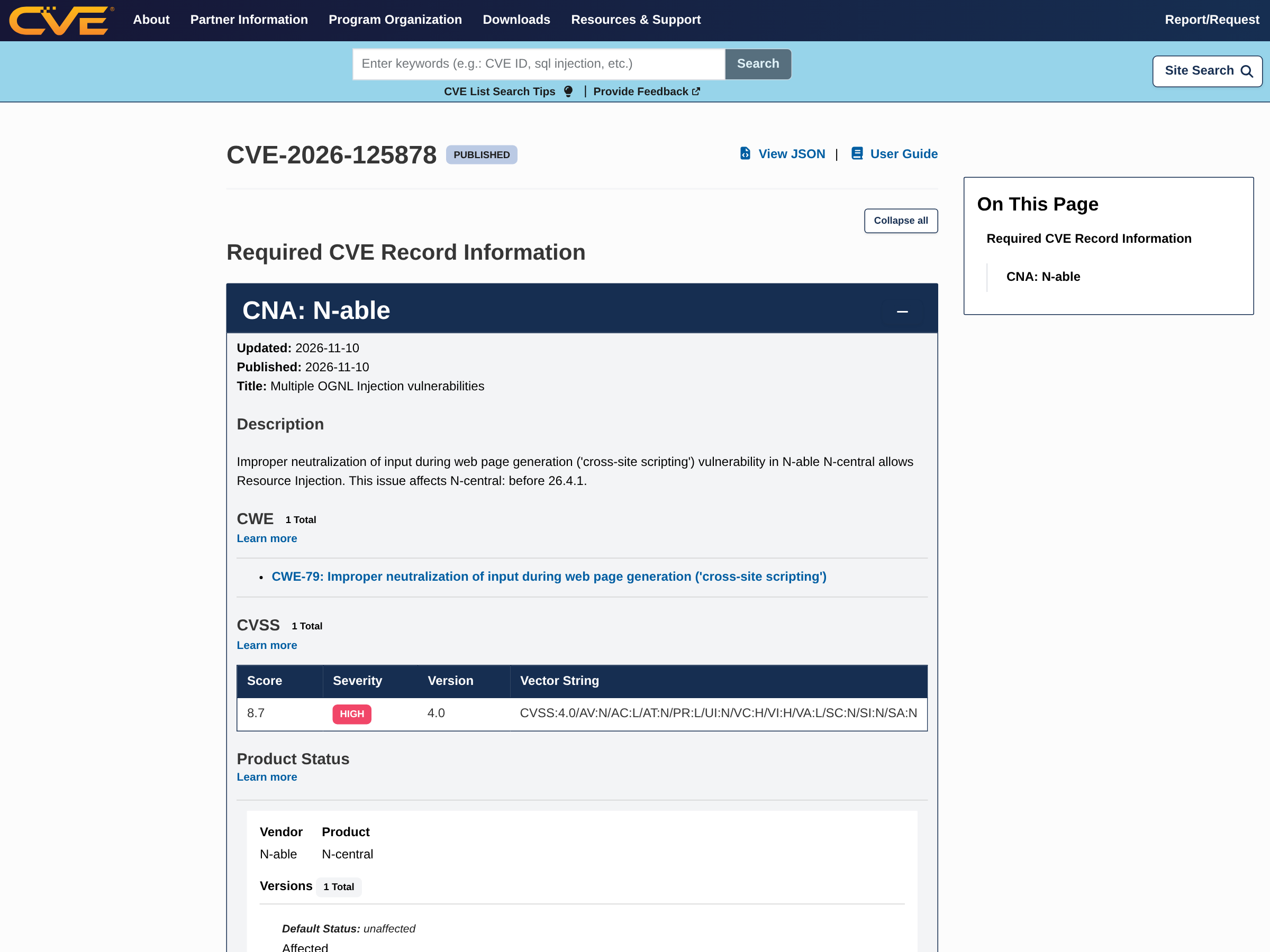
One record carries a detail worth flagging for anyone doing their own triage. CVE-2026-125878 has the title OGNL injection and a weakness entry for cross-site scripting, an inconsistency between its title and CWE field. Read the release notes text and the vendor advisory when the fields disagree, because a filter keyed on CWE-79 would treat that entry as a client-side problem.
Agents upgrade before Probes as servers return online
The upgrade order is the part that costs a night. N-able's Hotfix 2 release notes give the compatibility order: upgrade the Agents first, then the Probes, so that communication survives the transition. A provider who upgrades the server and stops there still runs old agents across every customer site.
N-able upgrades hosted servers, while customers in both hosted and on-premises environments must upgrade their Agents and Probes. On-premises customers must also upgrade their own servers within a maintenance window backed by a rollback plan.
The affected range needs care too. CVE records list N-central before 26.4.1, and Rapid7 notes that the researcher tested appliance build 2026.4.0.31 while the vendor notice did not state a full affected range. An environment on an older branch has to assume it is in scope.
The customers behind the console inherit the exposure
Every N-central deployment sits in front of somebody else's business. When the console is offline, the provider loses its remote hands on hundreds of machines at the moment it needs them, which is why the vendor-hosted shutdown is a real operational event for end customers who never heard of the vulnerability.
Two conclusions follow for a provider. The first is that the RMM console belongs at the top of the patch order permanently, ahead of the servers it manages, because its compromise is the compromise of everything downstream. The second is that the same control depends on infrastructure monitoring with plain-language alerts.
Rapid7 recommends treating the disclosure as an emergency, upgrading on-premises servers outside normal cycles and leaving them offline until the upgrade lands. That guidance is the vendor's own assessment of how much of the disclosure is public. With seven identifiers fixed against 33 disclosed issues, the server, Agent and Probe upgrades belong in the same maintenance plan.
Sources
- Critical vulnerabilities in N-able N-central prompt hosted shutdown, Rapid7 Emergent Threat Response, 10 November 2026
- CVE-2026-125882, RCE via file repository upload path traversal, CVE Program
- N-central 2026.4 HF2 Release Notes and Agent, Probe and PME guidance, N-able Status, 10 November 2026
- CVE-2026-125878, multiple OGNL injection vulnerabilities, CVE Program
Source: Rapid7's Emergent Threat Response post and the CVE Program records for CVE-2026-125882, CVE-2026-125883 and CVE-2026-125878, all fetched on 11 November 2026. Together, those pages carry the 33-issue count, the disclosure and hotfix dates, the seven CVEs fixed by Hotfix 2, the affected range and the Agent-before-Probe upgrade order.