
ISOC Is Microsoft's Answer to Agent-Speed Attacks. The Loop Still Needs Human Judgment
Microsoft merges SIEM and threat protection into one integrated SOC loop. Storm-3168 shows why the convergence is necessary — and why least privilege inside the loop decides if it works.

TL;DR
- On September 23, 2026, Microsoft announced the integrated security operations center (ISOC) in Microsoft Defender, bringing SIEM and threat protection together on one foundation.
- The argument is architectural: security cannot operate at AI speed when protection and operations are separate systems; every handoff and integration boundary slows defenders down, and agents inherit that complexity.
- Two days later, Microsoft published Storm-3168: an agentic-driven cloud attack where compromised service principals ran 150+ destructive or credential-collection operations in 35 minutes, including 100+ storage-account deletion attempts in about seven minutes.
- ISOC is the right direction, but the loop only holds if identity and least privilege inside it are enforced; Storm-3168 succeeded precisely because a compromised identity already carried broad Contributor roles.
- The banner on Microsoft's own stack diagram is the honest promise: "Strategy stays human. Scale becomes autonomous." Audit the strategy-stays-human part before you buy the scale.
The convergence that makes agentic defense possible
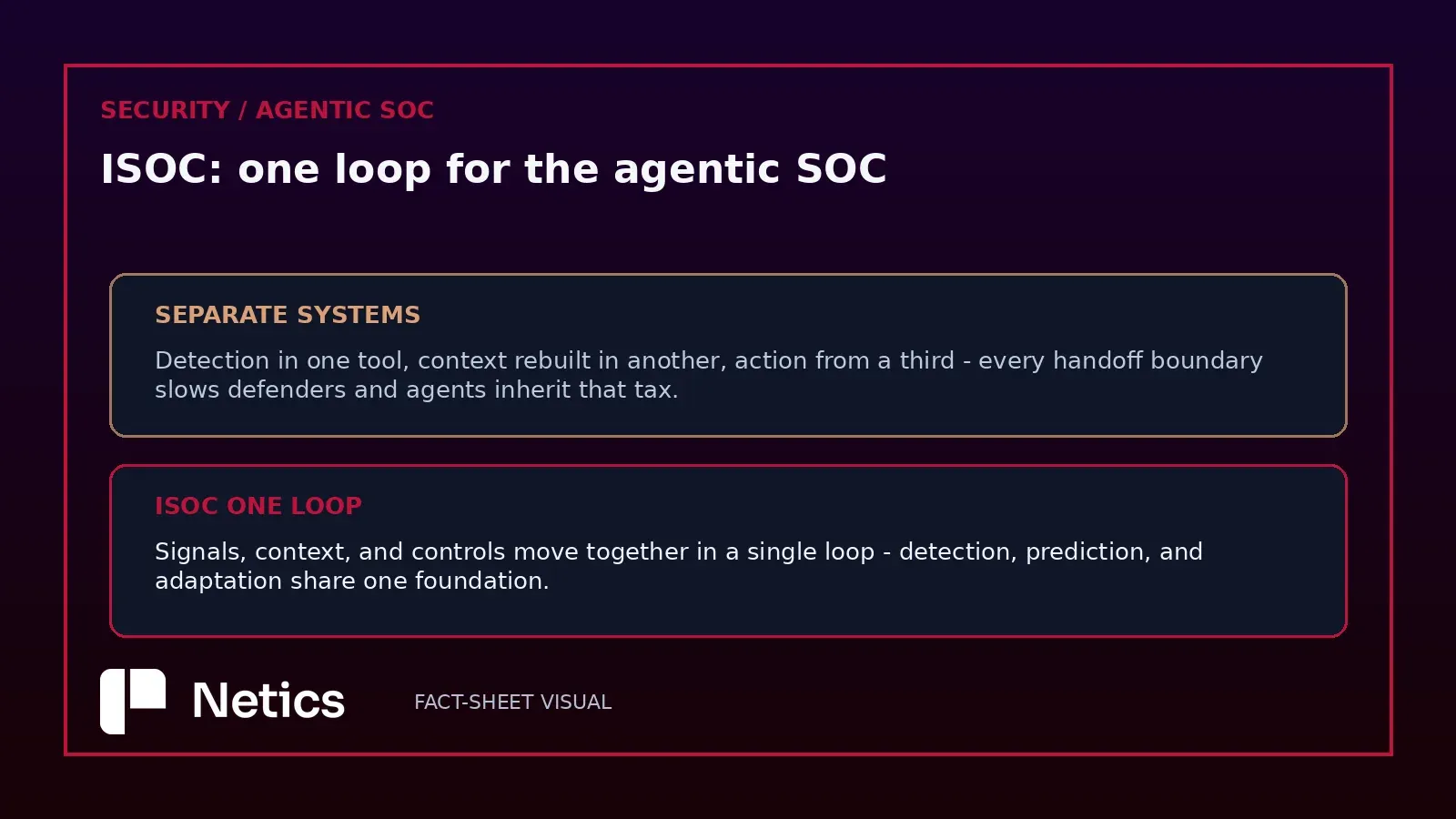
Microsoft's September 23 announcement reads like a small essay on why security operations broke, then a product answer. The diagnosis: "security cannot operate at AI speed when protection and operations are built as separate systems. Every handoff, integration, and boundary slows defenders down. Agents inherit that complexity." That sentence matters more than any feature list. When a SOC analyst has to stitch together signals from one tool, rebuild context in another, and act from a third, an agent running inside that workflow inherits every seam. The ISOC answer is to collapse SIEM and threat protection into one foundation that people and agents share, so "see, understand, and act" stop being three products.
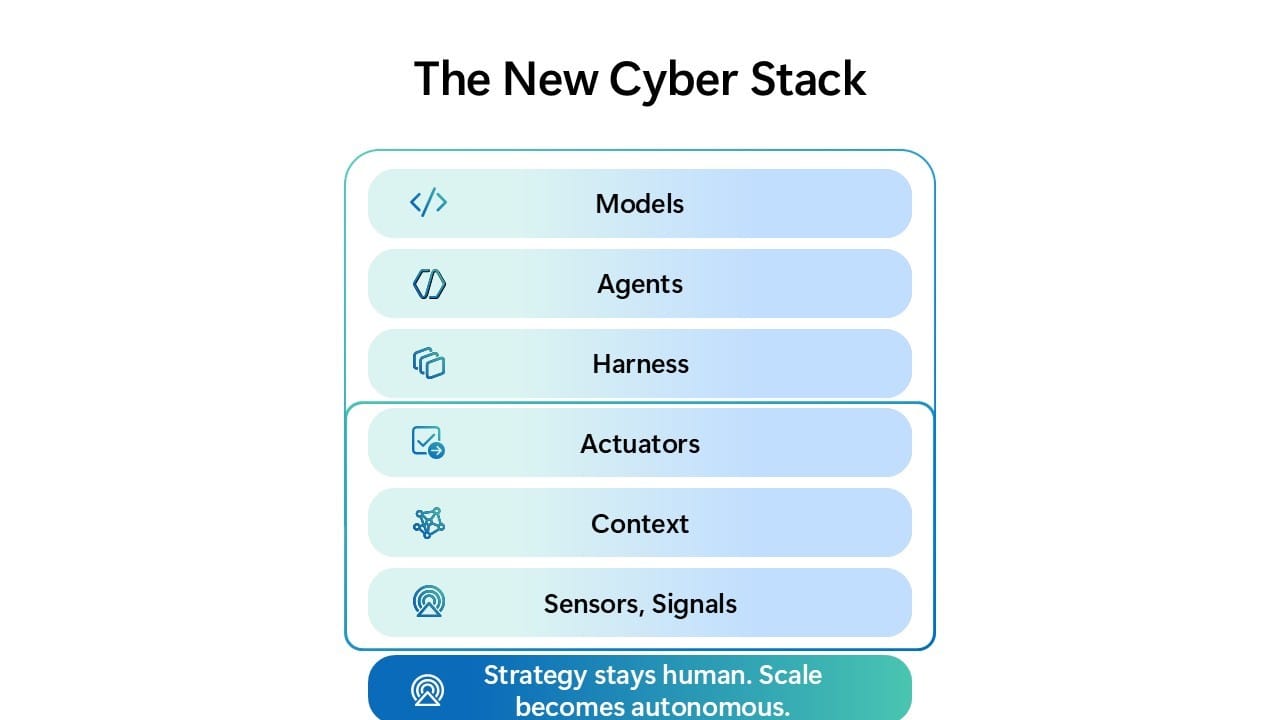
The stack itself is a statement about where intelligence lives. Signals and sensors give the system awareness; context turns signals into understanding; actuators turn insights into protective action. Between them sit models, a harness, and specialized agents. Microsoft introduced this end-to-end cyber stack alongside Project Perception in July 2026, and ISOC is what happens when the whole stack is allowed to work as one system instead of being assembled by the customer.
The attacker case that makes the loop necessary
Two days after the ISOC post, Microsoft Security Research published Storm-3168, threat-actor activity it describes as "the first documented agentic ransomware operation" (originally surfaced by Sysdig in July 2026). The detail that should change how you read the ISOC announcement is not the malware — it is the orchestration. Microsoft observed two compromised service principals in the same tenant: one performed reconnaissance, the other performed discovery, destruction, and credential collection. The destructive sequence "lasted for about 7 minutes. This involved 100+ storage account deletion attempts." In total the actor "attempted 150+ destructive or credential collection related operations in 35 minutes," which is automation, not a person clicking.
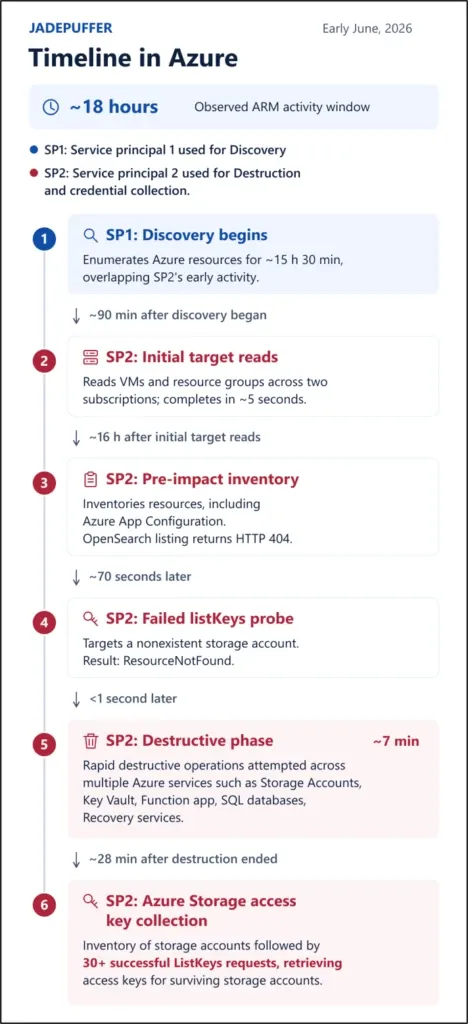
The uncomfortable part is that nothing in Storm-3168 required a novel exploit. The operations "followed the identity's existing Azure role assignments": a group-granted Storage Account Contributor role authorized the destructive storage work; direct Contributor access authorized the application-resource deletions. Five tokens were issued for the destructive service principal, four for deletion and one for inventory and key retrieval, with two deletion tokens active in the same 70-second window. Removing the original disclosure from a public GitHub issue did not remediate the exposure — "publicly exposed credentials remain usable until revoked or rotated."
Where the loop meets least privilege
Here is where ISOC and Storm-3168 have to be read together. The integrated protection loop detects, predicts, and adapts while an attack is still unfolding, using telemetry and controls to disrupt threats in progress. That is genuinely valuable: an intelligence layer that sees a storage-account deletion wave starting has something concrete to flag. But Storm-3168 shows the loop can only respond to what identity policy allowed in the first place. The actor's operations were authorized by the roles they already had. An integrated loop that watches over an over-privileged identity will dutifully log a 100-deletion burst that its own authorization model enabled.
Independent safeguards still earned their keep in Storm-3168: Azure resource locks and storage-account-level deletion protection blocked deletion attempts for the few storage accounts that had them, and SQL deletion attempts failed only because the actor used an unsupported API version. Those are not SIEM features. They are controls that hold even when a compromised identity holds broad administrative permissions. The practitioner lesson holds for ISOC exactly as it held for the older toolchain: convergence fixes the seams between tools, it does not fix an authorization model that grants Contributor everywhere.
What the announcement does not say about the human
The most honest sentence in the ISOC post is the banner on its own diagram: "Strategy stays human. Scale becomes autonomous." Microsoft repeats the division of labor throughout — "agents provide the speed and scale to execute continuously, while people set priorities, apply judgment, and define the outcomes that matter." That is the right split, and it is also the part of the pitch that needs the hardest operational follow-through. "There's no separate agentic layer to assemble" is true inside Microsoft's stack; it is not true across the customer's identity estate, its approval workflows, or the recovery account that must survive a compromised operator.
The endgame Microsoft describes — "The next SOC will not be defined by how many AI features it has, but by whether people and agents can perceive, reason, and act across an environment as one system" — is the correct target. The path is not a product toggle. It is the daily work of least privilege, resource locks, recovery safeguards, and the discipline to treat a GitHub-issue secret leak as a rotation event. None of that changes the calculus: an attacker who can orchestrate 150 cloud-deletion attempts in 35 minutes is exactly the opponent that needs one loop instead of five tools. The loop's value, though, is capped by the authorization model it watches. Start the ISOC pilot with the identity inventory open, not closed. New threat-intelligence breakdowns land on neticslabs.com.
Sources
Source: Reimagining the SOC for the agentic era in Microsoft Defender — microsoft.com/en-us/security/blog, 2026-09-23. Supporting source: Storm-3168: Agentic-driven cloud attacks using compromised service principals — microsoft.com/en-us/security/blog, 2026-09-25. Internal linkage: the Microsoft Purview network-DLP rollout analysis covers the enforcement layer for agent traffic on the same Microsoft stack, and the agent-network red-teaming research covers the multi-agent failure modes this architecture is meant to contain.
Source: Reimagining the SOC for the agentic era in Microsoft Defender — microsoft.com/en-us/security/blog, 2026-09-23, plus the Storm-3168 post of 2026-09-25 for the attacker-side evidence and figure.