
Google’s Agentic Video Understanding Changes the Economics of Watching Video
Google’s Gemini agentic video understanding searches frames, audio, and transcripts on demand. Netics examines the cost shift and the controls production teams still need.

Google is turning video analysis from a sampling problem into a search problem. In a September 1, 2026 announcement, the company introduced agentic video understanding across Gemini 3.7 Flash, 3.6 Flash, and 3.5 Flash-Lite. The feature is available for uploaded and YouTube videos through the Gemini API in Google AI Studio and the Gemini Enterprise Agent Platform.
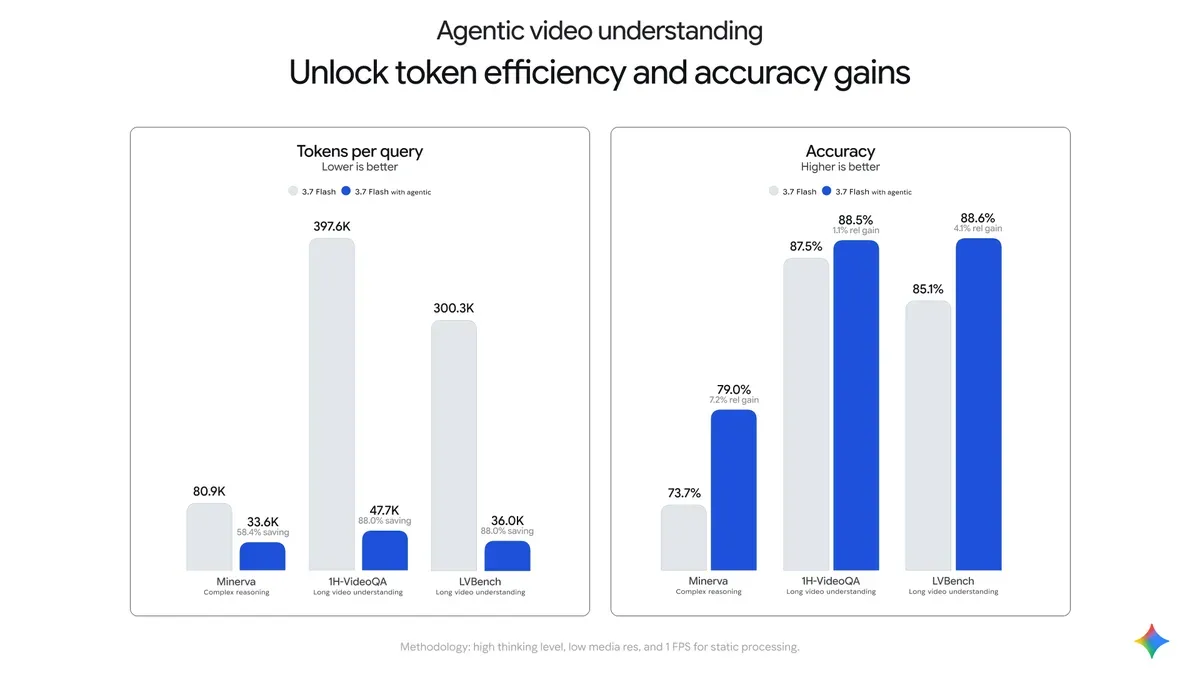
The announcement’s headline numbers are attention-grabbing: Google reports up to 88% lower token consumption, up to 66% lower analysis cost, and up to 7% higher accuracy. Those are Google’s benchmark results, not a universal production guarantee. The more important change is architectural. Gemini is no longer expected to consume a uniformly sampled representation of an entire video before answering. It can decide where to look and which signal to use.
TL;DR
Google’s agentic video understanding lets Gemini dynamically search and inspect relevant portions of a video across visual frames, audio, and transcripts. That is a meaningful departure from fixed-FPS ingestion, especially for long recordings where uniform sampling burns tokens on irrelevant material and can miss rapid events. Google reports up to 88% token reduction, 66% lower cost, and 7% better accuracy. Netics’ view is that the feature should be treated as a retrieval-and-verification primitive, not as permission to remove human review. Start with narrow questions, log the inspected evidence, measure quality and cost on your own footage, and keep a deterministic escalation path for decisions that affect safety, compliance, or money.
The key shift is from watching everything to locating evidence
Traditional video processing gives the model a stream sampled at a fixed rate. Google describes the default as 1 frame per second, adjustable through the API. That baseline is simple and predictable, but it imposes a blunt trade-off. Increase the frame rate and the system sees more detail while consuming more tokens. Keep it low and the system is cheaper, but a brief state change, a cut boundary, a small visual artifact, or a fast physical action can fall between samples.
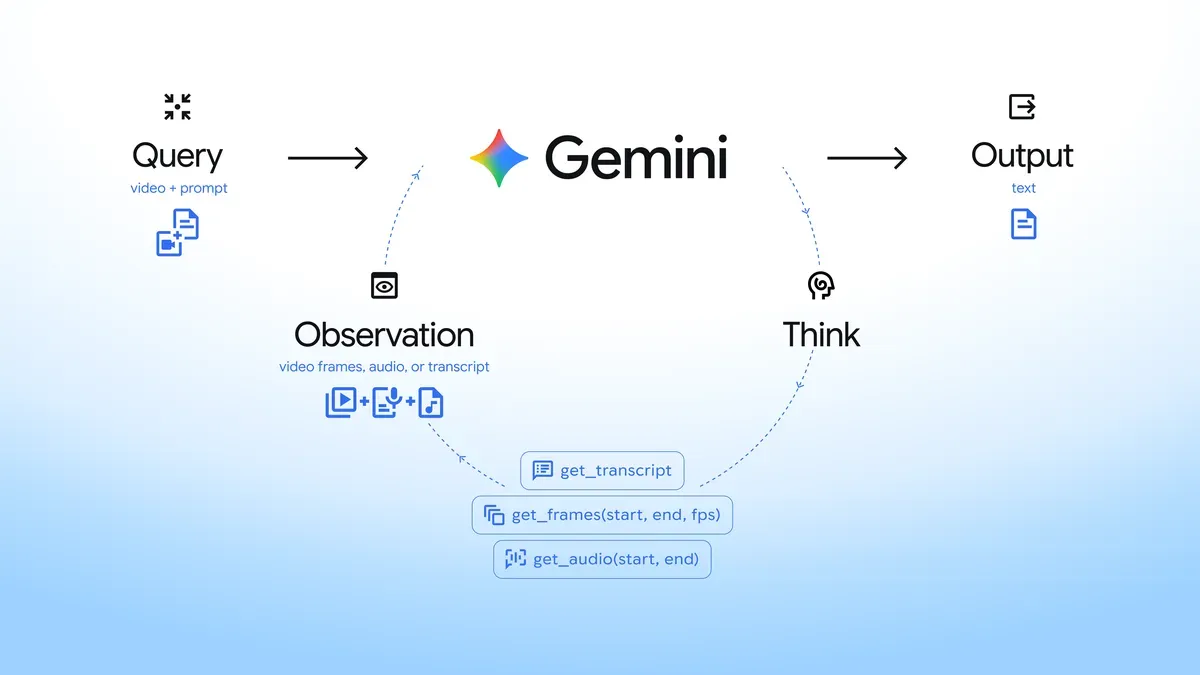
Agentic video understanding changes who makes that trade-off. Gemini combines its reasoning with native video tools and can dynamically search, scan, and inspect target segments. It can choose what to watch, at what speed, and through which modality: frames, audio, or transcript. Google describes this as an agentic loop that invokes an internal tool to load the relevant portion of the video file.
That distinction matters. This is not simply a better compression setting or a larger context window. The model is being given a way to form a question, request a slice of evidence, inspect it, and continue. A transcript may locate the relevant minute. Audio may reveal an alarm or a speaker’s qualification. A higher-rate visual resample may then test what happened in the exact seconds around that cue. The pipeline becomes selective and multimodal instead of uniformly visual.
The engineering consequence is a new boundary between retrieval and interpretation. A video system should first find candidate evidence, then spend expensive reasoning capacity on the candidate window. That is closer to search infrastructure than to a one-shot upload.
Why token efficiency changes production video pipelines
Long-form video has always punished naive automation. A 10-minute how-to guide is manageable; a 90-minute lecture or multi-hour recording becomes expensive when every segment is represented at a fixed rate. Teams often respond with local workarounds: extract frames, create a transcript, chunk the assets, run separate searches, and stitch the results together. Those steps can work, but they turn every application into a small media-orchestration project.
Google’s reported efficiency gains suggest that the model can absorb more of that orchestration. The company says agentic processing reduces analysis costs by up to 66% and token consumption by up to 88%, while improving accuracy by up to 7% across standard video-analysis benchmarks. Again, the attribution matters. These are not numbers Netics can transfer to a factory camera feed, a French training archive, or a customer’s security footage without testing.
The production implication is still substantial. When the cost of asking a question falls, video stops being an asset that must be preprocessed into a single expensive index before anyone knows what they need. A team can preserve richer source material and issue targeted queries later. Editors can locate a sub-second moment. Operations teams can search a multi-hour recording for a sequence of events. Analysts can use audio and transcripts to narrow the window before asking the model to inspect visual detail.
This also changes what should be cached. Instead of caching every sampled frame as the primary product, a pipeline can cache transcript segments, retrieval queries, selected time windows, evidence snapshots, and the model’s reason for requesting a resample. That creates a more useful audit trail and may reduce repeated analysis. It also creates new storage and governance questions: which source moments were inspected, which were ignored, and can another reviewer reproduce the answer?
A practical example makes the economics clearer. Imagine a multi-hour maintenance recording and a question about when a warning light first appeared, whether an audible alarm followed, and how long the condition lasted. Uniform sampling may miss the light’s transition or require a costly high frame rate across the whole file. A goal-directed loop can use transcript and audio cues to locate candidate intervals, then resample those intervals more densely. The saving is not just fewer tokens. It is fewer custom services and fewer brittle assumptions about the right sampling rate before the question is even known.
Netics has made the same broader argument about AI prototypes: a working model call is not a production architecture. The production-readiness boundary for AI prototypes applies here too. For teams building practical AI automation, lower inference cost is valuable only when the surrounding pipeline can explain what it inspected, what it missed, and what happens when the answer is uncertain.
Retrieval, anomalies, and counting are the credible early use cases
Google highlights four capabilities that show where the feature is most useful. Sub-second moment retrieval targets tight cut boundaries and rapid state changes that 1 FPS sampling can miss. This is relevant to automated editing, quality control, and event indexing, but the output should be a time range with evidence, not merely a sentence claiming that a moment exists.
Long-form needle-in-a-haystack search is the obvious economic win. The system can answer complex questions across multi-hour video without consuming millions of tokens, according to Google’s framing. That makes archives more queryable without forcing a team to manually label every hour in advance.
Anomaly detection benefits from adaptive resampling. A system can identify an interesting time window and inspect it at a higher frame rate, rather than applying the highest rate to the entire recording. This is a sensible design for rapid motion and subtle visual defects, although an anomaly detector still needs a defined baseline. “Interesting” is not the same as “dangerous,” and a model should not silently convert novelty into an incident.
Counting actions and objects is another useful test. Repeated physical movements and distinct objects are precisely where a fixed sample can produce unstable totals. Dynamic inspection may improve the count by examining relevant intervals more closely. Production teams should still test occlusion, camera movement, lighting changes, duplicate detections, and the difference between an object appearing in a frame and an object completing an action.
The announced roadmap extends the idea beyond developer APIs. Google says the feature will roll out to users in the Gemini app across Flash and Flash-Lite models, and that it will later power Ask YouTube on the video watch page. That would make visual grounding part of a mainstream answer interface. It also raises the standard for source attribution: an answer grounded in a video should identify the relevant moment and distinguish what is visible from what is inferred.
The agentic loop does not remove verification
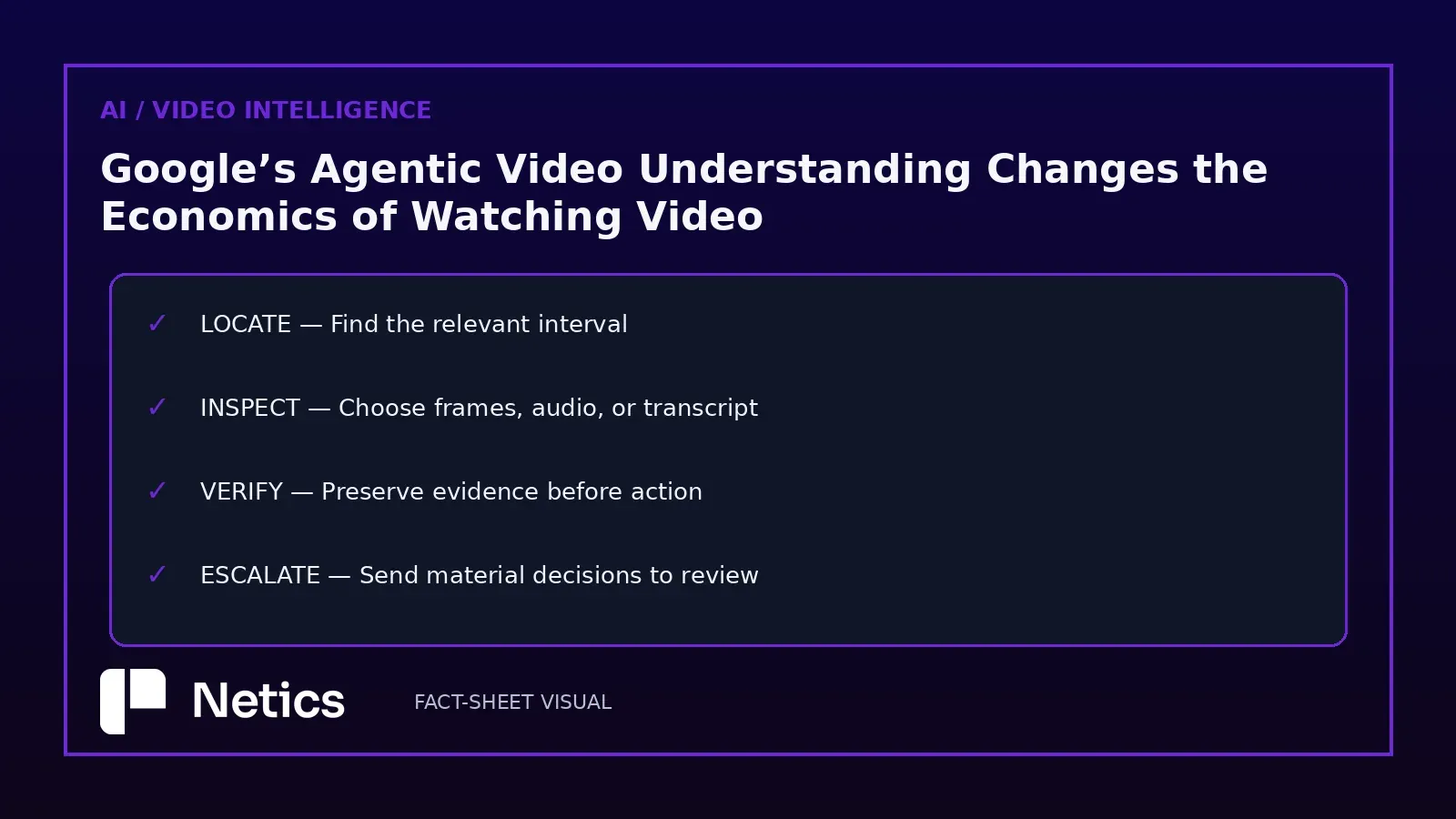
The phrase “agentic” can make a useful retrieval mechanism sound more autonomous than it is. The internal loop may choose a segment and modality, but that does not prove the selection was complete. A model can search the wrong cue, trust an inaccurate transcript, miss an event outside the retrieved window, or describe a plausible interpretation as an observed fact.
For governance, the minimum evidence record should include the original asset identifier, query, inspected time ranges, modalities used, sampling decisions where exposed, model version, and answer. Keep the evidence window available for a reviewer. For high-impact workflows, store the relevant frames or an immutable reference to them rather than relying on a future re-run to produce the same result.
Verification should be risk-weighted. A low-stakes editor search can tolerate a quick answer with a visible timestamp. A safety alert, insurance assessment, employee-monitoring decision, or compliance record needs a second check and a documented threshold for escalation. Audio and transcripts can improve retrieval while also introducing their own errors, accents, missing speech, translation drift, or speaker attribution problems.
Privacy is equally practical. Video often contains faces, voices, screens, license plates, workplace behavior, or confidential documents. Dynamic inspection may reduce processing volume, but it does not automatically reduce legal responsibility. Retention, access control, regional processing, deletion, and vendor terms still need explicit decisions. Selective analysis is a cost technique, not a data-protection policy.
A sane adoption path for production teams
Start with a question family, not a general promise to “understand video.” Choose one measurable job such as locating edits, finding alarm events, or counting a defined object. Build a labelled test set that includes positive cases, near misses, noisy audio, bad lighting, and long irrelevant stretches.
Run a baseline with the existing fixed-FPS workflow. Record cost, latency, recall, precision, missed short events, and reviewer time. Then enable agentic processing by setting the API configuration to processing: "agentic", as Google documents, and compare the same questions on the same assets. Do not compare a carefully tuned baseline with an unbounded agent and call the result a benchmark.
Next, make the retrieval trail part of the interface. Every answer should expose timestamps and a short evidence rationale. Add a fallback for low confidence, missing transcript, conflicting modalities, or questions that require full-file coverage. Keep the standard Gemini API pricing assumption in the cost model; Google says there is no additional feature fee, but total spend still depends on tokens, asset handling, retries, concurrency, and downstream storage.
Finally, separate discovery from decision. Let Gemini find candidate moments and summarize evidence. Keep a deterministic rule, a second model, or a human reviewer responsible for actions with material consequences. That is the adoption pattern worth carrying from this announcement: use the model to decide where expensive attention goes, but do not let an efficiency claim become an excuse to hide the evidence trail.
Sources
- Introducing agentic video understanding with Gemini — Google, September 1, 2026.
- Video understanding with the Gemini API — Google AI for Developers, accessed September 13, 2026.
- Video understanding in Gemini Enterprise Agent Platform — Google Cloud documentation, accessed September 13, 2026.
- Ask YouTube — YouTube Help, accessed September 13, 2026.