
API Rate Limits Are Part of AI Agent Architecture
An AI agent that ignores rate limits is an uncontrolled client with a retry loop.

TL;DR
Rate limiting is not only an HTTP-client concern for an AI agent. It shapes planning, concurrency, retries, budgets, and the point at which a system must stop and ask for help. The article covers the Netics position, the operational boundary, and the implementation checklist. The TL;DR also covers the 429 protocol signal, operating headers, and the Netics boundary.
A 429 is a protocol signal
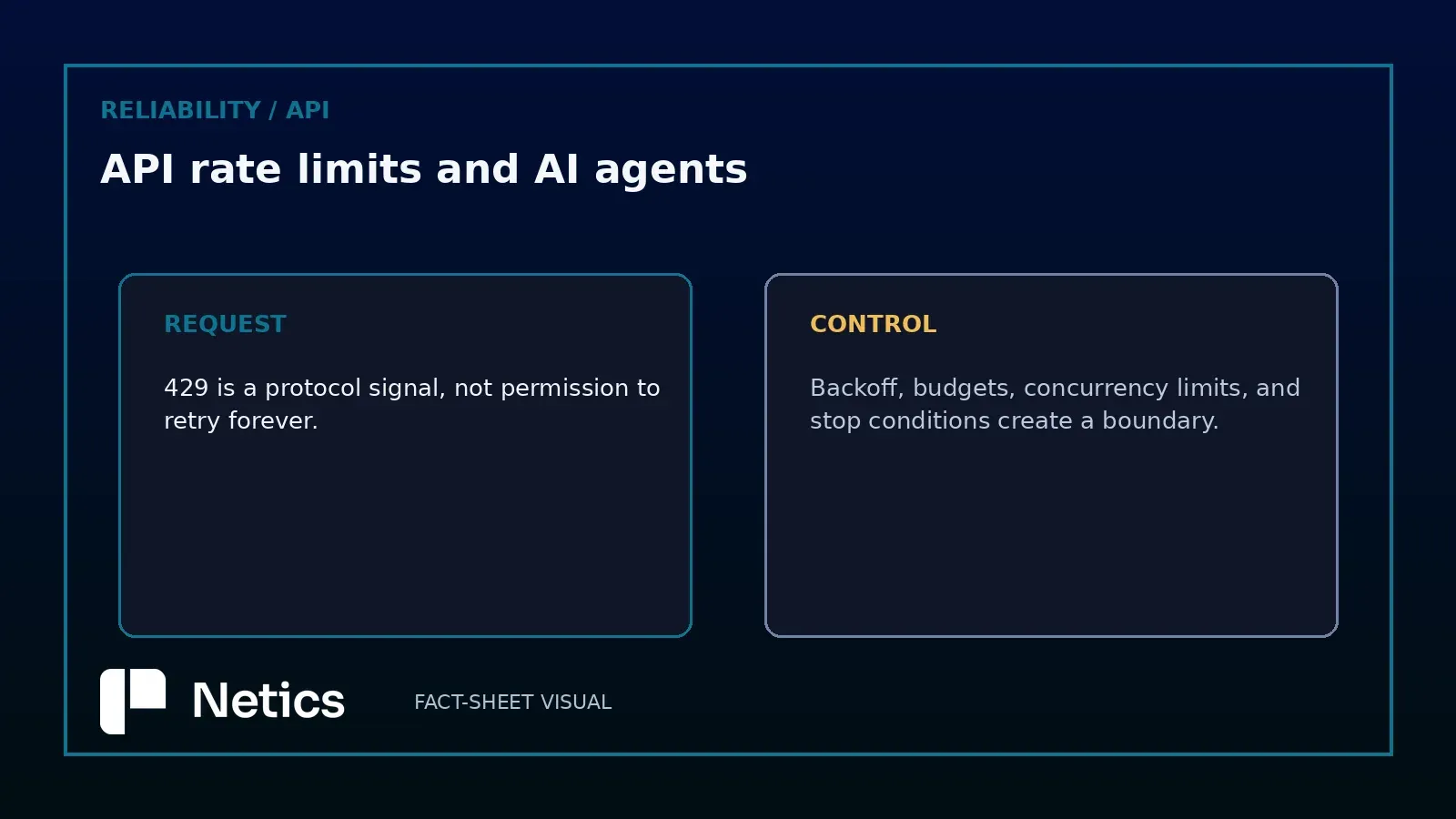
RFC 6585 [1] defines 429 Too Many Requests and allows Retry-After to tell a client when to try again. It does not define how a server counts requests, so that boundary remains application-specific.
Agent loops make the limit visible
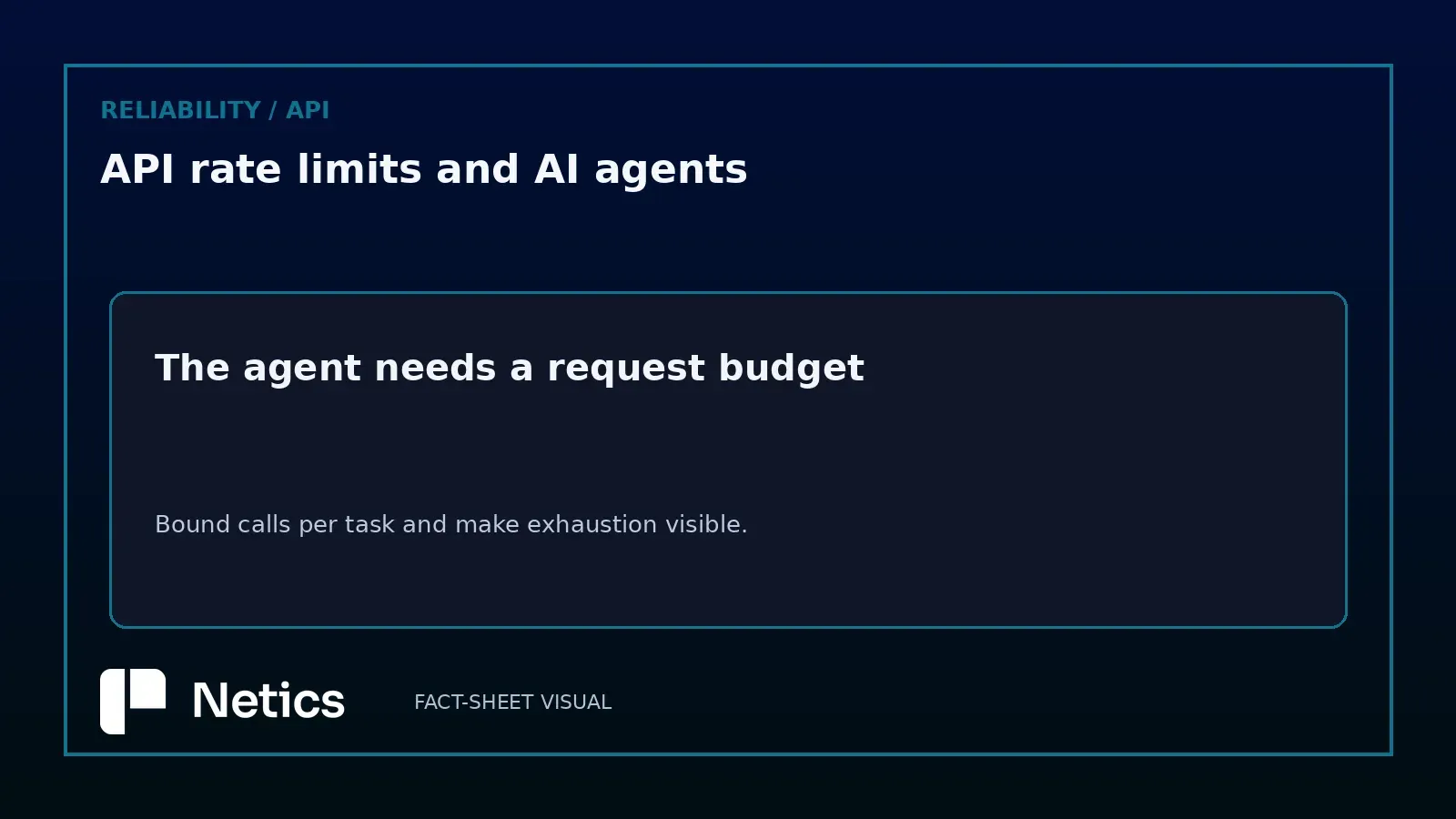
An agent may retry several tools, fan out across resources, or continue a plan whose assumptions are stale. Give each tool a budget, cap concurrency, use exponential backoff, and define a stop condition. Put these controls in the planner and executor.
Headers are operating evidence
GitHub documents primary and secondary limits [2], remaining-budget headers, reset times, concurrency constraints, and endpoint-specific limits. An agent can use this evidence to reduce parallel work before rejection.
The Netics boundary
Separate whether a call is allowed, how much work is safe to schedule, and what to do after rejection. Store limit state with the task or tenant. Make side effects safely retryable. Explain why the agent stopped.
GitHub’s rate-limit endpoint documentation [3] shows resource-specific budgets.
For an API architecture review, visit Netics or book a free audit.
Provider rate-limit signaling is not standardized
Every major API exposes its budget differently, and an agent that hardcodes one provider’s header names will misread every other provider’s response. OpenAI returns x-ratelimit-limit-requests, x-ratelimit-remaining-requests, and x-ratelimit-reset-requests, plus token-based equivalents. Anthropic returns anthropic-ratelimit-requests-limit, anthropic-ratelimit-requests-remaining, and a reset timestamp, tracked separately for requests and for tokens. AWS API Gateway enforces account-level throttling with a token-bucket model (burst and steady-state rate) and returns a bare 429 with no standardized remaining-budget header at all, so a client must infer its position from repeated rejections rather than read it in advance. An orchestrator that normalizes these into one internal budget representation, instead of branching per provider inside the retry logic, is the difference between a control loop that degrades gracefully and one that silently retries into further throttling.
Backoff with jitter, not a fixed delay
A fixed retry delay synchronizes every client that hit the same limit at the same moment, producing a new burst exactly when the window resets. AWS’s widely cited “Exponential Backoff and Jitter” guidance describes the fix: decorrelated jitter, where each retry sleeps a random duration between a base delay and three times the previous sleep, capped at a maximum. This spreads retries out instead of synchronizing them, and it degrades predictably as concurrency rises. Implement this per tool call inside the agent’s retry logic, not as one global sleep, since different tools hit different providers with different limits and different reset windows.
Testing the boundary before it fails in production
Rate-limit handling is rarely exercised until the day a provider actually throttles a production workload, which means the first real test happens under incident pressure. A mock server that returns 429 on a configurable schedule, with the target provider’s real header names, lets a team exercise backoff, budget accounting, and stop conditions in CI rather than discovering gaps live. Run that test against every provider integration separately, since a fix validated against OpenAI’s header format will not catch a bug in how the same code parses AWS’s bare 429 with no remaining-budget field.
Ownership and review questions
Assign one component to own the budget and another to report provider-specific outcomes. Ask what happens when a task reaches eighty percent of its budget, when a provider omits retry guidance, and when a side effect has an unknown result. Test cancellation while several calls are in flight. The review should show that a task can stop, explain what completed, and resume without duplicating a write. These are architecture properties, not tuning details.
Decision criteria for leaders
Set budgets from observed task shapes, then keep a safety margin for provider variation. A budget should be visible to the orchestrator and explainable to the user. Separate transient transport failures from provider throttling and from application errors. Do not hide all three behind one retry counter. When the task cannot continue safely, emit a durable state that another worker can reconcile. This approach turns rate limits into predictable capacity constraints and makes autonomous behavior easier to test, review, and operate.
Operating questions
A good implementation must be observable by more than one team. Ask what data is produced, where it is retained, who can change it, and what event triggers a fresh verification. Assign an owner for policy and an owner for operations. Record exceptions with an expiry date, a responsible person, and a reason. Define a recovery path as well: when a control fails, the team should be able to pause, correct, and resume without losing history. This discipline turns a security recommendation into a repeatable procedure. It reduces implicit decisions, makes audits easier, and gives operators a clear signal when the system leaves its documented assumptions.
Handoff notes
Keep decisions and evidence with the relevant release or task. During review, compare the observed result with the declared policy, then improve the procedure instead of hiding the gap. The loop should remain short, understandable, and reusable by the next team. It also provides a concrete starting point for quarterly tests and provider changes.
Final review
Before production, have security and operations review the scenario together. Check limits, alerts, logs, and the recovery plan. A documented decision is better than a broad promise: it states what is guaranteed, what is not, and which action follows when the system leaves its assumptions.