
AMD Helion Sizes a Rack Around the Work Agents Do Between Model Calls
AMD introduced Helion on 12 October 2026 as an OCP rack blueprint for agentic AI, with a CPU-only shape reaching 32,768 EPYC cores, an all-in-one shape combining EPYC nodes with Instinct MI3

TL;DR
- AMD Helion is a rack blueprint, a reference design for a complete server rack, built for agentic AI (software agents that call models and tools to carry out multi-step tasks) and introduced by AMD on 12 October 2026, based on an Open Compute Project spec-design and built on the open-platform approach of its Helios rack-scale system.
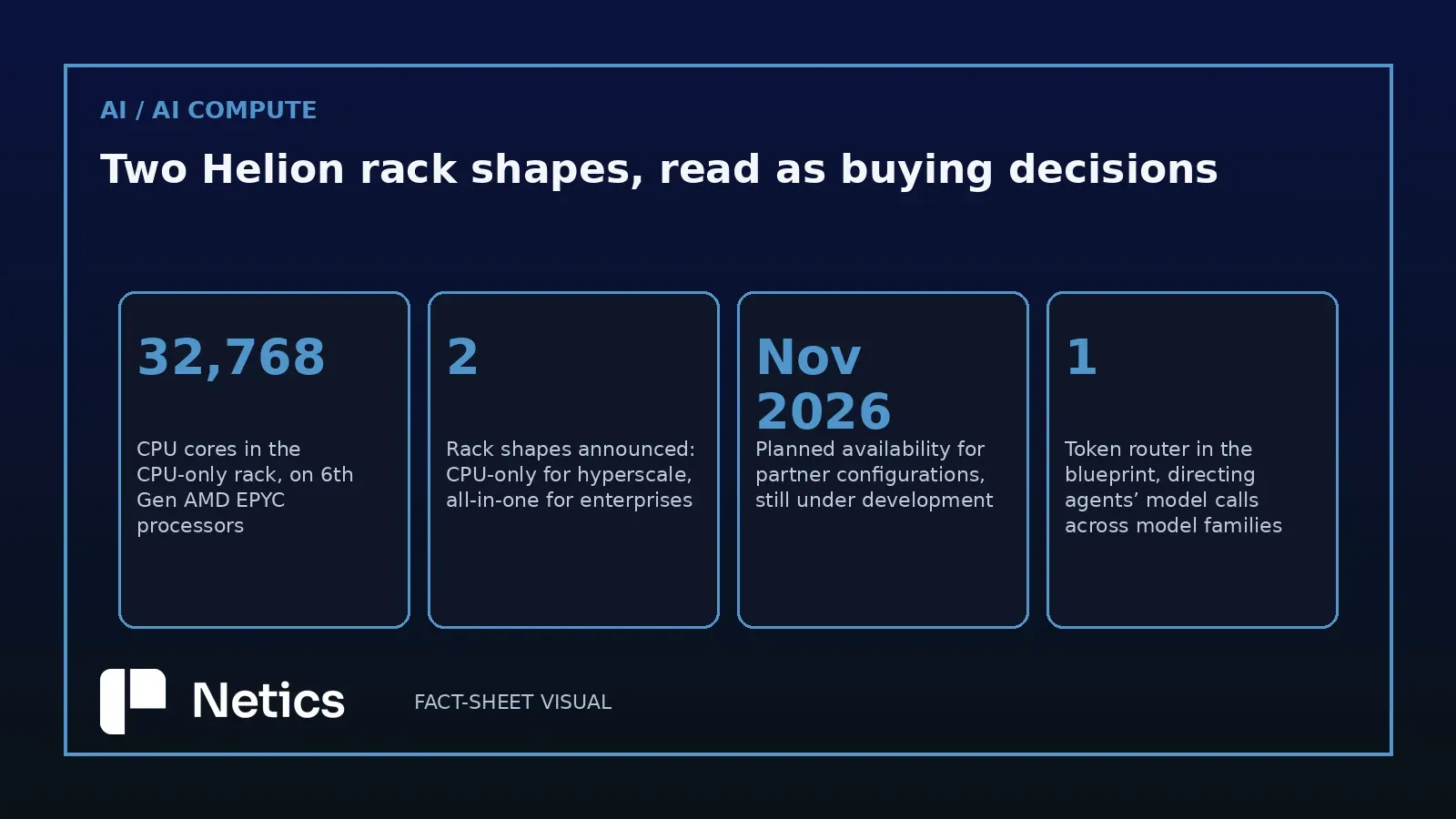
- The blueprint comes in two shapes: a CPU-only rack on 6th Gen AMD EPYC processors supporting up to 32,768 CPU cores for hyperscale customers, and an all-in-one rack mixing EPYC CPU nodes with Instinct MI350P GPU nodes for enterprise deployments.
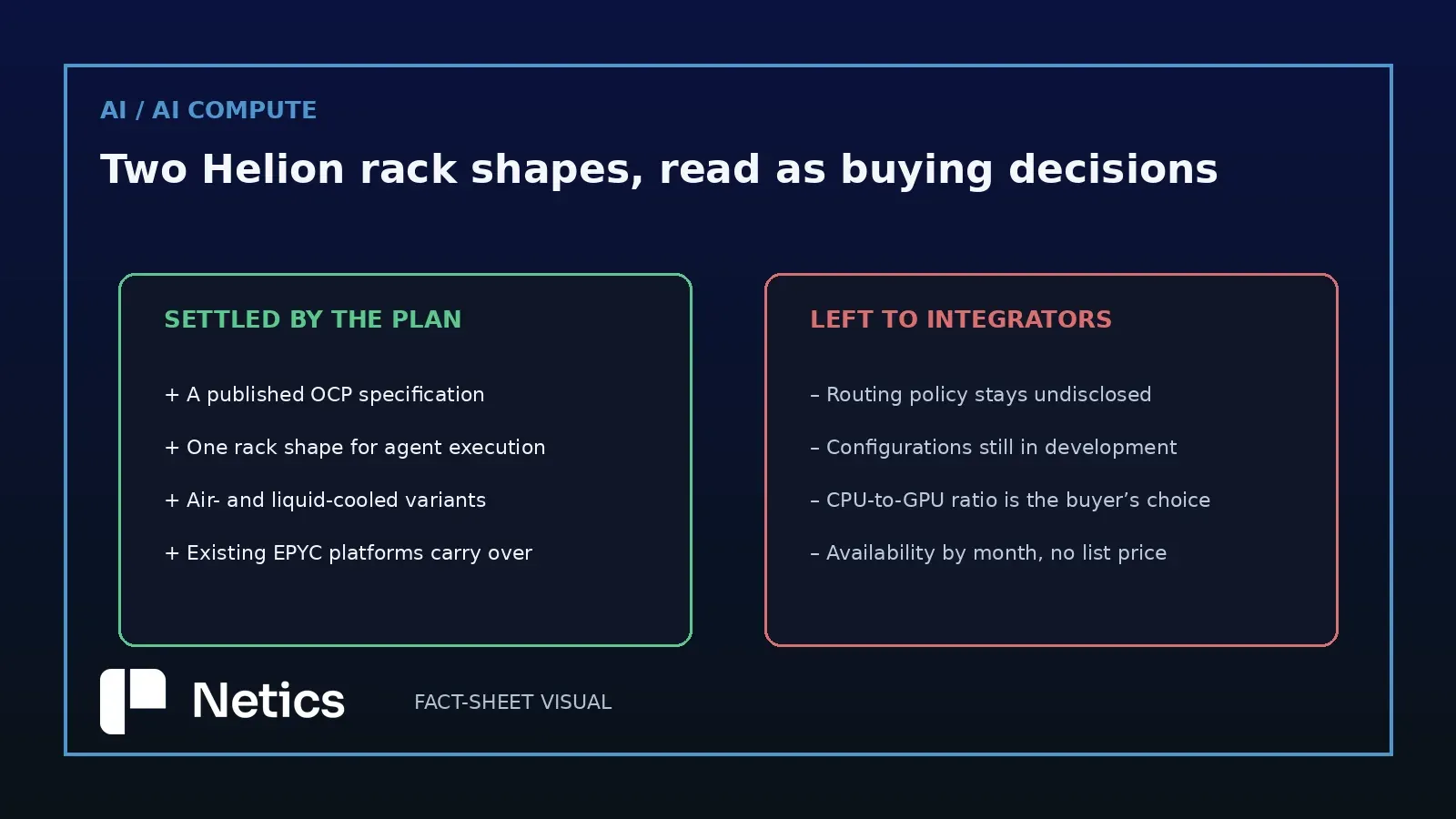
- The design gives agent execution its own CPU tier and lets a buyer match CPU density and power against GPU acceleration, which is the configuration question agent workloads raise once a model call is one step among many.
- An integrated token router inside the blueprint directs the model calls agents make across frontier and open-source models, and AMD's release does not document its routing policy.
- The partner quotes from Cisco, Dell, Hon Hai, HPE, Lenovo, Supermicro and Wiwynn describe reference designs and integration work that is scheduled to reach the market in November 2026, with configurations still under development.
- AMD plans to hand the specification to OCP so other vendors can build against it, which ties the rack's longevity to a community process.
- The questions a buyer can price before then are the shapes of the comparison: what a CPU-only rack replaces, what an all-in-one rack consolidates, and whether Helion specifications and partner systems will take Verano, the LPDDR-equipped EPYC part AMD showed for 2027.
The two rack shapes AMD published on 12 October
AMD announced Helion from Santa Clara on 12 October 2026, on the opening day of the OCP Global Summit in San Jose, where chair and CEO Lisa Su used her keynote to place the rack inside a wider portfolio of open infrastructure for agentic AI.
The first shape carries no accelerator. It is a CPU-only rack built on 6th Gen AMD EPYC processors supporting up to 32,768 cores, aimed at hyperscale customers who want dedicated capacity for agent execution and connect to model inference infrastructure they run separately. The figure is a ceiling in cores with no agent count attached, and the vendor presents it as capacity for the part of an agent's work that runs outside the model.
The second shape consolidates. EPYC CPU nodes, Instinct MI350P GPU nodes and general-purpose compute share one platform, aimed at enterprises that want agent execution and inference in the same rack. Both shapes come in liquid-cooled and air-cooled versions, and AMD says customers can deploy them inside existing IT infrastructure.
Why agent execution needs its own CPU tier
As we read it, a large share of an agent loop's work happens outside the model. It assembles context, calls tools, parses results, writes session state and decides what to do next, and that work falls to the CPU side of the system. Dan McNamara, who runs AMD's compute and enterprise AI business, frames the workload as several things at once: personal agents, enterprise applications, code execution and complex workflows, each with its own compute requirements.
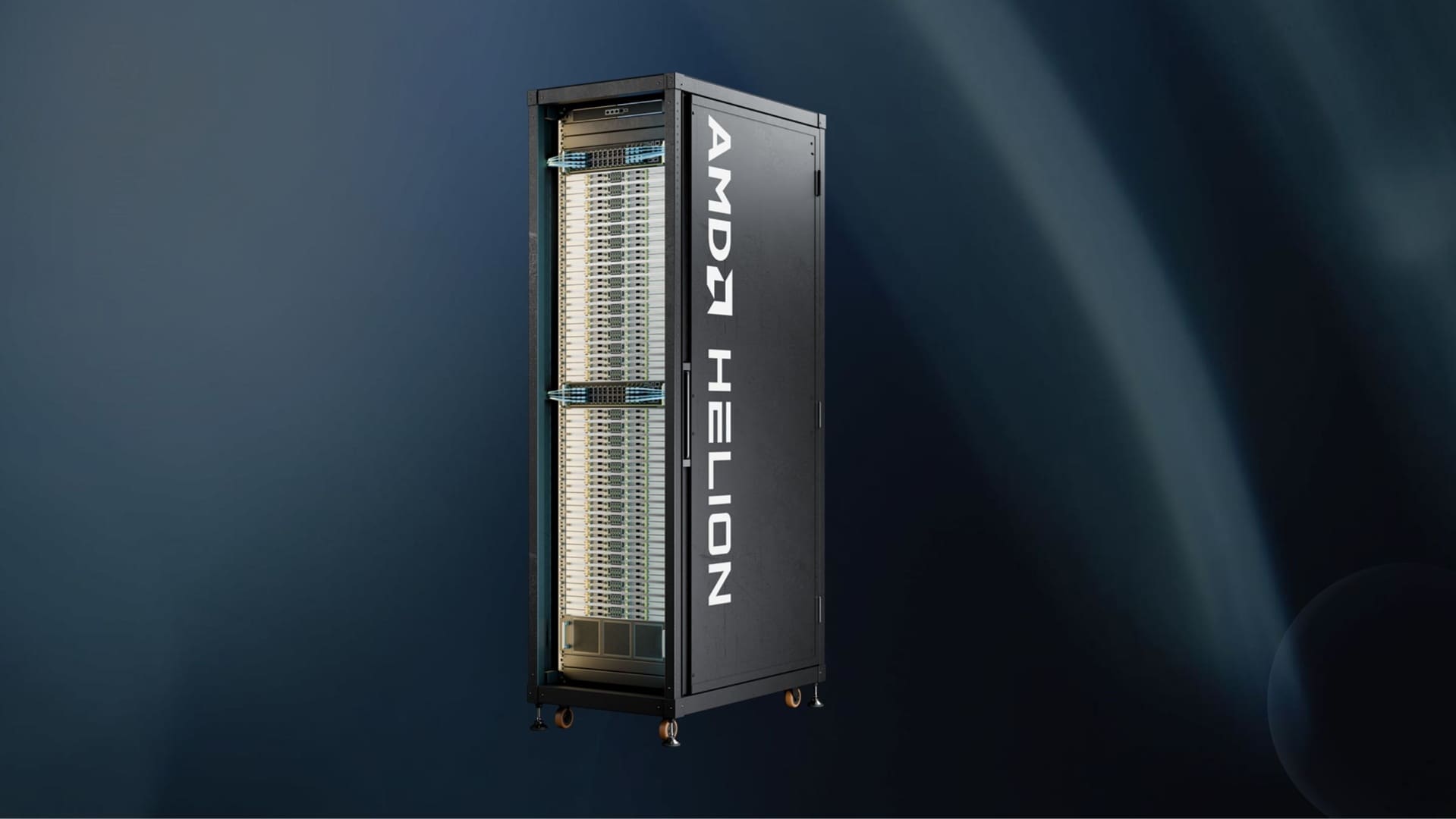
Reading the announcement as an infrastructure argument, the CPU-only shape treats agent execution as a tier of its own, with capacity kept separate from the inference hardware. The risk this design answers, in our reading, is a capacity plan that sizes only the accelerators: if tool calls and lookups wait on an undersized CPU side, the accelerator can sit idle and the plan understates the rack.
The token router that sits inside the blueprint
The blueprint also includes what AMD calls an integrated token router, which directs agents' model calls across frontier and open-source models. That places routing inside the rack definition itself, at the infrastructure layer, and the release stops there: it describes no routing policy, latency budget, failover behaviour or governance model for which model a given call reaches.
AMD Helios, the GPU rack the same company put into production over the past year, offers a useful comparison for what a complete design looks like. The keynote write-up describes Helios racks integrating Instinct GPUs, EPYC processors, Pensando networking and the ROCm software stack, with customer deliveries and workload validations underway. Helion arrives as a companion rack to Helios, and the routing layer is the part a buyer will want specified.
What the partner quotes commit to in November
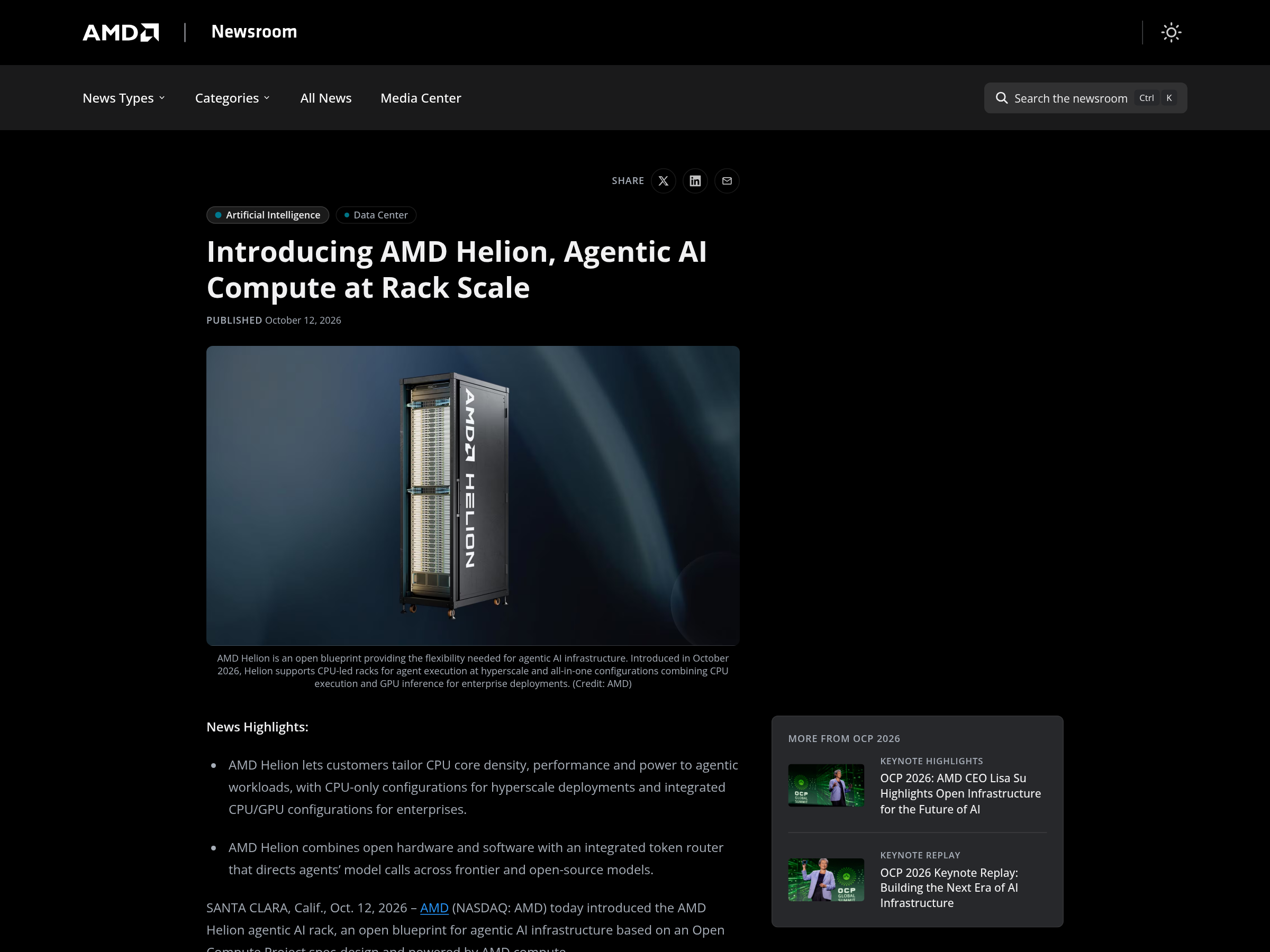
The vendor list reads as an integration roster: Cisco, Dell Technologies, Hon Hai Technology Group, HPE, Lenovo, Supermicro and Wiwynn. The commitments vary in weight. Dell says its support for the AMD Helion Agentic Rack Reference Design extends the promise of its PowerRack line to agentic AI. HPE cites its recent customer agreement to deploy AMD Helios as a demonstration of what open, rack-scale architectures deliver. Supermicro describes an open, ORv3 compliant rack-scale architecture brought to market through its building-block programme.
AMD states that Helion agentic rack configurations are under development with those partners and are planned to be available in November 2026. A month is a short lead time for a rack programme, and the honest reading of an availability month without a price list or a part number is a direction of travel: the design is published, and the systems are being built.
The specification AMD is handing to OCP
AMD plans to contribute the Helion specification to the Open Compute Project so the community can develop and adopt it. A contributed rack specification is a longer-lived asset than a product SKU: any manufacturer can build against it, and the design outlives the announcement cycle that produced it.
The same move carries a dependency. Specs contributed to a foundation develop at the pace of their working group, and a feature the community does not adopt waits for a future revision. For an operator planning three years of capacity, that trade is worth naming, because it decides whether a rack design stays available from several suppliers or drifts back into a single vendor's roadmap.
The questions a buyer can price today
Two capacity questions follow from the two shapes. A CPU-only rack asks what it replaces: if agent execution currently runs on general-purpose servers, the comparison is core count, memory per core and the cost of the connections that carry each model call to inference infrastructure elsewhere. An all-in-one rack asks what it consolidates, and consolidating execution and inference in one frame changes the blast radius of a maintenance window as much as it changes the bill.
A third question belongs to the calendar. Helion's CPU-only rack is specified on 6th Gen EPYC, and AMD used the same keynote to show Verano, a 6th Gen EPYC processor described as the first EPYC CPU with an LPDDR memory interface and available in 2027; the release does not say whether Helion specifications and partner systems will take that part. Asking that question before a purchase order is the practical version of this announcement, and Netics works that planning problem through sovereign infrastructure and cloud exit. The same reading applies to the rack figures published for other silicon families, as we set out when Microsoft's Maia 300 rack numbers arrived earlier in October.
Sources
Source: Introducing AMD Helion, Agentic AI Compute at Rack Scale — newsroom.amd.com and ir.amd.com, AMD newsroom announcement and investor-relations press release, 12 October 2026, retrieved 2026-10-15 (the AMD Helion agentic AI rack as an open blueprint for agentic AI infrastructure based on an Open Compute Project spec-design and powered by AMD compute, building on the open-platform approach of AMD Helios; a CPU-only rack on 6th Gen AMD EPYC processors supporting up to 32,768 CPU cores for hyperscale customers, providing dedicated capacity for agent execution and connections to separate model inference infrastructure; an all-in-one rack combining AMD EPYC CPU nodes, AMD Instinct MI350P GPU nodes and general-purpose compute for enterprise agentic AI; an integrated token router directing agents' model calls across frontier and open-source models; liquid- and air-cooled versions; deployment in existing IT infrastructure; the plan to contribute the specification to OCP; configurations under development with ecosystem partners and planned for November 2026; Dan McNamara describing agentic AI as spanning personal agents, enterprise applications, code execution and complex workflows with different compute requirements; partner statements from Cisco, Dell Technologies, Hon Hai Technology Group, HPE, Lenovo, Supermicro and Wiwynn, including Dell's support for the AMD Helion Agentic Rack Reference Design within its PowerRack offer, HPE's citation of its recent customer agreement to deploy AMD Helios and Supermicro's description of an open, ORv3 compliant rack-scale architecture brought to market through its Data Center Building Block Solutions).
Source: OCP 2026: AMD CEO Lisa Su Highlights Open Infrastructure for the Future of AI — newsroom.amd.com, AMD newsroom keynote write-up, 12 October 2026, retrieved 2026-10-15 (the opening keynote of the 2026 OCP Global Summit in San Jose, California, on Monday 12 October, with the four-day event running from there; Lisa Su presenting AMD's open, full-stack infrastructure for agentic AI at every scale; the 6th Gen AMD EPYC processor codenamed Verano shown during the keynote, described as the first AMD EPYC CPU with an LPDDR memory interface and available in 2027; AMD Helios one year after its 2025 OCP debut, ramping production with customer deliveries, deployments and workload validations underway and each rack integrating AMD Instinct GPUs, AMD EPYC processors, AMD Pensando networking and the AMD ROCm software ecosystem).
Source: AMD's newsroom announcement, its investor-relations press release and its OCP 2026 keynote write-up, all of 12 October 2026 — the configurations, core counts, partner statements and dates used in this article, retrieved 2026-10-15. Images are AMD's official product rendering and a capture of its announcement page, plus two Netics editorial diagrams.