
Gartner Sizes the AI Capacity Bill at $8.5 Trillion and Counts $3.6 Trillion of Revenue
Gartner's 14 October 2026 analysis says AI data centre owners would need $8.5 trillion of cumulative revenue by 2030 against no more than $3.6 trillion attributable to AI, exposing over $3.5

TL;DR
- AI infrastructure is the data centre capacity, accelerators and networking that providers buy to serve model training and inference, and the question Gartner addressed on 14 October 2026 is whether the revenue those installations generate can cover what they cost.
- Gartner's analysis puts the requirement at a cumulative $8.5 trillion of revenue through 2030 to cover announced capital spending, financing costs and a 12% return on invested capital, against attributable enterprise and consumer AI revenue forecast at no more than $3.6 trillion.
- More than $3.5 trillion of AI infrastructure spending could be exposed to impairment by the end of 2030, with more than $4 trillion of asset value exposed to write-down risk through 2032 in the same projection.
- Neocloud providers carry most of that exposure: Gartner expects over 80% of them to cease independent operations by 2030 as AI-optimized infrastructure spending grows from $66 billion in 2027 to $174 billion in 2030.
- In the same week, on 15 October, technology hardware stocks fell, with SK Hynix down more than 10%, Samsung Electronics down 8.73% and the tech-heavy South Korean index falling 8% overnight, and both CNBC and the Guardian tie the moves to the cost of financing.
- For the company reserving capacity, the practical response sits in the contract: match commitment length to the silicon refresh cycle, keep the workload portable, and know what survives a change of provider ownership.
- Netics reads capacity decisions as infrastructure decisions, and this one belongs in the same review as where the workload runs and who operates it.
What Gartner published on 14 October 2026
Gartner published the analysis on 14 October 2026 from Stamford, Connecticut, and the headline figure is a gap between spending and revenue: more than $3.5 trillion of AI infrastructure spending could be exposed to impairment by the end of 2030 if AI providers continue their current pace of capital spending. The same statement expects over 80% of neocloud providers to cease independent operations by 2030 (Gartner, as carried by CXOtoday, 14 October 2026).
What matters in reading it is the timing: the statement projects capital returns forward and places the impairment exposure at the end of 2030. Gartner's own note says failure to achieve sustainable returns on rapidly depreciating assets would almost certainly necessitate write-downs, and puts the earliest date for the assumed 12% return on invested capital at the end of 2032. These are one analyst firm's projections, and the $8.5 trillion requirement rests on that assumed 12% hurdle rate, so a lower required return would narrow the gap.
The arithmetic: $8.5 trillion needed against $3.6 trillion attributable
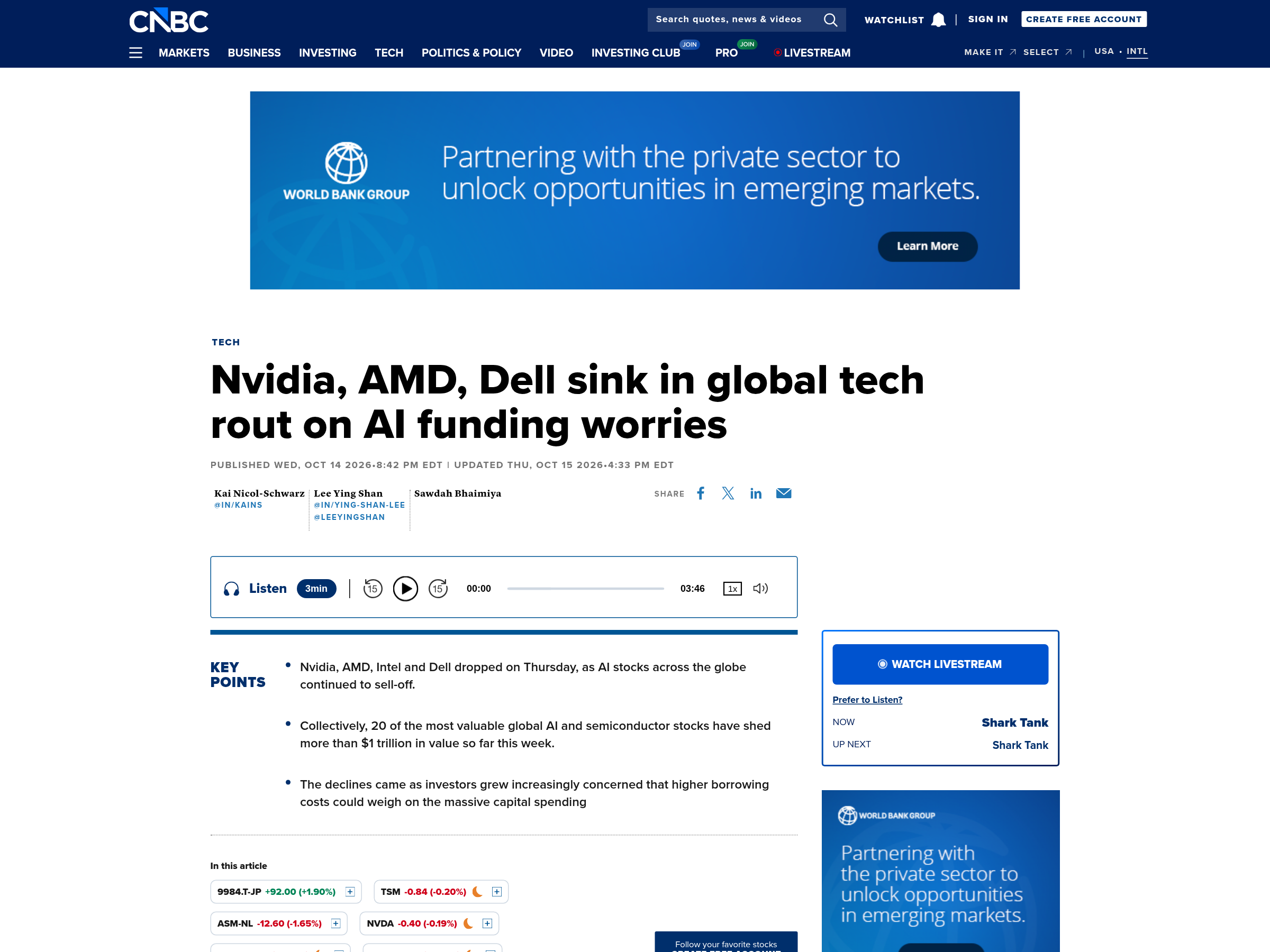
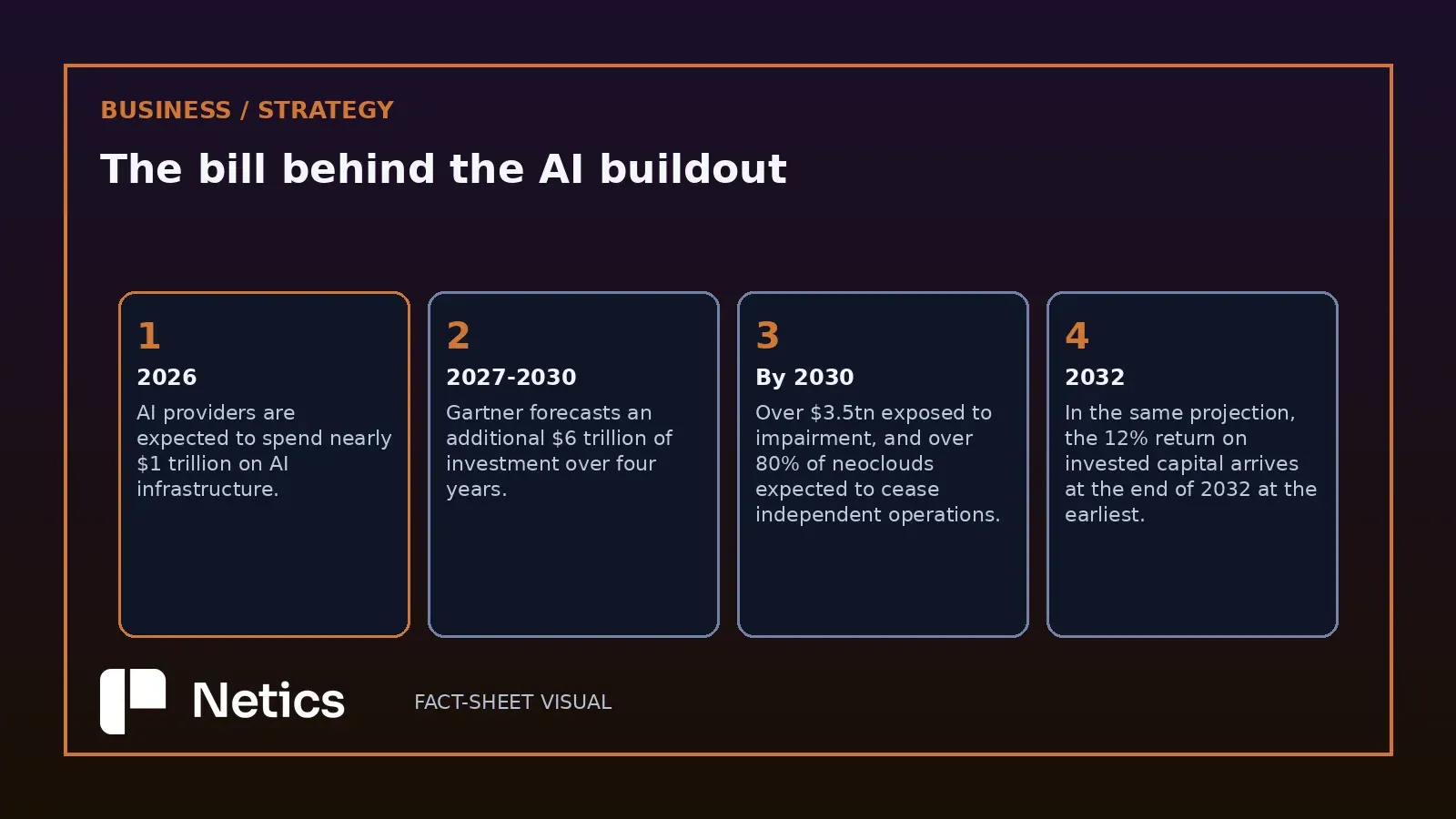
Will Sommer, a senior director analyst at Gartner, lays out the two lines that have to cross. AI providers are expected to spend nearly $1 trillion on AI infrastructure in 2026 and to invest an additional $6 trillion between 2027 and 2030. Covering announced capital spending, financing costs and a 12% return on invested capital requires a cumulative $8.5 trillion of revenue through 2030. Total enterprise and consumer AI revenue attributable to AI data centres is forecast to reach no more than $3.6 trillion.
The release also names where the revenue lands. Most AI-native providers run asset-light business models, and Gartner predicts that less than half of AI revenue will be earned by the providers that own significant AI infrastructure. Netics draws one inference from that split, beyond what Gartner states: the money a company pays to rent inference through an API reaches the owner of the underlying infrastructure only in part.
Why neocloud providers carry the exposure
Gartner notes that hyperscalers hold diversified revenue across several lines. A neocloud has one: AI-optimized infrastructure, and it has to earn its return before the generation of semiconductors it bought stops being competitive.
Gartner estimates that spending on AI-optimized infrastructure as a service grows from $66 billion in 2027 to $174 billion in 2030, and Sommer's reading of that curve is blunt: the growth rate is too low for most AI compute providers to recover their AI investments before the current generation of AI semiconductors is replaced. The deadline comes from depreciation, and demand sets the volume.
What the market did the same week
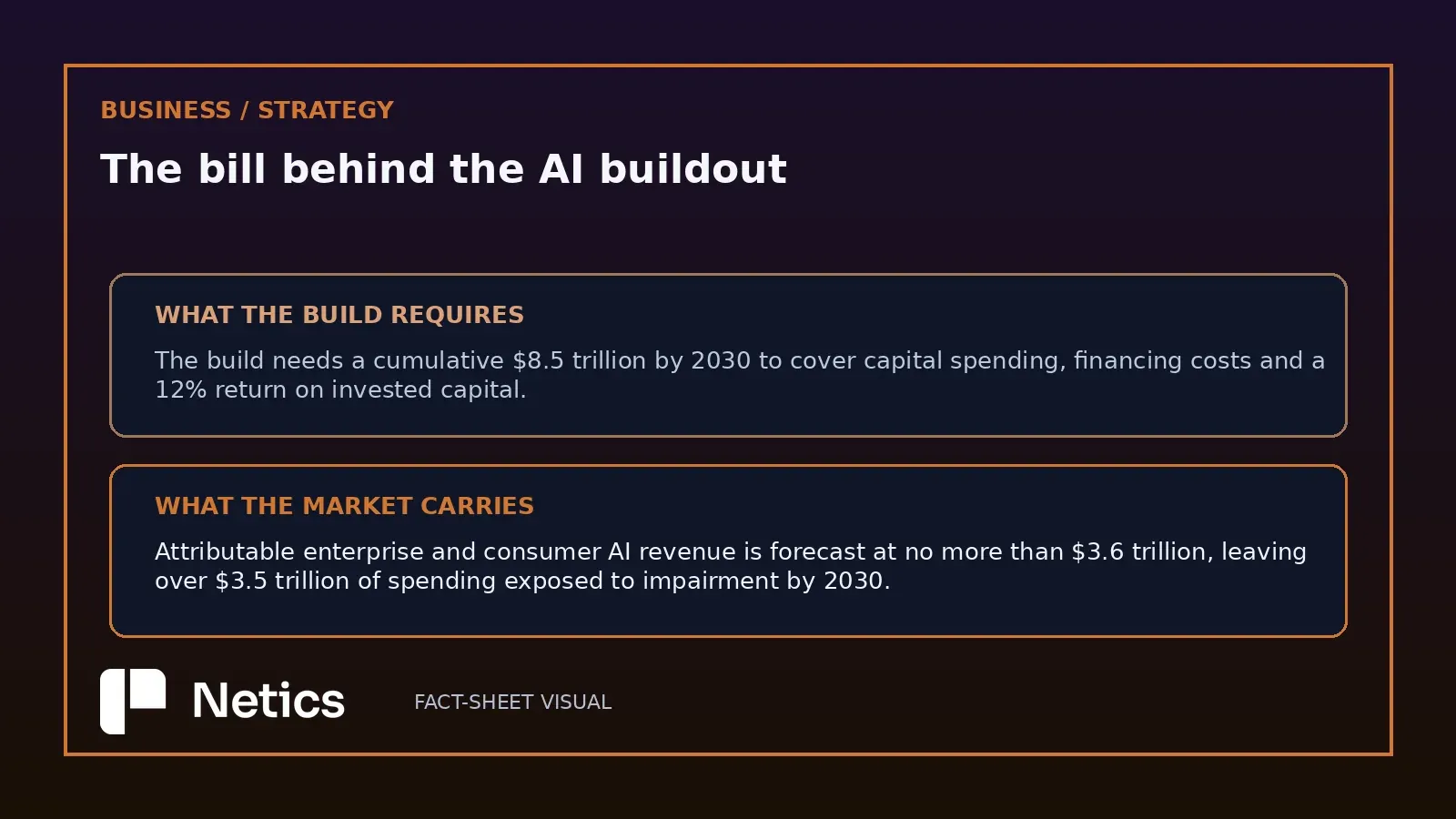
In the same week, the 15 October session brought sharp falls in technology hardware stocks, which CNBC attributes to investor concern that higher borrowing costs weigh on the capital spending AI infrastructure requires. In Asia, SK Hynix fell more than 10% and Samsung Electronics 8.73%, with LG Innotek down 8.95%, Seoul Semiconductor 9.28% and Samsung SDI 6.26%; SoftBank Group fell 7.9% in Japan while Advantest dropped almost 14% and Tokyo Electron 6.45% (CNBC, 15 October 2026). In Europe, Infineon shed 5% and ASM International 7%, with TSMC down 1.81% in Taiwan.
The Guardian's account of the same session frames the driver as the cost of financing: an accelerating sell-off of AI-linked shares, fears over rising inflation and future interest rate hikes, and a heavily indebted sector, with the tech-heavy South Korean index down 8% overnight and trading halted by circuit breakers. Equity repricing and asset impairment are separate events. What they share is the input, which is the cost of capital applied to a long-lived asset.
What an SME reserving capacity can control
A move in the capacity market can reach a smaller buyer through its contract. A concrete case, marked as a hypothetical: a Casablanca logistics company signs a three-year reserved GPU commitment so its document-processing models keep a predictable monthly cost, and the price is calculated on the hardware generation installed at signature. Two years in, the provider is under pressure, the silicon has been superseded, and the commitment still runs.
Three things in that contract are worth negotiating while the market is calm. Term length relative to the refresh cycle, so no commitment outlives the hardware generation it prices. Renewal and price-review mechanics that name a published index, so the annual increase follows a benchmark both sides can read. And usage terms that permit a partial exit, so a workload can move without renegotiating the whole agreement.
The exit question a contract should answer
Gartner's prediction of consolidation describes providers ceasing independent operation, which is how a customer experiences an acquisition or a restructuring: the service continues under a new owner with new priorities. The question to settle in advance is what the contract permits when that happens.
Migration assistance, data egress terms and the portability of the workload decide whether a move is a project or a crisis, and they are cheaper to obtain before a signature than after one. Where the workload runs on a portable base — containers, a Kubernetes control plane, an open orchestrator — an exit becomes an infrastructure exercise and the application keeps running, which is how Netics scopes sovereign infrastructure and cloud exit. A public buyer faces a related question, which we covered when the EU technology sovereignty package was presented in June: its procurement rules for highly critical state tenders would let contracting authorities exclude bidders based on ownership, financing structure or exposure to third-country data-access law.
The capacity a company reserves today is priced on a capital structure its provider has to sustain across the depreciation of everything it financed, so the commitment term should end before the hardware generation it prices is replaced.

Sources
Source: Gartner Says Over $3.5 Trillion of AI Infrastructure Spending Could Be Exposed to Impairment by the End of 2030 — Gartner statement of 14 October 2026, as reproduced by CXOtoday on 14 October 2026, retrieved 2026-10-16; the Gartner newsroom page itself returned HTTP 403 on that date (more than $3.5 trillion of AI infrastructure spending exposed to impairment by the end of 2030 if the current pace of capital spending continues; over 80% of neocloud providers expected to cease independent operations by 2030; Will Sommer on nearly $1 trillion of AI infrastructure spending expected in 2026 and an additional $6 trillion forecast between 2027 and 2030; the $8.5 trillion of cumulative revenue needed through 2030 to cover announced capital spending, financing costs and a 12% return on invested capital; attributable enterprise and consumer AI revenue forecast at no more than $3.6 trillion; less than half of AI revenue predicted to be earned by providers that own significant AI infrastructure; more than $4 trillion of asset value exposed to write-down risk through 2032 and the 12% return not expected before the end of 2032 at the earliest; hyperscalers holding diversified revenue against neoclouds exposed on a single line; AI-optimized infrastructure-as-a-service spending growing from $66 billion in 2027 to $174 billion in 2030, a rate described as too low for most AI compute providers to recover their investments before the current semiconductor generation is replaced).
Source: Nvidia, AMD, Dell sink in global tech rout on AI funding worries — CNBC, 15 October 2026, retrieved 2026-10-16 (technology hardware stocks falling across Asia and Europe; SK Hynix down more than 10%, Samsung Electronics 8.73%, LG Innotek 8.95%, Seoul Semiconductor 9.28%, Samsung SDI 6.26%, SoftBank Group 7.9%, Advantest almost 14%, Tokyo Electron 6.45%, Renesas Electronics 8%, TSMC 1.81%, Infineon Technologies 5% and ASM International 7%; investors concerned that higher borrowing costs weigh on the capital spending required to build out AI infrastructure).
Source: Tech market sell-off deepens amid fears over US inflation and AI debt — the Guardian, 15 October 2026, retrieved 2026-10-16 (an accelerating sell-off of AI-linked shares across global markets on fears over rising inflation and future interest rate hikes, with traders wary of a heavily indebted sector; the tech-heavy South Korean index down 8% overnight in Asia, triggering circuit breakers and halting stock trades; chip makers and technology investors including Samsung and SoftBank among the sharpest fallers).
Source: Gartner's statement of 14 October 2026 as carried by CXOtoday, plus CNBC and the Guardian for the 15 October session, all retrieved 2026-10-16. Gartner's own newsroom page refused automated retrieval with HTTP 403 on that date. Images are captures of the CNBC and Guardian articles, plus two Netics editorial diagrams.